

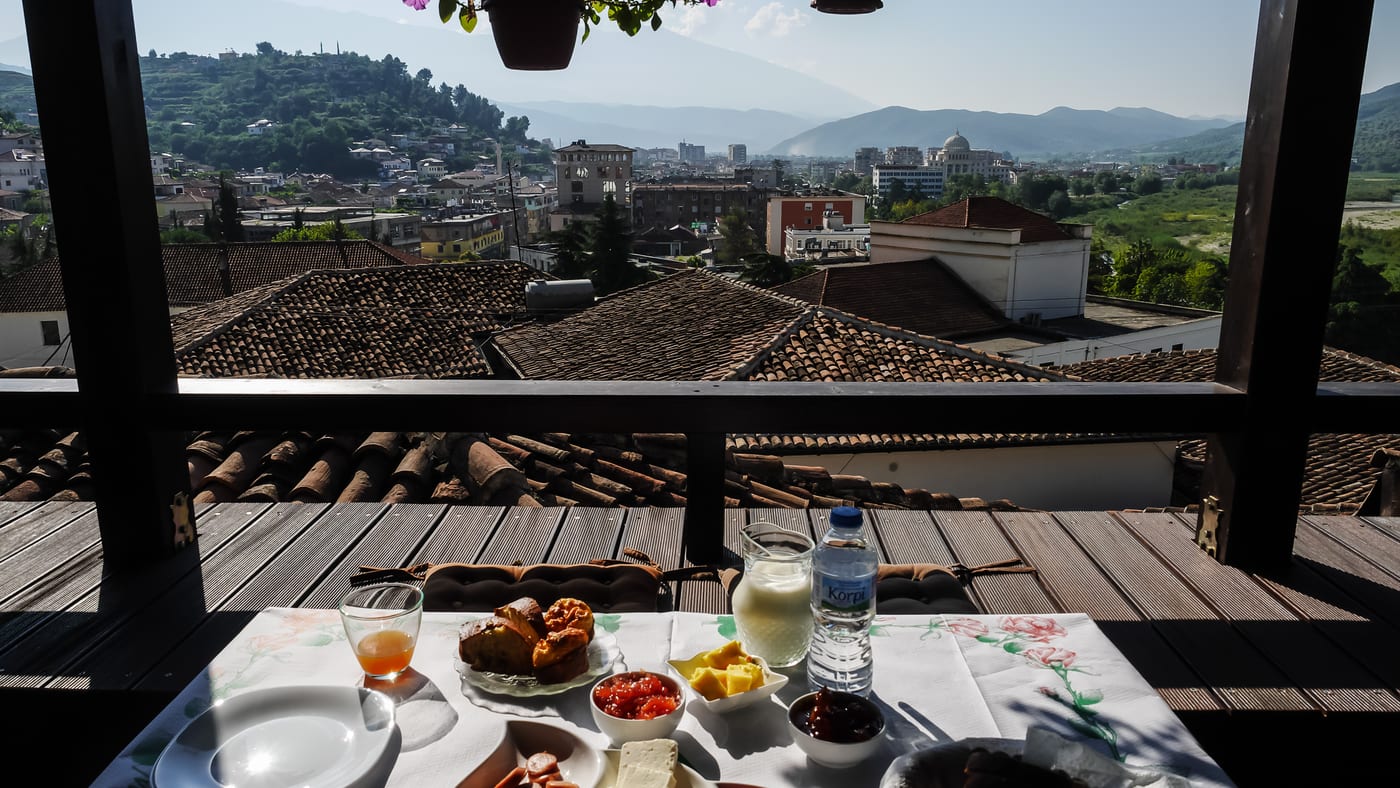
There is a specific point at which an Albanian-American household stops eating its grandmother’s cooking and starts cooking it. It usually arrives later than expected — after the move-out, after the kid, after the funeral when someone realizes nobody wrote the recipe down. The first attempt is almost always the wrong dish, made too fast, with the wrong yogurt and a casserole that broke in the oven.
This guide is for that moment. It is not a list of thirty Albanian dishes — that lives at /blog/albanian-dishes, and it is the right place to browse the full catalog. This page is narrower. It tells home cooks what to make first, what to keep in the pantry, where to buy the real ingredients in the United States, and the order to learn the dishes in. The actual recipes — the quantities, the temperatures, the food science — sit on the individual recipe pages, and we link to each one as it comes up.
The premise is straightforward. Albanian cooking is older than the modern Albanian state and lives across Albania, Kosovo, North Macedonia, Montenegro, the Arbëresh villages of southern Italy, and the diaspora. It is a small repertoire, deeply made. A cook who learns six dishes well — byrek (filo pie), tavë kosi (yogurt-baked lamb), fasule (white-bean stew), qofte (meatballs), tarator (cold yogurt soup), and a chopped salad — can host any Albanian meal a household will ever need to serve. The goal of this page is to get a new cook from zero to those six.
A note before the recipes: the food is the inheritance most diaspora households kept. Names changed, accents softened, the language thinned out across generations — but the byrek still came out of the oven on Sunday and the raki still got poured before dinner.
What “Albanian food” actually is
Albanian cooking sits where the Mediterranean meets the Balkans. On one side: lamb, olive oil, oregano, garlic, and the long Adriatic coastline. On the other: yogurt, baked casseroles, filo pastry, slow stews, and the Ottoman pantry that ran through the region for five centuries. The result looks familiar to anyone who has eaten Greek, Turkish, or Italian food and is unmistakably its own once you sit at the table.
The country splits regionally between north and south — Gheg and Tosk in linguistic terms — and the cooking splits with it. The north (Shkodër, Kukës, Tropojë, and across into Kosovo) leans heavier: more red meat, more bread, more dairy, more long-cooked stews. Flija, the layered crepe-like pancake, is a Gheg signature. The south (Berat, Gjirokastër, Korçë, Sarandë) leans lighter and more vegetable-forward: more olive oil, more wild greens, more citrus, more seafood along the coast. The southern lakror is thinner and crispier than its northern cousins.
A handful of ingredients run through everything. Kos (yogurt) is both a side and a structural ingredient — it cools the chili in fërgesë, sets the topping on tavë kosi, thins into the cold soup tarator, and gets stirred into stews. Albanian kos is tangier and thicker than American supermarket yogurt, closer in body to strained Greek yogurt. Bukë (bread) is the literal center of the table; the Albanian phrase for “going to eat” translates word-for-word as “going to eat bread.” Olive oil, oregano, garlic, paprika, and onion form the base spice rack.
And then there is meze (small-plate opener) — the hospitality format that opens any serious gathering. Olives, gjizë (fresh ricotta-style cheese), pickled peppers, suxhuk (cured sausage), white feta, tarator, byrek triangles, raw onion, dry-cured sausage. Hospitality (mikpritja) is fundamental in Albanian culture, and the meze table is how it gets expressed.
The five recipes to start with
The fastest way to build a working Albanian repertoire is to learn five dishes in a specific order. Each one teaches a technique that the next one builds on. After the fifth, a home cook can read any Albanian recipe and see how to execute it.
1. Fasule (white-bean stew)
Start here. Fasule is the most forgiving Albanian dish — dried great northern or cannellini beans, onion, garlic, sweet and hot paprika, tomato paste, oregano, and either smoked suxhuk or lamb shoulder, simmered for about two hours until the broth thickens. It teaches the base flavor of Albanian cooking (paprika and slow-rendered fat) and demands almost nothing of the cook beyond patience. Serve with crusty bread, a small bowl of kos, and pickled chilies. Improves on day two. Full recipe at /blog/fasule.
2. Tarator (cold yogurt-cucumber soup)
Second. Tarator is a five-ingredient cold soup — full-fat yogurt thinned with cold water, finely diced cucumber, crushed garlic, dill, salt, and a slick of olive oil. Some southern households add walnuts. It is one bowl, no heat, and it teaches the cook how Albanian kos behaves when it is loosened with water — which is the same thing the cook will need to understand for tavë kosi. Drink it from a glass or eat it with bread. The full version lives at /blog/tarator.
3. Qofte (Albanian meatballs)
Third. Qofte are minced lamb or beef seasoned with onion, garlic, mint, oregano, and a soaked-bread binder, shaped into small ovals, dredged in flour, and pan-fried until the outside is dark and the inside is just set. They are the universal Albanian street food and the dish every diaspora cook eventually makes from memory. Qofte teach two essential techniques: the bread-and-onion meatball binder, and the high-heat pan sear that shows up later in fërgesë and tavë dheu. Eat hot with yogurt, lemon, and chopped salad.
4. Byrek (filo pie)
Fourth. Byrek is the everyday Albanian filo pie — five to twelve paper-thin sheets of dough wrapped around a savory filling (most commonly spinach and cheese), brushed with olive oil between layers, and baked in a round pan until the top is deep gold. Frozen supermarket phyllo works fine. Byrek teaches the diaspora cook how to handle filo without shattering it — the damp towel, the light brush of oil, the rest before cutting — and once those moves are in the hand, every other filo dish (lakror, baklava, kadaif) becomes accessible. Full recipe at /blog/byrek.
5. Tavë kosi (yogurt-baked lamb)
Fifth, and only fifth. Tavë kosi is the dish most often named Albania’s national dish — lamb braised in garlic and oregano, layered with rice, baked under a yogurt-egg-roux topping that puffs and browns like a soufflé. It is the dish people try first and fail at because it requires three skills the previous four dishes already taught: braising meat, working with full-fat yogurt without curdling it, and layering a casserole that bakes evenly. By the time a cook reaches tavë kosi in this sequence, the dish stops being a gamble and starts being a Sunday-lunch staple. Full recipe at /blog/tave-kosi.
After those five, the doors open: fërgesë (peppers, tomatoes, and gjizë finished in a clay pan), lakror (the southern thin-crust pie), japrak (stuffed grape leaves), flija (the layered northern crepe-pancake), and the dessert side that runs through trilece and baklava.
The Albanian-American pantry
A cook who keeps the right things on the shelf can make most of the Albanian repertoire on a Sunday afternoon without a special trip. The base pantry is small, cheap, and stable.
Dry goods. Dried great northern or cannellini beans (for fasule); long-grain white rice (for tavë kosi, stuffed peppers, japrak); all-purpose flour (for filo, roux, dredging qofte); fine semolina (for halva); orzo or fine egg noodles (for supë me mish).
Spices and herbs. Sweet paprika and hot paprika (real Hungarian or Spanish, not the dusty supermarket jar that has been open since 2019); dried oregano (Mediterranean, not Mexican); dried mint (essential for qofte, japrak, and stuffed peppers); bay leaves; black pepper; kosher salt; ground cumin; cinnamon stick (for braises and sweets); a fresh nutmeg.
Pantry liquids. Olive oil — buy a 3-liter tin of decent extra-virgin and a smaller bottle of a peppery one for finishing; red wine vinegar; lemons by the bag; tomato paste in a tube (better than a can, because half a teaspoon is often what a recipe needs).
Refrigerator staples. Full-fat plain Greek yogurt; feta in brine (not pre-crumbled); ricotta or gjizë; one block of kaçkavall if you can find it; eggs; unsalted butter; one yellow onion and one red onion at all times; a head of garlic; flat-leaf parsley and dill in season; whole cucumbers.
Freezer. A box of frozen phyllo dough (Athens, Apollo, or Krinos brands all work); frozen chopped spinach; frozen okra (for bamje); a bag of frozen lamb shoulder cubes if a butcher is far.
The semi-perishables. A length of dry suxhuk, kept in the fridge wrapped in butcher paper. A small jar of pickled hot chilies. A bottle of homemade raki if a relative has been generous; otherwise a Turkish rakı or Greek tsipouro will get a meze table close.
The cost of a full first stock-up is roughly $40 to $60 for the base, plus $20 to $40 for whatever protein is being cooked that week. After the first stock-up, weekly Albanian cooking runs cheaper than equivalent American home cooking because so much of it is bean-and-vegetable-forward.
Where to buy Albanian ingredients in the US
The five biggest concentrations of Albanian Americans double as the places to shop. None require a specific store name — walk the neighborhood, look for Albanian flags and signage in the cyrillic-free Latin alphabet, ask in Albanian if it is in the family.
Bronx, New York — Belmont and Arthur Avenue. The historic Italian-American neighborhood now has a strong Albanian footprint. Italian delis along Arthur Avenue carry filo, lamb, feta, and olive oil at fair prices. Albanian-owned bakeries and butchers a few blocks east stock fresh byrek trays, suxhuk, kos, gjizë, and Korçë beer. New York State holds the largest Albanian-American population — roughly 56,000 by the 2024 American Community Survey — and the Bronx is its center of gravity.
Sterling Heights and Warren, Michigan. Metro Detroit is the second-largest concentration (~27,000 statewide). The strip along Van Dyke Avenue and Mound Road has multiple Albanian groceries, butchers, and bakeries. Fresh byrek by the tray, lamb shoulder cut to order, imported raki in plastic bottles, and gjizë in plastic tubs are all routine here. This is the easiest US city for sourcing the harder-to-find items.
Astoria and Ridgewood, Queens. Older Greek and Italian groceries cover most of the basics. Smaller Albanian-owned shops along Steinway Street and through the Ridgewood-Glendale border stock the harder-to-find items — including boza and salep, which also turn up at Bulgarian and Turkish groceries in the same blocks.
Paterson and Garfield, New Jersey. Northern New Jersey holds a long-established Albanian community. Bakeries in Garfield carry fresh byrek by the tray, halal butchers up and down Main Avenue handle lamb to order, and the corner groceries in the Albanian sections of Paterson stock the full Balkan dairy run.
Waterbury, Connecticut. Smaller community than the Bronx or Detroit, but with deep roots and a few Albanian-owned bakeries and groceries that carry the full range — dairy, dried beans, suxhuk, and raki. Bridgeport and Yonkers (NY) round out the broader tri-state circuit.
For cooks outside those metros, three substitution patterns work. Italian delis cover olive oil, cured meats, fresh ricotta, and decent feta. Greek groceries cover yogurt, filo, feta, oregano, and lamb. Halal butchers handle lamb to spec, and many will grind it for qofte.
Substitutions when the real ingredient is not nearby
Most Albanian recipes survive intelligent substitution. A small set of ingredients are hard to replace; the rest are negotiable.
Kos → full-fat plain Greek yogurt. The closest workable substitute. The fat is what carries tavë kosi’s topping and tarator’s body, so do not use 2% or non-fat. Strained Bulgarian kiselo mlyako is even better if available.
Gjizë → whole-milk ricotta, drained. Drain the ricotta in a fine-mesh strainer over a bowl in the fridge for at least four hours, ideally overnight. The result is close to gjizë in texture and tang. Skipping the drain step gives a wetter filling that leaks in byrek.
Suxhuk → Spanish dry-cured chorizo, Polish kielbasa, or Andouille. Each pulls the dish in a slightly different direction — chorizo adds smoke, kielbasa adds garlic, Andouille adds heat — but all three work in fasule and on a meze board. Mexican fresh chorizo does not work; it is a different category.
Kallmet → other Mediterranean reds. Kallmet is the Albanian native red grape and is rarely sold outside the diaspora. A southern Italian Aglianico, a Greek Agiorgitiko, or a Spanish Garnacha pour into the same neighborhood. For weeknight cooking, any unfussy Mediterranean red works for fasule or with grilled meat.
Raki → Turkish rakı, Greek tsipouro, or grappa. Homemade Albanian raki is the prize, but the Turkish and Greek cousins serve the same function on a meze table. Italian grappa is rougher in style but will do for cooking. Avoid flavored or anise-heavy versions where the recipe calls for a clean grape distillate.
Kaçkavall → aged provolone or Pecorino-style sheep cheese. Kaçkavall is a firm, slightly salty sheep or cow cheese that grates well over baked dishes. Pecorino is the closest American-supermarket substitute; aged provolone in a block (not the deli slices) also works. Mizithra is too dry; mozzarella is too wet.
Filo → frozen supermarket phyllo. The Athens and Apollo brands are universally used in diaspora kitchens. Hand-rolled petë is better, but the gap closes considerably with technique.
The tools that actually matter
Albanian cooking does not demand specialty equipment. Six items cover almost everything.
A heavy 10-to-12-inch skillet, cast iron or carbon steel. For qofte, fërgesë, and any pan-finished dish. Stainless will work; non-stick is fine for everyday but loses the fond that flavors stews.
A 12-inch round metal baking pan (tepsi). This is the pan byrek and tavë kosi go in. A 12-inch round cake pan with at least 2-inch sides substitutes; a rectangular 9-by-13 Pyrex is a workable second-best. Buy the metal one if you can — the conduction is what gives byrek its bottom-crisp finish.
A heavy Dutch oven (5-to-7 quart). For fasule, çomlek, bamje, and any long braise. A heavy lid that traps steam matters more than the brand. This also replaces the saç for flija and lakror with a small loss in smoky character.
A pastry brush. Cheap, plastic-handled, with stiff bristles. Filo needs a brush, not a spoon, not your fingers.
A fine-mesh strainer. For draining ricotta into gjizë, for thinning yogurt into tarator, for rinsing rice. A regular colander is too coarse.
A sharp knife and a wooden cutting board. Every Albanian recipe begins with chopped onion. Working with a dull knife is the silent reason new cooks give up.
That is the full list for the first year. The saç — a heavy domed lid covered in embers, traditional for flija and lakror — is a beautiful piece of equipment and worth buying eventually if a household leans into northern cooking, but it is a stage-two investment.
A note on fat. Many traditional recipes call for lard or rendered lamb fat. The diaspora largely substitutes butter and olive oil, which is the right call for everyday cooking. For special occasions, a tablespoon of rendered lamb fat in the right place restores something the substitutes leave behind. Albanian cooking is not low-fat cooking; underdone fat is one of the recurring reasons home versions taste flatter than the grandmother’s.
Building an Albanian meal
An Albanian meal has a shape. Knowing the shape makes hosting much easier than knowing every dish.
Open with meze and raki. Ten minutes before guests sit, set out a board with white feta, gjizë or drained ricotta, sliced suxhuk, olives (Kalamata or any salt-cured), pickled hot peppers, a small bowl of tarator, and a stack of warm byrek triangles cut small. Pour small glasses of raki, chilled or room temperature. Toast with gëzuar (“cheers”). The meze course can run thirty minutes to an hour. Hospitality (mikpritja) is the entire point of this part of the meal.
The main course is one big baked dish. Tavë kosi, mish me patate (lamb and potatoes), or a tray of tavë dheu on a colder night. Set the dish in the center of the table in the pan it was baked in. Plate-by-plate American service is wrong here; the table serves itself.
A chopped salad on the side. Sallatë — diced cucumber, tomato, red onion, green pepper, parsley, white feta, olive oil, red wine vinegar, salt. No leafy greens. The acid and the feta cut through the richness of whatever is in the tavë. A small bowl of kos on the side does the same job.
Bread on the table at all times. Country loaf, baguette, or anything with chew. Bread is what guests sop the sauce with, what they wrap pickled peppers in, what they eat the gjizë with.
Dessert and coffee close the meal. Trilece (the three-milk soaked sponge cake), baklava, kadaif, or seasonal fruit and walnuts. Strong Albanian or Turkish-style coffee in small cups, sometimes with another small glass of raki alongside. The conversation extends another hour.
For six guests, this menu costs roughly $60 to $90 in groceries, takes about four hours of active work spread across two days, and reads as a complete Albanian meal to any guest at the table — Albanian or not. For a fuller version with restaurants doing the cooking, see /blog/albanian-restaurants-nyc.
Seasonal and holiday cooking
Albanian cooking runs on the religious calendar — Catholic, Orthodox, Muslim, Bektashi — and the agricultural one. Each season has its dish, and the diaspora carries the rhythm even when the geography no longer matches.
Easter (Pashkë). Tavë kosi is the centerpiece. Lamb is the protein of the season; the soufflé-topped casserole is the dish that signals “we are home.” In Orthodox households, paçë — the Easter tripe soup — is eaten at dawn. Red-dyed eggs and a sweet braided bread (kulaç) round out the table.
Eid al-Fitr and Eid al-Adha (Bajram). Lamb again, often roasted whole or in large pieces (mish në hell, spit-roasted lamb), with byrek, baklava, and halva — which has a specific commemorative role in some Muslim and Bektashi households. Eid morning starts with sweets and coffee before the main meal.
Christmas (Krishtlindje). Catholic and Orthodox households both serve byrek — a large tray, multiple fillings — alongside roasted meat. Northern households lean heavier; southern households lean lighter on the meat side and heavier on greens and seafood.
Sunday lunch. The weekly anchor. Large family gathers, byrek or fasule depending on the season, a tavë if there is time, salad, kos, bread, raki before, coffee after. The meal runs long. Sunday lunch is where the next generation learns how to cook by watching, and where the elderly relative tells the same three stories one more time. The rhythm matters more than any single dish.
Summer. Tarator, chopped salads, grilled lamb chops, and coastal seafood — sea bass, octopus, qofte peshku (fish meatballs). Light, cold, herb-forward. Burani takes a vegetable-forward turn this season.
Autumn. Bamje (lamb-and-okra) while okra is in season. Byrek me kungull (pumpkin byrek). Stuffed peppers as the local peppers come in.
Winter. Fasule on rotation. Çomlek. Tavë dheu. Mish me patate in the oven on a Sunday morning. Krofne (Albanian doughnuts) and trilece on the dessert end. Hearty cooking, long-cooked, served hot in the pan.
The diaspora calendar adds Thanksgiving (which gets quietly absorbed — turkey alongside byrek) and the New Year, which in many Albanian-American households is the main winter feast.
Teaching the next generation
The recipes survive when the next generation cooks them, not when they are written down. Writing them down is the floor; cooking them with a kid in the kitchen is the ceiling.
A few things help. Start small. A six-year-old can squeeze the spinach for byrek, dredge qofte in flour, or stir the tarator. A twelve-year-old can roll filo, layer a tavë, and run the timer. Use the Albanian names for the dishes — byrek, not “the spinach pie.” Use the Albanian counters for the ingredients when they are easy: një kokërr qepë (one head of onion), dy lugë vaj (two spoons of oil). The food vocabulary is some of the easiest Albanian to learn and some of the most useful.
For the broader question of teaching kids Albanian, the kitchen is one of the most effective settings — it is repetitive, sensory, and the words attach to physical objects. A child who can name twelve ingredients in Albanian by age eight has a real foothold in the language.
The other half is paying attention to the elders while they are still cooking. Watch the hands. Photograph the steps. Write down the unmeasured measurements — “a generous palmful of paprika” is a measurement if you record whose palm.
Cooking the food is one way to keep the inheritance. Counting yourself in the diaspora is another — add your name to the registry.