

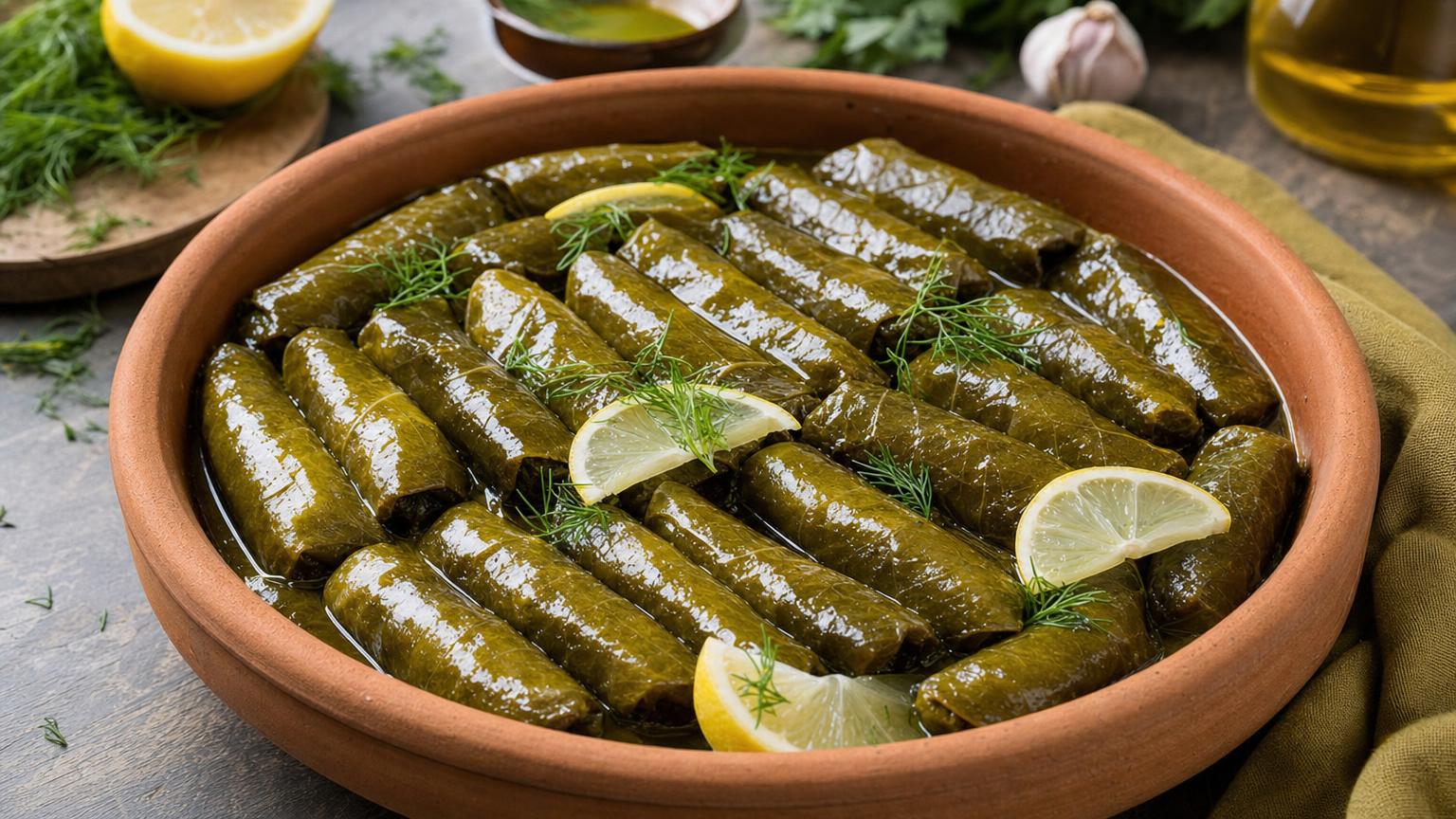
Japrak is the Albanian preparation of stuffed grape leaves — rice and ground meat seasoned with herbs, rolled into small parcels, and simmered slowly in a pot of broth and lemon. It is one of the oldest dishes on the Albanian table and one of the most patient. The rolling takes time. The cooking takes longer. The result is worth both.
The dish goes by several names in the diaspora. Japrak, japrake, sarma, dollma — the spelling and the term shift by region and family. The cabbage-leaf winter version is sometimes called sarma me lakra. All of them describe the same logic: a tender leaf, a rice-and-meat filling, a slow simmer.
This piece covers what japrak is, where it comes from, the regional variations across Albania, Kosovo, and the diaspora, the cultural weight it carries, and the traditional recipe at home-kitchen scale. The recipe uses ingredients available at any US supermarket. Jarred grape leaves are fine.
What Japrak Is
Japrak is a stuffed-leaf dish in the broader Mediterranean and Balkan family of dolma and sarma. The structure is simple. A leaf — most often a grape leaf in spring and summer, a cabbage leaf in winter — is laid flat. A spoonful of filling goes near the stem. The leaf is folded over the filling and rolled tight into a small cylinder, about the thickness of a thumb. The rolls are packed snug into a pot, covered with broth, weighted with an inverted plate, and simmered for about an hour.
The filling is the constant. Long-grain rice, ground beef or lamb, finely chopped onion, fresh herbs (mint, parsley, dill), salt, pepper, sometimes a pinch of cinnamon or allspice. The herb mix is what separates an Albanian japrak from a Greek dolmadaki or a Turkish yaprak sarma — the Albanian version leans heavier on mint and dill, lighter on cinnamon, and almost never includes pine nuts or currants the way some Levantine versions do.
The cooking liquid matters as much as the filling. A typical pot uses water or broth, olive oil, lemon juice, and sometimes a small amount of tomato. The acid from the lemon brightens the dish and helps the leaves stay tender. The olive oil enriches the broth as it cooks down.
A finished japrak is small. Each roll is two to three inches long and about the thickness of an adult thumb. A serving is five to eight rolls. The standard pot yields about 30 rolls and feeds six people as a main course, more as part of a meze spread.
There is a vegetarian version that drops the meat entirely and stretches the rice with more onion, herbs, and sometimes pine nuts or currants. It is sometimes called japrak pa mish (japrak without meat) and is the version served during Orthodox fasting periods (kreshma). It is eaten at room temperature with extra olive oil drizzled on top, closer in style to the Greek dolmadakia.
Origins and the Ottoman Connection
Japrak belongs to the Ottoman culinary inheritance that shaped the entire Balkan kitchen. The dish traveled with the Ottoman Empire and took root everywhere the empire reached — Greece, the Balkans, the Levant, North Africa, the Caucasus. Each region kept the structure and adapted the seasoning.
The names tell the story. Dolma comes from the Turkish verb dolmak, to be filled. Sarma comes from the Turkish verb sarmak, to wrap. Yaprak means leaf. The Albanian japrak is a direct phonetic borrowing of yaprak, picked up during the centuries when Albanian lands were part of the Ottoman administrative system. The same word produced japrake in some regional spellings and yaprák in some Greek dialects.
Stuffed grape leaves have deep roots in the eastern Mediterranean and the Middle East. Food historians trace stuffed-vegetable dishes in the region back many centuries — well before the Ottoman era — and stuffed vine leaves appear in some medieval Arabic cookbooks. What the Ottoman Empire did was carry and popularize the dish across a huge geography. By the time the empire receded in the 19th and 20th centuries, every successor state had its own version.
The cousins are everywhere. Greeks make dolmadakia (small grape-leaf rolls, often served cold with lemon and olive oil) and lahanodolmades (cabbage rolls, served warm with avgolemono). Bosnians and Serbs make sarma in winter, almost always with cabbage and a heavier paprika-and-meat filling. Bulgarians make sarmi both ways. Turks make yaprak sarma (grape leaf) and lahana sarma (cabbage). Armenians make tolma. Iranians make dolmeh barg-e mo. The Levant makes warak enab.
The Albanian version sits in the middle of this map. The seasoning is Mediterranean — mint, dill, lemon, olive oil. The technique is Ottoman. The serving style is Balkan: warm, with cold yogurt on the side, often as the centerpiece of a long lunch. None of this is unique. All of it is recognizably Albanian once it hits the table.
Regional Variations
Albanian japrak is not one recipe. The country splits between south (Tosk) and north (Gheg), and the dish splits with it. Add Kosovo, North Macedonia, Çamëria, and the Italian-Albanian Arbëresh, and the variations multiply.
South Albania (Tosk). Lighter, herb-forward, more lemon. The Tosk japrak is closer to the Greek dolmadakia in spirit — small rolls, plenty of mint and dill in the filling, a generous pour of olive oil, served warm or at room temperature. The vegetarian japrak pa mish is most common here, especially during Orthodox fasting.
North Albania (Gheg). Heavier, meatier, often with cabbage in addition to grape leaves. The Gheg version uses more meat in the filling, sometimes a pinch of paprika, and is more likely to be baked in the oven rather than simmered on the stovetop. Cabbage rolls (sarma me lakra) are the winter staple in northern households.
Kosovar. Kosovo’s japrak tradition leans toward lamb and toward larger, plumper rolls. The cooking liquid often includes a small amount of tomato, and the dish is sometimes finished with a spoonful of yogurt stirred into the pan juices at the end, which thickens the sauce and makes it richer. The Kosovar version is a close relative of the Macedonian and Bosnian sarma.
Çamëria. The Çam Albanians (originally from northwestern Greece) carry a Greek-influenced version with more cinnamon and sometimes a small handful of currants in the filling. The serving style is colder — at room temperature, with extra olive oil and a wedge of lemon, closer to meze than main course.
Arbëresh. The Arbëresh communities of southern Italy preserve a 15th-century Albanian foodway and make their own stuffed-leaf dishes, sometimes with chard or local greens in place of grape leaves, and often with the rice cooked in a tomato-based broth. The Italian influence is visible in the seasoning; the structure is the same.
North Macedonian. Albanian families in North Macedonia make a version close to the Kosovar, with the addition of a tomato-paprika sauce that signals the broader Macedonian Slavic kitchen. Cabbage versions dominate in winter.
The diaspora softens these lines. A Tosk grandmother in the Bronx and a Kosovar grandmother in Yonkers end up shopping at the same Mediterranean grocery and rolling with the same jarred grape leaves. The regional accents fade with each generation unless someone names them and writes them down.
The Cultural Anchor
Japrak is a holiday dish and a Sunday-lunch dish. It takes too long for a weeknight and rewards too much patience to be casual. When it shows up on the table, the gathering is meant to last.
It is on the table for Bajram (Eid), for Easter (Pashkë), for Christmas, for weddings, for any darka — the long evening dinner that anchors Albanian social life. The vegetarian version (japrak pa mish) appears during Orthodox fasting and on the Lenten table. The Muslim, Catholic, and Orthodox households all make it; the seasoning shifts at the margins, the dish stays the same.
It is also a teaching dish. Rolling japrak is the work of an afternoon — usually two or three people at the kitchen table, each working through a stack of leaves, talking. Grandmothers teach granddaughters the fold here. Mothers teach sons how to pack the pot. The rolls themselves are small enough that a beginner can practice on a single leaf without wasting a meal.
In the diaspora, the dish carries a second weight. It is one of the recipes most often lost when a generation is not asked to teach. The grandmothers cooked without measuring. They knew the filling was right by the smell of the mint when the herb hit the warm pan, the rolls by the way the leaf folded against the thumb, the broth by how much lemon the pot wanted on a given day. When that knowledge is not handed down, what survives is a memory — not the dish.
Writing the recipe down is part of how japrak survives the move across an ocean. So is rolling next to someone who already knows.
The Traditional Recipe
This is the grape-leaf version (japrak me gjethe rrushi), the spring-and-summer dish that uses jarred grape leaves from the supermarket. It yields about 30 rolls and serves 6 as a main course.
Ingredients
For the filling:
- 1 lb (450g) ground beef, or a 50-50 mix of beef and lamb (avoid extra-lean — 80/20 is right)
- 1 cup (200g) long-grain white rice, rinsed under cold water until the water runs clear
- 1 large yellow onion, finely chopped (about 1 cup)
- ¼ cup fresh mint leaves, finely chopped
- ¼ cup fresh flat-leaf parsley, finely chopped
- 2 tbsp fresh dill, finely chopped
- 2 tbsp olive oil
- 1½ tsp kosher salt
- 1 tsp freshly ground black pepper
- ½ tsp ground allspice (optional; some families use it, some do not)
For the rolls and pot:
- 1 jar (16 oz) grape leaves in brine, drained — about 50 to 60 leaves total (you will use 30 for rolling, the rest line the pot)
- ¼ cup olive oil
- Juice of 2 large lemons
- 3 to 4 cups water or low-sodium chicken broth
- 1 lemon, sliced into thin rounds, for the top of the pot
To serve:
- Plain whole-milk yogurt (kos), cold, in a small bowl
- Lemon wedges
- Crusty bread
A note on the leaves. Jarred grape leaves vary by brand. Look for whole leaves without too many tears. The smaller, more tender leaves at the top of the jar make the best rolls; the larger, tougher ones work for lining the pot.
A note on the rice. Rinse it well. Unrinsed rice releases too much starch into the filling and makes the rolls gummy. The rice goes in raw — it cooks inside the rolls during the simmer.
Equipment
- A large heavy-bottomed pot, 4 to 6 quarts, with a tight lid
- A small heat-safe plate that fits inside the pot, used as a weight
- A large bowl for mixing the filling
- A clean kitchen towel
- A pair of kitchen tongs (for fishing leaves out of hot water)
How to Make Japrak
Step 1 — Prepare the leaves (10 minutes)
Drain the grape leaves and rinse them under cold running water to wash off the brine. Place them in a large bowl and pour boiling water over them; let them sit for one minute, then drain and rinse with cold water. This softens the leaves and makes them pliable. Pat dry with a kitchen towel and stack them on a plate near your work area.
Sort through the stack as you go. Set aside the smaller, intact leaves for rolling and the larger, torn ones for lining the pot.
Step 2 — Make the filling (10 minutes)
In a large bowl, combine the ground meat, rinsed rice, chopped onion, mint, parsley, dill, olive oil, salt, pepper, and allspice. Mix with your hands or a fork until uniform. The filling should look loose and slightly wet — the rice will absorb the liquid as it cooks.
Do not overwork the meat. A few turns is enough. Overmixing makes the filling dense.
Step 3 — Line the pot (5 minutes)
Lay the torn or oversized leaves across the bottom of the pot in an overlapping single layer. This protective layer keeps the rolls from scorching against the bottom of the pot during the long simmer. Set the pot aside.
Step 4 — Roll the japrak (30 to 40 minutes)
Lay one leaf flat on a cutting board, shiny side down, stem facing you. If the leaf has a thick stem, snip it off with kitchen scissors.
Place about one teaspoon of filling near the stem end of the leaf, shaped into a small cylinder. Fold the bottom of the leaf up over the filling. Fold the two sides in toward the center over the filling. Roll away from yourself, snug but not tight, into a small cylinder about the thickness of your thumb.
The rolls should be firm enough to hold together but loose enough that the rice has room to expand. Too tight and the roll splits during cooking; too loose and it falls apart.
Pack the finished rolls into the pot, seam side down, in concentric circles starting from the outside and working in. Pack them snug — they should support each other. When the first layer is full, start a second layer on top.
Step 5 — Add the cooking liquid (3 minutes)
Pour the olive oil and lemon juice over the packed rolls. Add water or broth until the rolls are just covered. Lay the lemon slices on top.
Place the small heat-safe plate upside down on top of the rolls. The plate weighs the rolls down so they do not float and unwind during the simmer. This step is not optional.
Step 6 — Simmer (1 hour to 1 hour 15 minutes)
Cover the pot with the lid. Bring to a gentle boil over medium heat, then immediately reduce to the lowest simmer your stove will hold. Cook covered for one hour to one hour fifteen minutes, until the rice inside the rolls is fully tender.
Check at the one-hour mark by lifting one roll out with tongs and cutting it open. The rice should be soft and the meat fully cooked. If the rice is still firm, simmer for another 10 to 15 minutes and check again.
The broth should reduce as it cooks. If the pot looks dry before the rice is done, add ½ cup more water at a time.
Step 7 — Rest, then serve (15 minutes)
Pull the pot off the heat and let it rest, lid on, for 15 minutes. Resting allows the rolls to firm up and the broth to settle into the leaves. Serving immediately gives you a soft, broken roll; a 15-minute rest gives you a clean, intact one.
Lift the rolls out gently with a slotted spoon or tongs, transfer to a serving platter, and spoon a little of the cooking liquid over the top. Serve warm with cold yogurt, lemon wedges, and bread.
Common Mistakes
- Skipping the blanch. Grape leaves straight from the jar are stiff and tear when you try to roll them. The one-minute hot-water bath softens them and is the difference between a clean roll and a frustrating one.
- Packing the filling too tightly. The rice expands as it cooks. A tight roll splits along the seam and dumps its filling into the broth. Roll snug but not tight; the leaf should give a little when you press it.
- No weight on top. Without a plate weighing them down, the rolls float, unwind, and turn into a pot of loose rice and torn leaves. The plate is not optional.
- Boiling instead of simmering. A hard boil agitates the rolls and breaks them open. The simmer should be barely visible — small bubbles around the edge of the pot, no churning surface.
- Cutting one open too early. Pulling a roll out at 30 minutes to check doneness lets steam out and slows the cook. Wait until the one-hour mark, then check.
- Skipping the rest. Hot rolls served immediately are soft and prone to breaking. The 15-minute rest off the heat is what gives you a clean serving.
Variations
The same technique works across the whole family of japrak fillings and leaves. The patterns are stable.
- Japrak me gjethe lakre (cabbage leaves). The winter version. Core a head of green cabbage, blanch the whole head in boiling water for 5 to 8 minutes until the outer leaves separate easily, peel them off, trim the tough rib at the base of each leaf, and use exactly the same filling and pot setup as above. Cabbage rolls are larger — about the size of a small sausage — and the simmer runs about 90 minutes.
- Japrak pa mish (vegetarian). Drop the meat. Use 1½ cups rice, double the onion (sweat it in olive oil first), and add ¼ cup pine nuts and 2 tbsp dried currants if you want the eastern-Mediterranean version. Serve at room temperature with extra olive oil and lemon. This is the Lenten and Orthodox-fasting version.
- Japrak me kos (with yogurt). A Kosovar finish. In the last 10 minutes of cooking, whisk 1 cup of plain yogurt with 2 tbsp of the hot broth from the pot, then pour it over the rolls. The yogurt thickens the sauce and gives the dish a richer, tangier finish. Do not let the yogurt boil or it will split.
- Japrak me mish qengji (lamb). Replace the beef with ground lamb, or use a 50-50 blend. Add a pinch of cinnamon to the filling. The lamb version is closer to the Kosovar and southern Albanian table.
- Baked japrak. A northern Albanian variation. Pack the rolls into a baking dish instead of a pot, cover with broth, oil, and lemon, top with the lemon slices and a sheet of parchment, and bake at 350°F (175°C) for 75 to 90 minutes. The result is slightly drier and more concentrated than the simmered version.
Serving and Pairing
Japrak is rarely served alone. The standard Albanian table puts it next to a small bowl of plain whole-milk yogurt (kos) — cold, ungarnished, eaten by the spoonful between bites. The yogurt cools the warm broth and cuts the richness of the filling. Without it, the dish feels heavy. With it, the dish balances.
A wedge of lemon on the plate gives each diner the option to brighten the rolls further. A piece of crusty bread soaks up the broth that pools on the plate. A chopped salad of cucumber, tomato, white onion, and feta with olive oil and red wine vinegar rounds out the table.
For drinks, a small glass of raki is the traditional pairing, served chilled before the meal as part of the meze spread. With the meal itself, a Mediterranean white — a Greek assyrtiko, an Italian vermentino, or an Albanian shesh i bardhë if you can find one — works well. The acid in the wine echoes the lemon in the broth.
Japrak reheats beautifully. Cool the rolls in their broth, refrigerate up to four days, and reheat gently on the stovetop with a splash of water. The flavors deepen overnight; many cooks say the second-day japrak is better than the first. Do not microwave — the leaves toughen and the rolls dry out. A slow stovetop reheat with the lid on is the right way.
For a meze spread, japrak sits next to byrek, qofte, tave kosi, olives, feta, and bread. It can be the main course or a single item among many. The portion shrinks with the spread; a serving of two or three rolls is plenty when there are six other dishes on the table.
A Note on Survival
Japrak is the kind of dish that lives or dies generation by generation. The grandmothers who roll it without measuring the filling are the same grandmothers who cook tave kosi, fasule, and the rest of the table that anchors the Albanian American home. When that generation is gone and no one wrote the recipe down, the dish slips out of the family.
Counting ourselves is the other piece of holding the diaspora’s shape. If you want to be counted in a community-led count of Albanian Americans, register with NAR. Free. Neutral. Your data stays yours. The recipes survive when families teach them; the community survives when it is counted.