

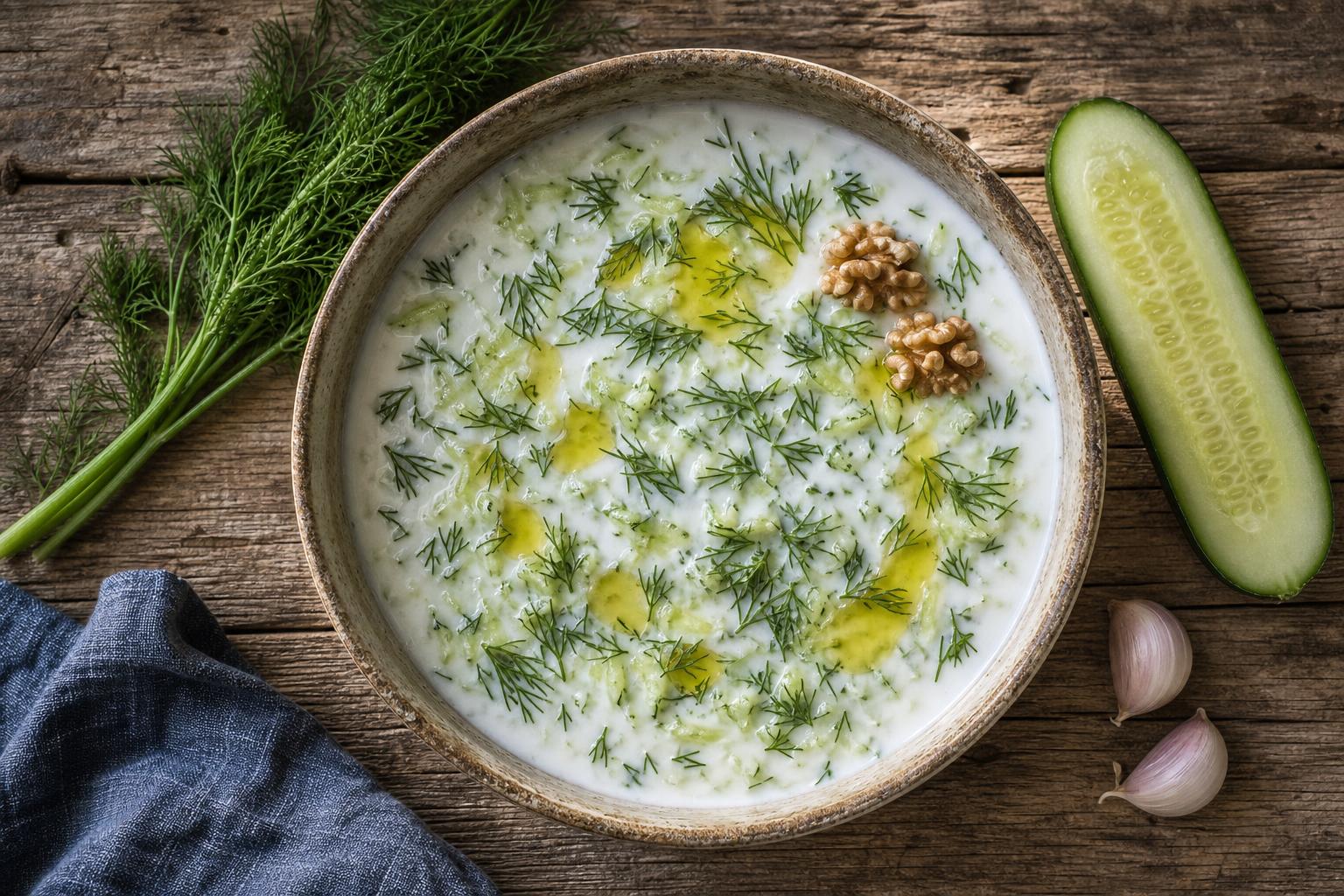
Tarator is what Albanians eat in July when it is too hot to cook. Cold yogurt thinned with water, grated cucumber, garlic crushed with salt, fresh dill, a finishing drizzle of olive oil. Five ingredients, one bowl, no stove. It comes out of the refrigerator already done.
For most Albanian-American families, tarator is the first dish that goes on the table at a summer cookout — before the lamb on the grill is ready, alongside the bread and the chopped tomato salad. It is the dish that says the meal has started without a single thing having been cooked. This is the traditional recipe with the quantities, ratios, and timings nailed down. It serves four to six. It takes fifteen minutes of work and an hour in the refrigerator.
What Tarator Is, and Where the Word Comes From
The word tarator is older than the soup. It comes into the Balkans through Ottoman Turkish, and the most-cited etymology traces it to the Venetian trattòr (from Italian trattore, “restaurant owner,” ultimately from Latin tractare), per Sevan Nişanyan’s Etymological Dictionary of Contemporary Turkish. The earliest documented appearance is in Evliya Çelebi’s Seyahatnâme (1655), where tarator describes a sauce made from garlic and vinegar. The walnut-and-bread version — the one still served with fried fish in Turkey today — shows up later, in the 1844 Ottoman cookbook Melceü’t-Tabbâhîn.
That walnut-and-bread version is still alive in modern Turkish cooking. What happened next is that the same word also followed yogurt north and west into Bulgaria and Albania, where alongside its Turkish meaning it picked up a second one — “cold yogurt soup.” In northern and eastern Albania the two traditions converged — the soup picked up crushed walnuts inside it, the way Bulgarian tarator does. In central and southern Albania the soup stayed walnut-free.
So when an Albanian says tarator, they almost always mean the cold yogurt-cucumber soup. When a Turkish cook says tarator, they almost always mean the walnut-bread sauce. Same word, two dishes, a shared Ottoman history.
The Albanian Version, Compared to the Cousins
Tarator sits inside a family of yogurt-and-cucumber dishes that runs from Iran across Anatolia and the Balkans into Greece and Cyprus. They are not the same dish in different costumes — the technique and the register are different — and home cooks who get this wrong end up with something that is none of them.
- Albanian tarator. Yogurt, grated cucumber, garlic, fresh dill, olive oil, water to thin, optional walnuts. Served as a first-course soup, eaten with a spoon.
- Bulgarian tarator. Same base, but crushed walnuts are stirred into the soup, not just sprinkled on top. The walnut content is what makes it Bulgarian.
- Turkish cacık. Closer to a yogurt drink than a soup. Often includes mint or dried herbs. Served alongside grilled meat as a cooling counterpoint.
- Greek tzatziki. Strained yogurt, thicker, served as a dip with bread or grilled vegetables. Not a soup.
- Iranian mast-o-khiar. Yogurt with cucumber, walnuts, raisins, sometimes rose petals — a sweet-savory variant.
The Albanian version is closest to the Bulgarian one and a step away from the Greek one. It is yogurt-forward (the yogurt is the dish), cucumber-forward (the cucumber is the texture), and herb-forward (dill, sometimes mint). It is a soup, not a dip — that is the line that separates it from tzatziki.
Regional Variations Within Albania
There is no single Albanian tarator. Consistency, herb choice, and walnut presence vary by household and region, and the practice shifts as you move across the country.
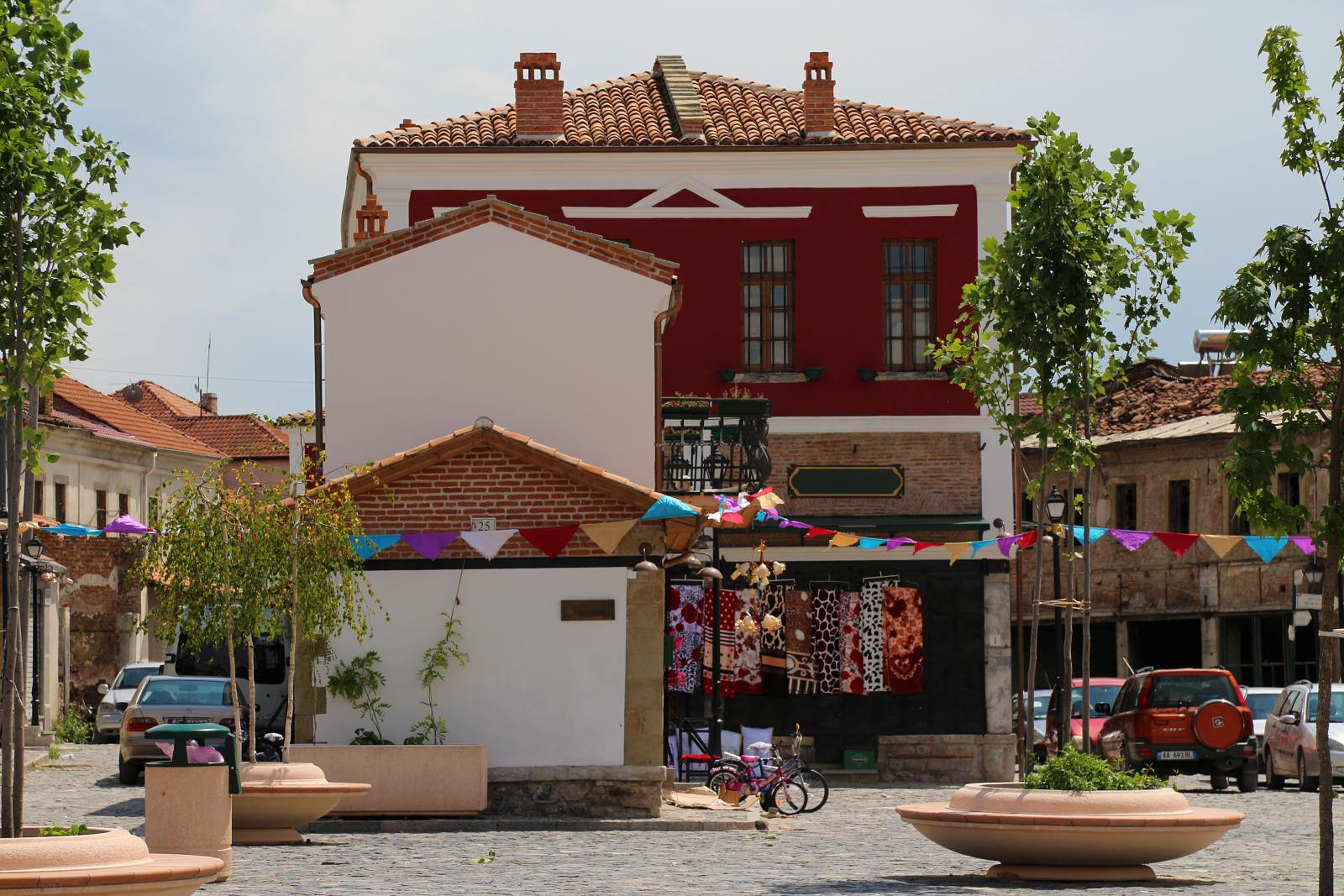 Old Bazaar of Korçë, the historic market at the heart of the city’s distinctive regional cuisine. — Image: Wikimedia Commons / CC BY-SA 4.0
- Central Albania (Tirana, Durrës, Elbasan). Yogurt, grated cucumber, garlic, dill, olive oil, water. No walnuts. Served thinned to soup consistency. This is the version most diaspora cooks grew up eating, and the version this recipe defaults to.
- Korçë and the east. Some families in the east stir crushed walnuts into the soup the way Bulgarian tarator does — not a universal regional rule, but common enough that diaspora cooks from Korçë grew up with it. Albania doesn’t share a border with Bulgaria, but Korçë sits in the country’s southeastern corner, and the wider Ottoman-era Balkan foodways connect the two cuisines — including a walnut-forward yogurt soup.
- South coast (Vlorë, Sarandë, Berat, Gjirokastër). Closer to the Greek register, with more olive oil. Some cooks in the south substitute fresh mint for dill, or use both; others strain the yogurt slightly so the bowl sits between soup and dip. Sourcing for these practices is anecdotal — there is no single regional rulebook.
- Shkodër (north). Some northern cooks make a denser, less-water version and serve it as a side dish rather than a first course. As with the southern coast, this is reported practice rather than a written canon.
When a recipe insists on a single “authentic” tarator, it is usually telling you about one Albanian region while pretending it is telling you about Albania. The version below is the central-Albanian default. The variations are written as variations, because that is the truth of the dish.
Ingredients
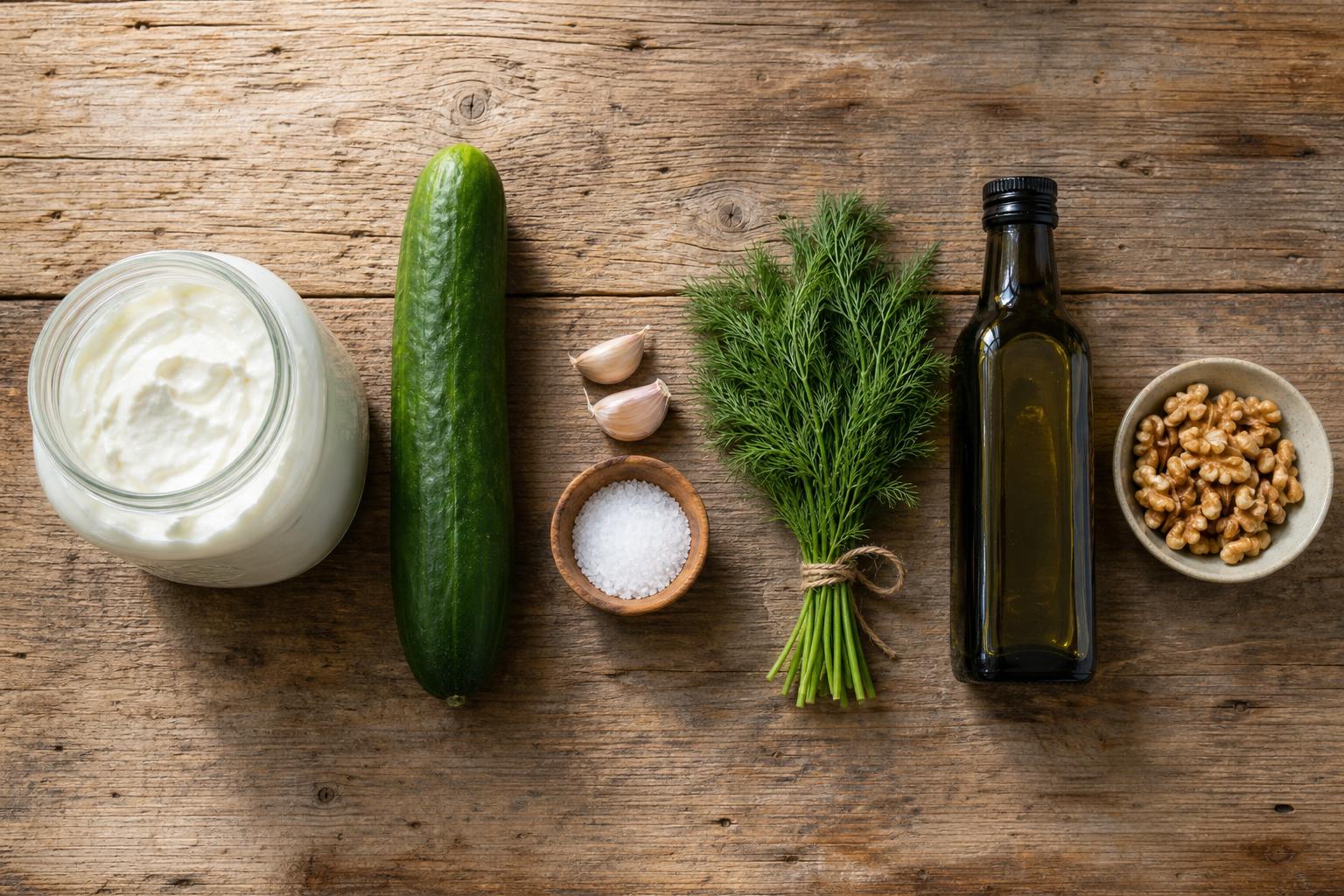 *Tarator ingredients: whole-milk Greek yogurt, English cucumber, garlic, fresh dill, kosher salt, olive oil, and optional crushed walnuts for the eastern Albanian variant. — Graphic by NAR
Serves 4-6 as a first course. All measurements are US standard.
- 32 oz (4 cups) plain whole-milk Greek yogurt
- 1 large English (hothouse) cucumber, or 2 medium Persian cucumbers
- 2 cloves garlic
- ¾ tsp kosher salt, plus more to taste
- 3 Tbsp fresh dill, finely chopped (plus more for garnish)
- 3 Tbsp extra-virgin olive oil
- 2½ cups cold water (start with 2 cups; add the rest to taste — see note below)
- ¼ cup crushed walnuts (optional, for the eastern walnut version)
- Ice cubes, for serving (optional)
A note on the yogurt and water ratio. Strained Greek yogurt (Fage Total, Chobani Greek, etc.) is roughly twice as thick as the unstrained, full-fat kos Albanian families used to make at home, so it needs roughly its own volume of water added back to pour like a soup — plan on 2 to 2½ cups of cold water for a 32-oz tub of strained Greek yogurt. With unstrained full-fat plain yogurt — Wallaby Organic, Maple Hill, or Stonyfield Whole Milk Plain (not Greek) — you may need only ½ to 1 cup. Add the water in stages and stop when the soup ribbons cleanly off a spoon. Avoid 0% Greek — the soup comes out chalky no matter what you do.
A note on the cucumber. English (hothouse) cucumber is the right call: thin skin, fewer seeds, brighter color in the bowl. Persian cucumbers also work and are sometimes easier to find in Middle Eastern groceries. Avoid the waxed slicing cucumber from the standard supermarket case — peel it if it is all you have.
A note on the dill. Fresh dill is the standard. In some southern coastal Albanian households fresh mint replaces dill (or the two are used together) and the dish is still tarator. Dried dill is the one substitution to avoid — it tastes like hay and the soup will taste like hay too.
How to Make Tarator
Step 1 — Make the garlic-salt paste (2 minutes)
Peel the garlic. Put it on a cutting board with ½ tsp of the salt. Pound the garlic with the salt using a mortar and pestle, or crush it with the flat of a knife and work it into a paste against the board. The salt is doing structural work here: it draws moisture out of the garlic and lets the cells break apart cleanly. Mincing without salt leaves you with sharp, raw-tasting garlic chunks; the paste distributes evenly through the soup.
Step 2 — Prep the cucumber (3 minutes)
Wash the cucumber. If using English cucumber, do not peel it. Grate the whole cucumber on the large holes of a box grater into a bowl. Sprinkle ¼ tsp salt over the gratings, stir, and let it sit for 5 minutes while you assemble the rest. The salt pulls water out of the cucumber and concentrates the flavor.
You have a choice here. Drain the released water for a denser soup. Keep the released water for a thinner soup. The traditional central-Albanian version keeps it; that is what gives the bowl its body.
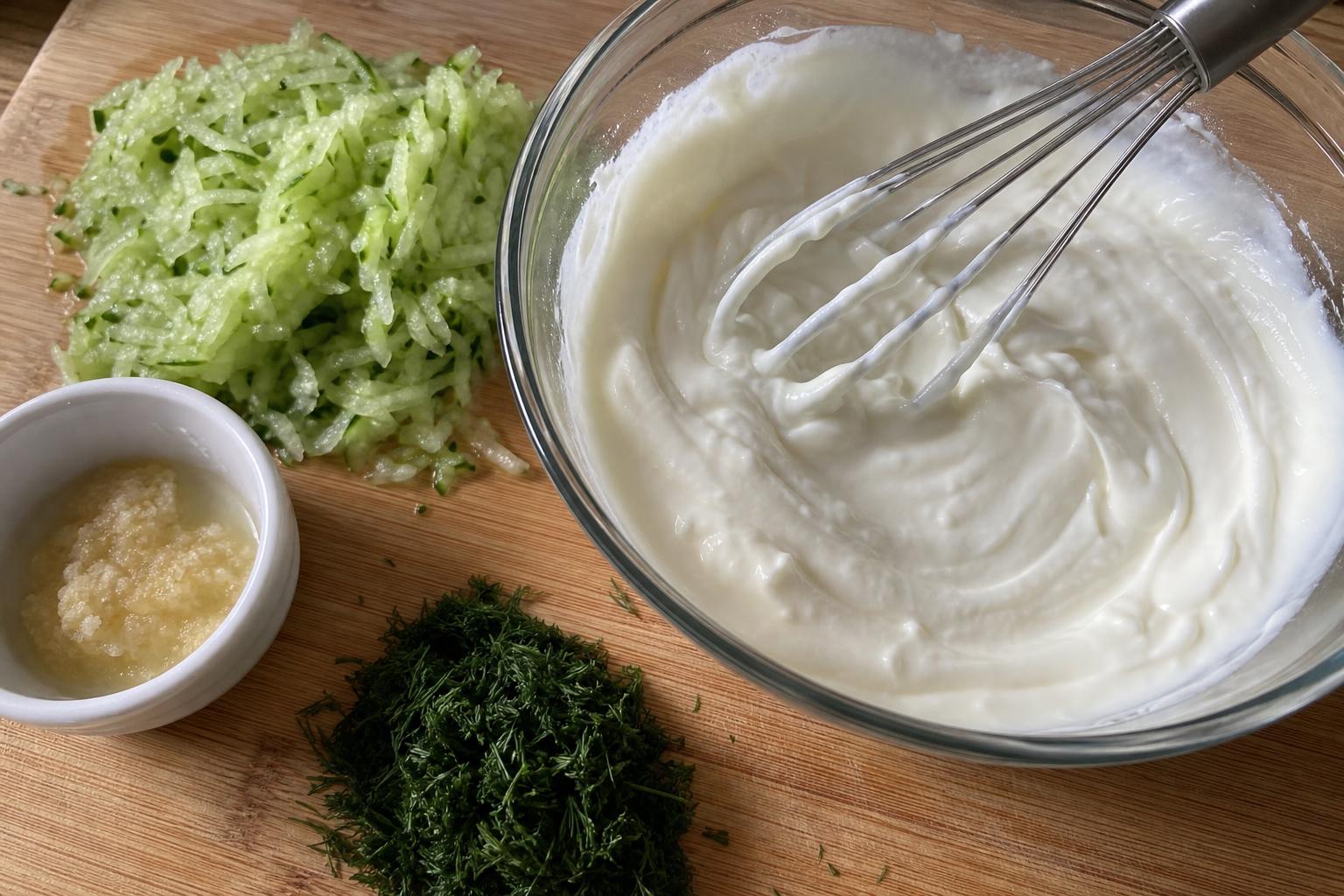 *Whisking the yogurt base smooth before folding in grated cucumber, garlic-salt paste, and fresh dill. — Graphic by NAR
Step 3 — Whisk the yogurt base (2 minutes)
Empty the yogurt into a large bowl. Whisk in 2 cups cold water and the olive oil until smooth. The mixture should pour off a spoon in a steady ribbon — not too thick, not too thin. If it is still too thick to ribbon, add the remaining ½ cup water in 2-Tbsp pours until it does. With unstrained full-fat yogurt you will need much less water; start with ½ cup and add as needed.
Step 4 — Combine (2 minutes)
Add the grated cucumber (with its liquid, if you kept it), the garlic-salt paste, and 2 Tbsp of the chopped dill to the yogurt. Stir gently with a spoon — do not over-whisk, or you will incorporate too much air and the texture turns frothy. Taste. Add more salt if needed; tarator should taste a little salty when warm because it gets less salty when cold.
If you are making the eastern walnut version, fold the crushed walnuts in now.
Step 5 — Chill, then finish (1 hour + 1 minute)
Cover and refrigerate for at least 1 hour, ideally 2-3. The chill is not optional. Tarator at room temperature tastes flat; tarator at 38°F tastes alive — the cucumber crispness sharpens, the dill brightens, the garlic settles.
To serve: stir once (the cucumber settles), ladle into bowls, drizzle with the remaining olive oil, scatter the remaining 1 Tbsp dill across the surface. Add an ice cube or two to each bowl on a hot day — Albanian families in Vlorë do this in August and the soup is better for it.
Why This Recipe Works (Food-Science Note)
A handful of small choices make the difference between a thin, watery bowl and a silky one.
Grated, not diced. Grating breaks the cucumber’s cell walls and releases pectin and water that thicken the yogurt naturally. Diced cucumber stays in chunks; the soup around it is just yogurt thinned with water. The body of tarator comes from the cucumber — grate it.
Garlic crushed with salt, not minced. Salt drawn into the garlic does two things: it breaks the cells more cleanly than a knife alone, and it removes the volatile sulfur compounds that taste raw. The result is garlic that flavors the soup rather than punching it.
Whole-milk yogurt, not 0%. Fat carries flavor and gives mouthfeel. The 0% versions of Greek yogurt are a different ingredient — drier, more sour, and they do not reconstitute into a silky soup no matter how much water and oil you add.
An hour in the refrigerator. Tarator is a chemistry experiment that needs time. The salt finishes drawing water out of the cucumber. The garlic mellows. The dill perfumes the yogurt. The yogurt itself thickens slightly as it cools. Skip the chill and you serve a different dish.
How Albanian-Americans Make It in the US
Tarator is one of the easiest Albanian dishes to translate into American kitchens because nothing about it requires a specialty store. Five ingredients, all in any US grocery.
- Yogurt. Fage Total 5% (whole milk) is the closest US-grocery match for the dense, full-fat kos Albanian families used to make at home. Stonyfield whole-milk plain works thinned. Wallaby and Maple Hill full-fat plain (not strained) work without thinning. Chobani plain whole-milk works in a pinch — slightly sweeter than Fage, but the salt in the dish balances it.
- Cucumber. English (hothouse) cucumber is best. Persian cucumbers from Middle Eastern groceries are excellent. Standard slicing cucumbers are usable if peeled and seeded.
- Dill. The fresh dill bunches in any supermarket herb section are sufficient. Buy the day you cook.
- Garlic. Fresh cloves only. Pre-jarred minced garlic in oil tastes wrong here.
- Olive oil. A grassy extra-virgin works best — California Olive Ranch, Partanna, or any Greek/Italian/Spanish unfiltered EVOO. Save the expensive single-estate oil for finishing.
- Walnuts (optional). California walnut halves, crushed in a mortar or with the flat of a knife.
The version above is calibrated for US-grocery ingredients. An Albanian grandmother making tarator with homemade kos would skip the water entirely; with US Greek yogurt, the water is what restores the original consistency.
Serving and What to Pour Alongside
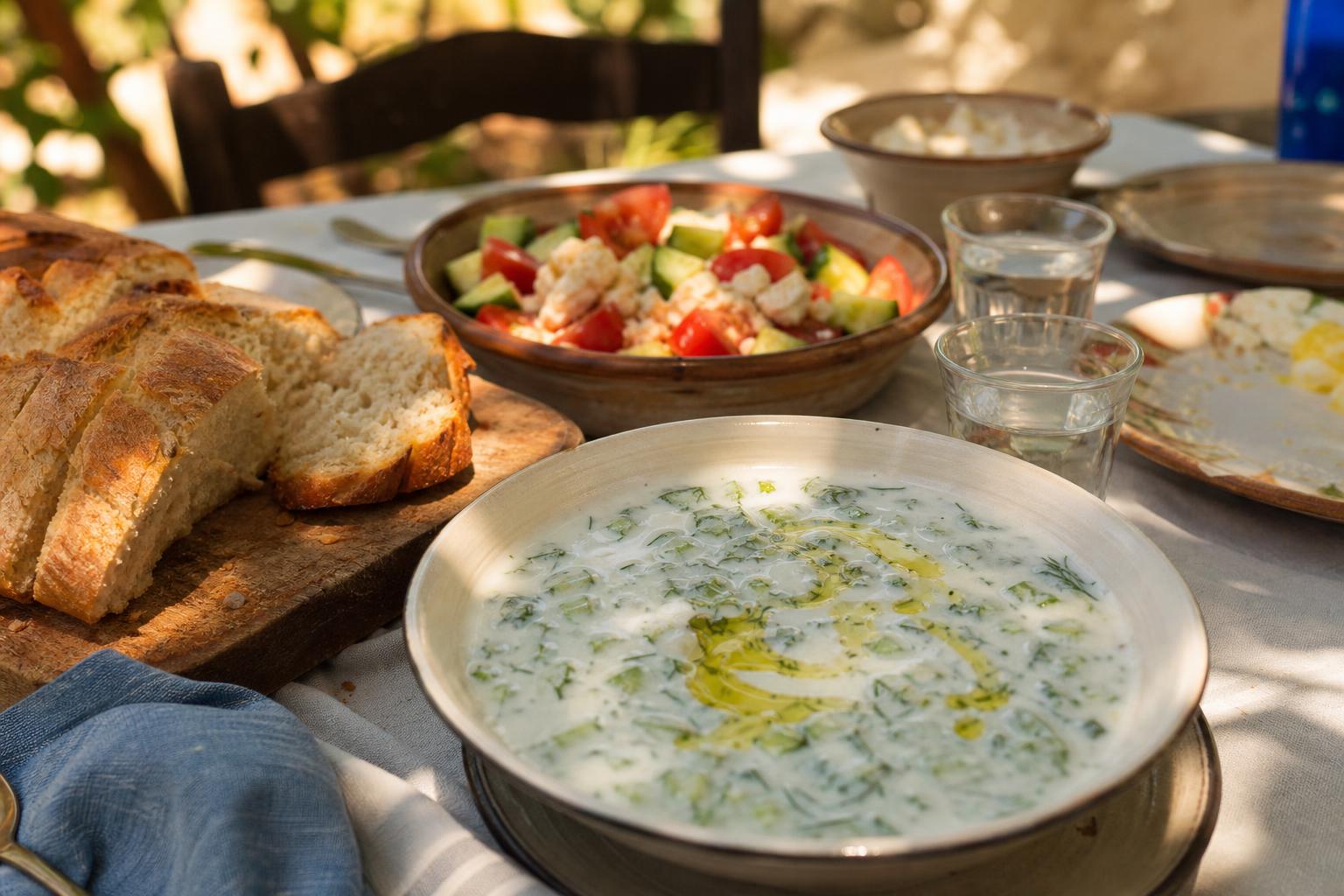 *Tarator served as a summer first course alongside country bread, a chopped tomato-cucumber-feta salad, and raki — the full Albanian table in July. — Graphic by NAR
Tarator is summer food. In Albania you will not see it on the table from October through April, and that seasonal rule travels — Albanian-American families also cook it from May through September and rarely outside that. It is what you eat when it is too hot to want anything warm.
What it wants around it:
- Crusty bread. Country loaf, white bukë, or a fresh baguette. Tarator is also a vehicle for bread.
- Grilled lamb chops or grilled fish. The cold yogurt cuts through the smoke from the grill — that is the whole point of having tarator in the same meal as something off the coals.
- A chopped tomato-cucumber salad with feta, red onion, and red wine vinegar. The salad is acidic where the tarator is creamy; they balance each other.
- A small glass of raki before the meal, in some families. Cold or room temperature, never on ice.
- Albanian white wine — a Pulës from Berat is the ideal pairing if you can find it. Otherwise any dry, unfussy Mediterranean white.
Tarator shows up at Catholic, Orthodox, Muslim, and Bektashi tables across Albanian-American summer cookouts. It is one of the few foods that travels across every line in Albanian-American life, the same way tavë kosi does, and for the same reason — yogurt and bread and good ingredients are the dishes everyone agrees on.
Common Mistakes
- Skipping the chill. Room-temperature tarator tastes raw and unbalanced. Wait the hour.
- Mincing garlic instead of crushing it with salt. The bite is harsher and the texture is wrong.
- Under-watering strained Greek yogurt. A 32-oz tub of Fage Total or similar needs 2 to 2½ cups of cold water to ribbon off a spoon like a proper soup. If your tarator sits on the spoon instead of pouring, add water 2 Tbsp at a time until it does. (Unstrained full-fat yogurt is the opposite problem — start with ½ cup.)
- Using dried dill. It tastes nothing like fresh dill. If fresh dill is unavailable, fresh mint is a closer substitute than dried — and is the standard herb in some southern coastal Albanian households anyway.
- Over-whisking. Yogurt that has been whipped goes frothy and breaks. Stir gently, taste, serve.
- Diced cucumber when the recipe says grate. Diced makes a thinner soup. Grate.
- Using 0% Greek yogurt without compensating. It will set, but the texture is leaner. Add an extra tablespoon of olive oil and serve very cold to mask it.