
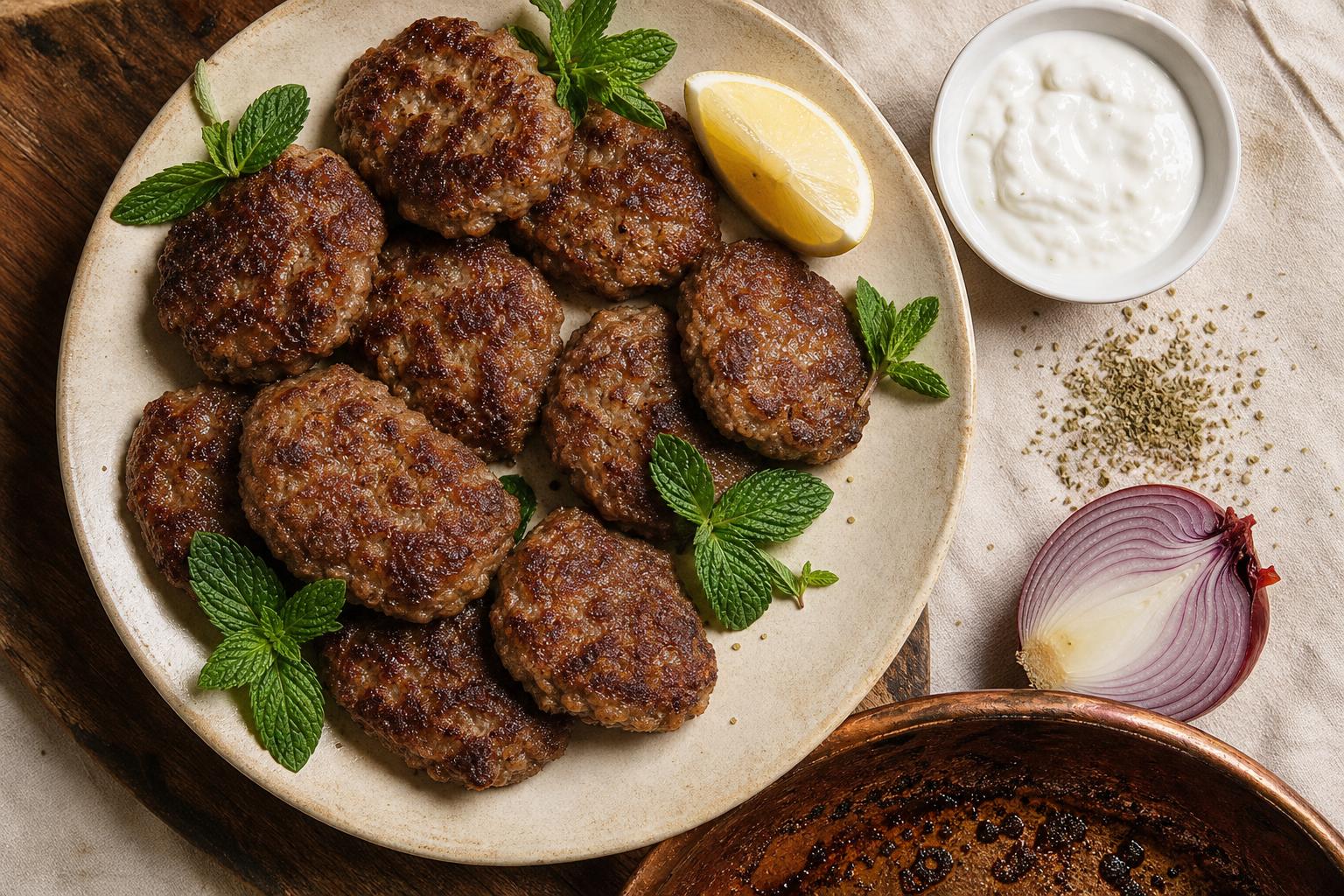
Qofte is the Albanian meatball — small, herb-flecked, and the dish that smells like every Albanian-American kitchen the moment the pan goes on the stove. The word covers a family rather than a single recipe: flat fried discs from Korça, longer grilled cylinders from Tirana, oven trays of qofte at family gatherings, and the qofte të fërguara that show up at weeknight dinners with a wedge of lemon and a bowl of yogurt. Across all of them, three things are constant: ground meat, grated onion, and an aromatic backbone built on mint, oregano, or both. This piece covers what qofte is, the regional variants, the lamb-versus-beef question, the methods, the cousins across the Balkans, what survives in Albanian-American kitchens, a working home recipe, and the table around it.
What Qofte Is
Qofte is the Albanian word for meatball or meat patty, traced back through the Ottoman period to the Persian-Turkic root kufta — meaning pounded or ground meat. The same root produced Turkish köfte, Greek keftedes, Bosnian ćufte, Bulgarian kyufte, Armenian kufta, and the Indian kofta of north Indian cooking. It is one of the most widely traveled food words on the map, and qofte is the Albanian branch of that tree.
In Albanian usage, the word names a shape more than a single dish. Qofte can be round balls (the ćufte shape, common in Kosovo and the north), flat discs the size of a quarter (qofte Korçare), longer ovals shaped on a skewer, or short cylinders fried in oil (qofte të fërguara). All of them are qofte. The shape changes by region, by cook, and by what the dish is going next to.
The base is stable across the variants. Ground meat — lamb, beef, or a mix — is bound with grated onion, an egg or two, soaked bread or breadcrumbs, and salt. The aromatic profile depends on region: oregano almost always, mint in the south, garlic everywhere, and sometimes paprika or chili in Kosovo and the north. The mix rests in the fridge for at least an hour before shaping, then cooks — pan, grill, or oven. What separates Albanian qofte from its neighbors is the herb fingerprint: mint-and-oregano forward, lamb-friendly, almost never with cumin.
Qofte Korçare — the Most Famous Regional Variant
Korça, the southeastern Albanian city on the Korça Plain, is the regional capital of qofte. Qofte Korçare is the version most outsiders mean when they say “Albanian meatballs” — small, flat, almost the size of a US quarter, fried in shallow oil in a heavy pan, and served at room temperature as part of a meze spread.
The Korça profile is built on three moves. First, the meat is a 50/50 beef-and-lamb mix, ground twice to fine. Second, the binder is bread soaked in milk and squeezed dry — not breadcrumbs straight from the bag, which goes dry and dense. Third, the herb is oregano, dried, generous, with a small share of mint folded in. Some cooks add crumbled feta; almost all add finely grated yellow onion, a healthy crack of black pepper, and a small splash of olive oil.
The cooking is shallow-fry in a wide cast-iron or carbon-steel pan with about a quarter-inch of oil at medium-high. Two minutes a side, browned on both faces, slightly soft middle. The discs land on a paper-towel-lined plate and rest before serving. Eaten warm or at room temperature, rarely hot from the pan.
Qofte Korçare belongs on a meze table — a small plate next to white cheese, olives, a bowl of kos (yogurt), pickled chilies, fresh tomato slices, and a small glass of raki. They are finger food in this register, not the centerpiece of dinner. In the diaspora, Korça-style qofte are the most-cooked version because they freeze and reheat well, scale to any party size, and travel to potlucks without losing their identity. Most Albanian-American cooks who say they make qofte are making some descendant of the Korçare version, even if the family is from Tirana or Shkodër originally.
Qofte Tirona, Fried Qofte, and the Elbasan Variant
Tirana — the capital and Albania’s largest urban kitchen — has its own qofte tradition. Qofte Tirona tend to be slightly larger than the Korça version, longer in shape, and finished on a grill rather than in a pan. The herb tilts toward mint, with oregano supporting rather than leading.
The Tirana version sits closer to the qebap tradition that runs through the Balkans — a longer oval pressed onto a metal skewer and grilled over charcoal until the outside is crisped and the inside is still juicy. The mix is leaner than the Korça version, often all beef, with grated onion, garlic, mint, parsley, salt, and pepper. Some cooks add a teaspoon of baking soda — a trick borrowed from Bosnian ćevapi — for a springier bite.
Qofte të fërguara — fried qofte — is the everyday weeknight version in every Albanian region. Small cylinder or oval, shallow-fried, the meal built around them rather than them being a meze opener. A plate of fried qofte, a bowl of yogurt, a chopped salad, and bread is a complete Tuesday-night dinner in most Albanian-American households. Fërguar means fried.
The Elbasan tradition adds a third variant. Elbasan, the central Albanian city most associated with tavë kosi, has a qofte tradition with a yogurt-based finish — qofte fried first, then briefly simmered in yogurt sauce or baked under a yogurt topping similar to the tavë kosi roof. The technique requires a second step most weeknight cooks skip, so it shows up rarely in the diaspora.
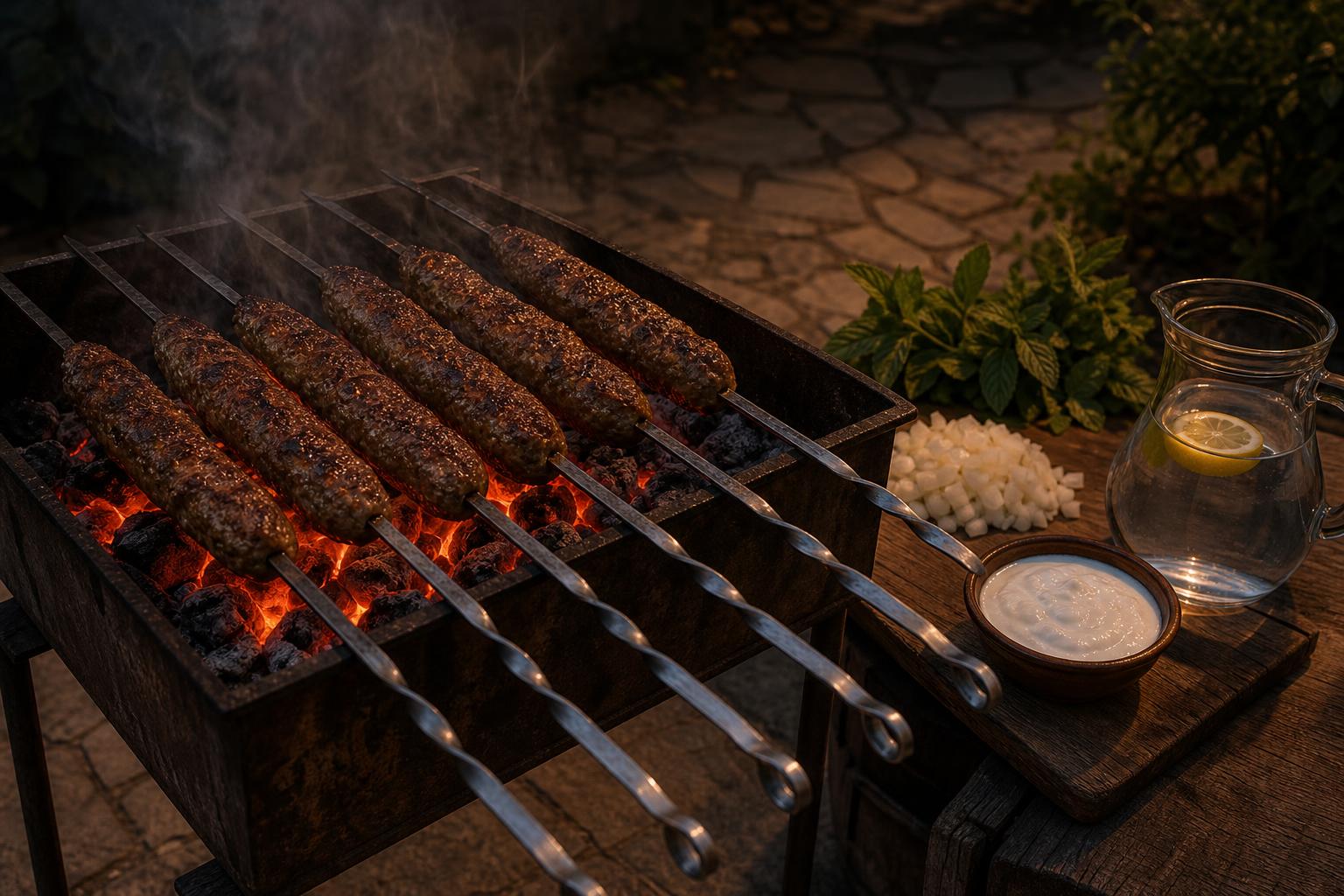
The grill form (qofte në skarë) is the summer move — backyard charcoal, longer ovals on metal skewers, three to four minutes per side until the outside takes a real char and the inside is just past pink. Served with raw onion, fresh tomato, hot peppers, and bread. This is the version that overlaps most with Bosnian ćevapi and Macedonian kebapi on the Balkan map.
The Lamb-vs-Beef Question and the Role of Mint and Oregano
The meat ratio is the first decision a qofte cook makes, and it shapes the dish more than any spice will.
Traditional rural Albanian qofte are lamb-forward. Every household kept sheep before the 20th-century urban shift, and lamb fat is what carries the dried oregano and mint through the meatball. Urban kitchens — especially Tirana and Korça — shifted toward a beef-lamb blend through the 20th century, with butcher shops selling pre-mixed mish i përzier (mixed meat) at roughly 50/50. The blend is now the standard Albanian profile, and most cookbooks specify it.
In the diaspora, beef dominates by default. Lamb is more expensive in the US, harder to source ground, and unfamiliar to children raised on burgers. The compromise most Albanian-American cooks settle on is a 70/30 or 80/20 beef-lamb mix when lamb is available, or all-beef with a touch of butter or olive oil added when it is not. Pure ground beef produces a flatter qofte — recognizable, but missing the depth lamb fat provides.
The herb question splits along the same regional lines. Oregano is the universal Albanian qofte herb — present in every regional variant from Shkodër to Korça. Mint is the southern signature, especially Korça, Gjirokastër, and the southern coast. Parsley shows up in some Tirana versions but is a supporting player. The northern and Kosovar versions often drop mint entirely and add red pepper flakes or paprika — a heat-forward profile that pairs with the meat-and-onion focus of the Gheg table.
A practical note. Dried oregano is what the recipes call for — what Albanian grandmothers hung from the kitchen ceiling to dry through the winter. Fresh oregano is a different ingredient; if substituting, use a third less. For mint, fresh is acceptable when dried is not on hand, but use roughly twice as much fresh as the recipe specifies for dried.
Cooking Methods: Pan, Grill, Oven
Albanian qofte cooks three ways, and the method changes the dish more than the ingredients do.
Pan-fried (qofte në tigan). The default. A wide heavy pan — cast iron is ideal — with a quarter-inch of olive oil or a neutral oil at medium-high. Two to three minutes per side, deep brown crust. This is the method for Korça-style discs, weeknight qofte të fërguara, and most diaspora cooking. The crust is the point — the contact area between the meat and the hot pan is where the Maillard reaction does its work and the oregano blooms in the rendering fat.
Grilled (qofte në skarë or në hell). Charcoal or wood-fired grill, longer ovals shaped onto metal skewers, three to four minutes per side over hot coals. The skewer conducts heat into the center and shortens the cook time, which keeps the inside juicy. Hell (skewer) is a distinct Albanian word, not a shared root with Greek souvlaki (from Latin subula) or Turkish şiş — but the skewer-grilling technique itself is shared across the region.
Oven-baked (qofte në furrë). The hands-off option. Shaped qofte on an oiled sheet pan, baked at 400°F (200°C) for 18 to 20 minutes, flipped once. Slightly drier than pan-fried, but it scales — useful when a family event needs 60 qofte at the same time. Some Elbasani versions finish the baked qofte under a yogurt sauce similar to the tavë kosi roof.
A note on oil temperature. Too cool and the qofte stew in the oil and absorb it; too hot and the outside burns before the inside cooks. The right temperature is when a piece of bread tossed in browns in 30 to 40 seconds — about 350°F (175°C). Work in batches; the temperature crashes when too many go in at once.
Albanian Qofte Compared to Its Cousins
Qofte sits inside a family of meatballs that runs from the western Mediterranean to the Indian subcontinent, all descended from the same Persian-Turkic root. The cousins are useful for understanding what makes the Albanian fingerprint specific.
Turkish köfte. The closest relative by name. Usually all-beef, heavier on cumin, with parsley as a load-bearing herb (Inegöl köfte and Tekirdağ köfte are the most famous regional versions). The Turkish profile is cumin-and-parsley forward; the Albanian profile is oregano-and-mint forward. Same shape, different aromatic register.
Greek keftedes. The closest relative by flavor profile. Keftedes lean on dried mint, oregano, and often a splash of red wine vinegar in the mix — a sour-bright kick Albanian qofte usually lacks. The meat is often a beef-lamb mix as in Albania. Southern Albanian (Çam) versions of qofte are nearly indistinguishable from Greek keftedes, which makes sense — the regions overlap geographically and the cooking traditions never respected the modern border.
Bosnian ćevapi. A cousin rather than a sibling. Small grilled cylinders, almost always all-beef, seasoned only with onion, garlic, salt, and pepper — no oregano, no mint, no cumin. Served with somun flatbread, raw chopped onion, and kajmak (clotted cream). Compared to Albanian qofte në skarë, plainer in seasoning and more tightly defined as a single dish.
Macedonian kebapi and Serbian ćevapčići are effectively the same dish under different names. Indian kofta sits at the far end — fried meatballs simmered in tomato or yogurt curry sauce, same root word, completely different finish.
The takeaway: when a recipe says köfte, keftedes, or ćufte, it is in the same family but not the Albanian dish. Substituting one for another changes the herb profile in ways grandmothers notice immediately.
Qofte in Albanian-American Kitchens
Qofte travels well into the diaspora because the structure is forgiving and the ingredients are available in any US supermarket. It is one of the most-cooked Albanian dishes in American kitchens, alongside byrek, fasule, and tavë kosi.
What gets kept. The shape — flat discs or short ovals. The aromatic backbone of grated onion, oregano, and (in southern families) mint. The shallow-fry technique. The serving format with yogurt, salad, and bread. The Saturday-night ritual of the kitchen smelling like onion-and-meat the moment the pan goes on.
What shifts. The meat ratio tilts heavily toward beef because lamb is harder to source. Bread soaked in milk gets replaced with packaged breadcrumbs more often than not. Herb intensity drops — Albanian-born grandmothers cooked with double the oregano of their American granddaughters. And the grill version becomes rarer in apartments without backyards, so the pan-fried version dominates the diaspora repertoire even in families that grew up grilling at home.
What gets lost. The household-cured fat — rural Albanian kitchens often used rendered lamb fat (dhjamë) or homemade gjalpë (clarified butter) in the qofte mix, which gave a flavor supermarket butter cannot replicate. The wild-foraged dried oregano (rigon i egër) is rarely available in the US. And the regional variation between Korçare, Tirona, and Shkodran grandmothers collapses into a single diaspora qofte — good, but slightly homogenized.
Most diaspora children learn to make qofte as their first Albanian recipe. The transmission is intact because the recipe rewards practice and forgives mistakes — a pound of ground meat, an onion, a jar of oregano, an egg, and the kids will eat what comes out of the pan.
A Working Home Recipe
This is the diaspora-friendly version — a beef-lamb mix, pan-fried, with the southern Albanian herb profile (oregano and mint). It yields about 18 medium qofte and feeds 4 to 6.
Ingredients
- 1 lb ground beef (80/20)
- ½ lb ground lamb (or another ½ lb beef if lamb is unavailable, plus 1 Tbsp olive oil added to the mix)
- 1 medium yellow onion, grated on the large holes of a box grater
- 3 cloves garlic, finely minced or pressed
- 2 slices stale white bread, crusts off, soaked in ¼ cup milk and squeezed
- 1 large egg
- 2 tsp dried oregano
- 1 tsp dried mint (or 2 tsp fresh mint, finely chopped)
- 1 ½ tsp kosher salt
- ½ tsp freshly ground black pepper
- ¼ tsp baking soda (optional — produces a springier texture)
- Olive oil or neutral oil for shallow-frying (about ¼ cup)
A note on the meat: ask the butcher to grind beef chuck and lamb shoulder together if possible. Pre-ground supermarket beef is fine, but coarse-ground from a butcher gives a better texture. Avoid extra-lean (90/10 or higher) — the qofte come out dry without enough fat.
A note on the bread: the bread-in-milk binder is what separates a tender qofte from a dense one. The starches absorb water and steam through the cook, keeping the inside moist. Skipping this step or substituting dry breadcrumbs straight from the bag changes the dish — it works, but the texture is heavier.
Steps
Step 1 — Build the mix (10 minutes). In a large bowl, combine the grated onion (with its juice), garlic, soaked bread, egg, oregano, mint, salt, pepper, and baking soda if using. Mix with a fork until uniform. Add the ground beef and lamb. Mix with clean hands until the mixture is uniform and slightly sticky — about 30 to 60 seconds. Do not overwork; over-mixed qofte come out tough.
Step 2 — Rest (1 to 4 hours). Cover the bowl and refrigerate for at least 1 hour. The salt draws moisture into the meat, the bread binds, and the herbs hydrate. Four hours is better. Overnight is fine.
Step 3 — Shape (10 minutes). Pull the mix from the fridge. Wet your hands with cold water — this keeps the meat from sticking. Pinch off a 1.5-ounce portion (about a heaping tablespoon), roll into a ball, and flatten into a disc about 2 inches across and ½ inch thick. The Korçare shape is flat; the Tirona shape is more oval. Lay the shaped qofte on a tray as you work.
Step 4 — Test one (3 minutes). Heat the pan over medium-high with a quarter-inch of oil. Drop one qofte in. It should sizzle steadily — if it bubbles violently, the oil is too hot; if it whispers, too cool. Cook 2 minutes a side, then taste. Adjust salt or herbs in the bowl if needed before committing the rest.
Step 5 — Fry the batch (15 minutes). Working in batches of 6 to 8 to keep the oil temperature up, fry the qofte 2 to 3 minutes per side until deep brown on both faces and cooked through. Internal temperature should hit 160°F for the beef-lamb mix; cut into one to check if unsure — the center should be uniformly brown with no pink streak. Move cooked qofte to a paper-towel-lined plate.
Step 6 — Rest and serve (5 minutes). Let the cooked qofte rest 5 minutes. They can be served warm, at room temperature, or refrigerated overnight and brought back to room temperature before serving. The flavor improves on day two.
Variations
Grill (qofte në skarë). Shape into longer ovals, 3 inches by 1 inch, press onto metal skewers, grill over hot charcoal 3 to 4 minutes per side. A half-teaspoon of baking soda helps the springy texture associated with ćevapi-style grilling.
Oven (qofte në furrë). Shape as above, oiled sheet pan, 400°F (200°C) for 18 to 20 minutes, flipping once. Slightly drier than pan-fried; works for batches of 30+.
Korçare-style. Shape smaller — 1 ounce, 1.5 inches across, ¼ inch thick. Fry 90 seconds per side. Add a tablespoon of crumbled feta to the mix. Serve at room temperature as meze.
Kosovar / northern. Drop the mint, double the garlic, add a teaspoon of sweet paprika and a half-teaspoon of red pepper flakes. Shifts harder toward the pepper-and-garlic register of northern Albanian cooking.
Pairings — What to Put on the Table
Qofte is rarely a solo plate. The Albanian table around it is the dish, not just the meat.
- Kos (yogurt). A small bowl of plain whole-milk yogurt, cold, served alongside. Some eat it spooned directly onto the qofte; some alternate bites; some fold a piece of bread around qofte and yogurt and eat with hands. Greek-style strained yogurt is the closest US substitute.
- Chopped salad (sallatë). Cucumber, tomato, white onion, feta, olive oil, red wine vinegar, salt. The acid cuts the richness of the meat — the same salad that goes with byrek, fasule, and tavë kosi.
- Bread (bukë). Crusty white bread or a country loaf, torn rather than sliced. Structural, not optional.
- Pickled chilies (speca turshi) and raw onion slices. For heat and for cutting the fat. Common in Kosovar and northern households.
- Byrek. On a holiday table, qofte and byrek share the spread — pastry as the carb anchor, qofte as the protein anchor.
- Raki and wine. A small glass of raki before the meal; a young Mediterranean red (Albanian kallmet if available) with it. Nothing oaky.
For a weeknight dinner, the table is qofte, salad, yogurt, bread. For a Sunday lunch or a holiday, add byrek, a stew (often fasule or fërgesë), and raki. The structure is the same; the scale changes.
A Note on What Survives
Qofte is the recipe most Albanian-American kids learn first. The grandmothers who cooked it without measuring are aging out, and the version they made — onion grated by hand, oregano by the palmful, lamb from a cousin who raised the sheep — is harder to reproduce in a Bronx kitchen than in a Korça one. But the dish travels because the structure is forgiving and the ingredients are available. A bag of ground beef, an onion, a jar of oregano, and an egg cover most of what is needed.
The recipes that survive are the ones that get cooked. If a family in the diaspora cooks qofte once a month, the dish is intact in that family. If no one cooks it for a generation, it is gone — replaced by hamburgers or meatloaf, recognizable by neither half of the family tree. Cooking is part of how the diaspora keeps its shape.
Counting ourselves is the other half. The National Albanian Registry is building a community-led count of Albanian Americans in the United States. If you have not been counted yet, take a minute and register at albanianregistry.org. Free, neutral, and the recognition certificate is yours to keep.