

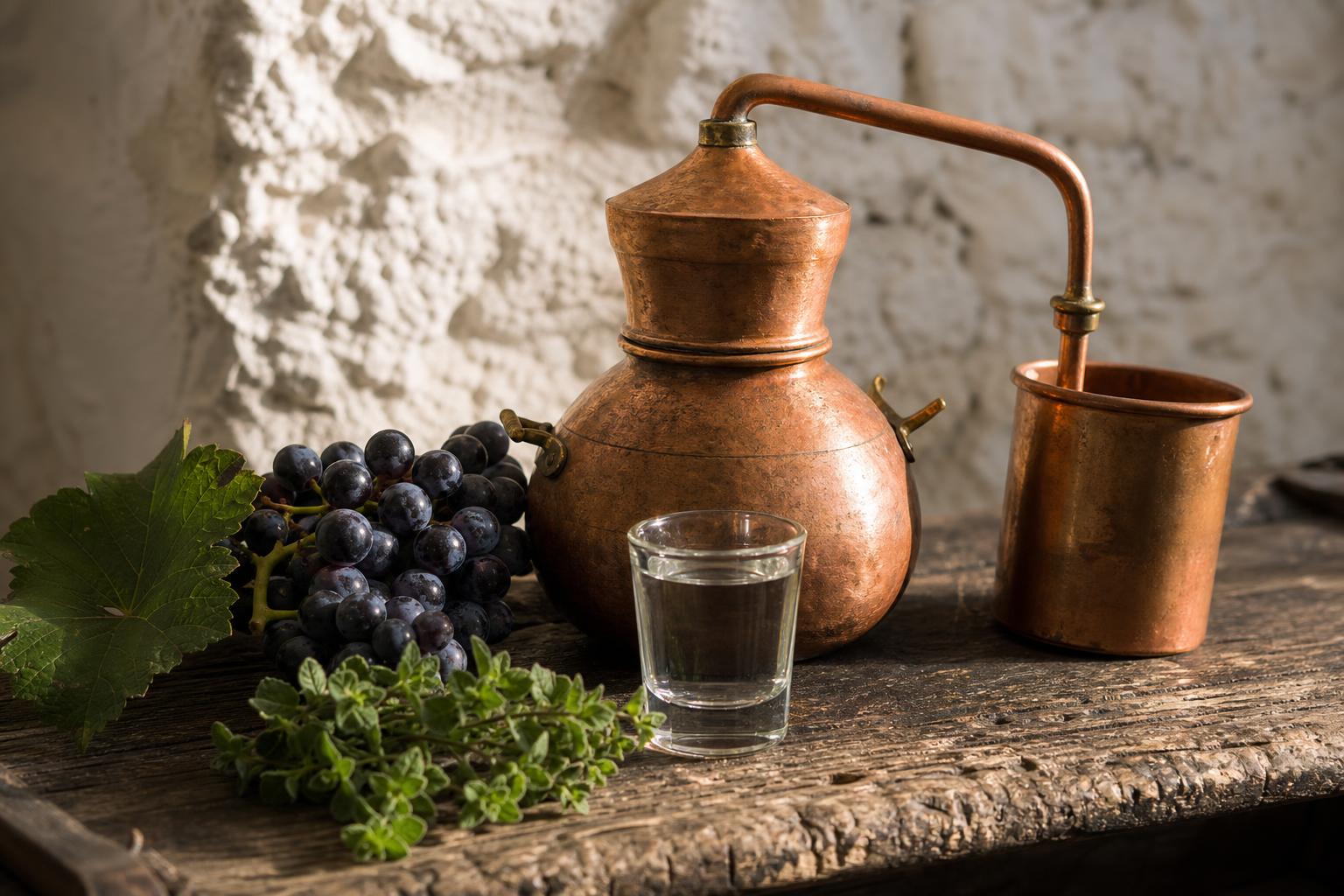
The bottle on the table
Walk into an Albanian home in Queens, Hamtramck, Worcester, or anywhere the diaspora has put down roots, and there is a good chance a bottle of raki is somewhere in the kitchen. Maybe it was carried back from Tirana in a checked bag. Maybe a cousin in Skrapar sent it. Maybe it was bought at the Albanian grocery on the corner and re-poured into an old olive-oil bottle so it looks the part.
That bottle is the most quietly important object in the room.
Raki — Albanian fruit brandy — is the country’s national spirit, but the word “spirit” understates the job it does. Raki is the way an Albanian household says welcome. It is poured for guests before they sit down. It is set on the table at weddings and funerals and the holiday meals in between. It is offered to the workman who came to fix the boiler and refused, with a smile, three times before being talked into “just a sip.” Refusing entirely is unusual. Insisting once or twice is the dance.
This guide is for Albanian Americans who grew up around that bottle and want to understand it better, and for non-Albanians who searched “Albanian raki” and ended up here. We will walk through what raki is, what it is made from, how the regional traditions differ, where to find it in the US, and how to drink it without embarrassing yourself or your host.
A note up front: this is a cultural guide, not a recipe. Distilling alcohol at home in the United States without a federal permit is a felony, and that is not a path NAR endorses. The “how it’s made” sections that follow describe the tradition as it is practiced in Albania, where home distillation is legal and common. Read it as heritage, not instructions.
What raki is
Raki is a clear, distilled spirit made from fermented fruit. In Albania it is the national fruit brandy, sitting in the same broader family as Serbian šljivovica, Bulgarian rakia, Greek tsipouro, Romanian țuică, and Italian grappa. Across the Balkans the umbrella term is rakia; the Albanian name is raki (singular and plural).
It is not vodka — vodka is grain or potato spirit, and is usually filtered to neutrality. It is not whiskey — there is no aging in charred oak (most raki is unaged or only briefly rested). It is not Turkish rakı (with the dotless ı) either — that is a separately styled, anise-flavored grape spirit that turns cloudy when water is added. Albanian raki has no anise, no licorice character, and stays clear. The names share a root in the Arabic araq, but the drinks parted ways centuries ago.
Commercial Albanian raki typically lands between 40 and 50 percent alcohol by volume (ABV), with 45 percent being the most common bottling strength. Homemade village raki — the bottle your aunt’s neighbor brings to the engagement party — is frequently stronger, sometimes pushing 55 or even 60 percent ABV. The Wikipedia entry for rakia puts home-produced Balkan rakia at an even wider range — typically 50 to 80 percent ABV — which shows just how strong an unregulated village batch can get.
You can also classify raki by clarity and color. Most is bottled clear. Some producers infuse it with herbs, walnut shells, or honey after distillation, producing a darker, sweeter sipping raki sometimes called raki me arra (raki with walnuts) or raki me mjaltë (with honey). These are not the everyday pour; they are end-of-meal or special-occasion bottlings.
What raki is made from
The base fruit is what most defines a raki. In Albania, three are dominant.
Grapes are the most common. Raki rrushi — grape raki — is the default, the workhorse, the thing people mean when they say “a glass of raki” without qualifying. Southern Albania, with its long warm growing season around Berat, Skrapar, and Përmet, produces the most celebrated grape rakis in the country.
Plums make raki kumbull — plum raki — most associated with northern Albania and the highlands. The plum gives a softer, slightly sweeter character than grape, and is closer in family to Serbian šljivovica and Bosnian plum brandies.
Mulberries make raki mani — mulberry raki — a regional specialty, particularly identified with Përmet and parts of the south. White and black mulberries each yield a distinct flavor; mulberry raki is often the smoothest and most aromatic of the three, and bottles fetch higher prices in shops.
Other fruits appear in smaller volumes. Raki kajsie (apricot), raki ftua (quince), raki fiku (fig), and walnut-infused styles all exist, though they are family or regional traditions rather than national defaults. Some northern households also make a corn-based moonshine sometimes loosely called raki, but purists distinguish that from true fruit raki.
The fruit itself is the entire flavor of the finished spirit. There is no malt, no spice, no oak. Whatever you taste in a glass of raki — the grape, the plum, the mulberry — was in the orchard six months ago.
How raki is made (the cultural process)
Raki-making is one of the most stubbornly persistent traditions in Albanian rural life. The pattern is the same across most of the country, with regional variations on equipment and aging.
Late summer and early fall, the fruit is harvested at peak ripeness — for grape raki, that means after the wine grapes are pressed; the leftover pomace (skins, stems, seeds) is often what gets fermented for raki, the same logic behind Italian grappa. For higher-end rakis, whole fresh grapes are used instead of pomace.
The fruit is crushed and left to ferment for several weeks in large open barrels or sealed plastic drums. No yeast is added in the traditional method — wild yeasts on the fruit’s skin do the work. Once fermentation finishes, the resulting low-alcohol mash is ready for distillation.
Distillation happens in a copper still — the kazan — heated with wood. The first vapors that come off the still (the “heads”) are discarded, because they contain methanol and other harmful volatiles. The middle portion (the “hearts”) becomes the raki. The last vapors (the “tails”) are either discarded or saved to redistill in the next batch. A skilled distiller knows where to make those cuts by smell, taste, and experience. A bad cut produces raki that is harsh, headache-inducing, or unsafe; a good cut produces raki that is clean, warm, and lingering.
The finished spirit is rested for at least a few weeks before drinking — sometimes months, in glass demijohns or oak — and then poured into bottles, jars, or whatever the household uses.
This is a description, not a how-to. Home distillation is legal in much of Albania and tightly regulated or illegal in most of the United States. Federal law requires a Distilled Spirits Plant (DSP) permit from the Alcohol and Tobacco Tax and Trade Bureau (TTB) before producing distilled spirits, and unlicensed distillation is a federal crime regardless of how it has been done in your village for four hundred years. If you want to make raki in the US, the lawful path is licensure or a small-scale craft distillery partnership.
Raki and Albanian hospitality
There is a saying that in Albania, a guest is sacred. The code that governs this — besa (the Albanian word of honor), and the broader hospitality tradition codified in older texts like the Kanun — turns the household into something closer to a temporary embassy when a guest arrives. The host’s job is protection, food, and company. Raki is the opening move.
A small glass — usually 25 to 50 milliliters — is poured and offered before the guest is even fully seated. It is accompanied, classically, by llokum (Turkish-style soft candy), figs, walnuts, or a piece of bread. The toast is gëzuar — “cheers,” literally closer to “may you be made joyful.” Eye contact is not optional. You raise the glass, you meet the eyes of every person at the table, you sip. You do not slam.
The role of raki widens out from there. At weddings, the bride’s and groom’s families exchange bottles. At engagements (fejesa) the men of both families share rakis as part of the formal agreement. At funerals (morti) and the 40-day commemorations after, raki is poured for those who came to pay respects. At Easter and Christmas tables, on Bajram, on Independence Day, on a Tuesday because a cousin you have not seen in a year happens to walk in — raki is on the table.
There is also, in many older Albanian households, a morning tradition: a small glass of raki with the first coffee of the day. A handful of villages still treat this as routine. Most diaspora families treat it as something a grandfather did, a memory more than a habit. We mention it because it is part of the cultural picture, not as a recommendation. NAR makes no health claims about raki — the folklore that calls it medicinal, digestive, or germ-killing is folklore, and we leave it there.
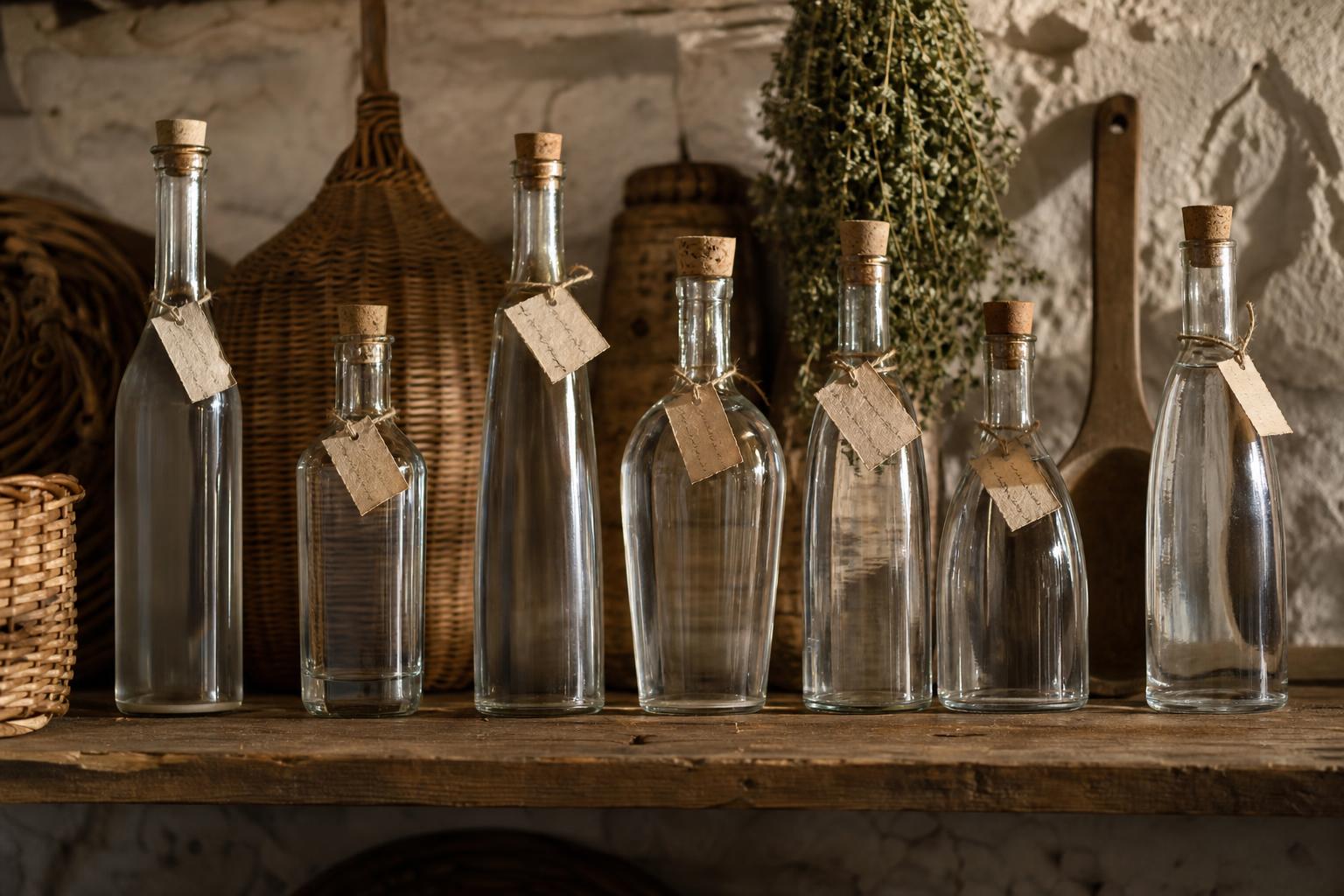
Regional variations: north and south
Albania is a small country with strong regional identities, and raki is one of the clearest expressions of that. A few names worth knowing.
Skrapari (southern Albania, Berat region) — the most famous grape raki in the country. Raki Skrapari is the bottle most likely to be on a serious Albanian table, and the one most often exported to the US. It is clean, dry, and confident. Locals will compare it to fine cognac and they are not entirely joking.
Përmet (south, Vjosa River valley) — known above all for mulberry raki (raki mani), prized for its smoothness. Përmeti is also a recognized grape-raki region. The two are often discussed together.
Berat (south-central) — produces well-regarded grape rakis; the surrounding vineyards supply much of the regional output.
Korçë (southeast, near the Greek border) — a plum-raki region (raki kumbulle), known for a cleaner, lighter style than the southern grape producers.
Northern Albania — Tropojë, Mirditë, the Dukagjin highlands, and the area around Shkodër lean toward plum raki, with mulberry and corn-based variants in pockets. Northern raki is often higher-proof and more rustic in style. Raki kumbull from the highlands is a distinctive northern signature.
Kosovo and Albanian-majority North Macedonia also have strong raki traditions, generally closer to the northern-Albanian style — plum-forward, high-proof, family-distilled. Kosovar raki is part of the same cultural family and is sometimes labeled rakia in stores influenced by neighboring Slavic naming.
These are starting points, not strict borders. Every village has its own producer. Every family has an opinion about whose raki is best, and that opinion is usually wrong if you ask the next village.
Where to find Albanian raki in the US
Imported Albanian raki is a small but real category in the US market, especially in states with concentrated Albanian populations.
Skrapari is the most widely distributed Albanian-labeled raki in the US. It is available at Albanian groceries and liquor stores in metro New York, northern New Jersey, southeast Michigan (especially around Detroit and Hamtramck), greater Boston, parts of Connecticut, and the Bronx. It is also stocked in some specialty Balkan and European liquor stores in cities with smaller Albanian communities. Pricing varies by state and retailer, generally in line with other imported specialty spirits.
Other Albanian-labeled brands appear in smaller distribution. The market shifts year to year as importers add or drop SKUs. If you cannot find a specific brand at your local store, ask the owner — most Albanian-American grocery and liquor store owners can order through their distributor with a few weeks of lead time.
State alcohol laws vary. In control states (Pennsylvania, Utah, North Carolina, and others) Albanian raki may not be on the standard list, and you will need to either special-order through the state board or buy when you travel. In open-market states like New York, New Jersey, and Michigan, the selection is broader.
A practical note for the diaspora: do not drink unlabeled raki of unknown provenance. Methanol contamination from poorly-distilled batches is a real risk, and it has caused poisonings in the Balkans within recent years. Bottles from a licensed producer with a label you can read are the safe path.
Raki versus other Balkan spirits
The Balkans produce a wide family of fruit brandies, and Albanian raki sits inside that family. Knowing the cousins helps.
Serbian and Bosnian šljivovica — plum brandy, the national spirit of Serbia. Strong, plum-forward, often aged briefly in oak. Closely related to northern-Albanian plum raki.
Bulgarian and North Macedonian rakija / rakia — same root word, often grape-based in the south, plum-based in the north. The Bulgarian style is sometimes lower-proof and slightly aromatic.
Greek tsipouro and Cretan tsikoudia — pomace-based grape spirits, broadly similar to Italian grappa. Tsipouro is occasionally flavored with anise (then called tsipouro me glykaniso), at which point it crosses into ouzo territory.
Turkish rakı (dotless ı) — distilled grape spirit redistilled with anise. Cloudy when water is added (the “lion’s milk” effect). Cousin in name only; very different drink in the glass.
Italian grappa — pomace-based grape brandy from northern Italy. Closest Western European cousin to Albanian raki rrushi, especially the pomace-based versions.
Romanian țuică and Hungarian pálinka — fruit brandies in the same broader family, with their own legal definitions and regional fruit traditions.
These are cousins, not competitors. None is “the original.” The fruit-brandy tradition predates modern borders, and every country in the region has a legitimate, distinct version.
Raki etiquette
A short field guide for the table.
Sip, do not shoot. Raki is sipped from a small glass. Treating it like a tequila shot will offend the host and ruin your night. The pace is conversational — one small glass over the course of a meze course or a half hour of conversation.
The toast is gëzuar. Said with eye contact, glasses raised, ideally with a small clink. Some Albanian households add specific toasts for specific occasions: për familjen (to family), për shëndetin (to your health), për ata që mungojnë (to those who are missing). The first sip follows the toast.
Refusing politely. It is acceptable to refuse a second or third pour, especially if you are driving or do not drink. The phrase is jo, faleminderit — “no, thank you.” A good host will not press past two refusals. If you do not drink at all, saying so up front is fine and respected.
Do not pour your own. In a traditional setting, the host or the eldest at the table pours. Reaching for the bottle yourself is not catastrophic, but it skips a small ritual.
Pace it. Village raki at 55 percent ABV is not table wine. A glass and a half of strong raki on an empty stomach can take you out of the evening. Eat first, sip alongside, and stop when you have had enough.
Compliment the raki, not just the host. If the raki is homemade, asking who made it and where they are from is the right move. People are proud of their raki for a reason. Ask.
Why this matters for the diaspora
Every Albanian American family carries a piece of this tradition into the US, and every generation of the diaspora has to decide what to do with it. First-generation parents brought the bottle. Second-generation kids saw it on every holiday table without always knowing why. Third-generation kids may have to learn the story from a search engine.
The tradition does not require a permit, an apostille, or a flight. It requires a bottle, a small glass, and someone to say gëzuar with. The hardest part is showing up at the same table. That is also the easy part.
The count and the table
The National Albanian Registry exists for the same reason raki is poured for a guest — because being counted, being welcomed, and being remembered are the same kind of act. The US Census records about 230,000 Albanian Americans (2024 ACS, B04006). The community estimate, including ethnic Albanians from Kosovo, North Macedonia, Montenegro, and Çamëria, plus second- and third-generation Albanian Americans, is closer to a million. We are building a community-led count to close that gap.
Raki belongs at the table. So does being counted.
Sources: Rakia — Wikipedia, Albanian cuisine — Wikipedia, Alcohol and Tobacco Tax and Trade Bureau — Distilled Spirits, regional producer information from Skrapari and Përmet labels available in US distribution. This article is general cultural information for adult readers (21+ in the US). It is not a recipe, not medical advice, and not an endorsement of unlicensed home distillation.