
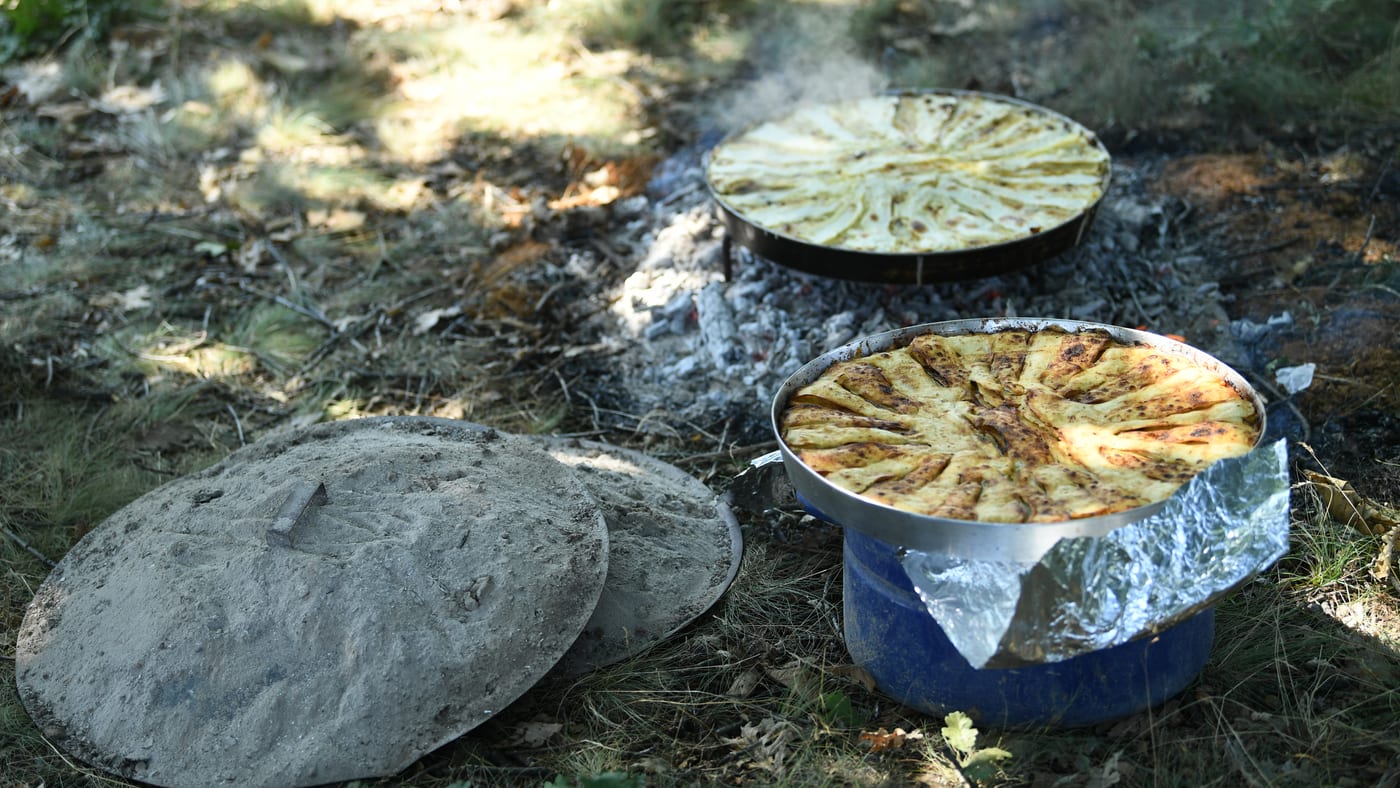
Flija is the most labor-intensive dish on the Albanian table. It is built from eight to fifteen paper-thin layers of plain batter, each one cooked individually under a saç — a domed iron lid heated by piling glowing embers over the top — and brushed between layers with butter and kos (Albanian-style yogurt). The finished dish is an accordion-like cake of thin pancakes glued together with cream and butter, sliced into wedges and served warm.
It comes from the malësi (highlands) — the mountainous spine that runs through northern Albania, Kosovo, and Montenegro. Flija is celebration food in those regions: weddings, Bajram, Christmas, the darka meals that mark a milestone. Making one is its own event. A traditional flija takes three to four hours, often a multi-person effort, and the cook moves between the fire, the batter bowl, and the saç for the entire run.
This piece covers what flija is, how the saç method works, the oven adaptation that diaspora kitchens use, the recipe at home-kitchen scale, and the regional variations that travel under the same name.
What Flija Is
Flija is a layered pancake. Structurally that is the whole description: eight to fifteen thin layers of cooked batter, each separated by butter or a butter-and-yogurt mix, stacked into a single round cake and cut into wedges.
The batter is intentionally simple. Plain all-purpose flour, cold water, and salt — whisked smooth, rested for half an hour, and used unleavened. The traditional version contains no eggs, no yeast, no sugar, and no milk. Salt and flour and water are the whole batter. The flavor comes from the butter and yogurt that go between the layers, and from the wood smoke if a saç is involved.
The “glue” is melted butter, sometimes blended with kos. Brushed on the surface of each cooked layer, the butter both flavors the layer and lets the next layer of batter spread evenly across it. As the layers stack, the butter saturates downward; by the end, the bottom layers are dense and rich, the middle layers tender, and the top layer crisp where the embers or broiler hit it last.
Flija sits in its own category among Albanian baked goods. It is not byrek — byrek is filo and filling baked once. Flija has no filling, and its layers are individually cooked rather than assembled raw and baked together. It is also not the same dish as Bosnian or Kosovar palačinke — those are thin pancakes served stacked or rolled, not embedded into one cake. The closest culinary cousin in the Western tradition is the French mille-crêpes — a layered crepe cake — but flija is built with the saç-and-ember method instead of pan cooking, which gives it a different texture and a wood-smoke note that mille-crêpes never carries.
The cut on the table tells you which dish you are eating. Byrek cuts into wedges or squares with crisp filo edges. Flija cuts into wedges with visible horizontal striations — a topographic cross-section of the layers, like the rings of a tree, but folded.
The Saç Method
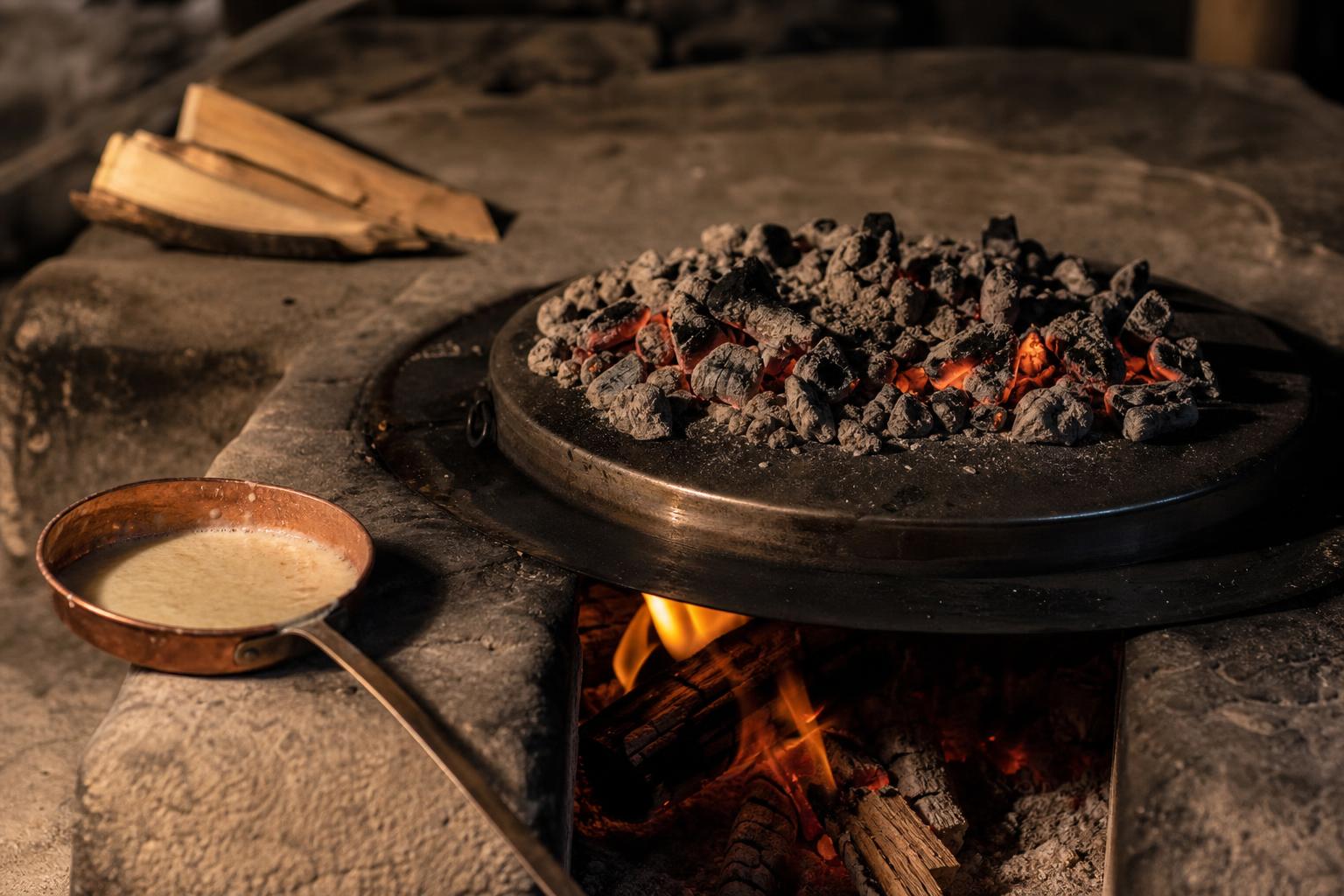
The saç is the historical technology behind flija, and the dish exists because the saç exists. Before electric ovens reached the highlands, the saç was how mountain households did anything that needed sustained, even radiant heat from above. It is a heavy iron or steel dome, sized to the pan it covers, set over a low round pan. The cook builds a wood fire on the hearth, and once the fire has burned down to a bed of glowing embers, the saç gets piled with embers and hot ash on top.
To make flija with a saç, the cook brushes a thin layer of batter into the pan, covers the pan with the heated saç, and waits a minute or two for the layer to set. Then she lifts the saç — using a long iron hook because the dome is hot enough to burn through anything else — brushes the cooked layer with butter, and pours the next layer of batter directly over the buttered surface. The saç goes back on. The embers, which have started to cool, get pushed back into the fire to reheat while a fresh batch is shoveled onto the dome.
The pan stays in one place for the entire two to four hours. The saç and the embers move. The cook moves. A skilled highland flija cook is a small choreography of fire-tending, batter-mixing, embers-rotating, and butter-brushing — usually with a second person handling the fire while the first handles the batter and the saç.
The result is uneven, organic, and unmistakably hand-made. The top layer carries faint scorch marks from the embers; the bottom is dense and golden from the pan; the layers in between alternate tender and crisp depending on how hot the saç was when each one cooked. A wood-fired smoke note runs through the whole thing — the closest thing in industrial cooking is the smoke a wood-burning pizza oven leaves on a Neapolitan pie.
The Modern Oven Adaptation
Most diaspora kitchens do not have a saç. The American oven does, however, have a broiler — a heating element at the top of the cavity that produces direct radiant heat. That is the same physics the saç uses. The broiler is not as forgiving as embers (it gets too hot too fast and can scorch), but with a heavy oven-safe pan and the rack positioned correctly, it produces a flija with the same layered structure.
The technique is identical in principle. Brush a layer of batter into the pan. Slide the pan under the broiler. Wait until the layer is set and lightly speckled — usually one to two minutes. Pull the pan out. Brush the cooked layer with butter (or with the butter-yogurt kos mixture, depending on the variant). Pour the next layer of batter, tilt to spread, and slide back under the broiler. Repeat eight to fifteen times.
What is lost is the wood-smoke note. What is gained is precision and pacing — the broiler is consistent, the layers cook evenly, and the cook is not also tending a fire. A diaspora flija made in a broiler is structurally faithful and tastes recognizably like the dish. It is not identical to a highland flija cooked under embers, and a grandmother who grew up watching her mother make flija on a saç will probably tell you that. Both versions are real.
The Recipe (Oven Version)
This is the home-kitchen, oven-broiler version. It yields a 12-inch round, serves 8 to 10, and takes about two hours of active time.
Ingredients
For the batter:
- 3 cups (375g) all-purpose flour
- 4 cups (1L) cold water
- 2 tsp kosher salt
For the glue:
- 1 cup (225g) unsalted butter, melted
- Optional, for the kos variant: ½ cup (120ml) plain whole-milk yogurt
A note on the batter: the proportion of water to flour is high — much higher than a normal pancake batter. Flija layers are meant to be paper-thin, almost a glaze rather than a pancake. The batter should pour like heavy cream, not like American pancake batter.
A note on the yogurt: whole-milk plain yogurt is what works. Greek-strained yogurt is fine; thin yogurt is fine; flavored yogurt is not. The kos variant gives the layers a slightly tangy note and a softer texture between layers.
Equipment
- A 12-inch round oven-safe pan, at least 1.5 inches deep (cast iron or enameled cast iron is best)
- A pastry brush
- A heatproof spatula
- A whisk
- A large bowl
Steps
Step 1 — Mix and rest the batter (35 minutes)
Whisk the flour, water, and salt in a large bowl until completely smooth, with no lumps. Cover the bowl and let it rest at room temperature for 30 minutes. Resting hydrates the flour fully, which is what produces the paper-thin spread when you pour the batter into the pan.
Step 2 — Preheat the broiler (5 minutes)
Position an oven rack 4 to 6 inches below the broiler element. Set the broiler to high. Brush the 12-inch pan with melted butter, including the sides.
Step 3 — Cook the first layer (2 minutes)
Pour ½ cup of batter into the pan and immediately tilt the pan to spread the batter in a thin, even sheet. The layer should be very thin — almost translucent in spots. Slide the pan under the broiler.
Watch through the oven window. After 1 to 2 minutes, the layer should be just set, with light brown speckles starting to appear. Do not let it brown deeply — that comes at the end.
Step 4 — Brush and add the next layer (1 minute)
Pull the pan out. Working quickly, brush the cooked layer with melted butter — a thin, even coat, not a flood. If you are doing the kos variant, alternate: butter on odd layers, butter-and-yogurt on even layers (whisk ½ cup yogurt into ½ cup of the melted butter).
Pour another ½ cup of batter directly over the buttered surface and tilt to spread.
Step 5 — Repeat (1.5 to 2 hours)
Slide back under the broiler. After 1 to 2 minutes, pull, brush, pour. Repeat until all the batter is used — 8 to 15 layers depending on how thinly you spread.
The pan will get hotter as the layers stack. After about layer six, the cook time drops to closer to one minute — watch the broiler more carefully, not less.
Step 6 — Finish the top (3 minutes)
After the final layer of batter is cooked and brushed, return the pan to the broiler for 2 to 3 minutes. The top should turn deep gold and slightly crisp. This finish is what gives flija its signature contrast — a crackly top, tender layers underneath.
Step 7 — Rest, then slice (15 minutes)
Pull the pan and let it rest 15 minutes on the counter. Resting lets the butter set into the layers; cutting too soon causes the wedges to slump.
After resting, slice into 8 to 10 wedges. Serve warm.
Critical-Path Notes
- Watch the broiler. Every broiler is different. Test the first layer carefully and adjust rack height if it scorches.
- Thin batter. If your batter spreads slowly, add a few tablespoons of water. Flija layers are paper-thin — heavy layers do not stack right.
- Butter every layer. Skipping the butter brush even once causes the layers above and below to fuse into a single pancake. The butter is structural, not just flavor.
- Patience is the recipe. Flija is not fast. The two-hour run is what produces the dish. Rushing the layers — pulling them too soon, brushing too lightly — produces a pancake, not a flija.
Serving and What Flija Means
Flija is served warm, sliced into wedges, with bowls of accompaniments on the table for guests to spoon over their portion. The traditional accompaniments are kos (plain whole-milk yogurt, served cold), honey, and sometimes fresh cream. The combination of warm buttered layers and cold tangy yogurt is the point: rich and sour at once, with the honey adding sweetness for those who want it.
In highland Albania, Kosovo, and Montenegro, flija anchors the celebration table. Weddings, Bajram (Eid), Christmas, baptisms, and major birthdays are the days flija shows up. Smaller gatherings get byrek or tavë kosi; the day someone breaks out the saç and starts mixing batter is a day that is supposed to be remembered.
In the diaspora, flija is rarer because the technology is rarer. Some Albanian-American families have a saç that traveled with them or was sent later by relatives. Others use the broiler. Either way, flija tends to mark the same kind of day in the US that it marks in the highlands — a wedding, a major holiday, the kind of family gathering where someone’s grandmother is the centerpiece of the kitchen.
Flija’s weight in the highlands doesn’t come from a certificate. It is a technique, a tradition, and a communal practice — the multi-person preparation, the slow build of layers, the gathering around the saç. That is what gets passed down, formal recognition or not.
Variations and Regional Differences
Like every traditional Albanian dish, flija varies by region. The variations are a map of the highlands.
- Tropojë (northern Albania). Thicker layers, butter-only glue, no yogurt. A denser, richer flija. Tropojë cooks tend toward maximum butter — the flija there is built for cold mountain days.
- Kosovo. Thinner layers, more kos in the glue, sometimes with cream. The Kosovar flija is lighter and tangier. It is also the version most likely to be served with extra yogurt on the side.
- Montenegro highlanders. Albanian communities in the Malësia of Montenegro also make flija, as part of the same highland food culture. The plis (the white felt cap that is one of the visual markers of highland Albanian identity) and the flija tend to travel together — both are markers of the same regional culture.
- Modern diaspora. Oven-baked, sometimes with whole milk substituted for part of the water in the batter, occasionally with an egg added. The diaspora versions are looser; the technique adapts to whatever the kitchen has. The core — many thin layers, butter between, hot radiant heat — survives.
None of these is the “real” flija. All of them are. The dish is wide enough to hold its variations.
Tips From the Highlands
A few things highland cooks know that take a few tries to learn at home.
The saç is the real secret. There is no perfect substitute. If a household in the diaspora cares deeply about flija, ordering a custom saç from a blacksmith in Albania is a real option — several US-based families have done it, and the cost is in the low hundreds of dollars including shipping. Some Albanian community organizations in the US have a shared saç that families borrow for major occasions.
Patience is the actual recipe. The two-hour run cannot be compressed. Layers cooked too fast under too much heat scorch on top and stay raw underneath. Layers cooked too slow under too little heat fail to set and slide off when the next one goes on. The middle path — the right heat, the right pace, the right thickness — is what experience teaches.
Cook with someone. Highland flija is almost never made alone. One person tends the fire and rotates the embers; another handles the batter and the saç. The diaspora oven version can be made solo, but it is also a good dish for two people working together — the layers stack faster and the rhythm is steadier with two sets of hands.
Honor the dish. Flija is a celebration food, and it is meant to be eaten in company. A flija made for a Tuesday dinner is technically possible but misses the point. Make it for the Sunday family lunch, the holiday table, the birthday, the wedding shower. Then it tastes the way it is supposed to taste.
A Note on Survival
Flija is one of the recipes that lives or dies generation by generation in the Albanian diaspora. The grandmothers who learned to manage a saç outdoors are not getting younger, and the technique does not transfer through cookbooks alone — it transfers through afternoons spent next to someone who already knows. Writing the numbers down is part of how the dish survives. Teaching the technique to whoever is in the kitchen the next time the family gathers is the other part.
If you want to be counted in a community-led count of Albanian Americans, register with NAR. It takes a minute. Free, neutral, your data stays yours. Counting ourselves is one of the ways the diaspora keeps its shape — alongside the recipes that get cooked and the saç that gets passed down.