The certificate
Your commemorative Certificate of Albanian Identity, in plain English.
A symbolic keepsake. Permanent, numbered, signed.
Every registrant gets one — free, instant, yours forever. Below: exactly what it is, exactly what it isn't, and how a stranger can verify it without our servers running.
What's on it
Seven things, all included.
- 1.Your name — set in Playfair Display, centered, the size you'd expect on a commemorative document.
- 2.A unique registration number (e.g., #00042). Sequential. Yours forever. The Founding 100 wall only goes up to #100 — first hundred registrants by number.
- 3.Issue date — the day you joined the count.
- 4.A QR code in the corner that opens the public verification page for your specific certificate.
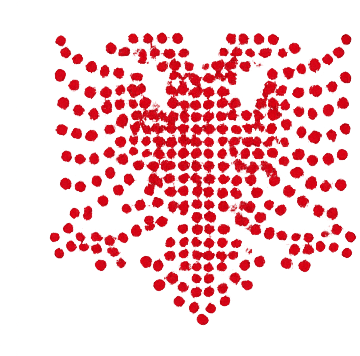
- 5.The NAR seal — gold, centered, struck with the double-headed eagle.
- 6.Bilingual frame — English and Albanian throughout. Certifikatë e Identitetit Shqiptar.
- 7.PNG and PDF delivery — PNG for sharing, framing, and social; PDF for printing. Email arrives within seconds of registration.
Scope
What it does, and what it doesn't.
The whole point is that you said it, we recorded it, and anyone can check.
It can
- ·Commemorate publicly that you self-identified as Albanian — with a date, a number, and a signature.
- ·Hang on a wall. Get framed. Sit in your wallet. Live on your fridge.
- ·Be shared on social to mark that you're in the count.
- ·Be checked against NAR's signature by anyone, anywhere, by scanning the QR — even if NAR's servers are down.
- ·Be reissued (with the same number) if you ever change your name.
It can't
- ·Get you an Albanian passport — that's a separate process at the consulate (we have a guide).
- ·Serve as government ID — not a driver's license, not a US ID, not a voter ID. It is not a legal identity document.
- ·Confer citizenship — Albanian or otherwise. Citizenship by descent is a separate consular process under Law 113/2020.
- ·Replace any consular document — birth certificate, ID card, family certificate.
- ·Be used to claim benefits, prove residence, or affect your tax/immigration status.
- ·Replace the U.S. Census — the Census Bureau's ACS is the official federal count and stays essential. NAR is a parallel community count, not a substitute. Complete the ACS when it arrives.
It is a commemorative keepsake. Nothing more, nothing less.
Independent verification
How a stranger checks it.
The QR on every certificate links to albanianregistry.org/verify/<number>. That page re-runs the cryptographic check on every visit and shows one of four states: verified, unsigned, invalid, not found.
- 1 Sign at issue. Every certificate is bound to a W3C Verifiable Credential using an Ed25519 key the moment you register. The credential includes your registration number, name, issue date, and a SHA-256 hash of the certificate image.
- 2 Public DID document. Our public verification key is published at /.well-known/did.json as a did:web identifier. Anyone — including future you, with no help from us — can fetch it.
- 3 Scan, fetch, verify. Stranger scans the QR. Verify page fetches the credential, checks the signature against the public key, confirms the image hash matches. No human in the loop. Takes ~200ms. Try one: verify certificate #00001 →
- 4 Survives us. The math doesn't depend on NAR being around. Any third party with the public key file can verify any certificate we ever issued, forever. If the 501(c)(3) ever winds down, your cert keeps working — guaranteed by Article VIII.
Want the receipts? DID document · Data handling · The signing code is in src/lib/vc.ts; pure node:crypto, zero third-party deps.
Be counted today
It takes 2 minutes.
The certificate is yours.
Register, get your number, get your certificate. The first 100 names go on the Founding 100 wall, forever.
Be counted →Questions? Reach the team →