

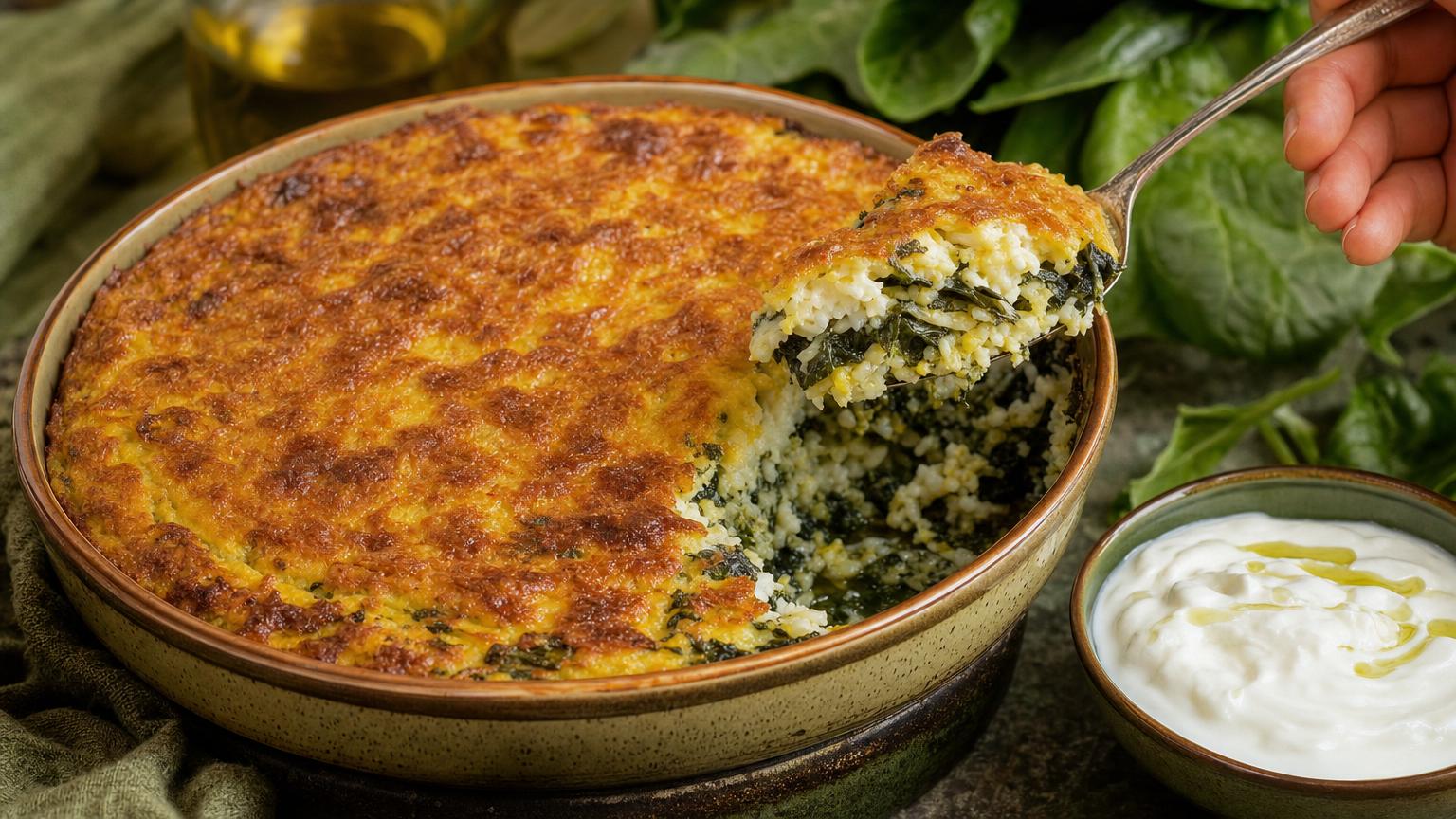
Burani is the Albanian baked dish of spinach, rice, and eggs — sometimes bound with yogurt, sometimes finished with poached eggs nested into the surface, almost always served from the pan it was baked in. It belongs to the same family as Persian borani and Turkish borani, but the Albanian version has its own logic: greens-first, rice as the body, eggs as the bind, olive oil as the fat.
It is a quieter dish than tavë kosi or byrek. It rarely shows up on restaurant menus. It shows up at family lunches, at Lenten tables, on weeknights when the spinach in the fridge needs to be used. That is exactly why it matters — burani is the kind of recipe that survives household-to-household, not chef-to-chef, and the kind that disappears most quickly when no one writes it down.
This piece covers what burani is, where the name comes from, the regional variations across Albania and Kosovo, the cultural moments it anchors, and the traditional recipe at home-kitchen scale with US-supermarket ingredients.
What Burani Is
Burani is a baked casserole built around three components: rice, greens, and eggs. The rice goes in first, parboiled in seasoned water or broth so it has cooked through but is not yet soft. Wilted spinach — squeezed hard to release water — is folded through the rice with herbs and a generous pour of olive oil. Beaten eggs (often whisked with yogurt) are poured over the top, and the whole pan goes into a moderate oven until the top sets golden and the eggs hold the dish together when sliced.
Two construction styles dominate. In the baked version, the eggs are whisked into the rice or poured over as a custard topping; the result cuts into wedges or squares. In the poached version, the rice-and-spinach mixture is loaded into a deep pan and four to six wells are pressed into the surface; whole eggs are cracked into the wells and the pan goes into the oven (or stays on the stovetop under a lid) until the whites set and the yolks stay soft. Both are correct. The baked version is more common at gatherings; the poached version is more common at family dinner for four.
The flavor profile sits in the southern-Albanian register: bright greens, plenty of olive oil, fresh dill or parsley, the soft tang of yogurt when used, salt that brings the spinach forward. There is no heavy cheese, no béchamel, no roux. Burani is a structural dish, not a rich one.
A note on naming. The standard spelling is burani. Some Kosovar and Çam families use buranija — the -ija ending is a regional softening, not a different dish. The same recipe answers to both names.
Origins and Etymology
The name traces a long road. Burani is a borrowing from Persian būrānī, a generic term for a category of dishes prepared with cooked vegetables and yogurt. The Encyclopaedia Iranica traces the word to Pūrān (also Būrān), the daughter of the Abbasid official Ḥasan b. Sahl and wife of the Abbasid caliph al-Maʾmūn in the 9th century. Court chefs created yogurt-and-vegetable dishes in her honor; the dishes carried her name forward.
An older theory roots the word in Būrāndoḵt, the Sasanian queen who ruled briefly in 630–631. Either way, the word is Persian, the dish is Persian in origin, and the technique — cooked vegetable plus yogurt — is the through-line that survived a thousand years of borrowing.
The word traveled into Ottoman cuisine, where borani became a category of yogurt-vegetable dishes (the spinach version is still called ıspanak boranisi on Turkish tables today). From the Ottoman Empire the word and the technique entered the Balkan kitchens — Albanian, Bosnian, Bulgarian, North Macedonian — and each language localized the spelling and the recipe.
The Albanian version drifted from the Persian original in two important ways. Albanian cooks added rice as a base, which the Persian dish does not have, and they made the dish bake-able as a single pan rather than serving it as a yogurt salad or dip (the Persian borani is closer to a Greek tzatziki in form). The result is structurally a casserole, etymologically a Persian word, and culturally an Albanian household staple.
Regional Variations
Albanian burani is not one recipe. The country splits broadly between south (Tosk) and north (Gheg), and the burani tradition splits with it.
Eastern Albania (Korçë and surroundings). Home cooks here make a rice-and-spinach burani finished either with a yogurt-egg topping poured over the top or with whole eggs cracked into wells and baked until the whites set. Two widely shared home recipes — Mediterranean Latin Love Affair and My Albanian Food — use dill, parsley, or basil and the poached-egg finish; neither ties the dish specifically to Korçë.
Southern Albania (Gjirokastër, Berat, Çamëria). Here the burani trends lighter — more olive oil, more herbs (dill, parsley, mint), often without yogurt, sometimes with leeks (presh) or wild greens (lakra) substituted for the spinach. Çam Albanians (originally from northwestern Greece) brought their own variant west when they were displaced in the mid-20th century, and the buranija spelling is more common in Çam households.
Northern Albania (Shkodër and the highlands). The northern table runs heavier, and the burani follows. Northern versions sometimes add ground meat, use butter alongside oil, and lean on cheese (gjizë, Albanian whey cheese) to bind. The dish edges toward a rice-and-meat jufka or pilaf in the north — still recognizable as burani, but with more body.
Kosovo (Prishtina, Gjakova, Prizren). The Kosovar version most often includes meat — burani me mish, with ground beef or veal cooked into the spinach — and is often served as a one-pan family meal rather than a side. The poached-egg finish is very common in Kosovo. The FRICOT Europe entry on the dish documents this version explicitly.
Arbëresh (Italian Albanian). The Arbëresh communities of southern Italy preserve a 15th-century Albanian foodway and have their own greens-and-rice traditions, often with locally available chard or wild greens, ricotta, and olive oil. The dish may carry an Italianized name in those villages, but the layering logic and the spinach-rice-egg structure trace back to the same source.
North Macedonia and Montenegro. Albanian communities in Tetovo, Gostivar, Ulqin, and the Plav-Gusinje belt cook recognizably Albanian burani with local twists — sometimes with cornmeal added to the rice, sometimes with a different herb mix.
The diaspora muddies these lines. A Kosovar grandmother in Yonkers and a Tosk grandmother in Worcester end up shopping at the same supermarkets and using the same chopped frozen spinach, and the regional tells get fainter with each generation.
The Cultural Anchor
Burani sits in a particular slot on the Albanian table. It is not the holiday centerpiece (that is byrek or roast lamb). It is not the Sunday-lunch showpiece (that is tavë kosi). It is the workhorse — the dish that goes on the table for darka (the long evening meal), for a Friday lunch when the family wants something light, for the Lenten table when meat is off the menu.
In Orthodox households across southern Albania, burani is one of the most-cooked dishes during the Great Fast and the other major fasting periods. Spinach, rice, olive oil, and eggs (when the fast permits) sit comfortably inside the rules. The same logic applies in Catholic Arbëresh villages and in the Bektashi tradition, where lighter, vegetable-forward dishes carry weight in spiritual practice.
In Muslim households, burani shows up year-round as a weekday plate and as part of larger gatherings. There is nothing seasonal or religious that excludes it from any Albanian kitchen.
The diaspora context adds a second weight. Burani is the kind of recipe that is taught grandmother-to-granddaughter without measurements — a pinch of this, a handful of that, the rice is done when it is done. When that generation passes and no one in the family wrote it down, what survives is a memory of a green casserole, not the casserole itself. Writing the numbers down is part of how burani survives.
The Traditional Recipe
This is the eastern-Albanian burani me spinaq dhe vezë (spinach-and-egg burani) with a yogurt-egg topping — the most common version in Albanian-American kitchens. Ingredients are sourced from any US supermarket. Yields a 9x13 pan; serves 8.
Ingredients
- 1 ½ cups (300 g) medium-grain white rice
- 1 lb (450 g) frozen chopped spinach, thawed and squeezed dry (or 2 lb fresh spinach, wilted and squeezed)
- 1 large yellow onion, finely chopped
- 4 scallions, thinly sliced (white and green parts)
- ½ cup (about 30 g) fresh dill, finely chopped
- ¼ cup (about 15 g) fresh parsley, finely chopped
- ½ cup (120 ml) extra-virgin olive oil
- 4 cups (950 ml) hot water or low-sodium vegetable broth
- 1 ½ tsp kosher salt, divided
- ½ tsp freshly ground black pepper
For the topping:
- 4 large eggs
- 1 ½ cups (360 g) plain whole-milk Greek yogurt
- 2 tbsp all-purpose flour
- ½ tsp kosher salt
- 2 tbsp olive oil, for the pan
A note on the spinach: frozen chopped spinach is the diaspora workhorse and is fine. Thaw it overnight in the fridge, then wring it out hard in a clean kitchen towel. Frozen spinach holds an unbelievable amount of water and that water is the single most common cause of soggy burani. If using fresh spinach, wilt it in batches, cool, and squeeze the same way.
A note on the yogurt: plain whole-milk Greek yogurt is the closest US-supermarket match for kos (Albanian yogurt). Read the label — milk and live cultures, nothing else. Thickeners and gums change the way the topping behaves in the oven.
Equipment
- A 9x13-inch (23x33 cm) baking pan, ceramic or metal
- A medium saucepan with a lid (for parboiling the rice)
- A large skillet (for the spinach-and-onion mixture)
- A large mixing bowl
- A whisk
How to Make Burani
Step 1 — Preheat and prep (5 minutes)
Heat the oven to 375°F (190°C). Brush the 9x13 pan with 2 tablespoons of olive oil, including the sides. Set aside.
Squeeze the thawed spinach hard in a clean kitchen towel until almost no water comes out. Set aside.
Step 2 — Parboil the rice (10 minutes)
Combine the rice, hot water (or broth), and 1 teaspoon salt in the saucepan. Bring to a boil, then reduce heat to a low simmer, cover, and cook 10 to 12 minutes — the rice should be three-quarters done, with a slight bite still in the center, and most of the liquid absorbed. Pull from the heat and uncover.
The rice will finish cooking in the oven. If it is fully cooked at this stage, the bottom layer of the burani turns mushy.
Step 3 — Cook the spinach-and-onion base (8 minutes)
Heat ¼ cup (60 ml) of the olive oil in the large skillet over medium heat. Add the chopped onion and cook 4 to 5 minutes, stirring, until soft and translucent. Add the scallions and cook 1 minute more.
Add the squeezed spinach to the skillet and stir to combine with the onion. Cook 2 to 3 minutes, breaking up any clumps with a wooden spoon, until the spinach is heated through and any remaining moisture has cooked off. Pull from the heat.
Stir in the chopped dill, parsley, the remaining ½ teaspoon salt, and the black pepper.
Step 4 — Combine rice and greens (3 minutes)
In the large mixing bowl, combine the parboiled rice and the spinach-onion mixture. Add the remaining ¼ cup (60 ml) of olive oil. Mix gently with a fork until the rice and greens are evenly distributed.
Transfer the mixture to the oiled 9x13 pan. Spread it in an even layer and press down lightly with the back of a spoon — even thickness matters, because uneven thickness produces a soft middle and a burnt edge.
Step 5 — Make the yogurt-egg topping (3 minutes)
In a clean bowl, whisk the eggs until fully blended. Add the Greek yogurt, flour, and ½ teaspoon salt. Whisk until smooth — no lumps of flour, no streaks of yolk. The mixture should pour like a thin pancake batter.
If the yogurt is very thick, whisk in 2 to 3 tablespoons of cold water to loosen.
Step 6 — Pour and bake (35 to 40 minutes)
Pour the yogurt-egg mixture evenly over the rice-and-spinach base. Tilt the pan gently to help the topping settle into the corners. Some of the mixture will sink in — that is correct. The rest stays on top and forms the golden crust.
Bake at 375°F (190°C) for 35 to 40 minutes, until the top is set, lightly puffed, and golden brown. The center should not jiggle when the pan is shaken.
If the top is pale at 35 minutes but the center is set, move the pan to the upper third of the oven for the final 3 to 5 minutes to brown.
Step 7 — Rest, then cut (10 minutes)
Pull the pan from the oven and let it rest 10 minutes on the counter. Resting is what lets the egg-yogurt topping fully set. Cutting hot burani slumps the squares.
After the rest, cut into 8 squares. Serve warm or at room temperature.
Common Mistakes and Critical-Path Notes
The dish has a small number of failure points. All are avoidable.
- Under-squeezed spinach. Frozen chopped spinach holds a surprising amount of water. Wring it dry. The bottom of an under-squeezed burani is gummy and gray.
- Over-cooked rice in step 2. The parboil is meant to leave the rice three-quarters done. Fully cooked rice at the start means soft, broken rice at the end. Pull the saucepan early and trust the oven to finish.
- Cold yogurt straight from the fridge. Cold yogurt poured over a warm base creates an uneven set. Take the yogurt out 20 minutes before you need it, or warm it gently with a spoonful of the rice cooking water.
- Skimping on olive oil. Burani is not a low-fat dish. The olive oil carries the flavor of the greens and keeps the rice from drying out. The traditional ratio is generous.
- Cutting hot. A burani pulled from the oven and cut immediately collapses; the egg topping is still loose. The 10-minute rest is what makes a clean square.
- Microwaving leftovers. The microwave steams the topping and turns the rice gummy. Reheat in a 325°F oven for 10 minutes, covered loosely with foil.
Variations and Modern Twists
The same base technique — parboiled rice, wilted greens, egg topping — supports a wide family of variations. The names follow the burani me [filling] pattern.
- Burani me presh. Leeks instead of spinach. Sweat 4 cups of thinly sliced leeks in olive oil until soft, then proceed as written. Common in southern Albania and Çamëria.
- Burani me mish. With ground meat. Brown 1 lb of ground beef or veal with the onion in step 3, drain excess fat, and add the spinach. Common in Kosovo.
- Burani me lakra. With wild greens or chard. Substitute foraged greens, dandelion, kale, or a chard-spinach mix for the spinach. Spring specialty.
- Burani me hithra. With nettles. A spring dish in the highlands; the nettles are blanched first to neutralize the sting, then proceed as for spinach.
- Burani me vezë sipër. Eggs poached on top, not whisked into a topping. Skip the yogurt-egg topping. After step 4, press 4 to 6 wells into the surface, crack a whole egg into each, and bake 15 to 18 minutes — until the whites set but the yolks stay soft. This is the Kosovar default.
- Burani me kungull. With grated zucchini in summer. Add 2 cups of grated, salted, and squeezed zucchini to the spinach. Lighter; better warm than cold.
- Vegan burani. Skip the egg-yogurt topping. Use a thicker layer of the rice-spinach mixture, finish with a drizzle of olive oil and lemon zest before baking, and bake until the top forms a crust. Common during fasting periods in Orthodox households.
Serving and Pairing
Burani is rarely the only dish on the table. The classic Albanian setup puts it next to a small bowl of kos (plain whole-milk yogurt, served cold for spooning over each portion) and a chopped salad of cucumber, tomato, white onion, and feta dressed with olive oil and red wine vinegar. The yogurt cuts the richness; the salad cuts the starch.
For a drink, tarator — the cold cucumber-yogurt soup of the Balkans — is the structural twin and pairs naturally. Kos i rrahur (beaten yogurt thinned with cold water and salt) is the classic non-alcoholic glass. With wine, an Albanian white such as Shesh i Bardhë or a Mediterranean rosé works; with raki, a small chilled glass before the meal.
Burani holds well in the refrigerator for 2 to 3 days. The right way to reheat is a 325°F (160°C) oven for 10 minutes, covered loosely with foil. The wrong way is the microwave, which steams the topping and turns the rice gummy. Cold leftover burani is also a respectable lunch — in southern Albania it gets sliced into wedges and packed for fieldwork.
The dish travels well to potlucks. It bakes ahead, holds at room temperature for two hours, and reheats cleanly. For a NAR family-style gathering or a diaspora Sunday lunch, double the recipe and bake in two pans rather than overloading one — the topping needs surface area to set properly.
A Note on Survival
Burani is the kind of dish that lives or dies generation by generation. The grandmothers who cooked it without measuring are the same grandmothers who cooked tavë kosi, fasule, byrek, and the rest of the Albanian table. When that generation goes, the recipes can go with them — unless someone in the family writes them down and learns to make them.
Counting ourselves is the other way the diaspora keeps its shape. If you want to be included in a community-led count of Albanian Americans, register with NAR. It takes about a minute, it is free, and your data stays yours.