
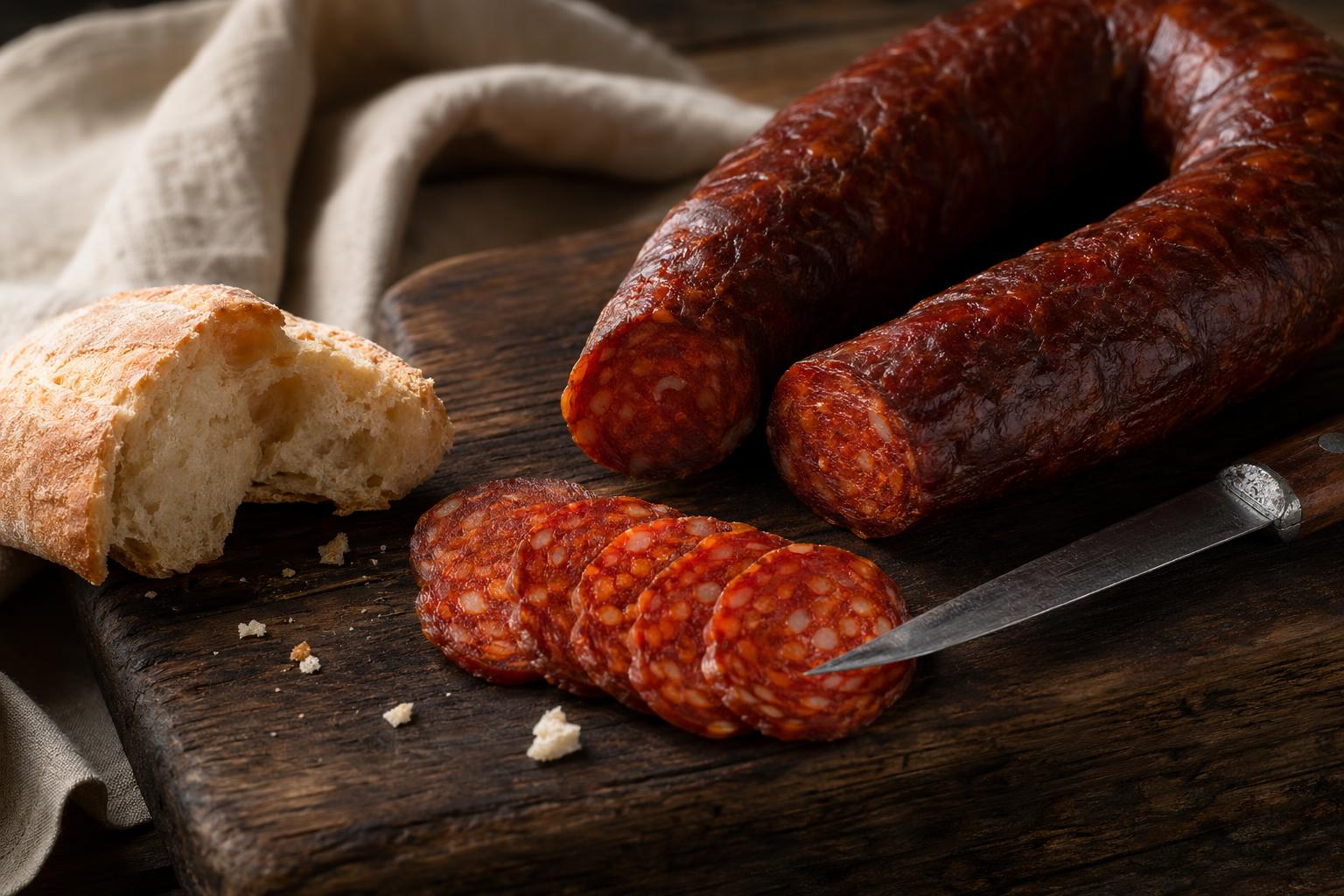
Sujuk is the cured beef sausage at the center of Albanian-American breakfast tables. It is Albanian suxhuk, also written sujuk in English and sucuk in Turkish — same dish across spellings, different spice profiles across borders. The Albanian version leans on paprika and garlic, with a touch of cumin and fenugreek, beef as the base, and a long cure that produces a firm, deep-red sausage with a sharp bite.
The diaspora ritual is straightforward and load-bearing. Slice it thin. Render it in a cold pan. Crack eggs into the rendered fat. Tear bread, pour coffee or tea, and the morning has its anchor. From the Bronx to Sterling Heights to Worcester, Sunday breakfast in Albanian-American homes has a sujuk shape to it.
The dish is older than any of these neighborhoods. Sujuk traces to a Turkic meat-preservation tradition that predates the Ottoman Empire, was carried across the Balkans during the Ottoman period, and settled into local kitchens — Turkish, Bosnian, Bulgarian, Greek, Armenian, and Albanian — each with its own spice fingerprint. The Albanian fingerprint is paprika-forward and garlic-heavy — a different emphasis than the Turkish or Bulgarian versions, though family recipes vary too much for a precise ratio.
This piece covers what sujuk is, where it came from, how it is eaten in Albanian-American homes, where to buy it in the US, the traditional homemade recipe, and the pan-frying technique that turns a slice of cured beef into the breakfast that built the morning.
What Sujuk Is
Sujuk is a dry-cured fermented sausage. The base is ground beef — usually chuck, around 80% lean — sometimes blended with a small share of lamb. A small amount of beef tallow or pork fat is added for richness, though many Albanian families keep it pork-free. The meat is mixed with garlic, paprika (sweet and a touch of hot), salt, cumin, fenugreek, and black pepper. Some traditions add a splash of red wine to bloom the spices and start the fermentation.
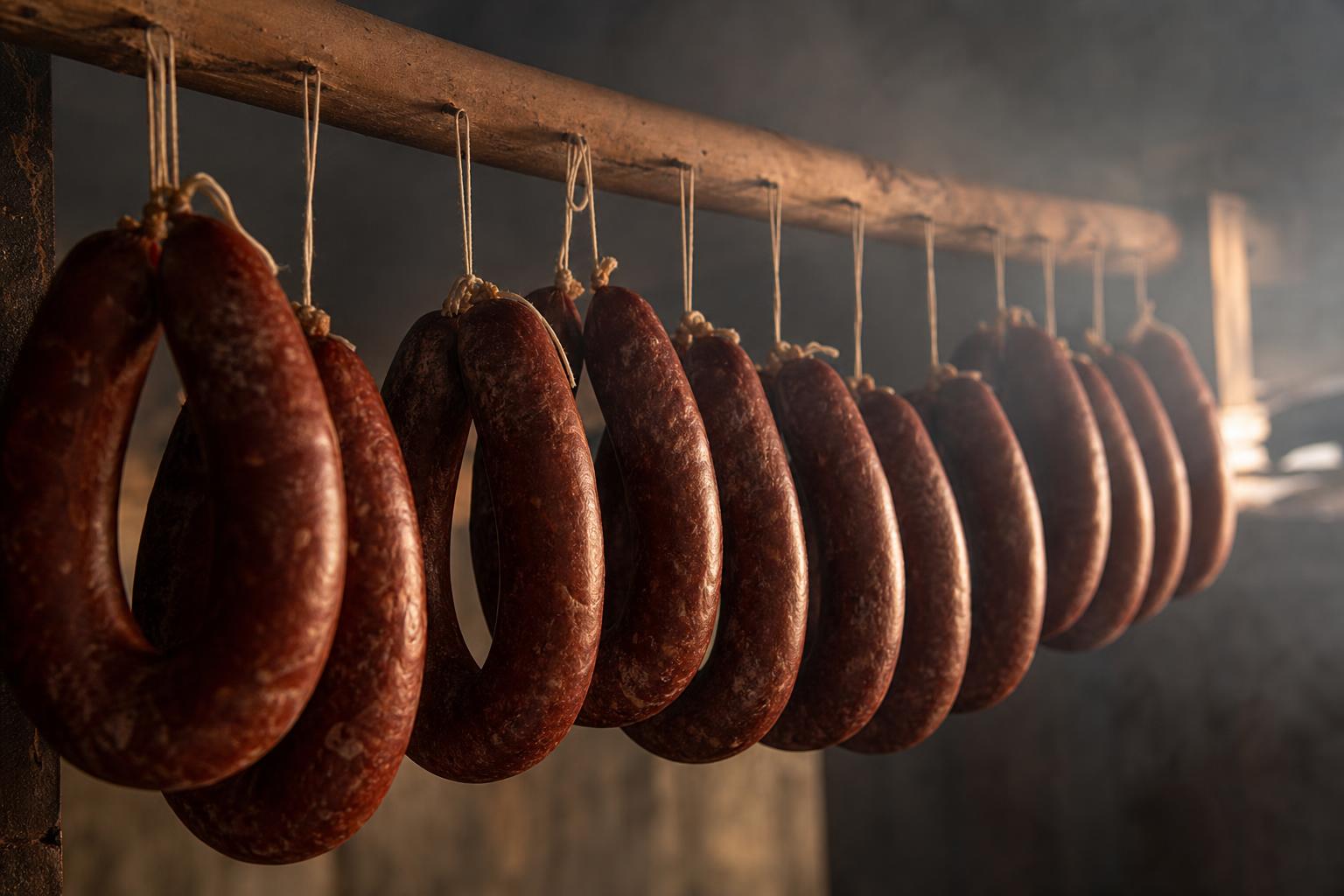
The mix sits refrigerated for a day so the spices bloom and the salt distributes. Then it is stuffed into hog or beef casings, tied into 8-to-12-inch loops, and hung. The sausages ferment for two to three weeks at controlled humidity, where lactic-acid bacteria drop the pH and develop the tang. Then they air-dry for another four to six weeks until the moisture content drops below 40% and the sausage feels firm. Total active-plus-wait time is six to eight weeks.
The result is structurally different from its European cousins. Italian salame runs higher in fat with a finer grind and a milder profile. Spanish chorizo is dominated by smoked pimentón. Polish kielbasa is usually smoked rather than dry-cured, and pork-based. Sujuk sits in its own category: beef-forward, paprika-and-garlic-driven, drier than salame, leaner than chorizo, and almost never smoked.
The spelling is its own story. Suxhuk is the Albanian written form. Sujuk is the standard English transliteration. Sucuk is Turkish. Sudžuk is Bosnian. Sudzhuk or sudjuk shows up in Bulgarian and Macedonian contexts. Suǰux is Armenian. The word traces back to Old Turkic sugut, meaning “dried thing” — first written down in the 11th century by Mahmud al-Kashgari, who described a sausage made by stuffing spiced rice and meat into casing. A thousand years later, the word and the technique have spread across a dozen kitchens.
Origin and Spread
Sujuk’s origin is Turkic, predating the Ottoman Empire. The dish moved with the people who made it — across Anatolia and into the Balkans during the long Ottoman period from the 14th to the early 20th century. Each region kept the dry-cure logic but adjusted the spice profile to local taste.
In Turkey, sujuk became sucuk and standardized around a cumin-forward spice mix and uniform commercial production. In Bosnia, Bulgaria, and Greece, the dish picked up its own regional spice adjustments, though the specific differences in shape and heat level live mostly in family and regional lore rather than any standard reference. In Armenia, suǰux preserved the ancient technique closely, remaining a staple of the country’s traditional cured-meat repertoire. In Albania, suxhuk settled into the household tradition and developed its paprika-and-garlic spike.
The Albanian sujuk took its own path because rural Albania kept household sausage-making alive longer than its neighbors. While Turkey commercialized early and Bulgaria followed, Albanian families continued to slaughter a cow in late autumn and turn the meat into sujuk that would carry the household through winter. That household scale is what produced the variation: every family had a recipe, and the spice ratios varied from village to village. The result is not a single Albanian sujuk recipe but a tradition with stable bones — beef, garlic, paprika, fenugreek, cumin, salt — and family-level variation in the ratios.
In the diaspora, that household tradition is mostly gone. Most Albanian-American families now buy sujuk rather than make it, either from Albanian butchers or from Bulgarian and Turkish brands stocked at Balkan grocers. A small number of enthusiast cooks still make their own — usually older men with a curing space in the basement and the patience for the eight-week wait.
How Sujuk Is Eaten in Albanian-American Homes
The default ritual is breakfast. Sujuk gets sliced about a quarter-inch thick, dropped into a cold pan, and brought up slowly so the fat renders before the slices crisp. Eggs go in next, scrambled into the rendered fat or fried alongside. The plate hits the table with bread — bukë, often a half-loaf of crusty white — and a small dish of kos (plain yogurt) or feta. Coffee or strong black tea finishes the picture. This is the Saturday or Sunday morning that runs long, with extended family showing up uninvited and the second pan going on by 10 a.m.
The other regular slot is in fasule, the Albanian white bean stew. Sujuk gets sliced and added partway through the simmer, where it breaks down a little and gives the broth a smoky paprika depth. Fasule me suxhuk is a winter staple, especially in Kosovar and northern Albanian families. The fat from the sujuk replaces the olive oil that would otherwise carry the dish, and the paprika tints the beans red.
Sujuk also shows up in the casual rotation in three other places. Crumbled into rice while the rice steams produces oriz me suxhuk — a one-pot meal that travels well. Sliced and laid over hot pasta with a spoon of tomato sauce makes a quick weeknight Albanian-Italian crossover the diaspora invented in apartments where the pantry held both. And as meze before a long dinner, sujuk gets sliced thin, plated next to white cheese and olives, and eaten with a chilled glass of raki.
A note on the breakfast version, because it is the load-bearing one. The bread is not optional. Albanian breakfast is a bread-led meal — the eggs and sujuk are built around something to wipe up the fat and the yolk. White hearth bread is traditional; a sourdough boule or a baguette covers the same ground. Toast does not work — the bread needs enough crumb to absorb.
Where to Buy Sujuk in the US
The reliable spots are Albanian and Balkan butchers and grocers in the dense Albanian-American neighborhoods.
In New York, Arthur Avenue in the Bronx has Albanian butchers running for decades, and Astoria in Queens has Balkan grocers carrying multiple regional styles. The Bronx — the Allerton section in particular — holds the densest Albanian census tract in the country, and Staten Island the most Albanian county, making New York the easiest place to find fresh Albanian-made sujuk.
In Michigan, Sterling Heights and the broader Macomb County area have the largest Albanian community outside New York. Several family-run Albanian butchers carry sujuk made in-house.
In Massachusetts, Worcester is the Albanian-American hub, with Boston nearby. Both have Balkan grocers carrying sujuk, though the Albanian-specific brands are easier to find in Worcester.
In Connecticut, Waterbury and Bridgeport carry Albanian butchers and grocers, including some that import directly from Albania or Kosovo.
A practical note: many Balkan grocers stock Bulgarian or Turkish commercial sujuk, which is fine but tastes noticeably different from the homemade Albanian version. If the goal is the Albanian profile, ask specifically for suxhuk or for an Albanian brand. The labels are sometimes in Albanian or have the Albanian flag on the wrapper.
For households outside the diaspora hubs, mail-order is the fallback. A handful of Albanian-American butchers ship sujuk vacuum-sealed; the community Facebook groups are the fastest way to find a current vendor.
Homemade Sujuk Recipe
This is the household-scale recipe. It yields about three pounds of cured sausage and takes six to eight weeks of mostly waiting time. Active work is two to three hours total, spread over the cure window. Read the whole recipe before starting; sausage-making rewards a clean workflow and punishes improvisation.
A safety note up front. Curing meat at home is a real food-safety undertaking. The salt cure, the fermentation, and the drying are what keep the meat safe — not the spices, not the time. Use curing salt #1 (pink salt, sodium nitrite) at the specified ratio, control humidity, and if anything looks or smells wrong during the cure, throw it out. Most diaspora cooks now buy commercially because the margin for error at home is real.
Ingredients
- 3 lb beef chuck (around 80% lean), ground coarse
- 1 lb beef tallow or pork fat, ground coarse (about 5% of total, for flavor)
- 4 Tbsp sweet paprika
- 1 Tbsp hot paprika (or smoked, if preferred)
- 6 cloves garlic, minced fine or pressed
- 2 Tbsp kosher salt (substitute curing salt #1 at the package’s recommended ratio if available)
- 1 Tbsp ground cumin
- 1 Tbsp ground fenugreek
- 1 tsp black pepper, freshly ground
- ½ cup dry red wine (optional, but traditional)
- Hog or beef casings, soaked in cold water 30 minutes and rinsed
Equipment
- A meat grinder with coarse plate (or pre-ground beef from a butcher)
- A sausage stuffer (a stand-mixer attachment works for small batches)
- A cool curing space — 50 to 55°F, around 75% relative humidity. A spare fridge with a temperature controller, or a cool basement room with a humidifier, is ideal
- Butcher’s twine
- A scale for weighing the salt and cure precisely
Steps
Step 1 — Mix the cure (15 minutes). Combine ground beef and tallow in a large bowl. Add paprika, garlic, salt, cumin, fenugreek, black pepper, and wine if using. Mix with clean hands until the spices are evenly distributed and the mixture starts to feel slightly sticky — that is the protein binding, and it is what holds the sausage together. Cover the bowl and refrigerate 24 hours so the spices bloom and the salt penetrates.
Step 2 — Stuff the casings (45 minutes). Pull the cure from the fridge. Fit the sausage stuffer with the casings — work one length at a time, knot the far end, and stuff slowly to avoid air pockets. Aim for a firm fill but not over-packed; the cure shrinks as it dries and over-packed casings will split. Tie the open end and twist or tie into 8-inch loops. A traditional Albanian shape is the U-loop, with the two ends tied together.
Step 3 — Hang and ferment (2 to 3 weeks). Hang the loops in the curing space at 50 to 55°F and around 75% relative humidity. The first three days are the active fermentation phase — bacteria drop the pH, and the cure starts to firm. Check daily. Some surface mold (white, dusty, even) is normal and expected; black or green fuzzy mold is not — wipe affected sections with a vinegar-water solution or trim them off if extensive.
Step 4 — Dry (4 to 6 weeks). After the initial fermentation, the sausages enter the drying phase. Keep the temperature steady and lower the humidity slightly if possible (down to around 70%). The cure is ready when the sausages feel firm and have lost about 30% of their starting weight. Weigh a few links at the start and check periodically. A sausage that feels soft in the middle is not ready; give it another week.
Step 5 — Finish. Cured sujuk can hang indefinitely in the cool space or be wrapped and stored. Cut into 6-to-8-inch pieces, vacuum-seal, and refrigerate or freeze for long storage.
Critical-Path Notes
- Humidity is the whole game. Too humid and mold takes over. Too dry and the casings case-harden — the outside dries before the inside, and the inside stays raw. A small humidifier with a humidistat in a spare fridge or a cool basement closet is the standard diaspora-enthusiast setup.
- Curing salt matters. Pink salt #1 (sodium nitrite) at the specified ratio is what keeps the meat safe through the long cure. Plain salt alone is risky over a six-week window.
- Weigh, don’t measure. Salt and cure ratios are weight-based, not volume-based. A scale is not optional.
- Mold management. White surface mold is fine and traditional. Black, green, or fuzzy mold means trim or toss.
Most diaspora cooks now buy. Homemade is for the enthusiasts with the basement space and the patience.
Pan-Frying Technique
This is the actual breakfast. The technique sounds simple, but the details matter — the wrong move turns sujuk into a tough, greasy slice instead of a crisp one.
Slice about a quarter-inch thick. Thinner slices burn before they crisp; thicker slices stay rubbery in the middle.
Use a cold pan and no oil. Sujuk has enough internal fat to fry itself; adding oil makes the pan greasy and the slices soggy. Cast iron is ideal, but any heavy pan works.
Heat slowly. Set the burner to medium-low and let the slices render. The fat starts to come out within a minute or two; resist the urge to crank the heat. Once the bottom has rendered and browned — about four to five minutes — flip. The second side cooks faster, three to four minutes. Don’t flip too fast: the crisp comes from contact time with the pan.
When the slices are browned on both sides and the edges have curled slightly inward, they are done. Move them to a plate. Crack eggs into the rendered fat, lower the heat slightly, and scramble or fry. The eggs will pick up the paprika color and the spice — that is what you want.
Storage
Fully cured sujuk, uncut and hung in a cool dry place, lasts several months at room temperature — that was the original point of the cure, surviving a Balkan winter without refrigeration.
Once cut, refrigerate. Wrap the cut end in plastic or wax paper, store sealed, and finish within a few weeks. The cut face develops a harder rind; trim and slice fresh from there. For long storage, vacuum-seal pieces and freeze. Six months in the freezer without significant flavor loss is realistic. Thaw overnight in the fridge before slicing — frozen slices fall apart.
A Note on the Cured Pantry
Sujuk is part of a small set of cured-meat traditions that the Albanian diaspora carried with it: sujuk, pastërma (air-dried beef, related to Turkish pastırma), and the household kavurma (preserved cooked meat in fat). All three were born of a pre-refrigeration kitchen that had to make a slaughtered animal last through winter, and all three survived into the diaspora because they tasted good enough to keep cooking even after the freezer made them unnecessary.
Counting ourselves is the other way the diaspora keeps its shape. If you are Albanian-American and want to be part of a community-led count of Albanian Americans, register with NAR. It takes a minute. Free, neutral, your data stays yours.