

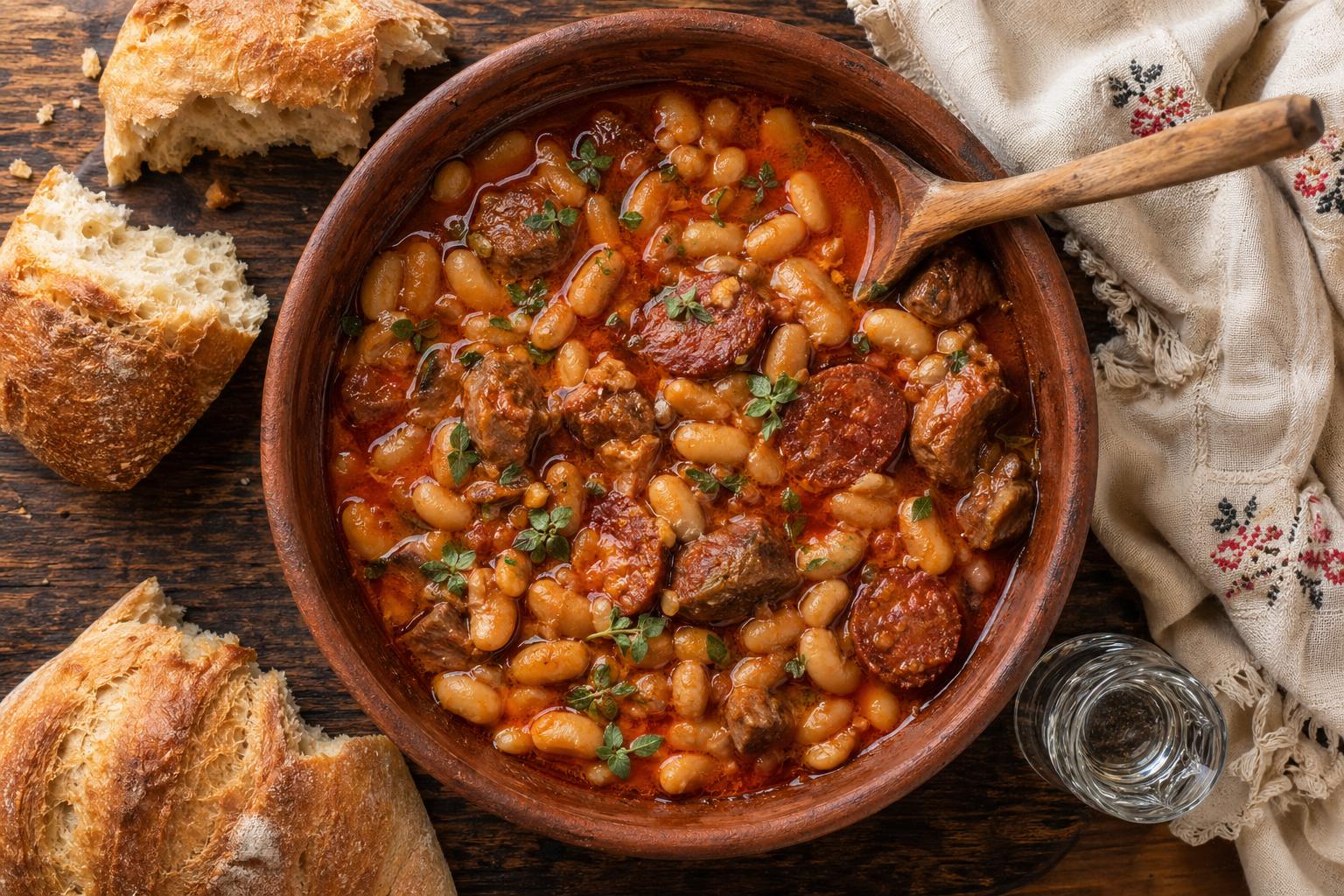
Fasule (also called grosh in some regional dialects) is Albania’s white bean stew — slow-cooked great northern or cannellini beans with smoked sausage or lamb, paprika, onion, tomato, and oregano. Hearty, rustic, and the dish that signals the cold months are here. It is the meal Albanian-American grandmothers serve on Sunday lunch alongside byrek (Albanian filo pastry), and the one a working family puts on the stove before church and walks back into three hours later.
Fasule is bread food. The broth — deep red-orange from paprika and tomato paste, slick with sausage fat — is meant to be sopped with a torn piece of country bread, not eaten with a spoon alone. A small bowl of kos (yogurt) goes on the table next to it. So does a plate of pickled chilies if the household leans Kosovar. Nothing about the dish is fussy.
This is the traditional recipe, with the quantities, temperatures, and timings nailed down. It serves six. It takes about three hours, most of it hands-off — the beans cook themselves once the pot is set up.
What Fasule Is, and Where It Comes From
Fasule is a long-simmered bean stew built on three things: white beans, a paprika-and-tomato base, and smoked or braised meat. The beans go in dried and soaked, the meat goes in early so its fat renders into the broth, and the whole thing cooks low for a couple of hours until the beans are tender and the liquid has thickened into something between a soup and a stew. It sits closer to the stew end.
The dish is eaten across Albania, Kosovo, North Macedonia, Montenegro, and the diaspora. In parts of northern Albania and Kosovo it is sometimes called grosh — an older Gheg-dialect word for bean, though the same word is better known today as the name of an old Ottoman-era coin. In standard Albanian, it is fasule. The Lunxheri region of Gjirokastër has its own bean dish, groshët, and along the coast cooks lean on white beans baked in a clay pot with mint and bay leaf — sometimes called fasulle plaqi. Different names, same family.
Fasule has cousins across the Balkans, but it is its own dish. Bosnian pasulj uses similar beans but typically goes thinner and lighter on paprika. Greek fasolada is broth-forward, often meatless, and finished with lemon. Hungarian bableves is closer in spirit but uses a roux thickener. The Albanian version is paprika-forward, meat-forward (smoked sausage or lamb shoulder), and stewlier than any of those — the broth coats a spoon rather than running off it.
For diaspora cooks, fasule is the recipe most likely to get cooked weekly through the winter. It is cheap, it scales, it freezes, and it improves on day two. That practicality is part of why it survives.
Ingredients
Serves 6. All measurements are US standard.
For the bean base:
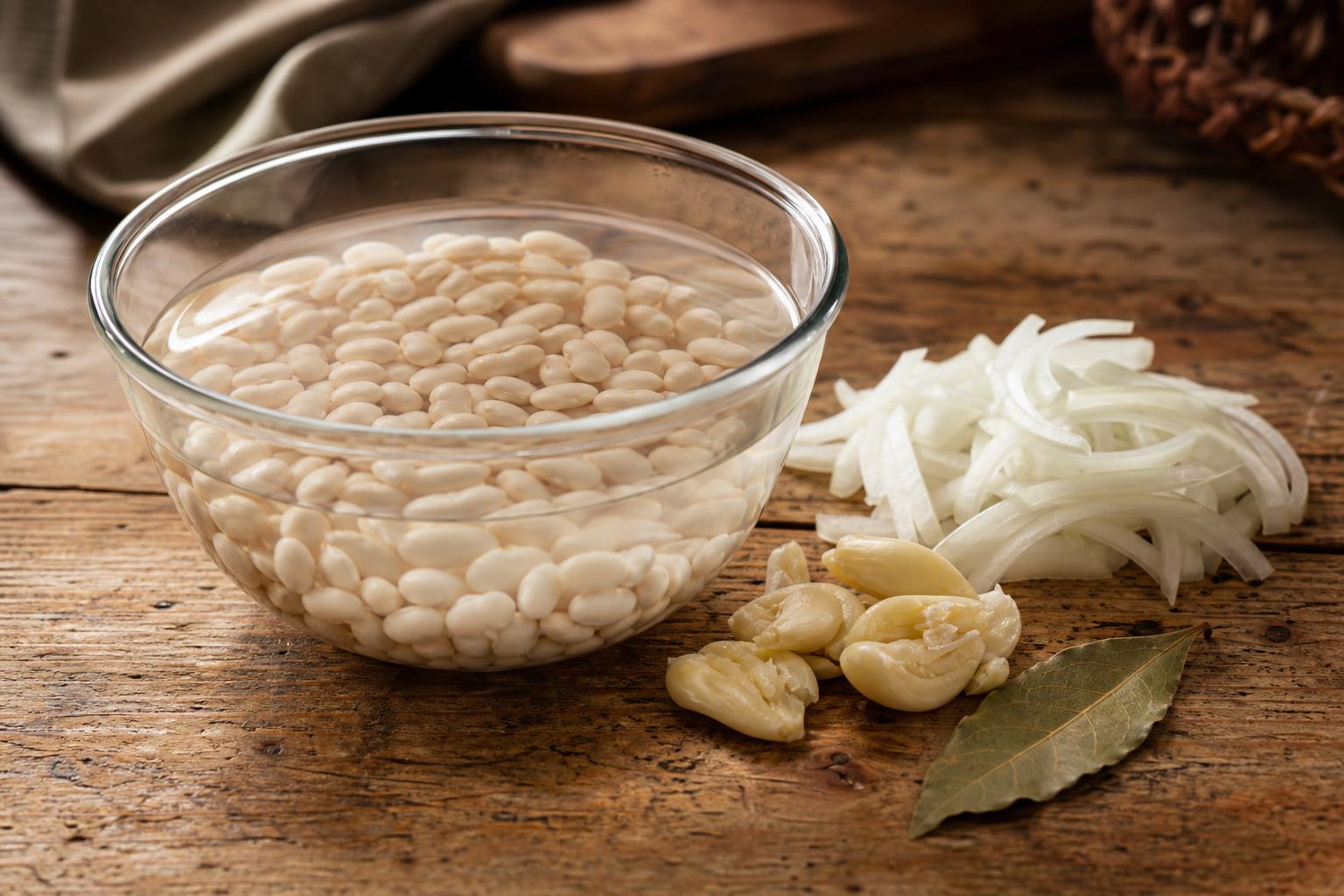
- 1 lb dried great northern or cannellini beans, picked over and soaked overnight in cold water
- 1 lb smoked Albanian sausage (sujuk) sliced into ½-inch coins, OR 1 lb boneless lamb shoulder cut into 1-inch cubes
- 1 large yellow onion, diced
- 4 cloves garlic, finely chopped
- 1 large carrot, diced
- 2 Tbsp tomato paste
- 1 Tbsp sweet paprika
- 1 tsp hot paprika (or smoked paprika if you want depth without heat)
- 2 tsp dried oregano
- 2 bay leaves
- 6 to 8 cups water or low-sodium stock
- 3 Tbsp olive oil
- 1 tsp kosher salt, plus more to taste
- ½ tsp freshly ground black pepper
A note on the sausage: sujuk (also spelled sudžuk or sucuk) is a dry-cured, paprika-spiced beef or lamb sausage common across the Balkans and the eastern Mediterranean. Albanian and Turkish sujuk both work. If you cannot find it, a good Polish kielbasa or Spanish chorizo (the dry-cured kind, not Mexican fresh chorizo) will get you in the same neighborhood. Andouille works too — slightly more aggressive, but the smoke is right.
A note on the lamb: shoulder is the cut. The connective tissue breaks down through the simmer and gives the broth body. Lamb leg is leaner and goes stringy. If you want a leaner version, use boneless lamb shoulder trimmed of large fat caps, not leg.
A note on paprika: real Hungarian or Spanish paprika is what you want — fresh, fragrant, deep red. The dusty supermarket jar that has been on the shelf for two years will give you a dull, flat broth. Paprika loses potency fast; if yours has no smell when you open the lid, it is not going to flavor a stew.
Equipment
- A heavy-bottomed pot or Dutch oven, at least 5 quarts (the beans triple in volume)
- A wooden spoon
- A small skillet for sweating the aromatics
How to Make Fasule
Step 1 — Soak and pre-cook the beans (overnight + 45 minutes)
The night before, place the beans in a large bowl, cover with cold water by 3 inches, and leave on the counter overnight. The next day, drain and rinse.
Transfer the soaked beans to the Dutch oven. Cover with 6 cups fresh water (no salt yet — salt early can toughen the skins). Add the bay leaves. Bring to a boil, then drop to a low simmer. Cook uncovered for 45 minutes — the beans should be just shy of tender, with some bite still in the center. They will finish cooking in the stew.
Drain the beans, reserving 4 cups of the cooking liquid. Set both aside.
Step 2 — Build the flavor base (15 minutes)
Wipe out the Dutch oven and return it to the stove over medium heat. Add the olive oil. When it shimmers, add the diced onion and the carrot. Cook 6 to 8 minutes, stirring, until the onion is translucent and the carrot is starting to soften.
Add the garlic and stir 30 seconds, just until fragrant — do not let it brown.
Add the tomato paste, both paprikas, the oregano, and the black pepper. Stir continuously for 90 seconds. The paste should darken and the spices should bloom in the oil — this is where the deep red-orange color of the broth gets built. If it starts to stick, splash in a tablespoon of water and keep going.
Step 3 — Brown the meat (10 minutes)
Push the aromatics to one side of the pot and add the sausage coins or the lamb cubes to the cleared space. Brown the meat for 4 to 6 minutes, turning once or twice. With sausage, you want the edges crisped and the fat starting to render into the pan. With lamb, you want a real sear on at least two sides of each cube.
Stir the browned meat into the aromatics.
Step 4 — Combine and simmer (1 hour 30 minutes)
Add the drained beans and the 4 cups of reserved bean cooking liquid back to the pot. Top up with additional water or stock to bring the total liquid to roughly 8 cups — the beans should be covered by an inch and a half. Add 1 tsp salt.
Bring to a gentle simmer, then cover partially (lid offset by about an inch to let steam escape). Cook on low for 1 hour and 30 minutes. Stir every 20 minutes or so to keep the bottom from catching. The beans should soften completely without falling apart, and the broth should reduce and thicken into something that coats the back of a spoon.
If you used lamb shoulder, the cubes should now be fork-tender. If they are still tight, give the pot another 20 minutes.
Step 5 — Adjust and rest (15 minutes)
Pull the bay leaves out. Taste the broth and adjust salt — sausage and stock both bring sodium, so wait until this point to season aggressively. Add a crack of black pepper. If the stew is thinner than you want, simmer uncovered for another 10 minutes; if it is thicker than you want, splash in stock or water.
Pull the pot off the heat and let it rest 15 minutes before serving. The broth thickens and the flavors round out as it sits.
Why This Recipe Works
The slow simmer is the load-bearing technique. Beans cooked at a hard boil split open and turn mealy; beans cooked at a low, lazy simmer for an hour and a half soften from the outside in and stay whole. That is what gives fasule its signature texture — beans that are creamy when you bite them but still recognizably bean-shaped on the spoon.
The deep red-orange broth comes from three things working together. Tomato paste, browned in oil before the liquid goes in, contributes glutamates and a roasted-tomato sweetness that watery canned tomato cannot match. Paprika, bloomed in fat for those 90 seconds in step 2, releases the carotenoid pigments and aroma compounds that give the broth its color and warmth. And the rendered sausage or lamb fat carries those flavors and pigments through the liquid in a way water alone cannot.
Skip any of those three steps — undercook the paste, dump cold paprika into a wet pot, drain off the meat fat — and the broth comes out pale, thin, and one-dimensional. Hit them all and the stew tastes the way an Albanian grandmother’s kitchen smells in November.
The overnight soak does more than save time. Soaked beans cook evenly because the water has fully penetrated the bean before heat hits it. Unsoaked beans cook from the outside in, so the skin softens and starts to slough off before the center is done. Soaking also leaches out some of the oligosaccharides — the carbohydrates that make beans hard to digest — which is why traditional recipes always start the night before.
Variations
Lent (kreshmë) version. Drop the sausage or lamb entirely. Bump the olive oil to ¼ cup, double the tomato paste to 4 Tbsp, add a second diced carrot and a finely chopped celery rib in step 2, and finish with a tablespoon of red wine vinegar stirred in at the end. Common in Orthodox households during the fasting weeks before Easter and Christmas.
Kosovar version. Slightly more chili heat. Replace the hot paprika with 2 tsp of Kosovar speca djegës (dried hot pepper flakes) or a single seeded fresh jalapeño minced and added with the garlic. Some Kosovo cooks also add a splash of red wine vinegar at the end to lift the broth. The dish runs a little hotter and a little brighter.
Winter greens version. In the last 30 minutes of simmering, stir in 4 cups of chopped lacinato kale or shredded green cabbage. The greens wilt into the stew and add bulk and a slight bitterness that cuts the richness. This is the version that shows up in Albanian-American houses where someone has a winter CSA box and wants to use it.
Pressure-cooker version. Skip the overnight soak. Use a 6-quart pressure cooker. Sauté the aromatics and brown the meat in the pot, add the dry beans plus 7 cups of stock, lock the lid, and cook 35 minutes at high pressure with a natural release. Total time from dry beans to dinner: 75 minutes.
Serving and What to Pour Alongside
Fasule is served in shallow bowls, hot, with the bread cut and on the table before the pot lands. It is not a centerpiece dish in the tavë kosi sense — it does not announce itself. It is a Sunday dish, a weeknight dish, a “the kids are coming home from college” dish.
What goes around it:
- Crusty bread. A country loaf, a baguette, or fresh bukë if you bake. The bread is structural — half the dish is sopping the broth.
- Kos (yogurt). A small bowl of full-fat plain yogurt on the side. Some eaters spoon it directly into the stew; others alternate bites. Either way, the cooling tang offsets the paprika and the sausage fat.
- Pickled chilies. Speca turshi — small green peppers pickled in vinegar and salt — sit on the table for the people who want more heat.
- Red wine. A young Albanian kallmet if available; otherwise a young Italian or Greek red. Nothing oaky, nothing complicated.
- Raki before the meal in some families. A small glass.
A Soft Note Before the FAQ
This is the kind of recipe that survives because someone wrote it down. The grandmothers who cooked it without measuring are aging out, and the version they made — paprika by the handful, beans soaked in whatever pot was free, sausage from the cousin who cured it himself — does not appear in any English-language cookbook. If you have one of them in your family, call her this week and ask her how she does it. Watch the pot if you can; ask what it should look like at the one-hour mark. Write down the answer. That is part of how the dish stays Albanian.
The National Albanian Registry is building a community-led count of Albanian Americans across the United States. If you have not been counted yet, take two minutes and register at albanianregistry.org. Free, neutral, and the certificate is yours to keep.