

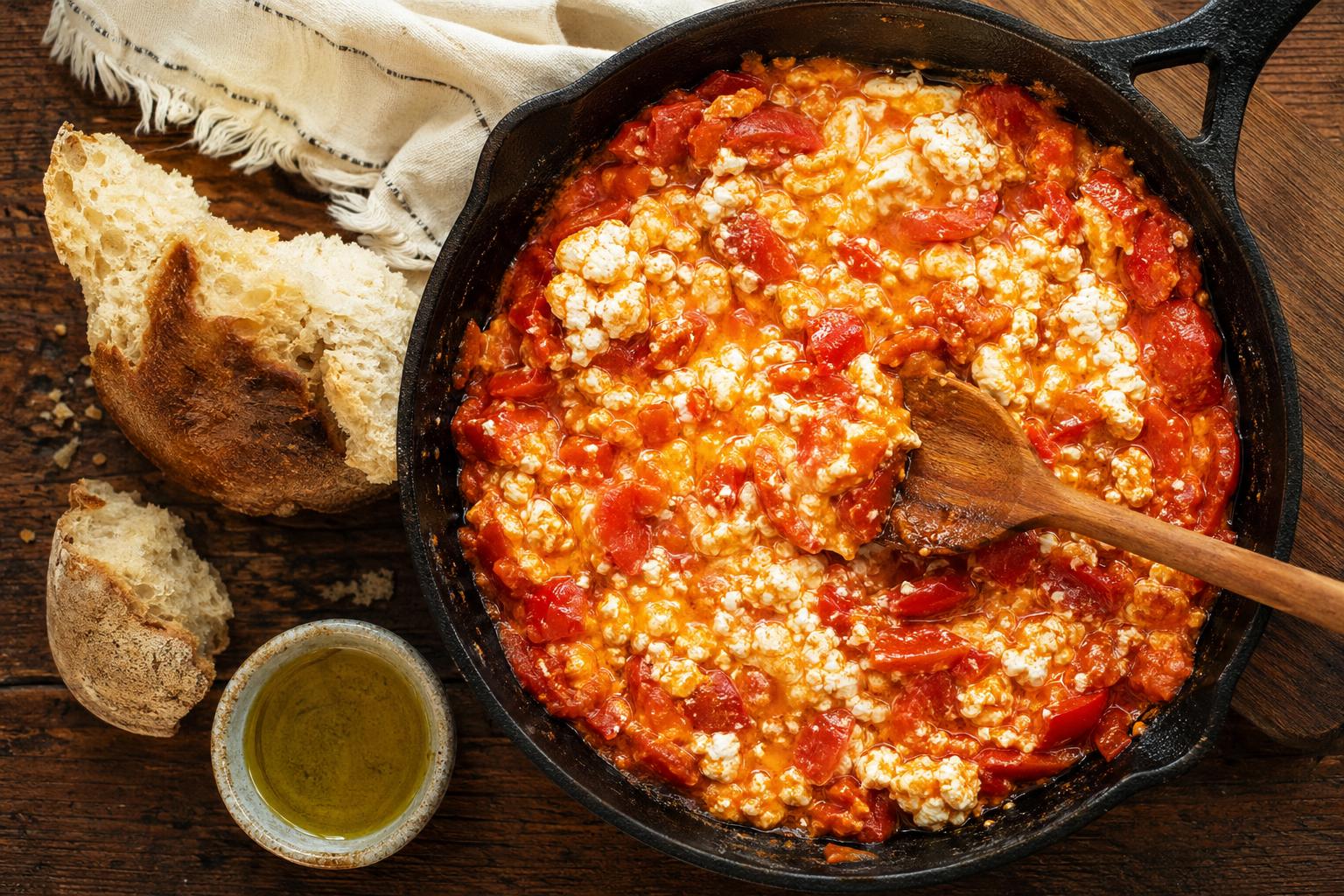
Fërgesë (also written fergesë) is Albania’s pepper-tomato-cheese stew. It is Tirana’s hometown dish — the one preparation the capital is most associated with on the Albanian table. The pepper-and-cheese version — often labeled Fërgesë e Tiranës on menus — is the one most cooks and restaurants mean by the name today: roasted bell peppers and tomatoes simmered with garlic, then bound off-heat with crumbled white cheese and beaten eggs that set into a custard-like body across the stew.
The result is chunky, orange-red, slightly tangy from the cheese, sweet from the roasted peppers, savory from the tomatoes and garlic. It goes on bread, with byrek, on the meze table, alongside grilled meat, or as a meal on its own with a hunk of crusty bread to mop the plate.
What makes fërgesë distinctive is that no other Balkan cuisine has an exact equivalent. Greek briam, Italian peperonata, Turkish menemen — all are roasted-pepper-and-tomato cousins, but none of them carries the cheese-and-egg bind that gives fërgesë its signature body. It is recognizably Albanian in a way few dishes are.
This piece covers what fërgesë is, the regional versions, the Tirana recipe at home scale, the cheese question, and how to serve it.
What Fërgesë Is
Structurally, fërgesë is a peperonata with a cheese-and-egg bind. The pepper-tomato base is straightforward: bell peppers blistered and peeled, fresh tomatoes or canned chopped, garlic, olive oil, salt and pepper. That much is shared across most Mediterranean kitchens.
The Albanian step is what comes next. Once the pepper-tomato base has thickened, the heat drops to low and the cook folds in crumbled gjizë (Albanian whey cheese) or feta along with beaten eggs. The mixture is stirred slowly and continuously while it warms — not high enough to scramble the eggs, not so low that the cheese stays cold and stiff. After three or four minutes, the cheese has melted into the stew and the eggs have set into a soft custard that binds everything together. The result is chunky but cohesive: visible pieces of pepper, recognizable tomato, all suspended in a creamy orange-red matrix.
The name fërgesë is closely related to the Albanian verb fërgoj — to fry, to sauté — though the exact derivation isn’t spelled out in standard dictionaries. Either way, the word points to a technique, not a specific dish. Several Albanian preparations are technically fërgesa: fërgesë me mëlçi (with liver), fërgesë verore (summer), fërgesë me mish (with meat). Over time the pepper-tomato-cheese version became the default, so when an Albanian says fërgesë without qualification, the pepper-and-cheese version is usually what they mean — though as the liver variant below shows, some traditionalists reserve the Tirana name for a different dish entirely.
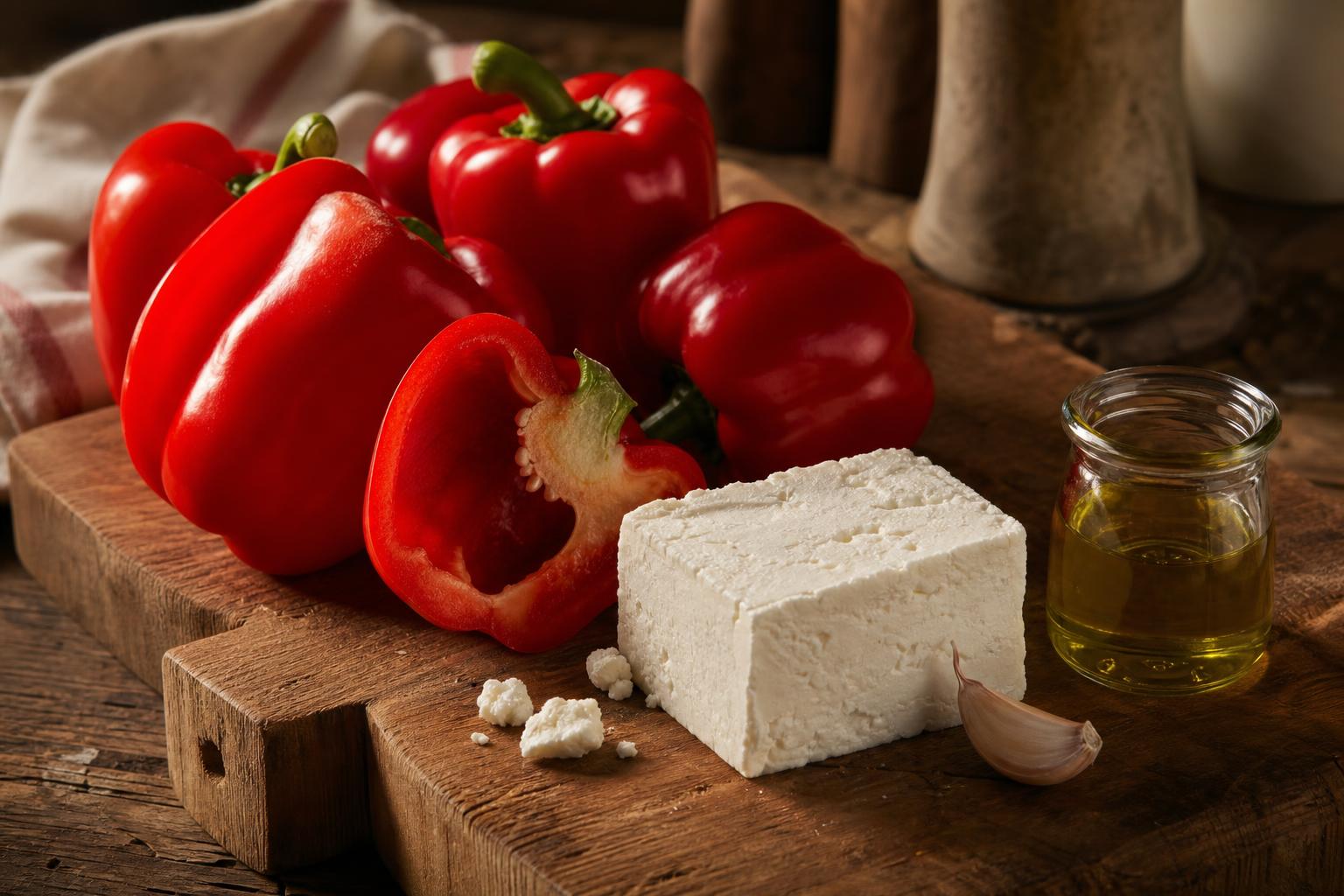 *Fërgesë ingredients — roasted red peppers, fresh white cheese (gjizë), garlic, and olive oil. — Graphic by NAR
Regional Variants
Albania is a small country, but its regional cuisines have real differences, and fërgesë shows them.
Tirana style (Fërgesë e Tiranës) is the version this article focuses on and the version most diaspora cooks make. Roasted peppers, tomatoes, garlic, olive oil, then crumbled white cheese and beaten eggs folded in off-heat. The defining textural feature is the cheese-egg bind that turns the stew custardy. This is the pepper-and-cheese fërgesë most commonly found on Albanian restaurant menus from Tirana to the Bronx — though, as the liver variant below shows, some Tirana traditionalists reserve the unqualified fërgesë tirane name for a different dish.
Korçë style. The southeastern city of Korçë has its own preparation, simpler and closer to a Mediterranean peperonata. Peppers and tomatoes are the heart; cheese appears in smaller quantities or not at all; the eggs are often skipped entirely. The Korçë version is what an Italian cook would recognize as a stovetop side dish — bright, clean, tomato-forward, with the peppers doing most of the work. Less rich than the Tirana style, more vegetable-driven.
With liver (Fërgesë me mëlçi). Tirana restaurants serve this as much as the pepper version. Chicken livers are diced, browned in butter or olive oil, then folded into a pepper-tomato base — sometimes with the cheese-egg bind on top, sometimes without. Many older Albanians consider the liver version the real Tirana fërgesë and the pepper-cheese version a vegetarian variant. That’s not just nostalgia — Wikipedia’s overview of Albanian cuisine notes the liver version is considered more traditional in Tirana and is sometimes called simply fërgesë tirane, with no qualifier at all.
With beef (Fërgesë me mish). Crumbled or diced beef is browned and added to the pepper-tomato base, with or without the cheese-egg finish. Heartier, more like a stew than a meze.
Summer style (Fërgesë verore). The vegetarian Tirana version, often made when peppers are cheap and tomatoes are at their peak. Lighter on the cheese, sometimes served at room temperature.
Modern simplified. Many diaspora cooks skip the cheese-and-egg step entirely and stop at the pepper-tomato sauté. Not technically fërgesë e Tiranës, but it is what shows up at a lot of Albanian-American family tables where the traditional cheese is hard to source.
The Recipe — Fërgesë e Tiranës
This is the Tirana-style pepper-tomato-cheese version. It serves 4 to 6 people as a side or meze, or 2 to 3 as a main with bread. Active time is about 25 minutes; total time, including pepper-roasting and rest, is about 45.
Ingredients
- 6 large red bell peppers (or a mix of red and yellow — avoid green, which stays bitter)
- 4 ripe tomatoes, cored and chopped (or one 14-oz can of chopped tomatoes, drained slightly)
- 4 cloves garlic, minced
- 3 tablespoons olive oil
- 1 cup (8 oz / 225 g) gjizë — Albanian whey cheese — OR a half-and-half mix of ricotta and crumbled feta (½ cup of each)
- 3 large eggs, beaten
- 1 teaspoon kosher salt, plus more to taste
- ½ teaspoon freshly ground black pepper
- Optional: ½ teaspoon sweet paprika; a splash (1 teaspoon) of white wine vinegar to brighten
A note on the peppers: roasted, peeled red bell peppers are the soul of this dish. Skipping the roast and using raw peppers produces a vegetal, slightly grassy stew that is recognizably wrong. Jarred roasted peppers from the supermarket will work in a pinch — drain them well and pat dry — but fresh-roasted is better.
A note on the cheese: gjizë is the traditional choice. If you cannot find it, the standard diaspora substitute is half ricotta, half feta. Ricotta carries the body and mild tang; feta carries the salt and the sharper edge that gjizë has on its own. All-feta makes the stew too salty and broken; all-ricotta makes it bland.
Equipment
- A heavy skillet, ideally cast iron, 10 to 12 inches across, with at least 2-inch sides
- A baking sheet for the peppers
- A plastic or paper bag (for steaming the peppers after roasting)
- A wooden spoon or silicone spatula
- A small bowl for beating the eggs
How to Make Fërgesë e Tiranës
Step 1 — Roast the peppers (10 minutes plus 10 to steam)
Heat the broiler to high and place a rack about 6 inches below the heating element. Lay the whole peppers on a baking sheet. Broil, turning every 2 to 3 minutes with tongs, until the skins are blackened and blistered on all sides — about 10 minutes total.
Drop the peppers into a paper bag or plastic bag and seal. Let them steam for 10 minutes — the steam loosens the skins. The blackened skins slide off in sheets. Discard skins, stems, and seeds. Slice the flesh into strips about ½ inch wide. Set aside.
While the peppers steam, prep the rest.
Step 2 — Cook the garlic (30 seconds)
Heat the olive oil in the heavy skillet over medium heat until it shimmers. Add the minced garlic. Stir constantly for about 30 seconds — the garlic should turn fragrant and pale gold but not brown. Burnt garlic ruins the dish.
Step 3 — Simmer the tomatoes (10 minutes)
Add the chopped tomatoes (or the can of chopped tomatoes) to the skillet. Stir to combine with the garlic-oil base. Bring to a simmer and cook, stirring occasionally, for about 10 minutes — until the tomatoes have broken down and the mixture has thickened into a chunky sauce. Most of the visible water should be gone; the surface should be glossy with oil.
If using paprika, stir it in here.
Step 4 — Add the peppers (5 minutes)
Add the roasted, peeled, sliced peppers to the skillet. Stir to coat them in the tomato base. Cook for another 5 minutes — the peppers will release a little of their juice and the whole mixture will tighten up into a thick, chunky stew. Season with the salt and pepper. Taste and adjust. If the tomatoes were very sweet, add the splash of white wine vinegar now to balance.
Step 5 — Bind with cheese and eggs (3 to 4 minutes)
Reduce the heat to low — really low. The skillet should be barely warm to the touch on the side, not actively bubbling. Add the gjizë (or the ricotta-and-feta mix) and pour in the beaten eggs. Stir gently and continuously, folding from the edges toward the middle.
The mixture will look loose for the first minute as the cheese melts. Keep stirring slowly. After 3 to 4 minutes, the eggs set into a soft custard that binds the stew. Stop stirring when the eggs are just set — residual heat finishes the cook. The stew should look chunky, glossy, and cohesive, not scrambled.
The single biggest mistake here is too much heat. High heat scrambles the eggs into curds and breaks the cheese. Low and slow is what produces the custardy bind.
Step 6 — Rest, taste, serve (5 minutes)
Pull the skillet off the heat. Let it rest for 5 minutes — the residual heat continues to set the eggs and the flavors come together. Taste once more and adjust salt.
Serve hot, straight from the skillet or transferred to a wide shallow bowl, with crusty bread on the side. Some Albanian cooks finish with a drizzle of olive oil and a pinch of fresh chopped parsley; both are optional.
The Cheese Question
The Tirana recipe calls for gjizë (pronounced gee-zuh) — Albanian whey cheese, the byproduct of cheesemaking. Like Italian ricotta, it is made by reheating the whey left over from harder cheeses and skimming the curds that rise. Unlike supermarket ricotta, it is drier, slightly tangier, and less sweet. Most Albanian households in Albania still buy it fresh from a local dairy.
In the US diaspora, real gjizë is harder to find than feta or ricotta, but not impossible. The Albanian groceries in dense diaspora neighborhoods stock it: parts of the Bronx (Belmont, Pelham Parkway), Detroit and Sterling Heights (MI), Astoria (Queens), Waterbury (CT), Worcester (MA). Look for a small white-cheese tub labeled gjizë or gjizë shqiptare in the refrigerated case. Some Greek and Macedonian groceries carry similar whey cheeses under different names — anthotiro, urda, manouri — that work as close substitutes.
Online, a handful of Balkan and Mediterranean specialty grocers ship gjizë and similar whey cheeses nationally — sellers change, so search for a currently-active one before ordering. Freshness matters more than brand.
For diaspora cooks who cannot get gjizë at all, the substitution ladder runs like this:
- Half ricotta, half feta — the standard diaspora mix. Closest combined approximation of gjizë’s texture and tang.
- All ricotta — works, but the result is mild. Good for kids; less recognizable as fërgesë to an Albanian palate.
- Goat cheese — different flavor, more assertive, but the texture is right and the tang is there. A non-traditional but workable substitution.
- Cottage cheese — looser, wetter; the stew comes out thinner. Drain it well first if this is the only option.
- Cream cheese — avoid. Wrong texture, wrong tang, the stew turns gummy.
Serving and Pairing
Fërgesë is rarely served alone. It belongs to the meze table — the spread of small dishes that opens an Albanian dinner — alongside byrek, feta, olives, cured meats (sujuk, prosciutto), pickled vegetables (turshi), and bread. A bowl of fërgesë in the middle of the table, warm, with bread torn and dipped, is the most common way it shows up at Albanian gatherings.
As a side, it pairs naturally with grilled lamb (qofte, tavë me mish), grilled chicken, or a simple roast. The acidity of the tomatoes and the richness of the cheese-egg bind cut through fattier mains.
As a meal on its own, with crusty bread and a green salad, it is a satisfying lunch — vegetarian, filling, and warm. It reheats well: a covered skillet over low heat for 5 to 7 minutes brings it back without breaking the texture. Avoid the microwave, which heats unevenly and scrambles the eggs that have already set.
The drink is raki before, served chilled in a small glass, or a dry white wine alongside — an Albanian kallmet or a Greek assyrtiko both work. With a heavier meal, a Mediterranean red is fine; with the dish on its own, white is the better match.
The Cultural Meaning
Fërgesë is Tirana’s hometown pride dish. The capital’s defining contribution to Albanian cuisine, in the way qofte korçare belongs to Korçë and tavë kosi belongs to Elbasan. Other Albanian regions cook fërgesë — most regions cook some version of it — but Tirana owns the name.
In the diaspora, fërgesë shows up at family gatherings as a “we remember home” dish. It is the dish that signals a particular kind of Albanian cooking — Tirana cooking, the cuisine of the city rather than the village. When a US-Albanian household serves fërgesë, it is often a deliberate statement about where the family came from. The pepper-tomato base is forgiving and easy to source in any US supermarket; only the cheese is hard.
Common Mistakes
A short list of what most often goes wrong, drawn from how the dish fails in home kitchens.
- Skipping the pepper roast. Raw bell peppers taste vegetal and slightly bitter. The roast caramelizes the sugars and softens the texture. There is no fërgesë without it.
- Cooking the cheese-and-egg step on high heat. This is the mistake that separates a clean fërgesë from a broken one. The heat must be very low — barely warm. High heat scrambles the eggs into curds and turns the cheese rubbery. If the pan is hissing or actively bubbling, it is too hot.
- Over-stirring or over-blending. The stew should keep visible pieces of pepper and identifiable tomato chunks. Some cooks blitz the whole pan with an immersion blender for a smooth texture; that produces a sauce, not a fërgesë. Keep it chunky.
- Using sweet tomato sauce instead of fresh tomatoes. Jarred pasta sauce is too sweet and too seasoned with Italian herbs. Fresh tomatoes or plain canned chopped tomatoes are what the dish wants. If the only option is jarred, look for a plain marinara with no sugar added and use less of it.
- Salting before tasting. Feta and gjizë both bring salt. Add the kosher salt cautiously and taste at the end before adjusting. Over-salted fërgesë is unrecoverable.
- Eating it straight from the pan, hot off the heat. A 5-minute rest lets the flavors come together and the bind set. Cutting the rest short produces a looser, less cohesive stew.
If you cook this — or your grandmother’s version, or your version with the cheese-and-egg step skipped — that is part of the Albanian-American food story too. NAR is building a community-led count of Albanian Americans, including the families teaching the next generation to cook. Get counted in two minutes. It is free, neutral, and your data stays yours.