
Who are the Albanians?
The short answer: a Balkan ethnic group of roughly 7 to 10 million people, speaking an Indo-European language called Albanian, present in the Balkans for at least 1,500 years, and spread across a global diaspora that has existed for 600.
The longer answer is what this page is for.
Albanians are native to the western Balkans — concentrated in the Republic of Albania, Kosovo, North Macedonia, and Montenegro — but they are not only the people of Albania. There are old Albanian villages in southern Italy that have stood for over five hundred years. There are Greek-speaking regions where Albanian was the first language spoken. There are Turkish, Egyptian, Swiss, German, Swedish, and American communities where Albanian is still spoken at the dinner table.
Why does an organization called the National Albanian Registry care about getting this introduction right? Because the question “who are Albanians?” is usually answered by sources — Wikipedia, encyclopedias, government statistics — that miss what makes the answer interesting. Albanians are not just the people of Albania. They are a community spread across half a dozen Balkan countries and a worldwide diaspora the official numbers don’t capture.
This explainer is for anyone who wants the honest version: where Albanians come from, where they live now, what they speak, what they believe, and how they ended up so geographically scattered for so long. We’ve written it warmly because the topic is warm. We’ve written it accurately because the topic deserves accuracy.
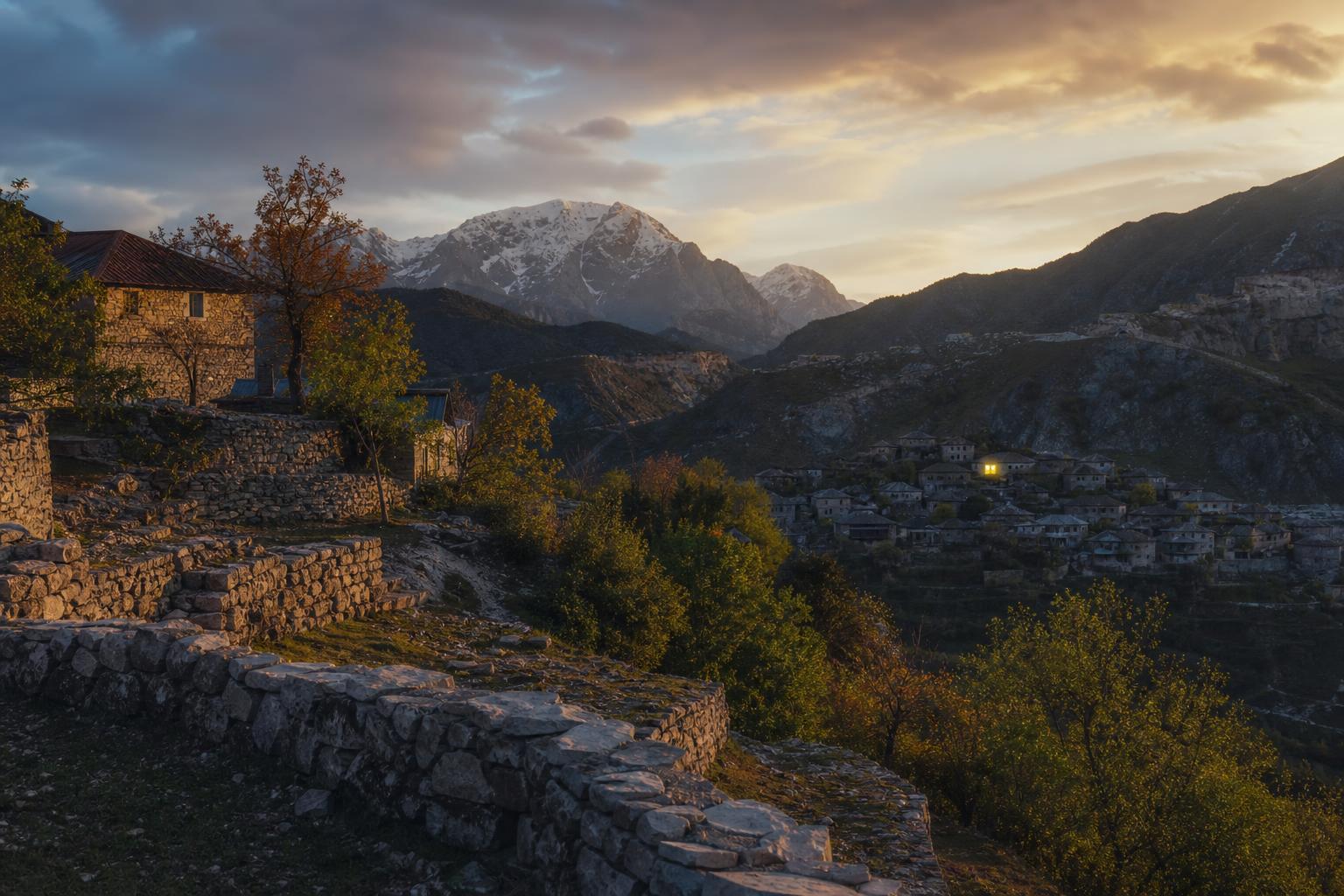 A village in the Albanian Alps (Bjeshkët e Nemuna) at dusk — the mountain spine of northern Albania, Kosovo, and Montenegro that anchored continuous Albanian settlement through the medieval period.
Graphic by NAR
A village in the Albanian Alps (Bjeshkët e Nemuna) at dusk — the mountain spine of northern Albania, Kosovo, and Montenegro that anchored continuous Albanian settlement through the medieval period.
Graphic by NAR
Origins, ethnonym, and the name “Albanian”
Albanians call themselves shqiptar (plural shqiptarë) and call their country Shqipëria. The English word “Albanian” is an exonym — a name given by outsiders. It traces back to “Albanoi,” recorded by the Greek geographer Ptolemy in the 2nd century AD as the name of an Illyrian tribe living near a town called Albanopolis in central Albania.
For most of recorded history, Albanians called themselves something else: Arbën in the north, Arbëresh in the south, and their land Arbëria. The shift to Shqipëria and shqiptar happened in the late 17th and early 18th centuries — relatively late, by ethnonym standards. The two leading theories about what shqiptar originally meant: one traces it to shqipe, the eagle on the national flag; the other traces it to a verb meaning “to speak intelligibly” or “to speak the same language.” Neither has won the academic argument. Both are taught.
Where Albanians come from
The scholarly consensus is that Albanians descend, at least partially, from the Illyrians — an Indo-European people who lived in the western Balkans before the arrival of the Greeks, Romans, and Slavs. The exact line of descent is debated. Britannica notes plainly that “the origins of the Albanian people are not definitely known,” and that’s a fair representation of where the field stands.
What is not debated: the Albanian language is the sole surviving member of the Albanoid branch of Indo-European. It does not derive from Latin, Greek, or any Slavic language. Its survival as an isolated branch implies a long, continuous presence somewhere in or near the western Balkans — long enough to absorb Latin loanwords from the Roman period, Slavic loanwords from the medieval period, and Ottoman Turkish loanwords from later, while keeping its own grammatical core intact.
The archaeological bridge between late-antique Illyria and the medieval Albanians is the Komani-Kruja culture (4th-9th c. AD), a “Latin-Illyrian” assemblage spread across central and northern Albania, southern Montenegro, and western North Macedonia. It is in the mountainous spine of this region that the Albanian language survived the upheavals of the early medieval Balkans. Albanians enter the historical record under their own ethnic name in the 11th century, in the Byzantine writings of Michael Attaleiates (1022-1080) (Wikipedia: Albanians).
So the frame to hold in mind: Albanians are an old Balkan people with a long, partially-documented history, a language whose linguistic isolation suggests deep regional continuity, and a settlement pattern that has been continuous in some places for at least a millennium and a half.
Where Albanians live today
Estimates of the global Albanian population range from about 7 to 10 million, depending on how broadly the diaspora is defined. The Balkan core is well-counted; the diaspora is not.
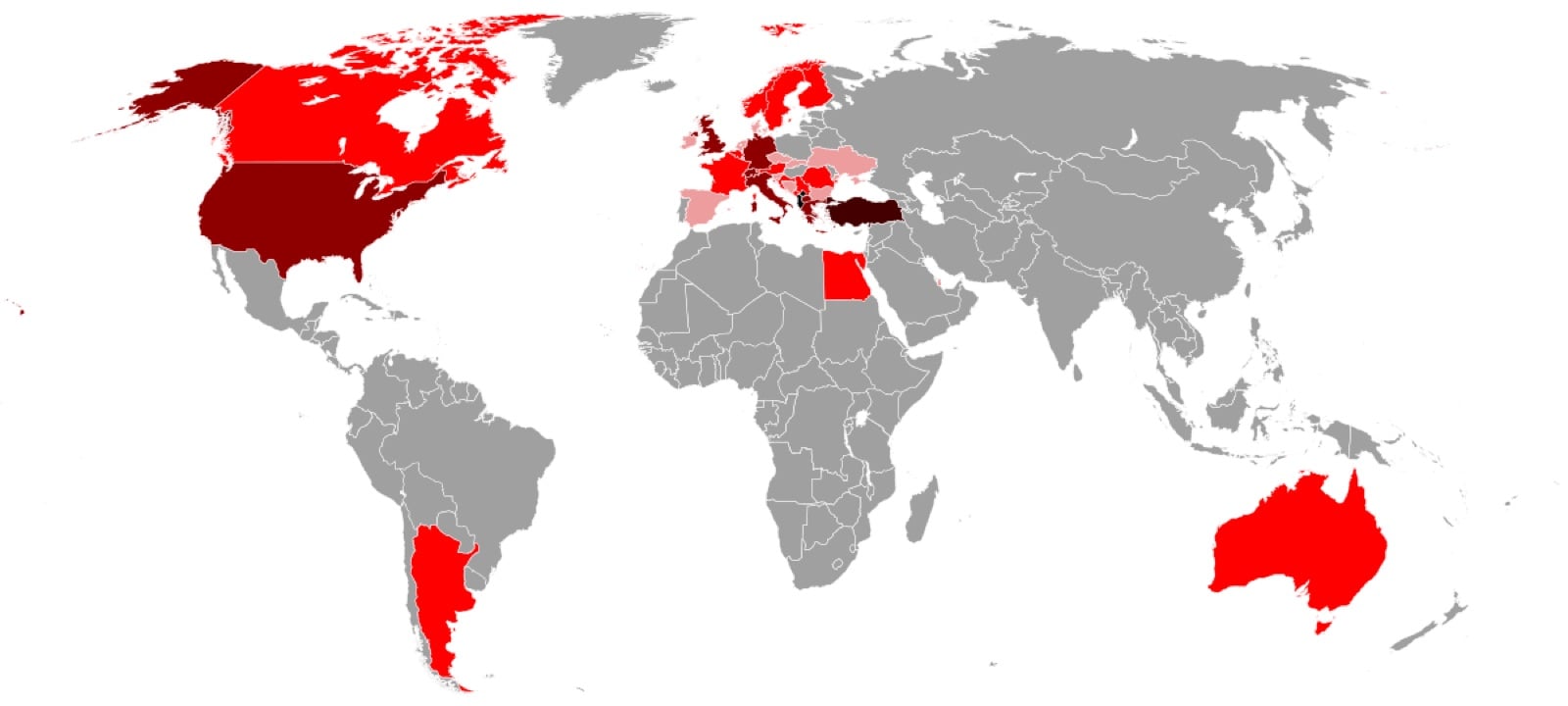 Worldwide distribution of ethnic Albanians — Albania and Kosovo as the Balkan core, with major diaspora populations in Italy, Greece, Turkey, Germany, Switzerland, and the United States.
Map: Wikimedia Commons / CC BY-SA
Worldwide distribution of ethnic Albanians — Albania and Kosovo as the Balkan core, with major diaspora populations in Italy, Greece, Turkey, Germany, Switzerland, and the United States.
Map: Wikimedia Commons / CC BY-SA
The Balkan core
- Republic of Albania — 2,402,113 (2023 census). The titular nation-state.
- Kosovo — 1,585,566 (2024). Albanians are roughly 92% of Kosovo’s population.
- North Macedonia — 446,245. The largest ethnic minority, around 25% of the country, with established political and cultural institutions.
- Montenegro and southern Serbia (Preševo Valley) — sizable Albanian populations, particularly in the southeast Montenegrin coast and the three-municipality Preševo Valley region.
A foundational fact for understanding the geography: when Albania declared independence in 1912, the Treaty of London (1913), with borders finalized by the Florence Protocol (1913), drew borders that left more than half of the ethnic Albanian population outside the new state — divided among Greece, Montenegro, and Serbia. The entirety of Kosovo was assigned to Serbia. This is why ethnic Albanians today live across multiple Balkan countries: not because they migrated there, but because the borders were drawn through them.
The historic diaspora — Italy and Greece
- Italy — Arbëreshë communities (~100,000 active speakers, broader heritage population larger). Albanians have lived in southern Italy and Sicily since the 13th-15th centuries, settled in waves that fled the Ottoman conquest. They speak Arbërisht, a medieval form of Albanian preserved by 500 years of relative isolation. Italy’s total Albanian-origin population, including modern post-1991 immigrants, is approximately 970,000 (Wikipedia: Albanians).
- Greece — 500,000 to 600,000. A combination of historic Arvanites (medieval Albanian settlers in southern Greece, particularly Attica and the Peloponnese) and modern post-1991 Albanian immigrants. Cham Albanians, originally from northwestern Greece, are a separate, smaller group with their own history and dialect.
- Turkey — 500,000 to 6,000,000. The enormous range reflects how disputed the count is. Turkey’s Albanian-descent population includes descendants of Ottoman-era Albanian elites, forced migrants from the late Ottoman period, and Albanians associated with Muhammad Ali’s Egyptian dynasty who later returned to Anatolia.
The modern Western diaspora
- Germany — 200,000 to 300,000
- Switzerland — ~200,000
- France — 33,000 to 75,000
- Sweden — ~54,000
- United Kingdom, Belgium, Netherlands, Denmark, Norway — smaller but established communities
- United States — 230,000 (American Community Survey ancestry) with community estimates closer to 1 million (see our long-form explainer at /blog/albanian-americans)
- Argentina — ~50,000
- Canada — ~39,000
- Australia — ~11,000
The Western diaspora is mostly post-1991, the result of the collapse of Albanian communism and the Yugoslav wars. The exception is the United States, which has had a continuous Albanian-American community since the late 19th century.
The Albanian language
Albanian (shqip) is an Indo-European language and the sole surviving member of the Albanoid branch within the broader Paleo-Balkan group. It has roughly 5 million speakers in the Balkans and several million more in the diaspora, depending on which heritage speakers are counted.
The two main dialects
- Gheg — spoken north of the Shkumbin River. Covers Kosovo, northern Albania, Montenegro, and northern North Macedonia. Also preserved by the small Croatian Arbanasi community.
- Tosk — spoken south of the Shkumbin River. Covers southern Albania, southern North Macedonia, parts of Greece, and the Italian-Albanian Arbëreshë.
Gheg and Tosk are mutually intelligible but distinct enough that older speakers can usually identify a region from the first few sentences.
The endangered diaspora variants
- Arbëresh — spoken in the Italian-Albanian villages of southern Italy and Sicily. Preserves a medieval form of Albanian from the 13th-15th century. Fewer than 100,000 active speakers; UNESCO classifies it as endangered.
- Arvanitika — historically spoken by the Arvanites in southern Greece (Attica, Boeotia, Euboea, the Peloponnese). Severely endangered today; mostly elderly speakers.
- Cham Albanian — historically spoken by the Cham community in northwestern Greece. The dialect declined in Greece due to 20th-century displacement; preserved by Cham communities in Albania and the diaspora.
Standardization
The modern Latin alphabet was settled at the Congress of Manastir (Bitola) in 1908 — a key act of the late Albanian Renaissance, replacing competing Greek, Arabic, and Cyrillic-based scripts. The standard literary form of the language was codified at the Albanian Orthography Conference (Tirana, 1972), which adopted a Tosk-leaning compromise still used today across Albania, Kosovo, and the broader Albanian-speaking world.
The alphabet has 36 letters, including digraphs like dh, gj, ll, nj, rr, sh, th, xh, and zh. Albanian has a definite article that attaches to the end of nouns, a feature shared with Bulgarian and Romanian — a deep structural inheritance from what linguists call the Balkan Sprachbund.
Albanian history in seven acts
Compressing 2,500 years of history into a page is a sin against detail. We accept the sin to give you the shape.
Act 1 — Illyrian roots (pre-Roman through 395 AD)
Indo-European peoples (including Pelasgian-speaking groups) settled the western Balkans in deep antiquity. By the 5th-2nd centuries BC, Illyrian kingdoms — most famously the kingdom of Queen Teuta — controlled the Adriatic coastline. Rome conquered Illyria progressively after 229 BC. After the Roman Empire’s split in 395 AD, the region passed to the Eastern Roman (Byzantine) sphere.
Act 2 — Medieval Albania (5th-14th c.)
Successive waves of Slavic, Bulgarian, Norman (under Manfred of Sicily), and Serbian (under Stefan Dušan) rule passed through the region. In 1190, the Principality of Arbanon was established with its capital at Krujë — the first Albanian polity to enter the historical record. Through the 14th century, regional Albanian principalities (the Thopia and Muzaka families among them) competed and consolidated.
Act 3 — Skanderbeg and Ottoman resistance (1444-1479)
In 1444, Gjergj Kastrioti Skanderbeg unified the Albanian principalities at the League of Lezhë and led a 25-year resistance against the expanding Ottoman Empire. He defeated Ottoman armies repeatedly and held Albanian independence until his death in 1468. Albania fell to the Ottomans by 1479 (with Durrës, the last holdout, falling 1506).
Skanderbeg remains the central national hero of Albanians worldwide. His double-headed eagle banner is the foundation of the modern Albanian flag.
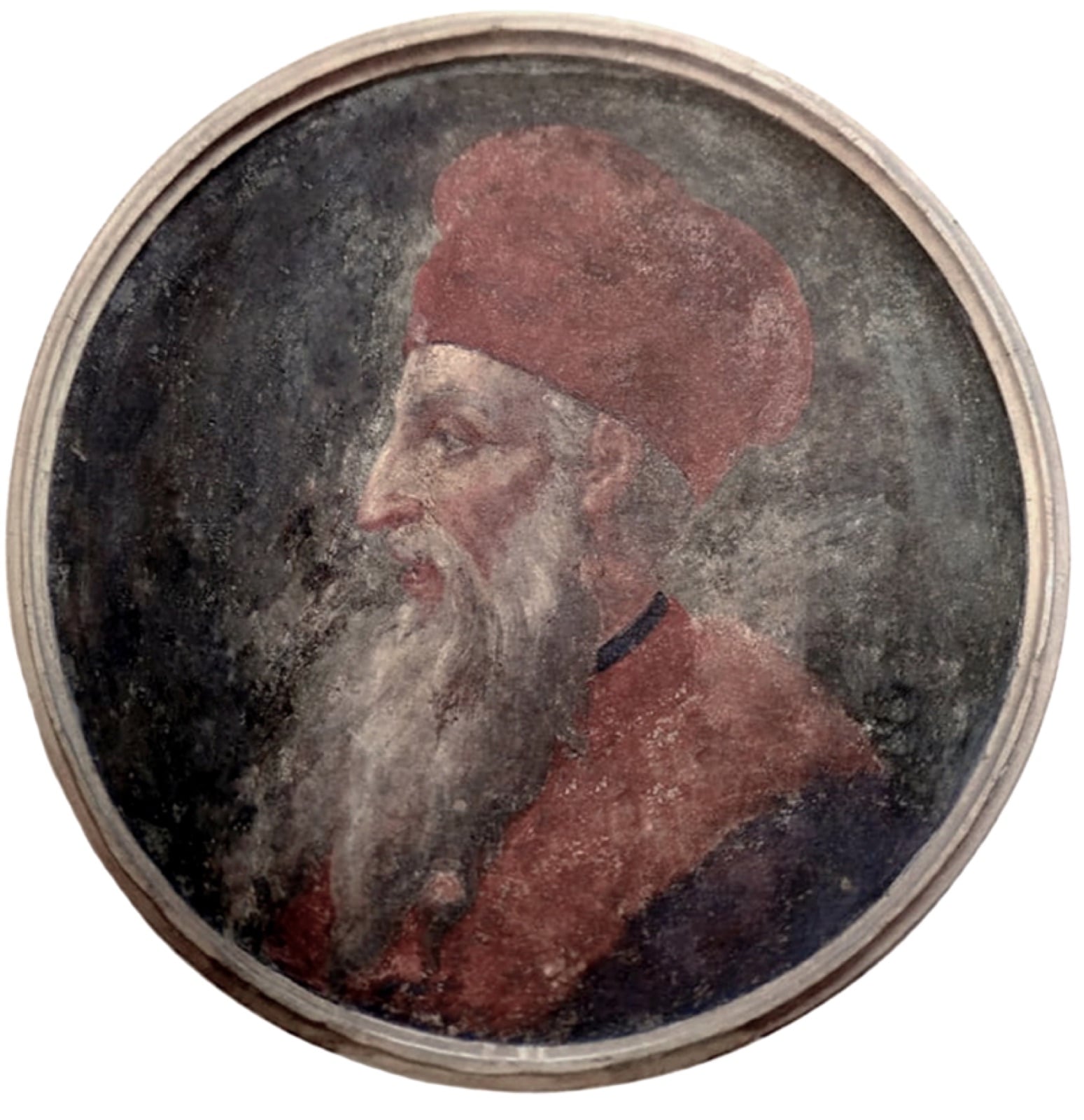 Gjergj Kastrioti Skanderbeg (1405–1468), 1466 portrait — held at Palazzo Skanderbeg, Rome. Led the 25-year Albanian resistance against the Ottoman Empire from the League of Lezhë (1444) until his death.
Photo: Wikimedia Commons / public domain
Gjergj Kastrioti Skanderbeg (1405–1468), 1466 portrait — held at Palazzo Skanderbeg, Rome. Led the 25-year Albanian resistance against the Ottoman Empire from the League of Lezhë (1444) until his death.
Photo: Wikimedia Commons / public domain
Act 4 — Ottoman Albania (1479-1912)
The Ottoman conquest set off the first great Albanian migration: roughly a third of the population fled westward to Italy, Sicily, and Dalmatia. Their descendants are today’s Arbëreshë.
For those who stayed, the late 16th and 17th centuries brought widespread conversion to Islam — a result of Ottoman policy, economic incentive, and tax pressure on non-Muslims. By the late 17th century, around two-thirds of Albanians were Muslim, often retaining Christian practices privately. Under Ottoman rule, Albanians achieved unusual prominence in imperial government: more than 40 Grand Viziers were Albanian, including the legendary Köprülü family that oversaw the empire’s greatest 17th-century expansion. Muhammad Ali Pasha of Egypt — born in a village in Albania (most likely Zëmblak, near Korçë) and raised from childhood in the port city of Kavala — founded a dynasty that ruled Egypt and Sudan into the mid-20th century, leaving a substantial Albanian community in Egypt.
Act 5 — Albanian Renaissance and Independence (19th c.-1912)
The 19th century brought Rilindja — the Albanian Renaissance — a cultural and political awakening that produced the first standardized Albanian texts, the first Albanian-language schools, and the first organized national movement. Key milestones: the League of Prizren (1878) asserted Albanian political identity against Ottoman partition plans; the Congress of Manastir (1908) unified the alphabet; and on November 28, 1912, Albanian independence was declared in the southern coastal city of Vlora.
The geographic catch came almost immediately. The Treaty of London (1913), finalized on the ground by the Florence Protocol (1913), drew Albania’s borders to leave more than half the ethnic Albanian population outside the new state — Kosovo to Serbia, Çamëria to Greece, parts of present-day North Macedonia and Montenegro to neighboring states. This partition is the historical root of why “Albanians” and “the population of Albania” are not the same set.
Act 6 — 20th century turbulence (1913-1991)
Albania survived occupation by six different armies during World War I, was nominally independent through the interwar period, was crowned a kingdom under King Zog in 1928, and was invaded by Italy in 1939 and Germany in 1943. In 1944, Enver Hoxha led the communist takeover and ruled until his death in 1985. Communist Albania broke with Yugoslavia in 1948, with the Soviet Union in 1961, and with China in 1978 — ending its 45-year communist period in nearly total international isolation.
Across the border in Yugoslavia, Albanians in Kosovo, North Macedonia, and Montenegro lived through a different 20th century — a long stretch of systematic discrimination, the 1981 Kosovo protests, and the 1989 revocation of Kosovo’s autonomy by Slobodan Milošević.
Act 7 — Post-communism, the Kosovo war, and the modern era (1991-present)
In 1991, Albanian communism collapsed. The 1990s brought economic chaos, mass emigration, and the 1997 pyramid-scheme crisis. Across the border, the Kosovo War (1998-1999) ended with a NATO intervention. Kosovo declared independence in 2008 and is now recognized by approximately half of UN member states. Albania became an EU candidate in 2014; Kosovo applied for EU membership in 2022. Modern Albania, post-isolation, is one of the most rapidly opening societies in Europe.
We present this section without partisan framing. The Kosovo question, Greek-Albanian relations, and the North Macedonia naming question are politically active topics; the National Albanian Registry’s role is to record what the historical record contains, not to advocate.
Religion: a defining feature of Albanian society is religious pluralism
Albanians are unusual among European nations in being durably multi-confessional. Approximate breakdown:
- Sunni Muslim (~50-60%) — the majority, concentrated in central and northern Albania, Kosovo, North Macedonia, and the Albanian-Turkish diaspora.
- Bektashi Sufi (~5-10%) — a heterodox Islamic order with a strong Albanian following. The Bektashi World Center is in Tirana, and Bektashism is recognized by the Albanian state as one of the country’s four traditional faiths.
- Roman Catholic (~10%) — concentrated in northwestern Albania around Shkodër, with significant Catholic Albanian communities in Kosovo, Montenegro, and the United States diaspora.
- Albanian Orthodox (~7%) — concentrated in southern Albania (Korçë, Berat, Gjirokastër), the historic Tosk-Orthodox heartland; the Autocephalous Albanian Orthodox Church was recognized in 1937.
- Non-religious / secular — a sizable segment, particularly in Albania itself, where the Hoxha regime declared Albania the world’s first atheist state in 1967 and banned all religion until 1990.
“The religion of the Albanians is Albanianism”
The line is from Pashko Vasa, an Albanian Renaissance writer, in his 1880 poem O moj Shqypni (“Oh, Albania”). It was a 19th-century nationalist slogan written to argue that ethnic and linguistic identity should hold the community together across religious lines, not a literal description of how every Albanian today thinks about faith. Devout Sunni, Bektashi, Catholic, and Orthodox communities exist alongside secular Albanians, and each is real on its own terms. The slogan describes one widely held attitude, not the whole picture. Where it does hold up: mixed-faith villages are common across Albania, mixed-faith marriages are unremarkable, and national holidays — Independence Day (November 28) and Skanderbeg Day (January 17) — cross every confessional line without comment.
This matters for how the diaspora works. Albanian-American Catholic, Orthodox, Sunni, and Bektashi communities share the same cultural events, the same language schools, and increasingly the same institutions. NAR speaks to each, equally.
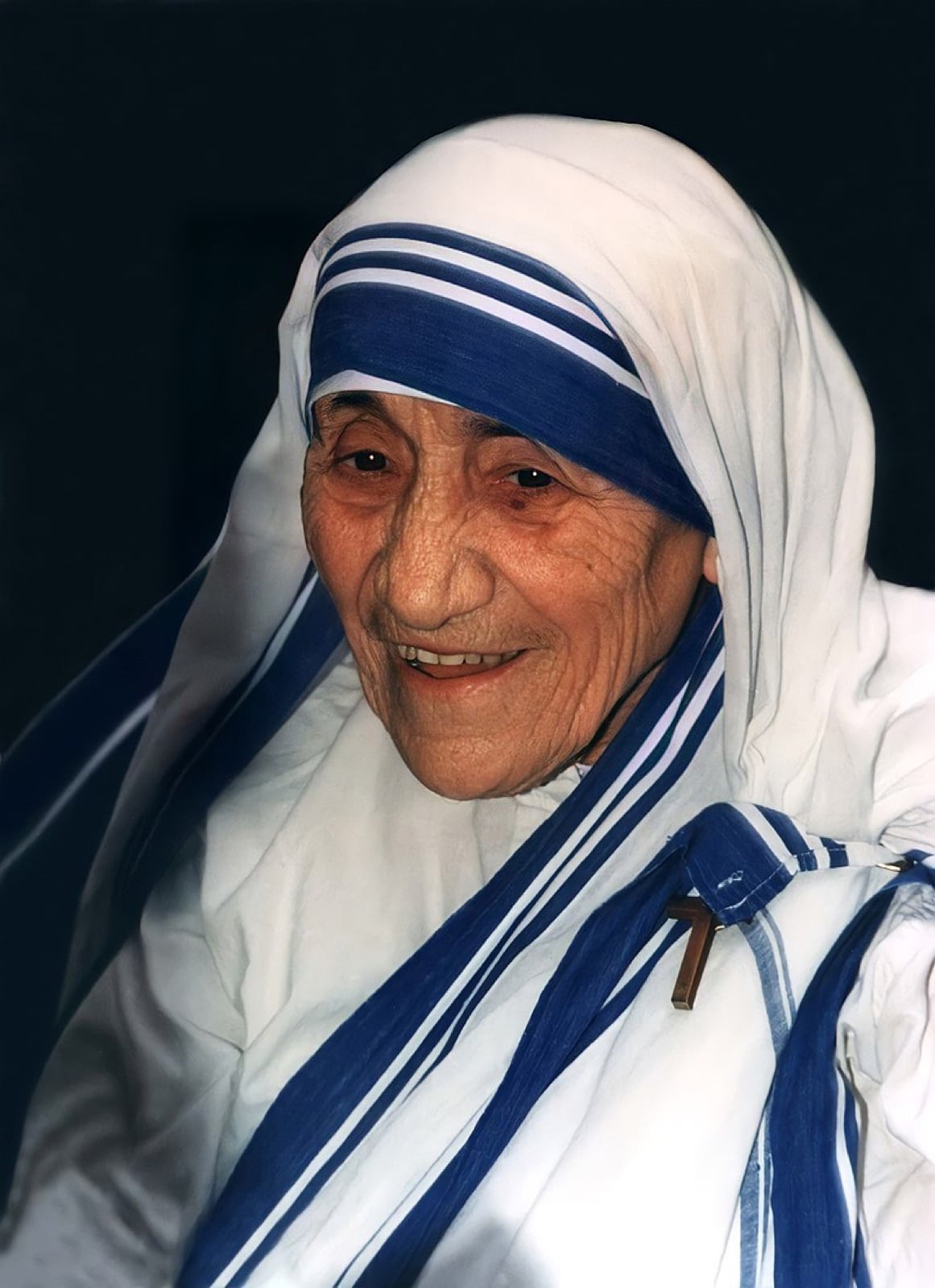 Mother Teresa (Anjezë Gonxhe Bojaxhiu, 1910–1997), photographed 1995 — born in Skopje to an Albanian Catholic family from Shkodër; founded the Missionaries of Charity in Calcutta, 1950.
Photo: Túrelio via Wikimedia Commons / CC BY-SA 3.0
Mother Teresa (Anjezë Gonxhe Bojaxhiu, 1910–1997), photographed 1995 — born in Skopje to an Albanian Catholic family from Shkodër; founded the Missionaries of Charity in Calcutta, 1950.
Photo: Túrelio via Wikimedia Commons / CC BY-SA 3.0
Culture and identity markers
A few of the cultural elements that the diaspora carries hardest:
The Kanun. Customary law codified in the late medieval period, most famously The Code of Lekë Dukagjini (named for a 15th-century chieftain). Governs family, hospitality, honor, blood feud, and inheritance. Translated to English in 1989 by Leonard Fox. Still partially active in some northern Albanian and Kosovar regions; primarily of historical and cultural interest elsewhere.
Besa. The Albanian code of honor. Besa is the binding word — once given, it must be kept to the death. Besa-besën — loyalty in trust — is the foundational social contract. During World War II, besa obligated Albanians to shelter Jewish refugees from German and Italian forces; Albania is the only country in occupied Europe whose Jewish population grew during the war.
Kângë kreshnikësh — epic frontier songs. A still-living oral epic tradition sung in the highlands of northern Albania and Kosovo. The closest Western parallel is the Homeric oral tradition. Albanian iso-polyphony — multi-voice unaccompanied singing from southern Albania — is inscribed in UNESCO’s list of Intangible Cultural Heritage.
Folk instruments. The qifteli (a two-string long-necked lute) and the lahutë (a one-string fiddle used to accompany the kreshnikësh epics) are the two instruments most associated with Albanian folk music.
Traditional dress. The fustanella — the white pleated skirt worn by men in southern Albania (and shared with Greece). The plis — the white felt skullcap worn across northern Albania and Kosovo. The xhubleta — the bell-shaped skirt-coat worn by women in the northern highlands; itself a UNESCO heritage element.
The double-headed eagle. Black on red, the flag of Albania and a symbol used across Albanian communities worldwide. Historically a Byzantine imperial symbol, taken up by Skanderbeg in the 15th century and carried through to today.
The diaspora is not new
Most ethnic groups have a small, recent diaspora. Albanians have an old, large one.
By 1500, Arbëreshë communities were established in dozens of villages across southern Italy and Sicily — they have lived in those places for over 500 years and still speak a medieval form of Albanian. The Arvanites of southern Greece settled even earlier, from the 14th century, and shaped the modern Greek state more than is generally remembered.
A second diaspora wave moved through the 18th-19th centuries, sending small Albanian communities to southern Croatia (the Arbanasi) and southern Ukraine. A third wave — late 19th through early 20th century — established the original Albanian-American communities in Boston, New York, Detroit, and the Connecticut River Valley, alongside smaller communities in Argentina and Australia.
A fourth wave, after 1991, is the largest and most recent: the post-communist emigration that built the modern German, Swiss, Italian, Greek, and second-generation Albanian-American communities.
Six hundred years of continuous diaspora movement means a few things. It means there is no single Albanian dialect, no single Albanian cuisine, no single Albanian religion — there are layered, regional Albanian identities, all genuine. It also means the global Albanian community is much larger than the population of Albania, and has been for centuries.
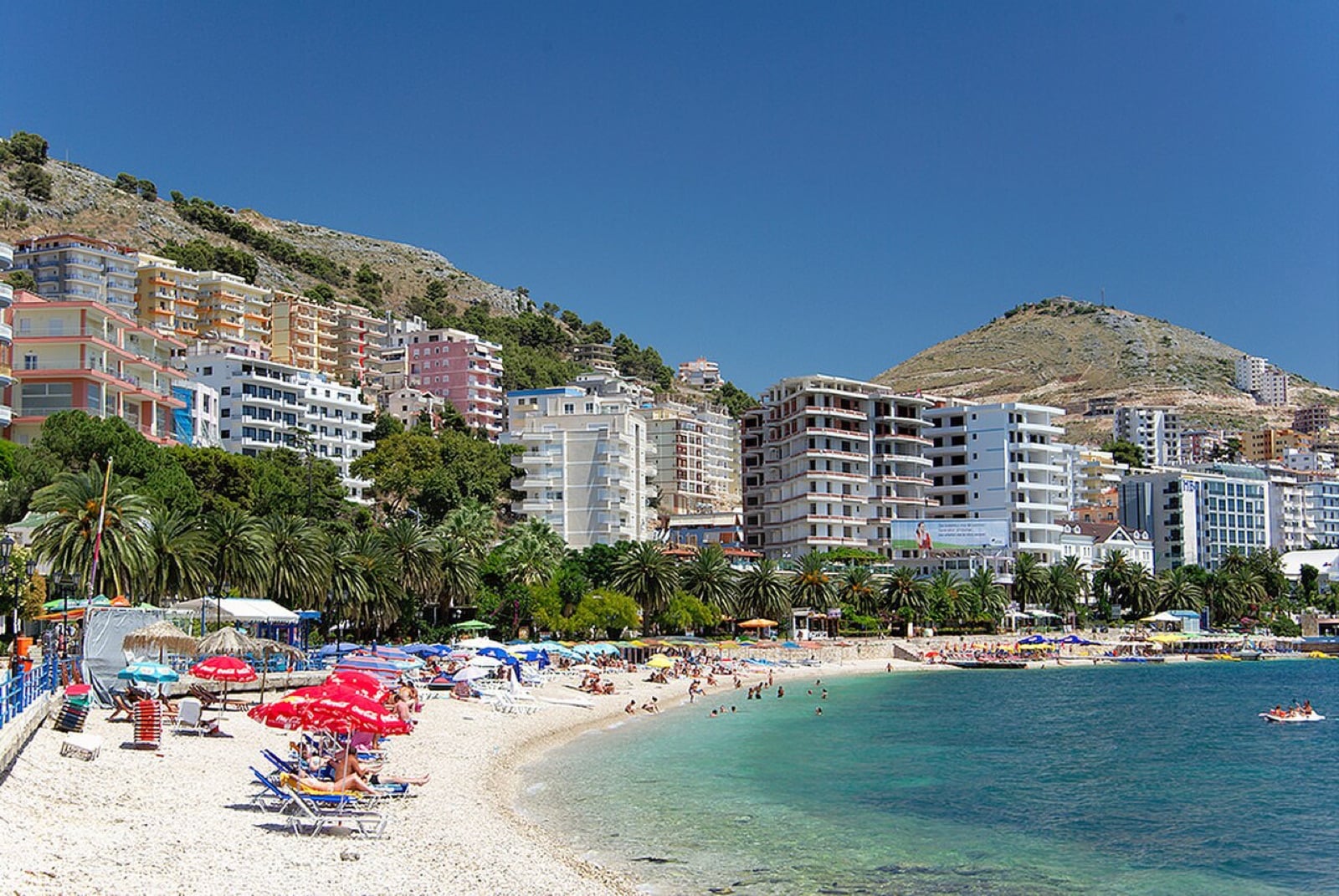 Sarandë promenade along the Ionian Sea, southern Albania (2016) — the southern Tosk-Orthodox heartland and one of Albania’s largest coastal cities.
Photo: Wikimedia Commons / CC BY-SA 4.0
Sarandë promenade along the Ionian Sea, southern Albania (2016) — the southern Tosk-Orthodox heartland and one of Albania’s largest coastal cities.
Photo: Wikimedia Commons / CC BY-SA 4.0
The undercount problem
If you’ve ever wondered why estimates of the global Albanian population vary by 3 million people, here is part of the answer.
Census methodologies miss Albanians. Pre-1912 immigrants to the United States, Australia, and Argentina were frequently filed under “Greek,” “Turk,” or “Yugoslav” by enumerators, depending on which empire they had emigrated from. Many of those families’ descendants today have no idea their ancestors were Albanian.
Modern Yugoslav-origin Albanians are split across categories. Kosovar, North Macedonian, and Montenegrin Albanians sometimes report ancestry as “Yugoslav” or by country of birth rather than as ethnic Albanians, especially in older census waves.
Heritage variants get classified separately. Italian Arbëresh, Greek Arvanites, Croatian Arbanasi, and Ukrainian Albanians are often counted as Italian, Greek, Croatian, or Ukrainian — even though their families have spoken Albanian dialects continuously for hundreds of years.
Second- and third-generation diaspora drift off the count. A third-generation Albanian-American who marks “American” on the ancestry question vanishes from the official numbers, even if they grew up eating byrek and going to Mass at an Albanian Orthodox parish.
This is not a failure of any one census. It’s a structural feature of trying to count a 600-year-old, multi-confessional, multi-country diaspora using forms designed for tidier categories. It is also why a community-led count matters.
Add yourself to the count
Albanians are not just the people of Albania. They are the people of Kosovo, North Macedonia, Montenegro, and the Preševo Valley. They are Italy’s Arbëresh and Greece’s Arvanites. They are Turkey’s centuries-old Albanian community and Egypt’s Albanian-descent families. They are the German, Swiss, Swedish, French, and Belgian post-1991 communities. They are the Albanian-American families who arrived in 1900, 1950, 1991, and last year. They are the second-generation kid in Massachusetts whose grandfather came from Korçë and the third-generation researcher in California who just learned where her great-grandmother was born.
The National Albanian Registry exists to make all of that visible — to build a community-led count of Albanian Americans that connects the diaspora across generations. We are a 501(c)(3) nonprofit. Joining is free, the certificate of recognition is free, and your data is yours.
If you’re Albanian — by any of the routes described above — you can add yourself to the count at albanianregistry.org/register.