
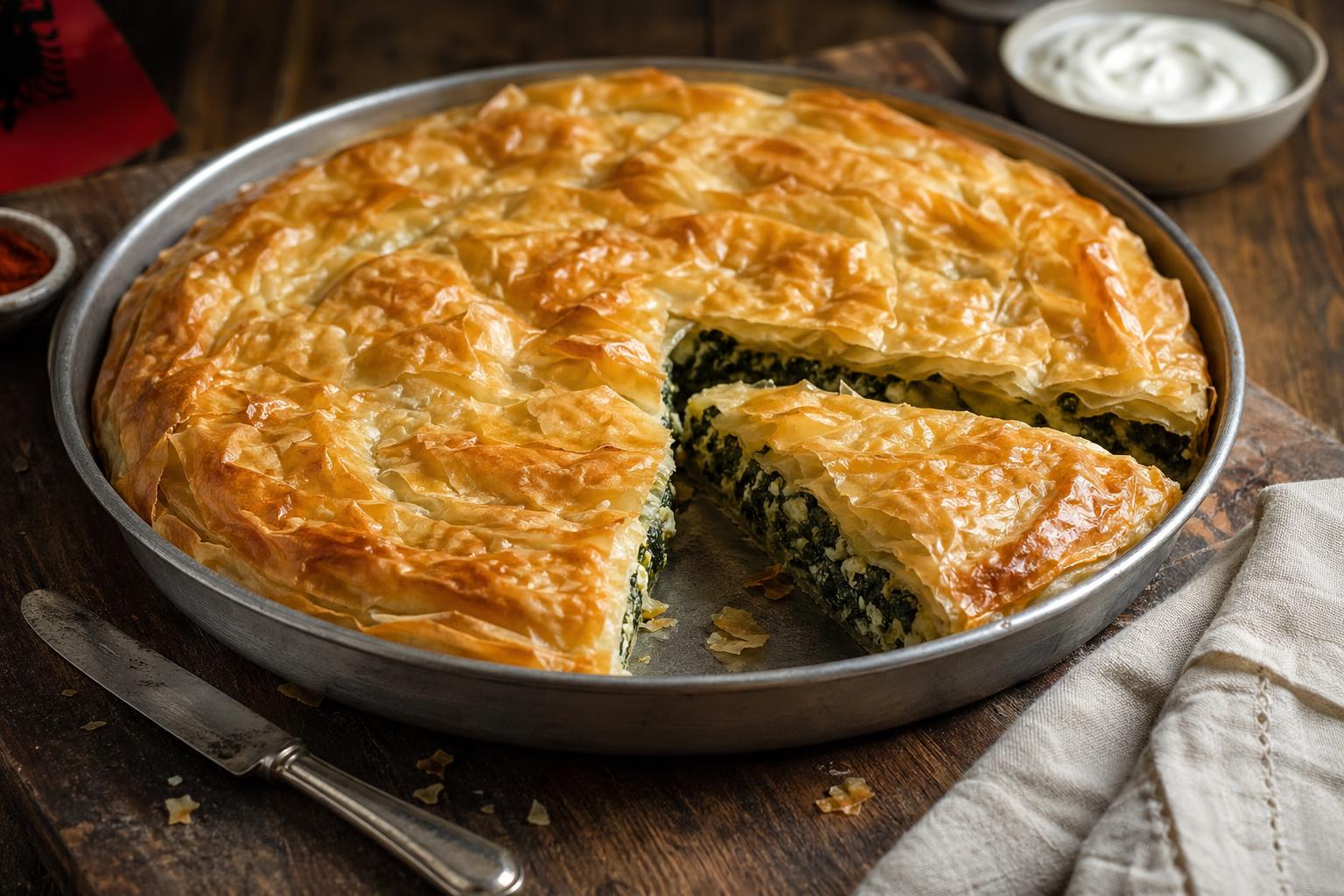
Byrek is the Albanian filo pastry — paper-thin layers of dough, a savory filling, baked in a round pan until the top is deep golden. It is one of the most common dishes in the Albanian diaspora and the one that shows up everywhere: Sunday family lunch, holiday tables, meze spreads with raki, and weeknight dinners when there are leftovers in the fridge.
The name comes from the Turkish börek, but the Albanian version is its own dish. Bigger pan, thinner layers, a different filling logic, and a strong preference for olive oil over butter. This piece covers what byrek is, the regional variations, the traditional recipe at home-kitchen scale, and how to serve it.
What Byrek Is
Byrek is a layered filo pie. The structure is simple: a stack of 5 to 12 paper-thin sheets of dough on the bottom, a savory filling spread across them, another stack of sheets on top, and olive oil brushed between each layer. It bakes in a round metal pan — the tepsi — at moderate-high heat until the top puffs slightly and turns deep gold. It cuts into wedges or squares and serves warm or at room temperature.
The dough is petë — Albanian filo, traditionally rolled by hand on a wooden board with a long thin pin. A good cook produces sheets thin enough to read newsprint through. The diaspora reality is that almost everyone now uses frozen phyllo from the supermarket, and that is fine. The ratio of layers to filling matters more than whether the sheets came from a hand or a freezer.
The filling is where regions and families diverge, but the categories are stable: cheese, spinach, meat, leeks, pumpkin, wild greens, beets. The naming follows a pattern — byrek me [filling]. Byrek me spinaq is spinach byrek. Byrek me djath is cheese byrek. Byrek me mish is meat byrek. The pattern travels.
A few things separate Albanian byrek from its cousins. Compared to Greek spanakopita — usually a spinach-and-feta filling bound with egg — the Albanian version uses kaçkavall or feta but layers the filo more thinly and spans far more filling categories than just spinach. Compared to Turkish börek, the Albanian byrek is bigger and built for a communal pan rather than rolled into individual cigars or coiled rosettes; the cut on an Albanian table is a wedge, not a piece. Compared to Bulgarian banitsa, whose filling mixes cheese, yogurt, and egg between the layers, Albanian byrek leans on a plain-olive-oil brush between sheets. The result is lighter and crisper on top, with a flakier shatter when you cut in.
Two related Albanian pies belong in the same family. Lakror, the southern Albanian pie, is sometimes classified as a byrek variant; it shares the layered structure but the filling tends to be greens or meat with a thinner top crust. Fli, the northern Albanian dish, is built differently — alternating layers of flour-and-water batter brushed with cream and butter, baked slowly under a saç (dome-shaped lid with embers piled on top). Fli is not byrek, but it lives in the same culinary neighborhood.
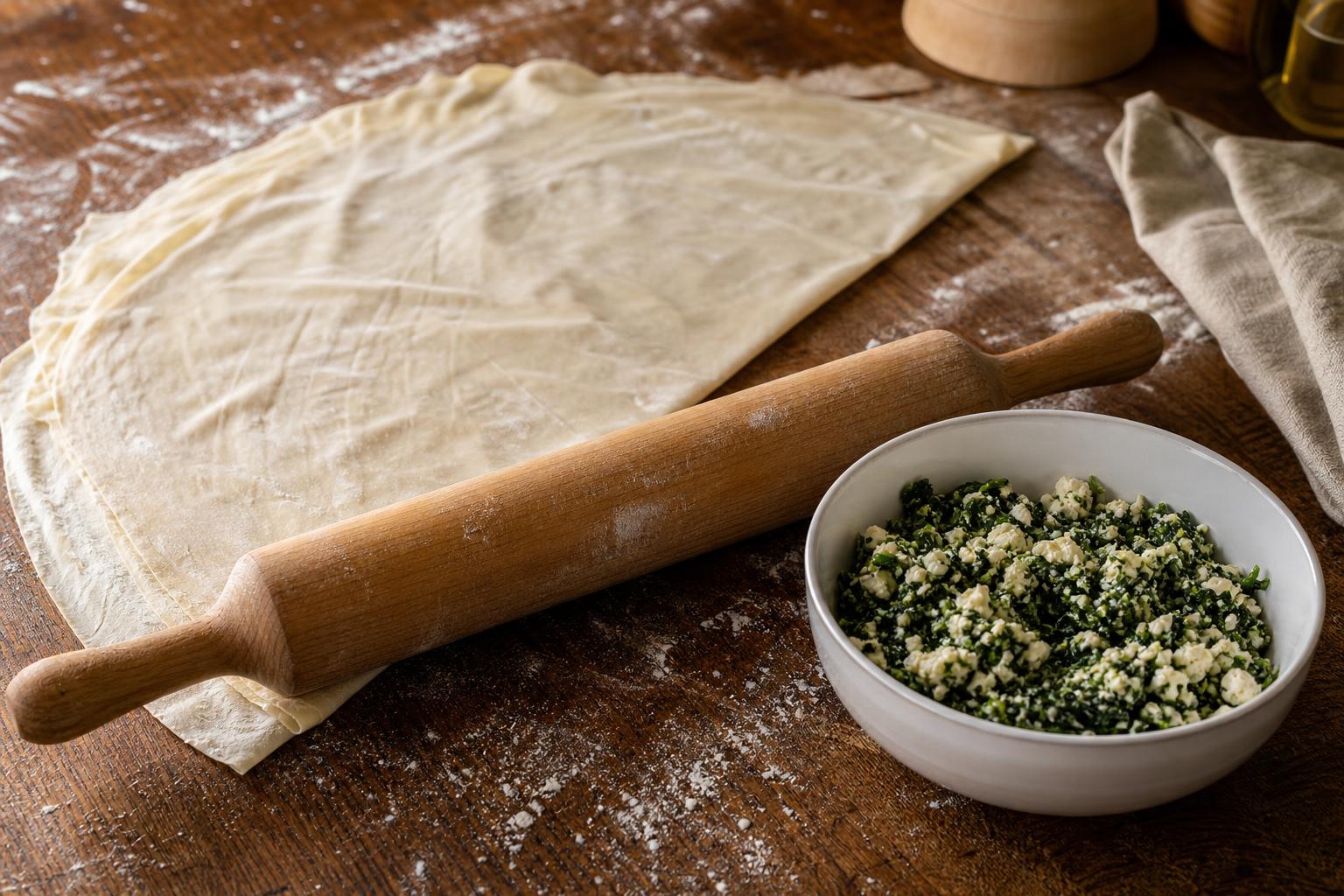 Hand-rolled petë (Albanian filo) and a bowl of spinach-and-cheese filling — the two components every byrek starts from. — Graphic by NAR
Regional Variations
Albanian byrek is not one recipe. The country splits geographically and culturally between the south (Tosk) and the north (Gheg), and the byrek tradition splits with it.
South Albania (Tosk-style). More olive oil, thinner layers, lighter fillings. Greens dominate: spinach, leeks, lakra (wild greens picked from the hillsides in spring), nettles. The Tosk byrek is closer to the Mediterranean — olive oil, herbs, vegetables — and pairs naturally with the southern table of feta, olives, and tomato salads. The southern dish lakror, a regional pie sometimes classified as a byrek cousin, lives in this register.
North Albania (Gheg-style). More cheese, denser fillings. The northern byrek often mixes kos (yogurt) into the filling for richness, and sometimes uses butter alongside oil between layers. Cheese-only byreks (byrek me djath) are common, as are versions with cheese plus eggs and a touch of yogurt. The northern table runs heavier — corn bread, stews, more dairy — and the byrek follows.
Kosovar. Kosovo’s byrek tradition leans toward meat — usually beef and onion, sometimes with a hint of paprika — and toward the spiral or coiled form (byrek i mbledhur) that resembles Bosnian burek. Cheese versions are common too, but the meat-and-onion variant is the signature.
Arbëresh (Italian Albanian). The Arbëresh communities of southern Italy preserve a 15th-century Albanian foodway and have their own pie traditions, often with greens, ricotta, and local Italian cheeses. The pies are sometimes called petulla or carry Italianized names, but the layering logic and the filling categories trace back to the same source.
Çam and North Macedonian. Çam Albanians (originally from northwestern Greece) and the Albanian communities of North Macedonia each have local variations — heavier on certain greens, sometimes with cornmeal in the filling, sometimes with a different oil-to-layer ratio. None is wrong; all are byrek.
The diaspora muddies these lines. A Kosovar grandmother in the Bronx and a Tosk grandmother in Worcester end up cooking with the same supermarket phyllo and similar feta, and the regional tells get fainter with each generation.
The Cultural Anchor
Byrek is the dish that anchors Albanian gatherings. Darka — the dinner gathering that runs long, with multiple courses and louder voices as the evening wears on — almost always has a byrek somewhere on the table. So does Easter (Pashkë), Bajram (Eid), Christmas, and the Sunday family lunch that is its own quiet weekly ritual.
In the diaspora, byrek carries a second weight: it is the recipe most often passed grandmother-to-granddaughter, and the recipe most often lost when a generation does not write it down. The grandmothers cooked without measuring. They knew the dough was right by feel, the filling by taste, the pan by the way the oil hissed when it hit. When that generation is gone and no one wrote it down, what survives is a memory of a dish, not the dish itself.
Writing the numbers down is part of how byrek survives. So is teaching the technique — the brush of oil, the squeeze of the spinach, the trim of the edges — to whoever is in the kitchen the next time the family gathers.
Byrek also crosses every line in Albanian-American life. Catholic, Orthodox, Muslim, Bektashi, secular — every household serves it. Northern, southern, Kosovar, Arbëresh — every region has a version. There are very few foods that travel that broadly across the Albanian diaspora without losing their identity. Byrek is one of them.
The Traditional Recipe
This is the spinach-and-cheese byrek (byrek me spinaq dhe djath), the most common diaspora version. It uses ingredients available in any US supermarket and yields a 12-inch round pan. Serves 6 to 8.
Ingredients
- 1 lb (450g) frozen filo dough (phyllo), thawed overnight in the refrigerator
- 1 lb (450g) frozen chopped spinach, thawed and squeezed dry
- 1 cup (220g) feta cheese, crumbled
- 1 cup (240g) ricotta cheese (or gjizë, Albanian whey cheese, if you can find it)
- 2 large eggs
- ½ cup (120 ml) olive oil, for brushing
- 1 tsp kosher salt
- ½ tsp freshly ground black pepper
- Optional: a pinch of grated nutmeg
A note on the filo: thaw it overnight in the refrigerator, not on the counter. A counter thaw produces uneven moisture and the sheets crack when you unfold them. Once it is open, work fast and keep the unused stack covered with a slightly damp kitchen towel. Filo dries in minutes and dry filo shatters.
A note on the cheese: feta carries the salt and the tang; ricotta or gjizë carries the body. Both matter. All-feta byrek comes out too sharp; all-ricotta comes out flat. The mix is the point.
Equipment
- A 12-inch round metal baking pan (a tepsi), or a 12-inch round cake pan with at least 2-inch sides
- A pastry brush
- A clean kitchen towel, slightly damp
- A large bowl
How to Make Spinach-and-Cheese Byrek
Step 1 — Preheat and prep (5 minutes)
Heat the oven to 375°F (190°C). Brush the round pan with a thin layer of olive oil, including the sides. Set aside.
Step 2 — Make the filling (5 minutes)
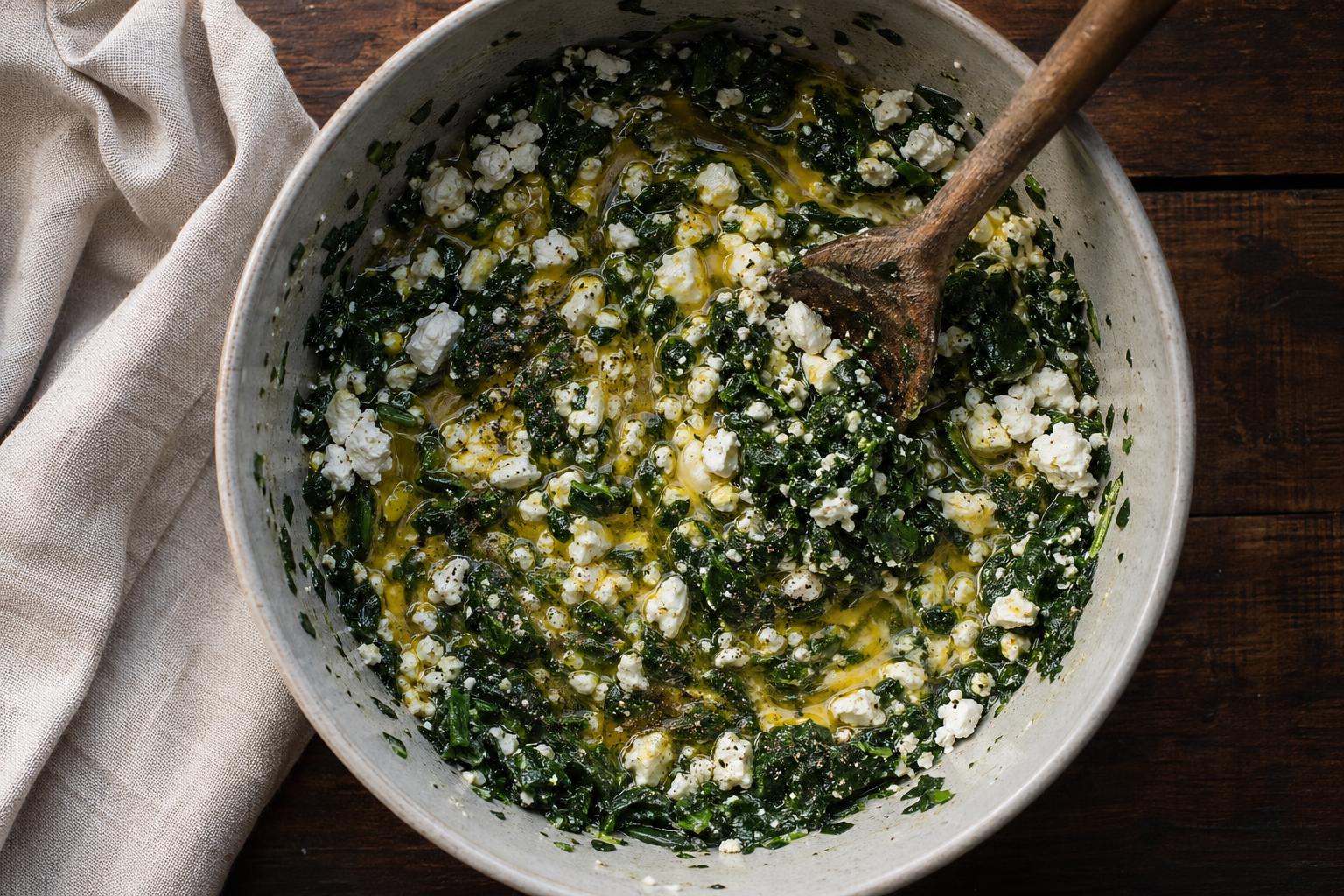 Step 2: the filling — squeezed-dry spinach, feta, ricotta, eggs, salt, pepper, mixed until uniform. — Graphic by NAR
Squeeze the thawed spinach hard. Wring it in a clean kitchen towel or press it through a fine-mesh strainer until almost no water comes out. This is the single most important moisture step; under-squeezed spinach is what makes byrek soggy.
In a large bowl, combine the squeezed spinach, crumbled feta, ricotta, eggs, salt, pepper, and nutmeg if using. Mix with a fork until uniform. The filling should look thick and slightly tacky, not wet.
Step 3 — Layer the bottom (10 minutes)
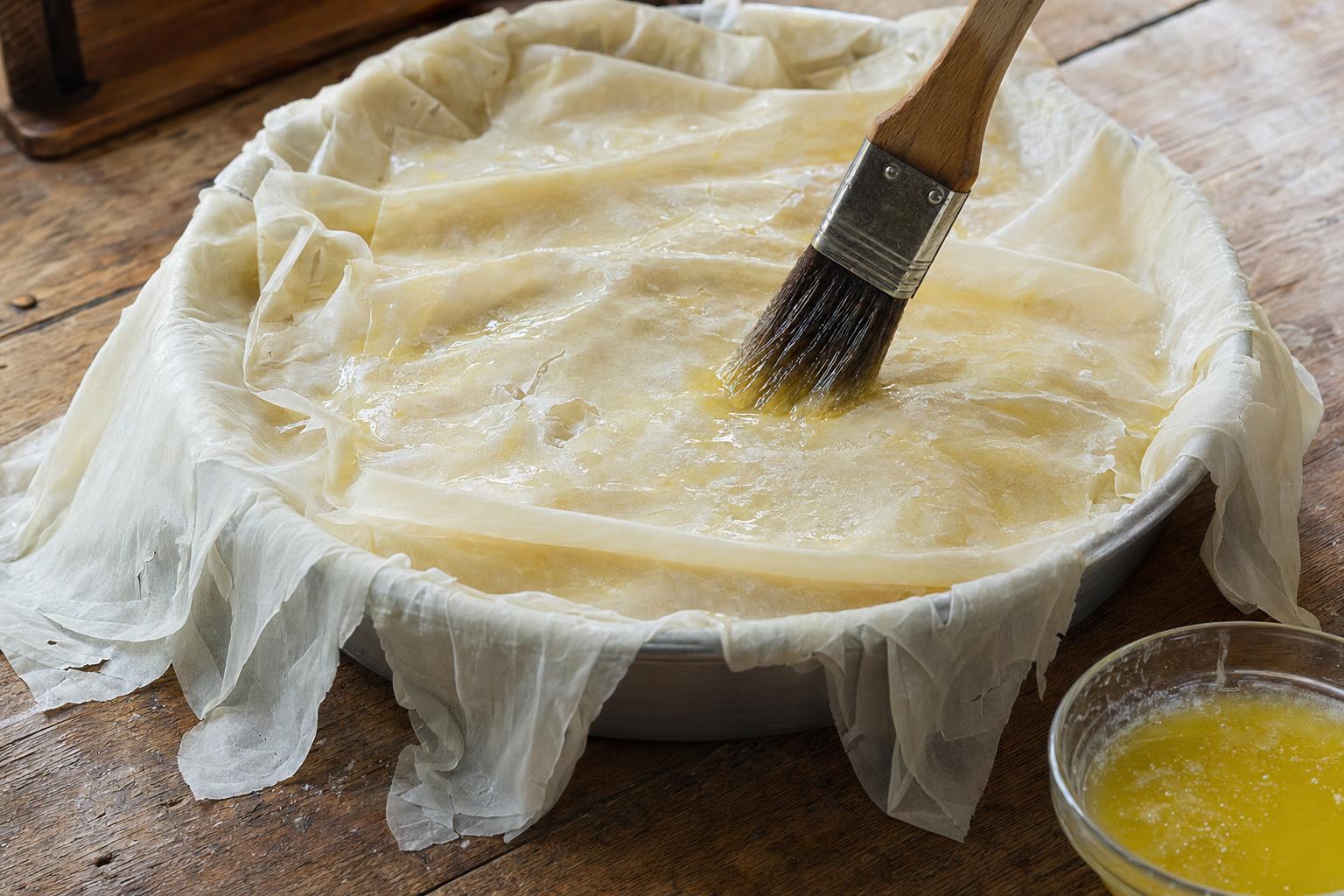 Step 3: layering the bottom — 8 to 10 filo sheets in the tepsi, each brushed with a thin coat of olive oil. — Graphic by NAR
Unroll the filo. Lay one sheet in the pan and brush lightly with olive oil. The brush should glide; do not flood the sheet. Lay a second sheet on top, brush. Repeat until you have 8 to 10 sheets stacked. The sheets will overhang the pan — that is correct. You will tuck them in later.
Keep the unused filo covered with the damp towel the whole time.
Step 4 — Spread the filling (2 minutes)
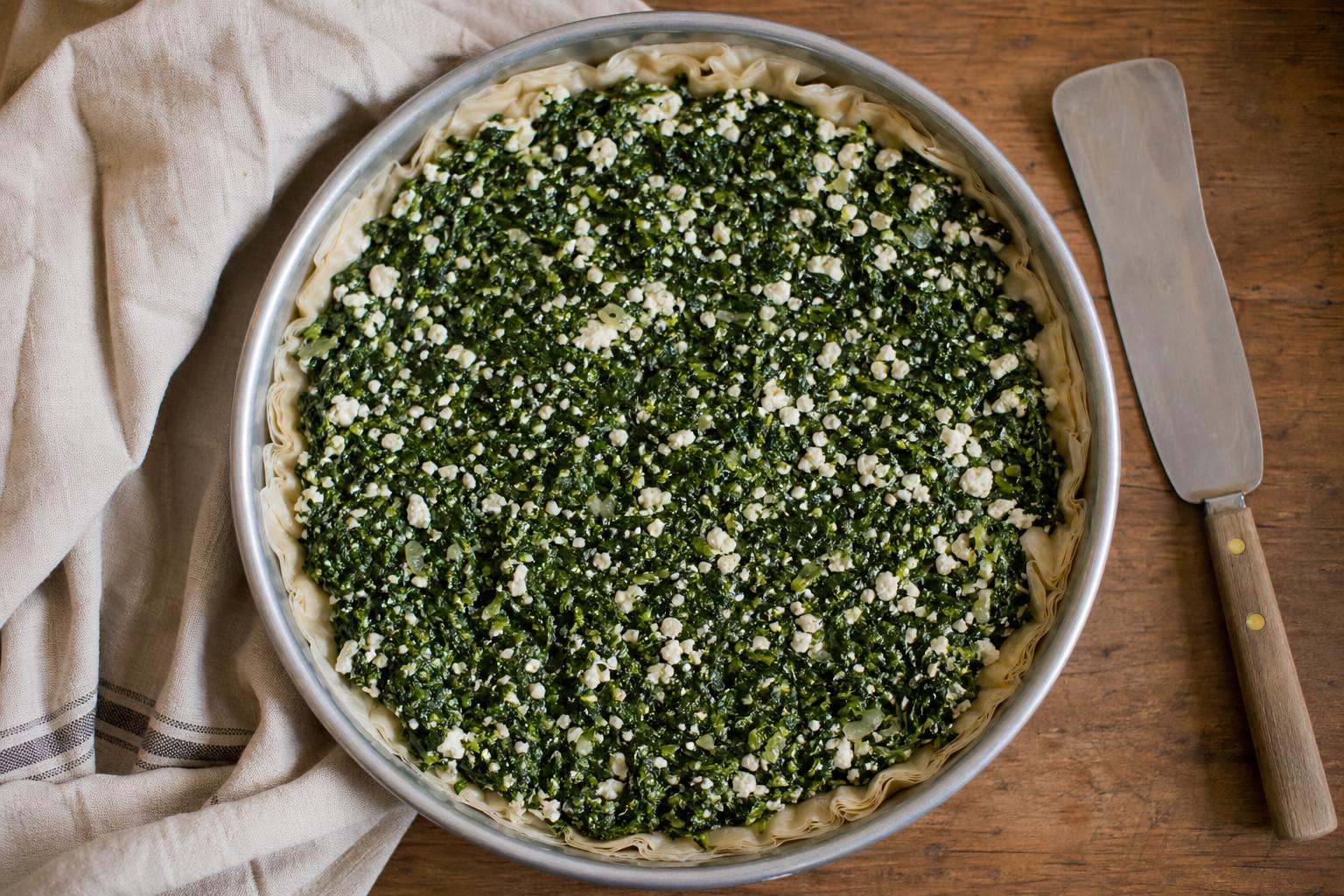 Step 4: filling spread to the edges of the pan in an even layer before the top stack of filo goes on. — Graphic by NAR
Spoon the filling onto the filo and spread it in an even layer all the way to the edges of the pan. Even thickness matters — a thicker spot in the middle causes a soft center and a thin edge causes a burnt edge.
Step 5 — Layer the top (10 minutes)
Lay a sheet of filo over the filling and brush with oil. Repeat for 8 to 10 more sheets. Brush the very top sheet with a slightly heavier coat of oil — that is what produces the deep-gold finish.
Step 6 — Trim and score (3 minutes)
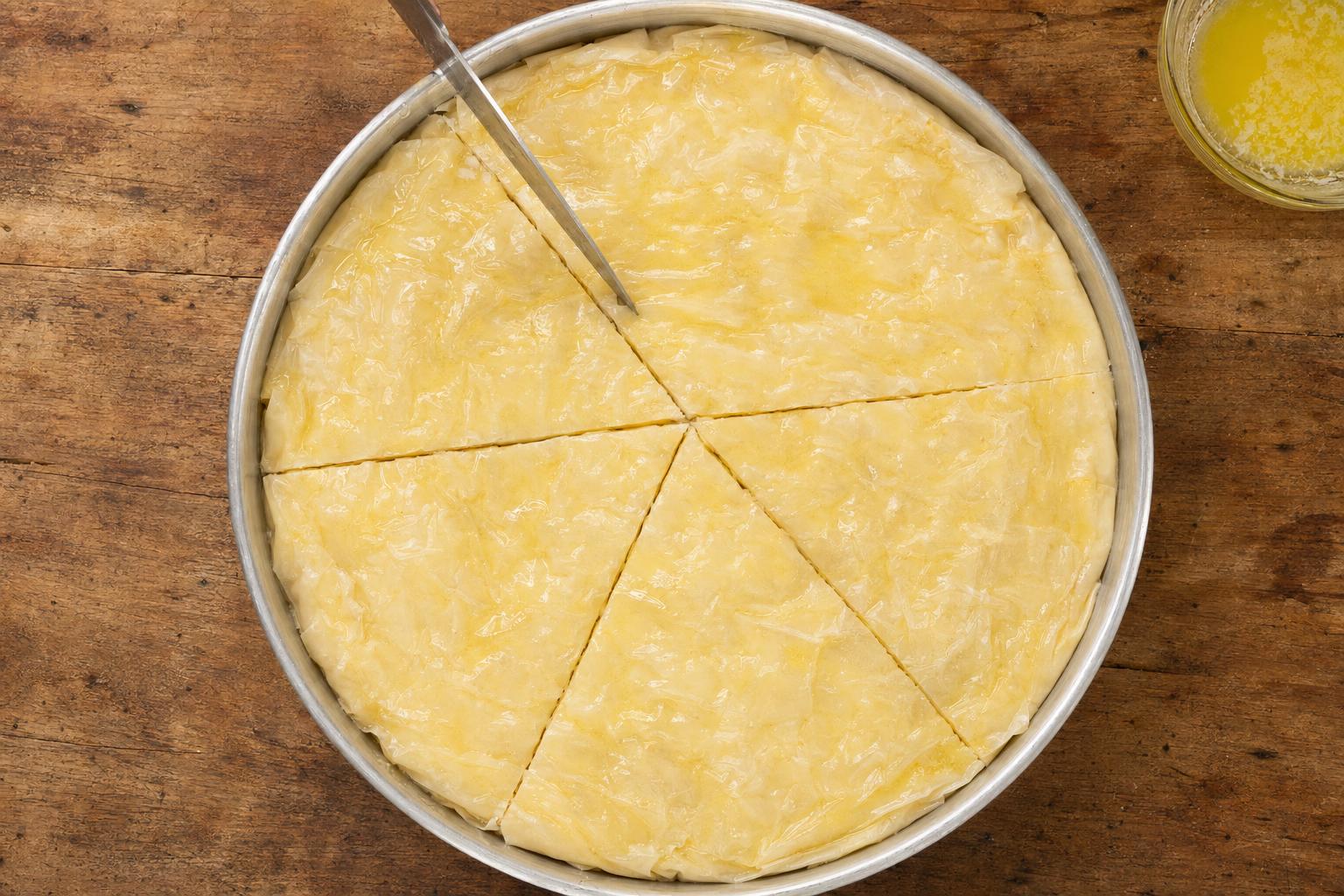 Step 6: scoring the top into 8 wedges — through the top sheets only, not down to the filling — so the baked pie cuts cleanly. — Graphic by NAR
Tuck the overhanging filo down into the sides of the pan, between the byrek and the pan wall. Some cooks crimp the edges; some just tuck. Both work.
With a sharp knife, score the top into 8 wedges. Cut through the top layers only — do not cut through to the filling. Scoring before baking is what lets you cut clean wedges later without shattering the top.
Step 7 — Bake (35 to 40 minutes)
Bake at 375°F (190°C) for 35 to 40 minutes, until the top is deep golden and the byrek pulls slightly from the sides of the pan. If the top is pale at 35 minutes, move the pan to the upper third of the oven for the final 5 minutes.
Step 8 — Rest, then cut (10 minutes)
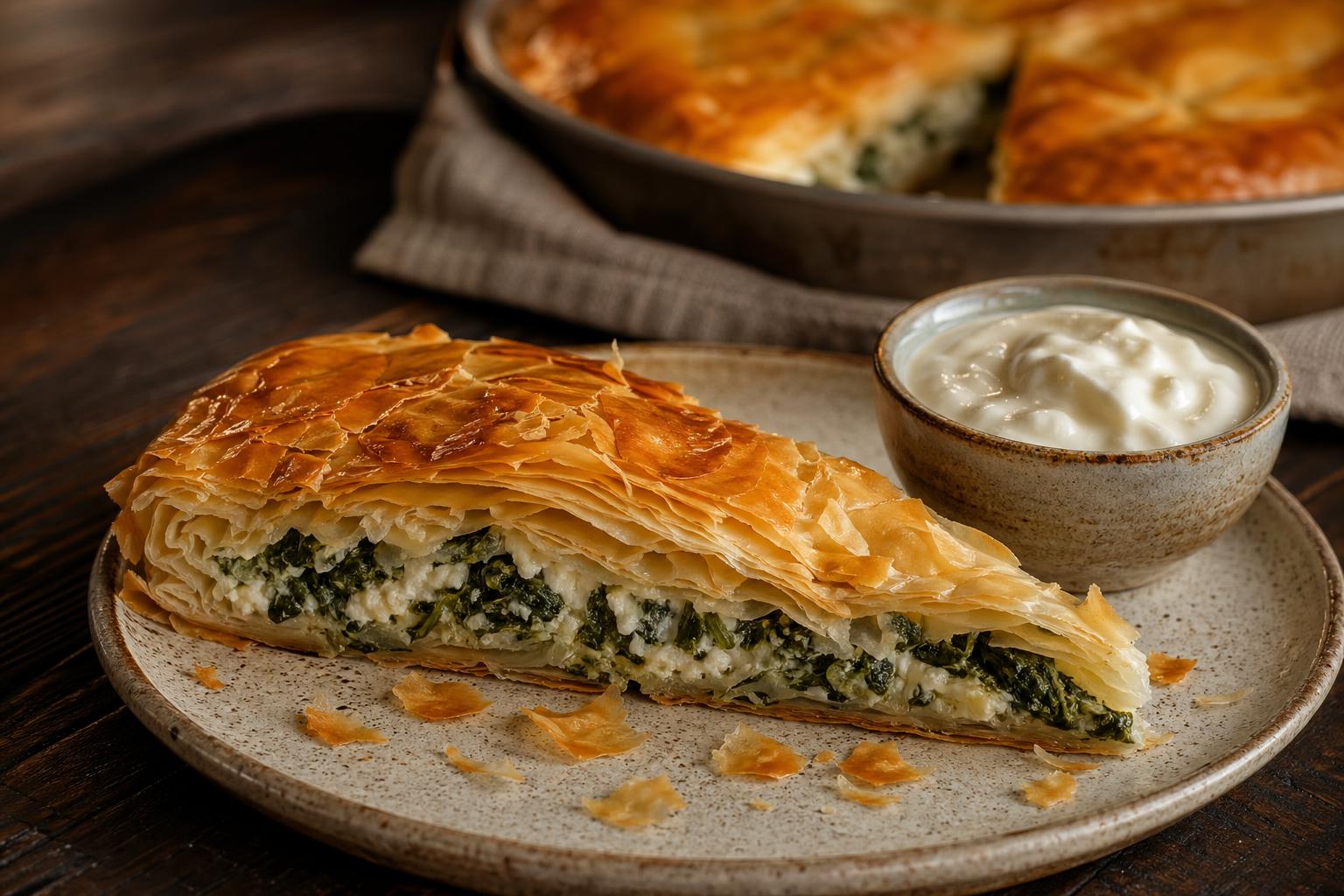 Step 8: a finished wedge after the 10-minute rest, served with a small bowl of kos (yogurt). — Graphic by NAR
Pull the pan from the oven and let it rest 10 minutes on the counter. Resting is what lets the cheese-and-egg filling set. Cutting hot byrek collapses the wedges into a soft mess.
After the rest, cut along the scored lines all the way through. Serve warm or at room temperature.
Critical-Path Notes
- Filo dries fast. The damp towel is not optional. Five minutes of uncovered filo on a dry kitchen counter and the sheets become unworkable.
- Squeeze the spinach. Wring it dry. Frozen chopped spinach holds water that will turn the bottom layers gummy if it is not removed.
- Light hand with the oil. Each sheet wants a thin, even brush — not a pour. Pooled oil makes the bottom greasy and prevents the layers from puffing.
- Score before baking. Cutting cold, cooked filo without scored top layers shatters the surface.
- Rest before cutting. Ten minutes minimum.
Common Mistakes
- Working with frozen filo. Filo that is still icy in the center cracks the moment you unfold it. Thaw overnight in the fridge, then 30 minutes on the counter still in its plastic before you open it.
- Drowning the layers in oil. A heavy hand with the brush makes a greasy, dense bottom. The right amount is barely visible — the sheet should look slightly translucent where the oil hit, not pooled.
- Skipping the squeeze. Spinach holds water, and that water has to go somewhere. If it stays in the filling, it ends up in the bottom layers. Wring it dry.
- Cutting hot. A byrek pulled from the oven and cut immediately collapses; the cheese-and-egg filling is still loose. The 10-minute rest is what makes a clean wedge.
- Microwaving leftovers. The microwave steams the filo. Use the oven at 350°F for 8 to 10 minutes — the layers come back.
Variations: The Key Fillings
The same layering and baking technique works across the whole family of byrek fillings. The names follow the byrek me [filling] pattern.
- Byrek me spinaq. Spinach. The diaspora default. The recipe above.
- Byrek me djath. Cheese only. Use 2 cups feta plus 1 cup ricotta or gjizë, 3 eggs, no spinach. Northern style.
- Byrek me mish. Meat. Brown 1 lb ground beef or lamb with one finely chopped onion, salt, pepper, and a pinch of paprika. Cool fully before layering. Kosovar style.
- Byrek me lakra. Wild greens. Use foraged or supermarket greens — chard, dandelion, kale, or a mix — wilted and squeezed dry. Tosk specialty.
- Byrek me kungull. Pumpkin. Use grated raw pumpkin, squeezed dry, with feta, sugar, and black pepper. Sweet-savory. Common in autumn.
- Byrek me presh. Leeks. Sweat 4 cups thinly sliced leeks in olive oil until soft, cool, mix with feta and eggs.
- Byrek me panxhar. Beets. A North Albanian variant — roasted beets, ricotta, dill.
Serving and Pairing
Byrek is rarely served alone. The classic Albanian table puts it next to kos (plain whole-milk yogurt, served cold in a small bowl alongside) and a chopped salad of cucumber, tomato, white onion, and feta with olive oil and red wine vinegar. The yogurt cuts the richness; the salad cuts the starch.
For a drink: kos i rrahur (beaten yogurt thinned with cold water and salt) is the traditional non-alcoholic pairing — sour, cold, salty, and structurally identical to Turkish ayran. With wine, a Mediterranean red works; an Albanian kallmet if you can find it. As meze before dinner, byrek shows up next to a small glass of raki, served chilled or room temperature.
Byrek reheats well. The right way is a 350°F (180°C) oven for 8 to 10 minutes, which restores the layers. The wrong way is the microwave, which steams the filo and turns the layers into one soft mat. Do not microwave byrek.
A Note on Survival
Byrek is the kind of dish that lives or dies generation by generation. The grandmothers who cooked it without measuring are the same grandmothers who cooked tavë kosi and fasule and the rest of the Albanian table. When that generation goes, the recipes can go with them — unless someone in the family writes them down and learns to make them.
If you want to be counted in a community-led count of Albanian Americans, register with NAR. It takes a minute. Free, neutral, your data stays yours. Counting ourselves is the other way the diaspora keeps its shape.