
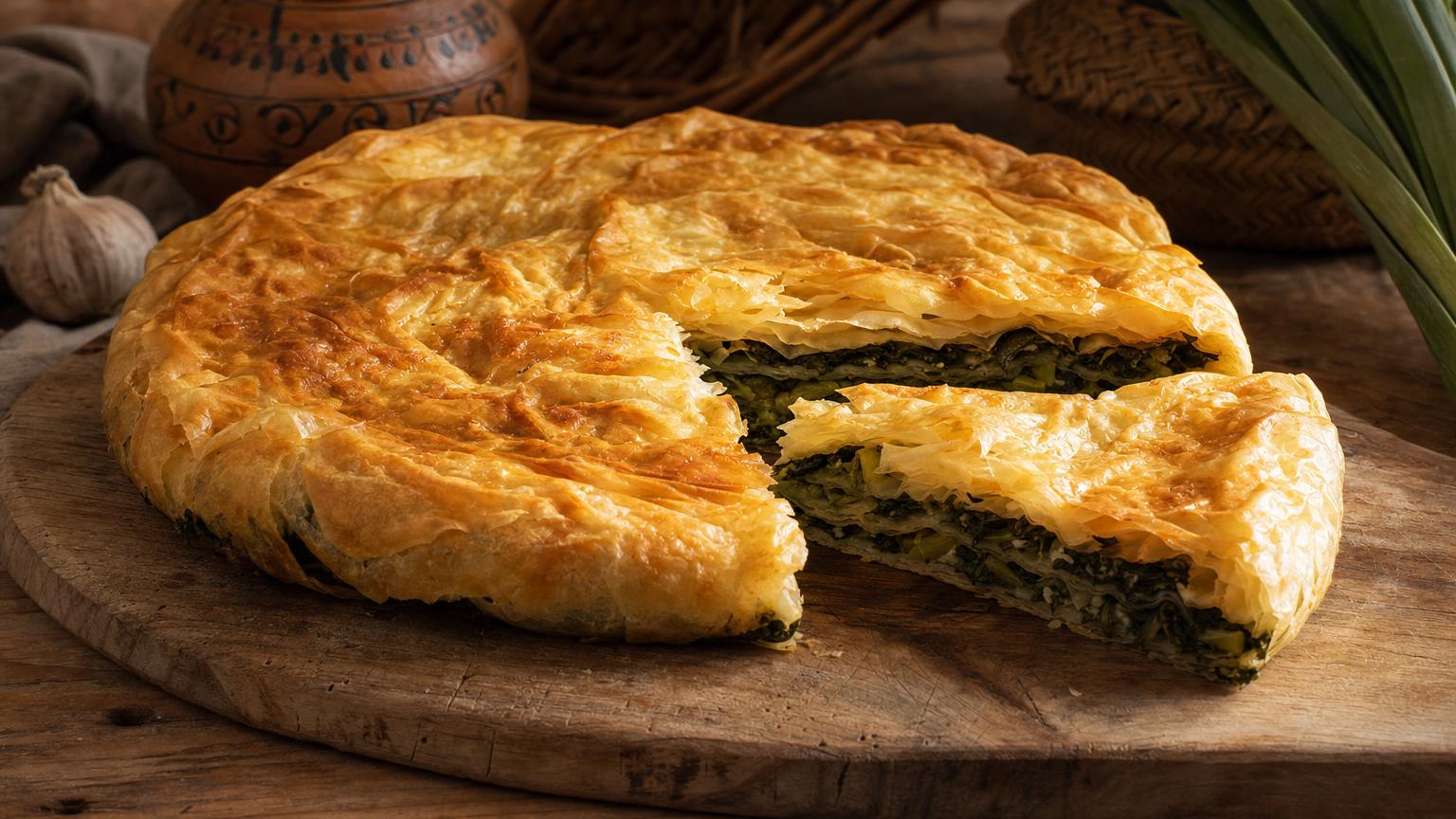
Lakror is a savory layered pie from southeast Albania, most closely associated with the city of Korçë and the surrounding villages. It belongs to the same broad family as byrek — the wider Albanian filo-pie tradition — but it is its own dish, with its own region and its own piece of equipment behind it.
In Albanian-American kitchens, lakror tends to be the regional pie someone’s grandmother makes when the family is from Korçë. It does not show up at every Sunday lunch the way byrek does. It shows up when the cook wants to tell you specifically where her people are from.
This piece covers what lakror is, how it differs from byrek and from flija, why the saç (a heavy iron lid traditionally piled with embers) defined the tradition, the fillings that name the dish — lakror me lakra, lakror me presh, lakror me kungull — and a step-by-step recipe for the pumpkin version most diaspora cooks make in the fall.
What Lakror Is
Lakror is a layered savory pie. The structure is simple: a sheet or stack of thin dough on the bottom of a round pan, a generous filling spread across it, another sheet or stack on top, oil between the layers, and a hot bake until the top crisps and the filling sets.
The dough is petë — Albanian filo, traditionally hand-rolled on a large wooden board with a long thin pin. In a strict Korçë lakror, the bottom and top are often a single thick petë each rather than the many thin layers that define a byrek. Some village versions use a stack of three or four medium sheets per side. Either reads as lakror.
The filling is wetter than a byrek filling, and that is the point. Greens cooked down with leek and oil, grated raw pumpkin with feta and onion, sliced tomato with herbs, browned meat with rice — the filling carries moisture into the bake, and the bottom crust catches some of it as it cooks. A good lakror has a slightly chewy, oil-saturated bottom and a crackly top.
The pan is a round metal tepsi, the same flat-bottomed pan used for byrek and for tavë kosi. In a saç-cooked lakror, the tepsi sits on a low hearth and the heated saç lid goes over the top, with embers shoveled onto the dome. In a modern oven version, the tepsi goes on the middle rack of a regular oven set hot. The cut on the table is a wedge, eight or twelve slices to a pan, served warm or at room temperature with a side of kos (yogurt).
Lakror vs. Byrek vs. Flija
Three Albanian pies, three different ideas about what dough, filling, and heat are supposed to do.
Byrek is the national Albanian filo pie. Five to twelve paper-thin sheets on the bottom, a relatively dry savory filling — squeezed spinach and feta, browned meat and onion, cheese and egg — five to twelve more sheets on top, brushed with olive oil between each layer, baked once at moderate-high heat. The structural emphasis is on the dough: thin, crisp, layered, shattered when the knife goes through. The byrek tradition spans Albania, Kosovo, North Macedonia, the Arbëresh of southern Italy, and the diaspora.
Flija is the highland celebration pie of northern Albania and Kosovo. Many thin layers of plain flour-and-water batter — often fifteen or more — each cooked individually under a saç, brushed with butter and yogurt, stacked into one accordion-like cake. There is no filling in the byrek sense — the layers themselves are the dish. Flija takes hours and is built for weddings, Bajram, and Christmas.
Lakror sits between the two. It uses dough like byrek does, but fewer and thicker sheets. It uses the saç like flija does, but bakes the whole pie in one go rather than layer by layer. The filling is more rustic than a byrek filling — wetter, larger pieces, sometimes barely cooked before it goes in.
A useful test at the table: a byrek cut shows many fine layers and a tightly bound filling. A flija cut shows horizontal striations all the way through, like rings of a tree. A lakror cut shows two or three thicker dough boundaries and a filling that has bled slightly into the dough — the bottom darker and softer, the top paler and crisper.
The Korçë Tradition and the Saç
The lakror tradition is rooted in the Korçë region of southeast Albania — the city itself, the municipalities of Devoll, Kolonjë, and Pogradec, and the farmland that runs up toward the borders with Greece and North Macedonia. Hill country, long winters, wood-burning hearths, and a pastoral foodway built around what the village kitchen could grow, gather, and store.
The saç is the technology that made lakror what it is. A heavy iron or steel dome set over a low round pan on the hearth. The cook builds a wood fire, lets it burn down to embers, and piles those embers and hot ash over the saç dome. The trapped radiant heat cooks the pie from above; the hot pan cooks it from below. A skilled cook moves embers on and off the dome to manage temperature, the same way a modern cook adjusts an oven dial.
The dish that comes out of a saç carries marks no oven leaves. The top picks up faint scorch lines where the embers sat closest. The bottom develops a dense, oil-saturated crust. A thin wood-smoke note runs through the whole pie — the same note a wood-fired pizza oven leaves on a Neapolitan pie, but quieter.
In the diaspora, the saç is rare. Some Albanian-American families brought one with them; some had one shipped later from a blacksmith in Albania; most use a regular oven. The pie still works in the oven. It does not taste identical to a saç lakror — the smoke note is gone, the crust more uniform — but it is recognizable as the dish, and the version most diaspora cooks have made for the last fifty years.
Common Fillings
Lakror takes its name from its filling. The pattern is lakror me [filling], the same way byrek is named byrek me [filling].
Lakror me lakra. Wild greens. Lakra is the Albanian word for cooking greens — spinach, chard, dandelion, nettles, wild leek, beet tops, whatever the village picker brought back from the hillside in spring. The oldest version of the pie, the one most associated with the Korçë countryside. Greens wilted, squeezed dry, mixed with sweated leek, olive oil, salt, sometimes a little cornmeal to bind.
Lakror me presh. Leek. A winter and early-spring dish, when the gardens are between seasons and the cellar still has leeks. Sliced thin, sweated slowly in olive oil until soft and sweet, sometimes mixed with crumbled feta or gjizë (Albanian whey cheese).
Lakror me domate. Tomato. A summer lakror, made when the August tomato is at its peak. Sliced tomato, salt, olive oil, fresh herbs, sometimes a layer of grated cheese underneath. The filling goes in uncooked; the bake reduces the tomato into something between a sauce and a roast.
Lakror me kungull. Pumpkin. The autumn lakror, and the version most often made in the diaspora because butternut squash is easy to find in any US supermarket. Grated raw pumpkin or squash, squeezed dry, mixed with sweated onion or leek, olive oil, salt, pepper, sometimes sugar. Kungull is the Albanian word for pumpkin.
Lakror me mish. Meat. Heavier, typical for celebrations and cold weather. Browned ground lamb or beef with onion, sometimes a handful of rice or bulgur to soak up the juices, salt, pepper, paprika.
Lakror me djath. Cheese. Less common than the vegetable versions but real. Crumbled feta, ricotta or gjizë, eggs, a little yogurt for body.
A grandmother in Worcester who tells you she is making lakror me kungull is telling you it is autumn and the squash is in. The dish names the season as much as it names the filling.
The Recipe: Lakror me Kungull (Pumpkin Lakror)
The home-kitchen, oven-baked version of the pumpkin lakror — the one most diaspora cooks make in October and November. Yields a 12-inch round pan, eight to ten slices.
Ingredients
- 1 lb (450 g) butternut squash or sugar pumpkin, peeled and grated on the large holes of a box grater
- 1 large leek, white and light green parts only, sliced thin
- 1 medium yellow onion, finely chopped
- 1/2 cup (120 ml) extra-virgin olive oil, divided (1/4 cup for the filling, 1/4 cup for brushing the dough)
- 1 lb (450 g) frozen filo dough (Athens or Apollo brand), fully thawed overnight in the refrigerator
- 1/2 cup (110 g) crumbled feta cheese (optional but traditional in many Korçë households)
- 1 large egg
- 1 tsp kosher salt, plus more for salting the squash
- 1/2 tsp freshly ground black pepper
- 1 tsp sugar (optional, pushes the natural pumpkin sweetness)
- 2 tbsp coarse cornmeal (optional, helps absorb residual moisture from the squash)
A note on the squash. Butternut and sugar pumpkin both work; kabocha too if you can find it. Avoid the watery jack-o’-lantern pumpkin and avoid canned puree. Grate it raw, salt it, squeeze it dry. The single biggest difference between a good lakror and a soggy one is how dry the filling went in.
A note on the dough. Hand-rolled petë is traditional; supermarket frozen filo is what most diaspora cooks use. Thaw overnight in the refrigerator — a counter thaw produces uneven moisture and the sheets crack when you unfold them. Once open, work fast and keep the unused stack covered with a slightly damp kitchen towel.
Equipment
- A 12-inch round metal baking pan (a tepsi), or a 12-inch round cake pan with at least 2-inch sides
- A box grater
- A clean kitchen towel for squeezing the squash
- A pastry brush
- A large mixing bowl
Method
- Preheat the oven to 400°F (205°C) with a rack in the middle position. Brush a 12-inch round pan with olive oil, including the sides.
- Peel the butternut squash, scoop out the seeds, and grate the flesh on the large holes of a box grater. You should have about 4 cups.
- Toss the grated squash with 1 teaspoon of salt in a colander and let it sit for 10 minutes. Transfer to a clean kitchen towel, gather the corners, and squeeze hard over the sink. Wring out as much liquid as you can. Under-squeezed squash is the usual cause of a soggy lakror.
- Heat 1/4 cup of olive oil in a wide skillet over medium heat. Add the chopped onion and sliced leek and cook, stirring, for 6 to 8 minutes, until soft and just starting to color. Add the squeezed squash, the optional sugar, and the black pepper. Cook another 3 to 4 minutes, just enough to take the raw edge off. Pull off the heat and let the filling cool for 10 minutes.
- Beat the egg in a small bowl. Stir the egg, the crumbled feta if using, and the optional cornmeal into the cooled filling. Taste and adjust salt.
- Unroll the thawed filo. Lay one sheet in the prepared pan and brush lightly with olive oil. The brush should glide; do not flood the sheet. Repeat until you have 6 to 8 sheets stacked on the bottom. The sheets will overhang the pan — that is correct. Keep the unused filo covered with a damp towel the whole time.
- Spoon the filling onto the layered filo and spread it in an even layer to the edges of the pan. Even thickness matters: a thicker spot in the middle bakes slow, a thin edge bakes fast and burns.
- Lay another sheet of filo over the filling and brush with oil. Repeat for 6 to 8 more sheets on top. Brush the very top sheet with a slightly heavier coat of oil — that is what produces the deep-gold finish.
- Tuck the overhanging filo down into the sides of the pan, between the lakror and the pan wall. Some cooks crimp; some just tuck. Both work.
- With a sharp knife, score the top into 8 wedges. Cut through the top layers only — do not cut down to the filling. Scoring before baking is what lets you cut clean wedges later without shattering the top.
- Bake at 400°F (205°C) for 40 to 45 minutes, until the top is deep golden and the lakror pulls slightly from the sides of the pan. If the top is pale at 35 minutes, move the pan to the upper third of the oven for the final 5 to 10 minutes.
- Pull the pan and let it rest 10 minutes on the counter. Cutting hot lakror collapses the wedges. After the rest, cut along the scored lines all the way through. Serve warm or at room temperature with a small bowl of cold kos (yogurt) on the side.
A Few Critical-Path Notes
- The damp towel over unused filo is not optional. Five minutes uncovered on a dry counter and the sheets become unworkable.
- The squeeze on the squash matters more than any other step. Keep wringing until liquid runs out, then keep going for another fifteen seconds.
- A light hand with the oil. Each sheet wants a thin, even brush, not a pour.
- Score before baking, rest before cutting. Both are non-negotiable for clean wedges.
Common Mistakes
A first-time US-oven lakror often has one of a few problems. All fixable.
Soggy bottom. Almost always a moisture problem. Greens not wilted and squeezed dry, squash not salted and wrung out, leek added raw, tomato sliced in without salting. The filling has to be drier going in than it would taste right in a sauté pan — the bake softens everything and releases more water. The cornmeal trick — a tablespoon or two across the bottom dough sheet, under the filling — helps catch residual moisture.
Dry, cracking top. Too long in the oven, or too little oil on the top sheet. The last filo sheet wants a slightly heavier brush than the layers below. If the top browns fast and the rest is pale, drop the rack one position or tent loosely with foil for the last ten minutes.
Filling that pours out when cut. Cut too soon. The 10-minute rest is when the egg sets and the layers grip each other.
Pale, undercrisp top. Oven too cool or rack too low. A real lakror top is deep gold, almost mahogany at the edges. Push to 425°F for the last five minutes and move the pan to the upper third of the oven for the finish.
Greasy, dense layers. Too much oil between sheets. The brush should leave each sheet lightly translucent, not pooled.
How Diaspora Cooks Adapt It
The Albanian-American kitchen is rarely the village kitchen. The diaspora has electric ovens, supermarket squash, frozen filo, and zero hearth space. Lakror has adapted, and the adaptations are honest.
Frozen filo replaces hand-rolled petë. Athens and Apollo brand filo, sold in the freezer aisle of most US supermarkets, is what most diaspora cooks use. A thinner, more uniform sheet, but it stacks and bakes well. Some cooks use more sheets per side — eight or ten rather than four or five — to compensate.
Electric ovens replace the saç. A 400°F oven on the middle rack with a heavy round pan produces a structurally faithful lakror. The wood-smoke note is gone, but the dough crisps and the filling sets. For the smoke, a saç is the only option.
Butternut squash replaces village pumpkin. US supermarkets stock butternut year-round. Korçë village pumpkin is denser and less stringy, but butternut is a fine substitute and what diaspora kitchens have used for decades. Sugar pumpkin (sometimes labeled “pie pumpkin”) is the closest American match. Skip the carving pumpkins.
Wild greens become supermarket greens. Lakra — the foraged hillside greens of the Korçë spring — translate in the US to a mix of spinach, chard, kale, dandelion greens, and sometimes beet tops. Different flavor, same structural function.
Feta replaces gjizë. Gjizë, the Albanian whey cheese that goes into many traditional fillings, is hard to find outside the densest Albanian neighborhoods. Crumbled feta, sometimes mixed with a little ricotta for body, is the standard substitute.
Diaspora lakror often gets cut into wedges, frozen flat, and reheated through the week. A 350°F oven for 8 to 10 minutes restores the layers. The microwave does not. Do not microwave lakror.
Where to Find Lakror in the US
Lakror is harder to find ready-made than byrek. Most Albanian-American bakeries carry byrek every day and rotate through other regional pies depending on the family running the kitchen. Lakror tends to show up seasonally — pumpkin in autumn, leek in late winter, greens in spring — and tends to come from bakeries with Korçë roots.
The neighborhoods to search are the same ones that anchor most of the US Albanian foodway: the Bronx and Yonkers in New York, Waterbury and Bridgeport in Connecticut, Detroit and Sterling Heights in Michigan, and Worcester and the Boston metro in Massachusetts. The Albanian byrektore (small bakery) is the right place to ask. A counter cook from Korçë will often have it under another name, or be willing to make a pan to order with a few days’ notice.
Regional Albanian-American organizations — particularly chapters in Worcester, Detroit, and the Bronx that draw heavily from southeastern Albanian villages — run cooking days and holiday gatherings where lakror is on the table. Showing up and asking the cook is the fastest way to learn. A Sunday in someone else’s kitchen helps more than any cookbook.
Keeping a Regional Pie Alive
Lakror is one of the dishes that lives or dies in the diaspora generation by generation. The grandmothers who managed a saç outdoors over an ember bed are not getting younger, and the technique does not transfer through cookbooks alone — it transfers through afternoons spent next to someone who already knows. Writing the numbers down is part of how the dish survives; teaching the technique to whoever is in the kitchen the next time the family gathers is the other part. If you want to be counted in a community-led count of Albanian Americans, register with NAR and get counted in the National Albanian Registry — free, a minute of your time, and one of the ways the regional foodways get the documentation they deserve.