
Open a fridge in Tirana on a Tuesday and you will find yogurt, half a tray of yesterday’s byrek, a wedge of feta, a jar of pickled peppers, a bag of tomatoes, and a covered bowl of fasule waiting to be reheated. Open a freezer and you will find ground lamb portioned for qofte, a roll of cured suxhuk, a bag of Korçë wild greens someone’s mother sent down from the mountains, and a box of supermarket phyllo. That fridge is the real subject of this article.
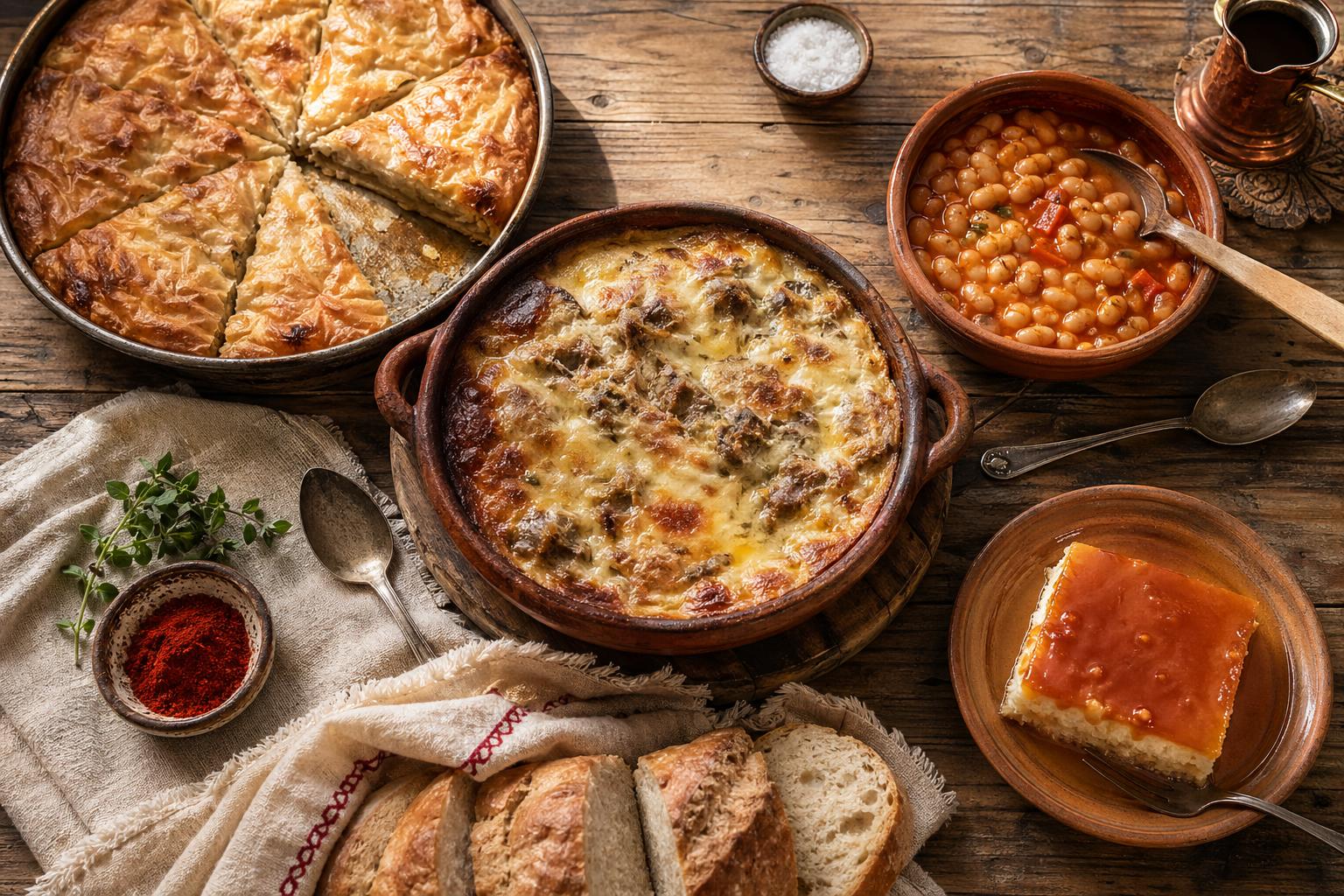
Most writing about Albanian food describes the showpiece dishes — tavë kosi for Easter, flija for the cabin in the mountains, baklava for Eid. That is the holiday menu. The weekday menu is shorter, more vegetable-forward, and built around a small set of high-frequency staples. This page maps that weekday menu. It is the companion to our encyclopedia of 30 Albanian dishes and our home-cook recipe guide, but the angle is different: not “what is famous in Albanian cooking” but “what is most often on the table.”
The audience is split. Some readers are Albanian Americans checking whether their family’s pattern matches the country’s. Others are non-Albanians who want a useful answer instead of a tourist brochure. We wrote this for both. Names appear in italics on first mention with an English gloss.
What Albanians actually eat in a typical week
A working description of weekday eating in Albania looks roughly like this. Breakfast is small and dairy-heavy: a piece of byrek (filo pie) with yogurt, or bread with white cheese, olives, and tomato, plus coffee. Mid-morning is another wedge of byrek or a sandwich from a kiosk. Lunch is the main meal — meat or beans, rice or potatoes, a chopped salad, bread, yogurt on the side. Dinner is lighter and often a smaller version of lunch or an open meze-style spread with cheese, olives, suxhuk, salad, and bread.
The frequency ranking, looking at how often dishes appear on Albanian tables in a normal week, comes out something like this. Bukë (bread) at every meal. Kos (yogurt) at most meals. Byrek two to four times a week in many households, sometimes daily for the kids. Sallatë (chopped tomato-cucumber-feta salad) most days through the warm months. Fasule (white-bean stew) once a week through the winter. Qofte (meatballs) once a week. Mish me patate (meat and potatoes) or a rice-and-meat one-pot for Sunday lunch. Suflaqe (the Albanian gyro-wrap) for a lazy lunch out. Fish two or three times a week along the coast, less often inland.
The holiday dishes — tavë kosi, flija, whole roast lamb, paçë (Easter tripe soup), big trays of baklava — are real, but they appear five to twenty times a year, not weekly. Conflating them with daily food is the most common mistake outsiders make about Albanian cuisine. The everyday cooking is closer to a Mediterranean vegetarian baseline with a meat top layer than to the lamb-and-yogurt holiday spread that gets photographed for tourism boards.
The pattern travels. In Albanian-American kitchens in the Bronx, Sterling Heights, Astoria, and Garfield, the weekday rotation looks similar — minus the kiosk byrek (no kiosks here), plus more take-out and a stronger Sunday-lunch tradition because the work week is structured differently. We come back to the diaspora pattern at the end.
Breakfast: byrek, kos, and coffee
Morning food in Albania is small, savory, and dairy-forward. The default plate is a triangle of byrek (filo pie, usually cheese or spinach) with a glass of cold yogurt or dhallë (salted yogurt drink, similar to Turkish ayran). On the side: a few olives, a slice of tomato, sometimes a hard-boiled egg. Coffee comes separately and arrives strong — Turkish-style in a copper xhezve in older households, espresso in cafés and most younger homes.
Bread with white cheese is the other standard. A few inches of country loaf, a slab of feta or fresh gjizë (ricotta-style cheese), a halved tomato, olive oil, salt, oregano. Eaten with the hands. This is what most working Albanians eat at home before leaving for the day, and it is the version that survived best in the diaspora because every American supermarket carries the ingredients.
Weekend breakfast scales up. Petulla — the small fried-dough puffs — come out of the pan in batches and get served three ways: dusted with sugar, drizzled with honey, or with crumbled feta and a glass of yogurt. Krofne (the Albanian yeasted doughnut, descended from the Austrian Krapfen and filled with vanilla cream or jam) shows up in bakery windows year-round and on home tables for Sunday breakfast and pre-Lent feasts.
The morning carbohydrate has shifted most over the last twenty years. Supermarket croissants, packaged toast bread, and breakfast cereals moved into Albanian homes through the 2000s and 2010s, especially in Tirana and the coastal cities. Byrek held its ground because it is cheap, filling, and sold at every neighborhood kiosk for less than the cost of a coffee. The furrë byreku — the small pie bakery — is still a fixture on most urban blocks.
Coffee deserves its own line. Cafés are everywhere in Albanian towns and cities, and the late-morning coffee with friends is a near-universal habit. Most Albanians drink espresso, makiato (a small milk-cut espresso, not the Starbucks drink), or Turkish coffee in small cups. Filter coffee is rare and American-style drip is rarer.
Lunch: suflaqe, qofte, and the midday plate
Lunch in Albania runs from noon to about 2 p.m. and is, in most working households, the largest meal of the day. The shape of lunch depends on whether someone is eating at home, at work, or on the street.
At home, lunch is a hot dish. Bean stew or a rice-and-meat one-pot through the winter; grilled or pan-fried protein with potatoes or rice through the summer; byrek with yogurt as the lighter fallback. A chopped sallatë — cucumber, tomato, red onion, green pepper, parsley, feta, olive oil, vinegar, salt — comes with everything from May through October. Bread is on the table at all times.
At work, the dominant midday food is suflaqe — the Albanian flatbread wrap, related to the Greek gyros and the Turkish dürüm, filled with roasted meat shaved off a vertical spit, fries (yes, fries inside the wrap), shredded cabbage or lettuce, tomato, raw onion, yogurt sauce, sometimes hot sauce. Suflaqe costs between 200 and 400 lekë (roughly $2 to $4) and is sold from dedicated suflaqeri counters in every Albanian city and town. It is the most widely eaten quick lunch in the country.
The grilled side of the menu — qofte të fërguara (pan-fried meatballs), qofte në zgarë (grilled meatballs), qofte korçare (the longer kebab-style version from Korçë) — runs second to suflaqe in volume but first in family-restaurant menus. A typical lunch order: four to six qofte, a plate of fries or rice, sallatë, yogurt, bread, water. Total cost in Tirana around 600 to 900 lekë.
The third pillar of midday eating is byrek by the slice, eaten standing up or back at the office. A small slice runs 50 to 100 lekë and works as a stretching meal between a small breakfast and a real dinner. Spinach (me spinaq), cheese (me djathë), and meat (me mish) are the standard fillings; pumpkin (me kungull), leek (me presh), and tomato-onion variations rotate seasonally.
What does not dominate Albanian lunch: salad-as-meal, sandwiches with cold cuts. Pizza is everywhere as fast food but it is an addition, not a replacement. Cold sandwiches are unusual; Albanians prefer something warm at midday.
Weeknight dinner: fasule, fërgesë, and the one-pan rotation
Dinner at home in Albania is usually 7 to 9 p.m., earlier in rural areas and later in Tirana. On a working weeknight the food is unfussy and built around one main dish, a salad, bread, and yogurt.
Fasule — the white-bean stew — is the single most common winter weeknight dinner. Dried great northern or cannellini beans simmered with onion, garlic, sweet paprika, tomato paste, oregano, and either smoked suxhuk or a lamb bone for fat. It cooks for about two hours, freezes well, and reheats better than the original day. Most Albanian households eat fasule roughly weekly from October through April. Served with a hunk of country bread, raw onion, pickled hot peppers, crumbled feta, and a small bowl of yogurt. There is also a vegetarian version eaten during Orthodox Lent.
Fërgesë — peppers, tomatoes, and onions cooked down with gjizë (Albanian fresh ricotta) and sometimes liver or veal, finished in a clay pan — is the central-Albanian Tuesday-night dish. Tirana’s version (fërgesë e Tiranës) is the canonical one. Summer fërgesë is mostly vegetable; winter fërgesë adds meat. The dish takes 30 to 40 minutes start to finish, which is part of why it shows up so often.
Grilled or pan-fried qofte with rice and salad covers another night. Roasted chicken with potatoes covers another. A baked tray of stuffed peppers (speca të mbushura) or stuffed grape leaves (japrak) covers another and produces leftovers for the next day’s lunch.
Pasta with red sauce has become a regular weeknight dinner in younger Albanian households over the last two decades — Italian food has unusually deep roots in coastal Albania because of geography and the satellite-TV era — but it sits alongside the Albanian rotation rather than replacing it. The pasta night in many Tirana homes is Wednesday; the fasule night is Thursday; Sunday is the big-meal day.
The Sunday lunch deserves its own paragraph because it is structurally different from the rest of the week. Extended family gathers, the meal runs three to four hours, and the cooking scales up. Mish me patate (lamb or veal with potatoes, oven-roasted in one pan) is the classic Sunday main in the north. Tavë kosi (yogurt-baked lamb) shows up most often in central Albania and at any major holiday across the country. A spit-roasted lamb or chicken is the warm-weather version. The Sunday meal opens with meze — small plates of feta, olives, suxhuk, tarator, byrek triangles — and a glass of raki, and closes with trilece or seasonal fruit and Turkish coffee.
Street food and quick eats
The Albanian quick-eat scene runs on five things, in rough order of volume.
Suflaqe. The wrap. Lamb, chicken, or mixed-meat shawarma off a vertical spit, fries inside, yogurt sauce, pickled cabbage, raw onion. The suflaqeri counter is the closest thing Albania has to American fast food, and most cities have one every other block in the downtown grid. Variations include suflaqe me biftek (steak strips) and suflaqe me pulë (chicken).
Byrek by the slice. Cheap, fast, hot from the furrë byreku. Spinach, cheese, meat, sometimes a sweet filling. A small slice is breakfast; a large slice is lunch. The neighborhood byrek bakery is a near-universal feature of Albanian urban life — every block in Tirana, every market town, every coastal village.
Qofte at the grill. Charcoal-grilled lamb-and-beef qofte served with onion, sallatë, and bread. The qebabtore — the grill-house — is the evening equivalent of the suflaqeri. In summer the grills move outdoors and the smoke is part of the experience.
Corn on the cob. Boiled or grilled, salted, sold from a cart on the beach or a busy intersection from June through September. Misër in Albanian. About 100 lekë.
Roasted chestnuts. Winter equivalent. Sold from carts on cold evenings in Tirana, Shkodër, and Korçë, served in paper cones. Gështenja.
Specialty quick-eats round out the list. Çorba — a clear chicken or lamb soup with rice or noodles — gets eaten as a hangover meal and a winter warmer. Trahana (fermented grain-and-yogurt cracked into a hot broth) is the deeper hangover cure. Salep — the hot milky drink thickened with orchid root or cornstarch, dusted with cinnamon — is winter-morning food sold by carts and bakeries.
Pizza belongs in this list too. Italian-style thin-crust pizza is everywhere in Albania, most of it family-run and reliably better than American chain pizza. It gets eaten at lunch, after school, or as a casual dinner. A real part of the modern Albanian pattern, not a tourist concession.
Sweets, snacks, and the after-meal stretch
Albanian sweets divide cleanly into Ottoman-tradition pastries, modern cake culture, and snack-aisle staples.
Ottoman pastries. Baklava — layered filo, walnuts (more often than pistachios in Albania), butter, lemon-scented syrup. Made in big trays for Eid, Christmas, Easter, weddings, and any serious family gathering. Kadaif — shredded filo with walnuts and syrup, lighter and crispier than baklava. Sheqerpare — small buttery cookies dipped in light syrup, a Gheg and Kosovar specialty. Halva — sweet semolina or sesame paste, served at memorial gatherings and religious holidays. Kurabie — buttery shortbread cookies that live in a tin on top of the fridge for unannounced guests.
Modern cake. Trilece — the three-milk soaked sponge cake — is the dessert most associated with modern Albanian restaurants and Albanian-American bakeries. It is on every café menu in Tirana, Pristina, and the diaspora. Some food historians credit Albania with introducing trilece to the Balkan region from Latin America in the early 2000s; whatever the precise path, the dish is now firmly Albanian in its current form. Tortë me arra (walnut layer cake) and karamele (caramel custard) round out the café menu.
Everyday snacks. Lokum (rosewater jellies) and sheqerka (sesame brittle) for kids. Sunflower seeds (fara) eaten by the handful on the xhiro (the daily walk) and at sidewalk cafés. Roasted chickpeas (qiqra të pjekur). Imported chocolate from Italian and Turkish brands is widely available.
Fruit closes the meal more often than dessert does. Watermelon (shalqi) in summer, persimmons (hurma) and pomegranates (shega) in late fall, citrus in winter, cherries and plums in spring. The end of an Albanian Sunday lunch is more often a bowl of fruit and a Turkish coffee than a slice of cake. The sweets come out on the holidays.
Regional differences north and south
Albania is small — about the size of Maryland — but the country splits regionally between north and south, and the food splits with it. The split tracks the same line as the Gheg and Tosk language divisions: north of the Shkumbin river one set of habits, south of it another.
The north. Shkodër, Kukës, Tropojë, Dibër, and across into Kosovo and northwestern North Macedonia. Heavier, drier, meat-forward. More red meat, more bread, more dairy, more long-cooked stews. Flija — the layered crepe-pancake baked under a heavy iron lid — is a Gheg signature. Sheqerpare and dense fried sweets dominate the dessert side. Kukës byrek uses thicker dough; Shkodër carp from Lake Skadar is a regional specialty.
The south. Berat, Gjirokastër, Korçë, Përmet, Sarandë, Vlorë. Lighter, more vegetable-forward, more olive oil. Wild greens in the spring (pite me lakra), more citrus, more seafood along the Ionian coast. The southern lakror — the Korçë thin-crust pie baked on embers under a saç — is the southern answer to flija. Wine culture is more developed in the south, especially around Berat, where the shesh i bardhë and shesh i zi native grapes anchor the local table.
The middle. Tirana, Durrës, Elbasan. The blend zone. Fërgesë e Tiranës and tavë Elbasani (the canonical tavë kosi) are central-Albanian dishes. This is where the modern Albanian restaurant menu got its current shape during the post-communism rebuild of the 1990s and 2000s.
Coastal vs inland. Independent of north-south. The Adriatic and Ionian coasts — Vlorë, Sarandë, Himarë, Durrës — eat fish multiple times a week: sea bass (levrek), bream (koce), sardines, octopus, mussels. Qofte peshku (fish meatballs) and grilled whole fish with lemon are coastal standards. Inland fish means freshwater: lake trout from Pogradec, carp from Shkodër.
The Albanian-speaking lands outside Albania. Kosovo, western North Macedonia, southern Montenegro, and the Arbëresh villages of southern Italy each have local variations. Kosovo’s food sits closest to northern Albania. Arbëresh cooking, isolated for 500 years, kept some medieval Albanian dishes and absorbed southern Italian ingredients — a related but distinct tradition.
What Albanian-Americans eat today
The diaspora kept the food. That is the closest thing to a single sentence about Albanian-American culture that holds up across generations. Names changed, accents softened, kids stopped speaking the language — but the byrek still came out of the oven on Sunday, the raki still got poured before dinner, and the tavë kosi still showed up at Easter.
The American weekly pattern in an Albanian household runs something like this. Weekday breakfast is usually American — cereal, toast, coffee — with byrek on the weekend morning. Weekday dinner is split between Albanian and American: fasule once a week through the winter, grilled qofte in the summer, roast chicken with potatoes regularly, supermarket pasta when the night is short. Sunday lunch is the anchor — the Albanian meal that does not skip, with extended family at the table and a baked main dish in the center.
Holidays compress the calendar. Easter (Pashkë) brings tavë kosi, lamb, red-dyed eggs, and paçë in Orthodox households. Eid al-Fitr and Eid al-Adha (Bajram) bring roasted lamb, byrek, baklava, and halva. Christmas brings a big tray of byrek and a roast. New Year is the main winter feast in many Albanian-American households — a habit that traces back to Albania’s own decades of state-enforced atheism, when religious holidays went unobserved and the secular New Year became the default winter gathering, not a Yugoslav import (Albania was never part of Yugoslavia and the two countries were largely estranged for most of the Cold War).
Albanian-American food sourcing concentrates in five metros. The Bronx (Belmont and Arthur Avenue), Sterling Heights and Warren in metro Detroit, Astoria and Ridgewood in Queens, Paterson and Garfield in northern New Jersey, and Waterbury in Connecticut. These are also the five largest Albanian-American population concentrations in the US. Outside those metros, Italian delis cover most of the basics and Greek and halal groceries cover the rest.
The shifts across generations are real but smaller than the headline. Second-generation cooks make fewer holiday dishes and more weekday ones. Third-generation cooks lean on the easy entries — fasule, qofte, byrek from frozen filo. The dishes that thin out are the long, time-intensive ones: flija, paçë, hand-rolled petë. This is why the recipes matter — and why writing them down with names intact (ë on tavë, ç on fërgesë) is part of the work.
The Albanian table is built around hospitality (mikpritja) as a structural principle. The meze opener, the long Sunday, the bowl of fruit at the end, the second pour of coffee. The reason Albanian families spend so much time at the table is not that the food takes long to eat. It is that the table is where the family is.
If your family’s everyday foods include byrek for Saturday breakfast, fasule on cold weeknights, and tavë kosi on Easter, you carry Albanian culture forward every time you cook. The diaspora is bigger than the official numbers — about 230,000 Albanian Americans counted in the 2024 American Community Survey, against a community estimate closer to 1 million counting ethnic Albanians and second- and third-generation Albanian Americans. Add your name to the National Albanian Registry — we count the families who keep this kitchen alive, and the count is how we close the gap between what the government sees and who is actually here.