

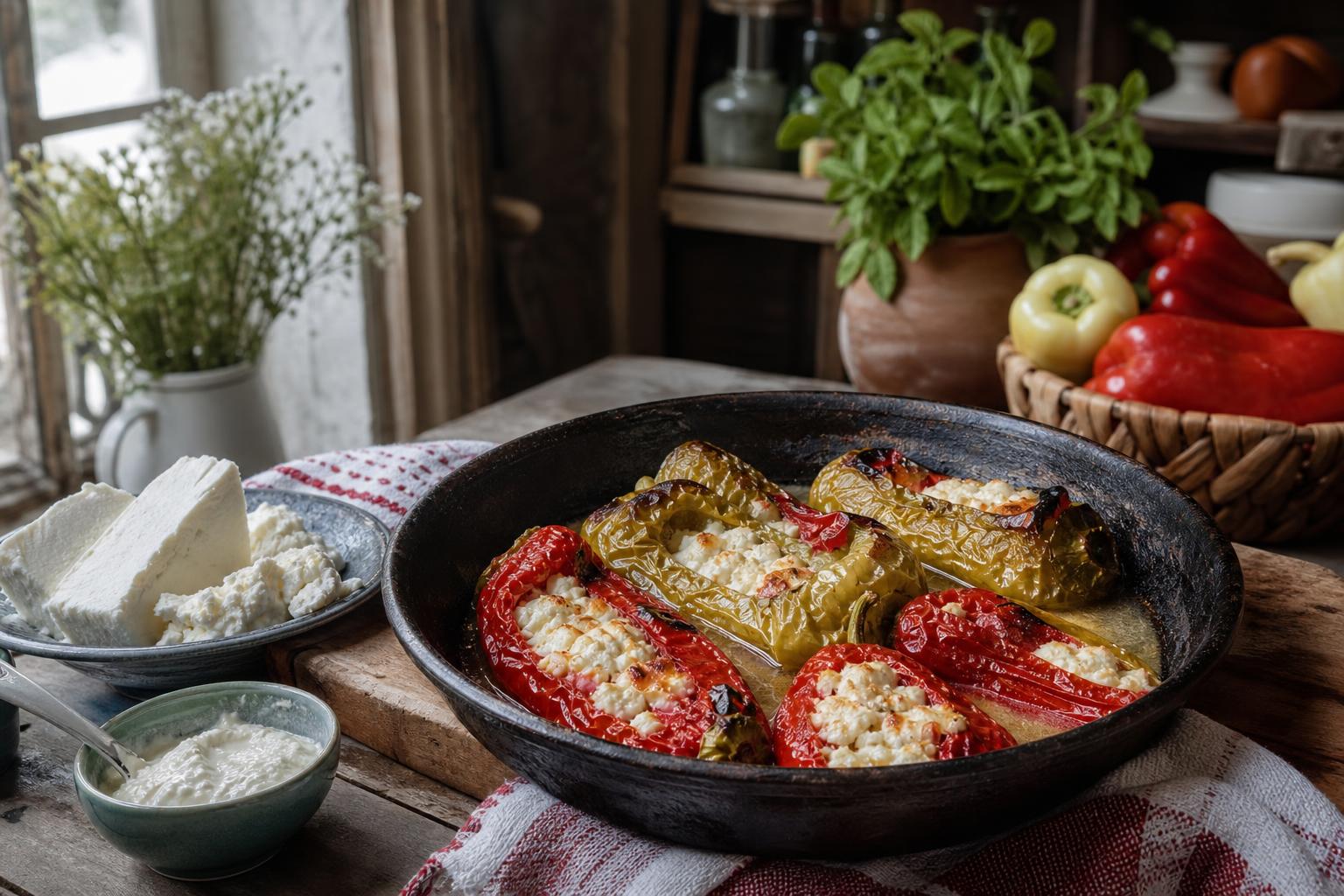
Speca me gjizë is the Albanian dish of peppers (speca) cooked with gjizë, the fresh whey cheese that anchors so much of the country’s cooking. The pepper is the vessel; the gjizë is the soul. Some households stuff long horn peppers and bake them whole; some roast bell peppers, slip the skins, and fold the flesh into a skillet of warm gjizë; some bake an open pan of peppers and cheese together until the top is freckled brown. All three are speca me gjizë. All three sit in roughly the same kitchen slot — late summer into autumn, when peppers are cheap and the gjizë is at its best.
It is a quiet dish. It does not show up on Albanian restaurant menus the way byrek or qofte does. It shows up at family lunches in Tirana, at dinner tables in Prishtina, on a Thursday night in a Bronx apartment when someone brought a tub of gjizë back from the Albanian grocery on Arthur Avenue. The pepper-and-cheese pairing is one of the most diaspora-native combinations in the Albanian kitchen — almost every supermarket in the US carries the peppers, and the cheese question is the only thing that separates a great version from a shortcut.
This piece covers what speca me gjizë is, what gjizë actually is, the pepper varieties that work in US kitchens, the regional differences across Albania and Kosovo, and the home-kitchen recipe with US-supermarket ingredients.
What Speca me Gjizë Is
The dish is built from two components and not much else: peppers and gjizë. Aromatics — garlic, mint or parsley, sometimes a pinch of dried chili — go into the cheese; olive oil ties everything together; salt and pepper finish it. There is no béchamel, no breadcrumb crust, no rice filler. The pepper carries the smoke from the roast or the broiler; the gjizë carries the tang and the body.
Three preparation styles dominate. In the stuffed-and-baked version, long horn peppers or small bell peppers are halved or slit lengthwise, deseeded, packed with seasoned gjizë, and baked in a 9x13 pan with a slick of olive oil and a splash of water until the peppers slump and the cheese sets golden on top.
In the roasted-and-folded version, peppers are roasted under the broiler until blistered, peeled, sliced, and folded into warm gjizë in a skillet with garlic and herbs. The result reads more like a meze — a spreadable, chunky dip eaten with bread.
In the baked-skillet version, peppers are roasted, sliced, and laid into a wide cast-iron skillet; gjizë is crumbled over the top, drizzled with oil, and the whole pan goes into a hot oven for 10 to 15 minutes until the cheese has softened and lightly browned. This is the version most home cooks pull together when guests arrive on short notice.
The flavor profile is sweet from the peppers, lactic from the cheese, grassy from olive oil, and bright from whatever herb went in. It is not heavy. A good speca me gjizë eats like a summer salad with a baked top — the cheese never dominates, the peppers never disappear under it.
What Gjizë Actually Is
Gjizë (pronounced gee-zuh, with a soft g) is Albania’s fresh whey cheese — the curd that rises when the leftover whey from harder cheeses is reheated. The technique is the same one used to make Italian ricotta and Greek anthotyro; the result is a soft, slightly grainy, mildly tangy cheese with low salt and short shelf life.
In Albania and Kosovo, gjizë is a village product more than an industrial one. A family with a few sheep or cows turns the morning milk into djathë i bardhë (the brined firm cheese closer to feta), reheats the whey, skims the curds, and drains them in cheesecloth. Sheep-milk gjizë carries more fat and richer flavor; cow-milk gjizë is lighter and more common in diaspora supermarkets.
Three things separate gjizë from its supermarket cousins. It is drier than US whole-milk ricotta — closer to drained ricotta or fresh paneer. It is less salted than feta. And it is fresher than aged whey cheeses — most gjizë is meant to be eaten within a week or two.
The closest US-supermarket substitute is whole-milk ricotta, drained for an hour, then crumbled with a few tablespoons of feta per cup to bring back the tang. The substitution is not perfect, but it is good enough that most diaspora kitchens default to the half-and-half mix.
Gjizë is the same cheese that anchors fërgesë, and it shows up across the Albanian table in everything from byrek me gjizë to spoon-fed breakfasts with honey and walnuts.
The Pepper Varieties That Work
Albanians cook speca me gjizë with whatever sweet pepper is local and in season. In Albania and Kosovo, that means kapia peppers (red, sweet, slightly elongated, with thick walls), long horn peppers, and the occasional Hungarian wax pepper for a mild kick. In the US diaspora, the question is which supermarket pepper produces the closest result.
Red bell peppers are the most reliable supermarket choice. Pick ones with thick, glossy walls; thin-walled bells release too much water and the dish goes soupy. Orange and yellow bells work the same way. Avoid green — they read vegetal and slightly bitter when baked.
Long horn peppers (sometimes labeled “Italian frying peppers,” cubanelle, or “long sweet peppers”) are the closest match for traditional kapia and the easiest to stuff. They split open neatly and hold their shape under heat. Hispanic and Italian groceries carry them year-round; mainstream supermarkets stock them in summer.
Hungarian wax peppers and banana peppers are the right call for a mildly hot version, common in Kosovo. Heat level varies plant to plant; taste a sliver of one before committing.
Avoid: thin-walled bell peppers; padron or shishito peppers (too small, too grassy); poblanos (the chocolate-and-earth flavor pulls the dish away from Albanian); jalapeños (too hot); pickled peppers (the brine clashes with the gjizë).
Whether the dish is stuffed or skillet-baked, the peppers benefit from at least a partial blister under the broiler before the cheese goes near them. The blister concentrates the sweetness and softens the wall so the pepper does not fight the fork at the table.
Regional Variations Across Albania and Kosovo
Speca me gjizë is not one recipe. The country splits broadly along familiar lines and the dish splits with it.
Central Albania (Tirana, Durrës, Elbasan). This is the heartland of the open-skillet version. Roasted bell peppers and tomato are common, with garlic, mint, and a generous fold of gjizë. The dish lives in the same culinary register as fërgesë — pepper-forward, dairy-bound, eaten warm with bread.
Southern Albania (Gjirokastër, Berat, Sarandë, Çamëria). Here the dish leans lighter, with more olive oil and more herbs (dill, parsley, fresh mint) and often without tomato. Çam Albanian families bake long horn peppers stuffed with gjizë and oregano. The dish edges toward the Greek-Albanian coastal cuisine and the wider Mediterranean register.
Northern Albania (Shkodër and the highlands). Northern versions are heavier — sometimes butter alongside oil, sometimes a small amount of grated hard cheese on top of the gjizë for a browner crust. The pepper choice tilts toward thicker-walled red bells; the herbs tilt toward parsley over mint.
Kosovo (Prishtina, Gjakova, Prizren, Mitrovica). Kosovar tables most often serve the stuffed-and-baked version, with long horn peppers and a filling that may include diced hot pepper or a pinch of crushed red chili. Speca të mbushur me gjizë is a weeknight staple. Some families add an egg to the cheese filling so the cooked gjizë holds its shape when the pepper is sliced.
Albanian communities in North Macedonia and Montenegro. In Tetovo, Gostivar, Ulqin, and the Plav-Gusinje belt, the dish carries Macedonian and Bosnian influences — a pinch of paprika here, a different cheese mix there, sometimes the addition of a kajmak-style topping. The bones of the dish are the same.
The diaspora muddies these lines. A Kosovar grandmother in Yonkers and a Tosk grandmother in Worcester end up shopping at the same supermarkets and using the same red bell peppers and the same tub of gjizë from the same Albanian importer.
Speca me Gjizë in the Albanian-Dairy Family
The dish belongs to a small but distinctive corner of the Albanian table — the pepper-and-dairy family. The two best-known members are fërgesë (peppers, tomatoes, gjizë, eggs, simmered into a stew) and speca me gjizë (peppers and gjizë, baked or folded). A third cousin is speca me djathë (peppers with brined white cheese, sharper because the cheese is feta-like, not gjizë).
The family shares a logic: roast the pepper to concentrate the sweetness, then bind it with the dairy the pepper grew up next to. The Albanian sheep-and-goat herding tradition produced enormous amounts of fresh whey cheese in summer; the same farmers grew sweet peppers as a kitchen-garden crop. Speca me gjizë is the dish that comes out of that pairing.
The family extends to turshi (pickled vegetables) — whole peppers brined with garlic and dill, served alongside a spoonful of gjizë on bread, a classic Albanian breakfast and a cold cousin to the baked version.
The dish also rhymes with the wider Balkan pepper tradition. Bulgarian chushki burek, Macedonian ajvar-and-cheese plates, Greek piperies gemistes me tyri — each Balkan kitchen makes a version. The Albanian one is identifiable by the cheese: gjizë’s dryness and tang, with very little salt, marks the dish as Albanian even when the pepper preparation looks shared.
Speca me Gjizë on the Albanian-American Table
In the US diaspora, speca me gjizë is a home-kitchen dish more than a restaurant one. Most diaspora cooks make it twice a year at minimum: once in late August when the farmers’ market is full of red peppers, and once at a holiday table where the spread already includes byrek, fasule, and a roast.
It travels well. The stuffed version bakes ahead, holds at room temperature for two hours, and reheats cleanly in a 325°F oven. For a diaspora potluck, the stuffed-and-baked version is the right call — squares cut clean, the cheese sets, and the peppers travel without slumping.
What it gets served with depends on the household. The most common pairings:
- Crusty bread. A round country loaf, torn at the table, used to scoop the cheese and pepper.
- Yogurt. A small bowl of kos (plain whole-milk yogurt, served cold) on the side cuts the richness.
- A simple chopped salad. Cucumber, tomato, white onion, olive oil, red wine vinegar — no feta on the salad if the gjizë is already on the table.
- Pickled vegetables. Turshi — pickled cabbage, cucumbers, peppers, carrots — provides the acid the dish does not have on its own.
- Raki before the meal, or a Mediterranean rosé or dry Albanian white such as Shesh i Bardhë alongside.
From late July through October, speca me gjizë is on the dinner-table rotation in many Albanian-American households. By Thanksgiving, the dish has retreated to the back of the recipe box; it returns the following July.
The Traditional Recipe — Speca me Gjizë të Pjekura
This is the open-skillet version — roasted bell peppers folded with seasoned gjizë and baked under a brief broil. Serves 4 as a main with bread; 6 as a side. Active time about 25 minutes; total time about 55 with the pepper roast.
Ingredients
- 6 large red bell peppers (or a mix of red and orange — avoid green)
- 1 cup (about 240 g) gjizë — Albanian fresh cheese — OR a mix of ¾ cup whole-milk ricotta (drained) plus ¼ cup crumbled feta
- 1 large egg, beaten (optional, for a firmer set)
- 3 cloves garlic, finely minced
- ¼ cup (about 15 g) fresh parsley, finely chopped
- 2 tablespoons fresh mint, finely chopped (or 1 teaspoon dried)
- ⅓ cup (80 ml) extra-virgin olive oil, divided
- ½ teaspoon kosher salt (less if using feta — taste first)
- ½ teaspoon freshly ground black pepper
- ½ teaspoon sweet paprika (optional)
- 1 teaspoon white wine vinegar (optional, for brightness)
- Crusty bread, for serving
A note on the gjizë. Taste a spoonful first — some are saltier than others — and adjust the added salt down accordingly. If using ricotta-and-feta, let the ricotta drain in a fine sieve for at least an hour. Watery ricotta is the most common cause of a soupy speca me gjizë.
A note on the egg. The egg is optional. Including it produces a firmer cheese mixture that holds its shape when sliced (Kosovar default). Skipping it keeps the cheese loose and creamy (central-Albanian default). Both are correct.
Equipment
- A heavy baking sheet, lined with foil
- A cast-iron skillet (10 to 12 inches) or a 9-inch ceramic baking dish
- A medium mixing bowl
- A wooden spoon
How to Make Speca me Gjizë
Step 1 — Roast the peppers (12 minutes plus 10 to steam)
Heat the broiler to high and place a rack 6 inches below the heating element. Lay the whole peppers on the foil-lined baking sheet. Broil, turning every 2 to 3 minutes with tongs, until the skins are blackened and blistered on all sides — about 10 to 12 minutes total.
Drop the peppers into a paper bag or a covered bowl. Let them steam for 10 minutes — the steam loosens the skins. Slip the skins off in sheets, discard the stems and seeds, and slice the flesh into strips about ½ inch wide. Save any juice that has pooled in the bowl.
Step 2 — Heat the oven and prep the cheese (5 minutes)
Heat the oven to 400°F (200°C). Brush the cast-iron skillet (or ceramic dish) with 1 tablespoon of olive oil.
In the medium bowl, combine the gjizë (or the drained ricotta plus crumbled feta), the minced garlic, parsley, mint, paprika if using, and black pepper. Add the beaten egg if using. Stir gently with a wooden spoon — overworked cheese turns gluey. Taste; add salt only if the cheese is undersalted (feta and gjizë both bring salt of their own).
Step 3 — Combine peppers and cheese (3 minutes)
Add the pepper strips and any reserved juice to the cheese mixture. Fold gently with the wooden spoon until the peppers are coated and evenly distributed. Add the white wine vinegar if using.
Transfer the mixture to the oiled skillet. Spread it in an even layer — the cheese should peek out between the pepper strips, not cover them. Drizzle the remaining olive oil (about 2 tablespoons) over the top.
Step 4 — Bake (15 to 18 minutes)
Bake at 400°F (200°C) for 15 to 18 minutes — until the cheese has softened, the edges are bubbling, and the top is freckled with light golden spots.
For more color on top, move the skillet to the upper third of the oven for the final 2 minutes, or run the broiler for 1 minute at the end. Watch closely — the cheese browns fast and burns faster.
Step 5 — Rest, then serve (5 minutes)
Pull the skillet from the oven and let it rest 5 minutes on the counter. The rest lets the cheese firm up and the flavors come together. Serve warm, straight from the skillet, with crusty bread and a small bowl of cold yogurt on the side. A scatter of fresh parsley or mint on top finishes the dish.
Variation — Stuffed-and-Baked
For the stuffed version, use 6 long horn peppers (or 4 small bell peppers) instead of the 6 large red bells. Skip the broiler roast. Halve the peppers lengthwise (or slit and butterfly the long horns), remove the seeds, and pack each half with the cheese mixture.
Lay the stuffed peppers in a 9x13 baking pan, drizzle with olive oil, add ¼ cup of water to the bottom of the pan, and bake at 400°F (200°C) for 25 to 30 minutes — until the peppers slump and the cheese sets golden on top.
Common Mistakes
The dish has a small number of failure points. All are avoidable.
- Watery ricotta. US supermarket ricotta carries more water than gjizë. Drain it in a fine sieve for at least an hour before using.
- Skipping the pepper roast. Raw bell peppers taste vegetal and slightly bitter when baked under cheese. The roast concentrates the sweetness.
- Over-stirring the cheese. Gjizë and ricotta both turn gluey when worked too hard. Fold gently; stop when the herbs are evenly distributed.
- Salting before tasting. Feta and some gjizë are already well-salted. Taste before adding salt; an over-salted speca me gjizë is unrecoverable.
- Cheese breaking on high heat. A 400°F oven is the sweet spot. A 450°F oven dries the gjizë out and breaks the curd. If the top is browning before the cheese has heated through, drop the rack one notch and tent with foil.
- Pepper skin in the dish. Pepper skin reads tough and papery when baked. The 10-minute steam after the broil is what makes the skins slip off cleanly.
- Microwaving leftovers. The microwave heats unevenly and weeps the cheese. Reheat in a 325°F oven for 10 minutes covered loosely with foil.
Sourcing Gjizë and Good Peppers in the US
The cheese is the harder half. Real gjizë is a small-production item, and the US distribution network is patchy. The reliable retail spots:
- Bronx (Belmont, Pelham Parkway, Morris Park). Multiple Albanian groceries on and around Arthur Avenue stock fresh gjizë alongside Albanian cheeses, suxhuk, and bread.
- Yonkers, Westchester County, and Astoria, Queens. Family-owned Albanian groceries carry gjizë; nearby Greek and Macedonian groceries stock similar whey cheeses (anthotyro, urda) that work as substitutes.
- Waterbury, CT and Worcester, MA. Small-scale Albanian imports at neighborhood groceries; call ahead for stock.
- Detroit, Sterling Heights, and Warren, MI. The largest concentration of Albanian markets in the Midwest. Gjizë is on the shelf year-round at the bigger stores.
- Online importers. A handful of small Balkan and Albanian specialty grocers ship gjizë and similar fresh whey cheeses nationally on cold packs. Search for an Albanian or Balkan grocer with online ordering, confirm they ship refrigerated, and check the use-by date before ordering.
For peppers, the supermarket and the farmers’ market both work. From mid-July through early October, red bell peppers and long horn peppers run cheap and at peak flavor. Shop by feel — a pepper should be heavy for its size and the wall should resist a gentle squeeze.
If gjizë is genuinely unavailable, the substitution ladder runs:
- Whole-milk ricotta + crumbled feta. Standard diaspora workaround. Drain the ricotta first.
- Greek anthotyro or Macedonian urda. The closest non-Albanian Balkan whey cheeses.
- Italian fresh ricotta from a deli counter. Drier than the supermarket tub version.
- Fresh paneer. Texture is right; tang is missing. Add a tablespoon of plain yogurt to compensate.
- Cottage cheese. Last resort. Drain it hard in a sieve first.
Make-Ahead, Leftovers, and Serving Notes
The stuffed version is the more make-ahead-friendly of the two. Stuffed peppers can be assembled a day before baking, covered tight, and refrigerated. Pull the pan from the fridge 30 minutes before it goes into the oven so the gjizë is not shocked by the heat.
The skillet version is best made and eaten the same day. The roasted peppers can be prepped a day ahead and stored in the fridge, but the assembled dish is at its best straight from the oven.
Leftovers keep 2 to 3 days in a covered container. Reheat at 325°F (160°C) for 10 minutes covered loosely with foil. The microwave heats unevenly, weeps the cheese, and softens the pepper skins past pleasant.
Cold leftover speca me gjizë is also a respectable lunch — spread on bread with a slice of tomato, it eats like an open-face sandwich. In southern Albania, this is a common fieldwork or beach lunch. The dish does not freeze well; the cheese breaks on thaw and the peppers turn rubbery.
For a larger gathering, double the recipe and bake in two pans rather than overloading one — the cheese needs surface area to set properly.
A Note on Survival
Speca me gjizë depends on someone in the family writing it down. The grandmothers who made it without measuring made it because the gjizë was sitting in the kitchen and the peppers were in the garden. Out of that context, the dish has to be reconstructed from memory — the gjizë comes from a tub at the grocery, the peppers from a supermarket on the way home, and the proportions get guessed at.
That is a real loss when no one writes them down. It is also a recoverable one. A diaspora kitchen with a printed recipe, a tub of imported gjizë, and a bag of red bell peppers is enough to keep the dish in the rotation — and to teach the next kid in the family how to roast a pepper and fold a cheese without breaking it.
Counting ourselves is the other way the diaspora keeps its shape. If you want to be included in a community-led count of Albanian Americans, register with NAR. It takes about a minute, it is free, and your data stays yours.