
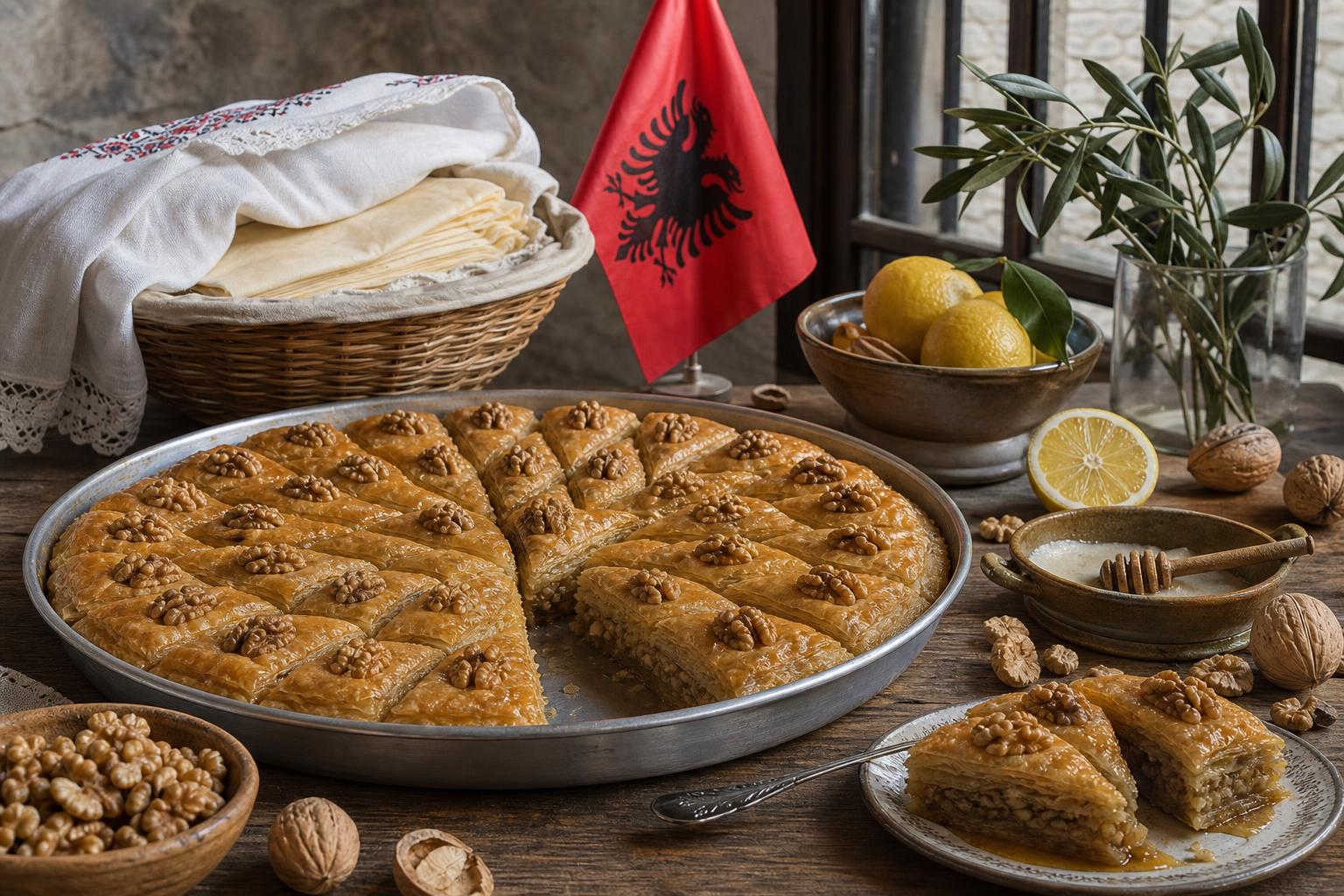
Baklava — bakllava in the more native Albanian spelling, baklava on most diaspora menus — is the layered filo-walnut-syrup pastry that anchors the Albanian dessert tradition. Paper-thin sheets of filo, ground walnuts between them, a slow bake, and a soak in lemon-scented sugar syrup poured cool over the hot tray. Cut in small diamonds, served at room temperature, eaten with strong coffee or sweet tea.
The pastry belongs to the broader Ottoman-Balkan tradition shared across the region. Every former Ottoman territory has its baklava, and the question of where it was invented has no clean answer. Albanian baklava is its own version within that family — walnuts not pistachios, lemon and clove in the syrup, less semolina than some Greek styles, and a diamond cut sized to one bite.
This piece covers what Albanian baklava is, the regional variations, the cultural slot the dish holds in diaspora life, the traditional recipe, and the critical-path notes that decide whether a tray comes out right.
What Albanian Baklava Is
Albanian baklava is a layered pastry built top to bottom: 8 to 12 sheets of filo on the bottom, a thick layer of ground walnuts mixed with sugar and cinnamon, another 8 to 12 sheets on top, and butter brushed between every sheet. Some recipes insert two or three middle walnut layers between thinner stacks of filo. The pastry bakes in a metal tray (tepsi) until the top is deep gold, then receives a cool sugar syrup spiked with lemon juice and sometimes a clove.
The structure separates it from the related Albanian sweets. Compared to shendetlie — the honey-walnut sponge cake — baklava has no batter and no leavened crumb. The body is filo and ground nut. Compared to trilece, there is no milk soak; the soak is sugar syrup. Compared to revani, there is no semolina.
The cut is a tell. Albanian and Balkan baklava is almost always cut in diamonds — long parallel slashes one direction, then a second set on the diagonal, producing 24 to 36 small rhombus pieces. The diamond is functional: it maximizes syrup-absorbing edge, and it portions the dense pastry into bites small enough that one piece is a serving.
The flavor runs in three registers. From the walnuts, an earthy base that prevents the sweetness from going flat. From the cinnamon, a warm middle note. From the syrup, a long sweetness lifted by lemon — a thread of acid that keeps the pastry from cloying. Some cooks add a drop of clove or rosewater; others keep it plain lemon-and-sugar. Both are correct.
Is Baklava Albanian?
Baklava belongs to a regional tradition older than every modern Balkan nation-state. Per Wikipedia, the pastry is generally traced to the Ottoman imperial kitchens of Topkapı, where it took roughly the form most people recognize today. Deeper roots may run back to layered-pastry traditions of the Byzantines, Persians, or earlier Central Asian cooks. Source documents before the 16th century are thin enough that confident attribution is not possible.
What is not in dispute is that every former Ottoman territory has its own baklava. Turkey claims it as a national pastry. Greece, Bulgaria, Bosnia, North Macedonia, Albania, Kosovo, and the Arab world each have versions with regional fingerprints. The Wikipedia entry on Albanian cuisine lists baklava (bakllava) among the country’s defining sweets, and it has been made in Albanian households for as long as written records of household cooking exist.
The Albanian version sits within that family rather than outside it. “Albanian baklava” does not mean “baklava that Albanians invented.” It means “baklava as Albanians make it.” That distinction is the responsible framing — and it matches how the same dish appears at Greek, Turkish, Lebanese, and Bosnian tables in the same diaspora neighborhoods. The 20% that’s regional is what the recipe below preserves.
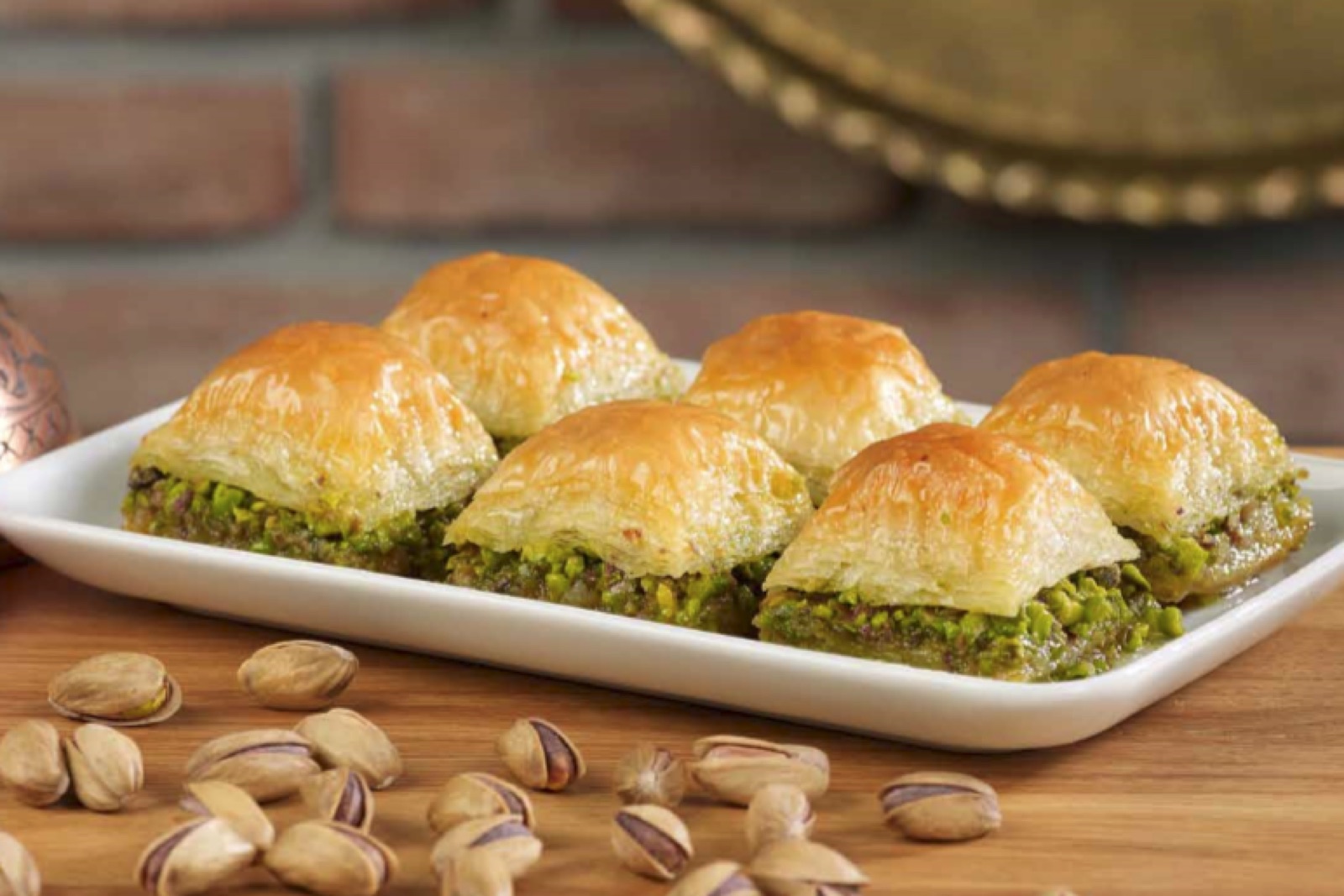 Baklava cut in diamonds — the same shared form across the eastern Mediterranean and Balkans, including the Albanian table.
Photo: Wikimedia Commons / Public Domain
Baklava cut in diamonds — the same shared form across the eastern Mediterranean and Balkans, including the Albanian table.
Photo: Wikimedia Commons / Public Domain
What Makes Albanian Baklava Distinct
Within the Ottoman-Balkan baklava family, Albanian bakllava has four signatures.
Walnuts or hazelnuts, not pistachios. Where Turkish baklava leans on pistachio and some Levantine versions favor a pistachio-cashew mix, Albanian baklava is made with walnuts (arrë) or hazelnuts — both are part of the documented tradition. Walnuts are what most Albanian households grew, traded, and stocked through the year — every village had walnut trees, and shelled walnuts kept through the cold months. Walnut flavor is what gives this version of Albanian baklava its earthier, less perfumey profile. Some southern Albanian and Arbëresh recipes mix in almonds; pistachios appear in modern adaptations but are not the traditional choice.
Lemon-scented syrup with a clove. The syrup base is sugar, water, lemon juice, a strip of lemon peel, and often one or two whole cloves. Some recipes add a tablespoon of honey for depth. Rosewater and orange-blossom water — common in Turkish and Levantine syrups — are uncommon in Albanian household recipes. The lemon does the heavy lifting: it cuts the sweetness, brightens the walnut, and keeps the syrup from going one-note.
A modest hand with the filo. Classic Turkish baklava is built from many thin sheets to get a light, glassy bite. Albanian household baklava tends toward fewer, thicker layers — a thicker top and bottom stack with one or two thin walnut layers between, or a single walnut layer in the middle with 8 to 10 sheets above and below. The result is a slightly chewier, walnut-forward pastry rather than the lighter, glassy Turkish version.
The diamond cut, sized small. The tray is scored in diamonds before baking — long parallel cuts one way, crosswise on the diagonal. Albanian household pieces tend to be smaller than American restaurant slices; one diamond is one bite, two at most.
There is also a quieter difference in the fat. Many Turkish recipes run butter-heavy. Albanian household recipes tend to use plain melted unsalted butter in thinner coats, sometimes mixed with olive oil for the bottom layer. The butter-vs-olive-oil debate inside the diaspora is real but local — a Tosk and a Gheg household can disagree on the ratio without either being wrong.
Regional Variations
Albanian baklava is not one recipe. The country splits between the Tosk-speaking south and the Gheg-speaking north, and the baklava tradition splits with it. Kosovo and the Arbëresh communities of southern Italy add further variations.
South Albania (Tosk-style). Lighter on the butter, sometimes with olive oil for the bottom layers. Walnut-forward, with cinnamon and occasionally a whisper of clove. The syrup runs thinner — more lemon, less honey — producing a baklava that reads brighter. Gjirokastër and the southern coastal towns are particular about thinness; a southern grandmother is the one most likely to roll her filo by hand.
North Albania (Gheg-style). Butter-forward, slightly more sugar in the syrup, slightly thicker walnut layers. Diamonds run larger. Some northern recipes finish the top with crushed walnut after the soak. Shkodër-area cooks often add orange peel to the syrup alongside the lemon.
Kosovar. Kosovo’s baklava tradition is close to the northern Albanian version but tends toward the larger, butter-richer Turkish-influenced register. Walnuts remain the default. The Bajram tray in Kosovar households is often a round tepsi sized for an extended family, with enough diamonds cut to serve a full afternoon of visitors. Kosovar weddings frequently include baklava alongside trilece and a savory byrek.
Arbëresh (Italian Albanian). The Arbëresh communities of southern Italy preserve a 15th-century Albanian foodway alongside Italian regional cooking. Their baklava recipes show clear Albanian DNA — walnuts, lemon syrup, layered filo — adapted to local ingredients. Some Calabrian households add almonds alongside walnuts; the syrup may pick up local citrus.
Diaspora-American. Kitchens in New York, Massachusetts, Michigan, and Connecticut work with US-supermarket filo and walnuts and metal pans from Greek-Turkish-Middle Eastern grocers. Regional differences flatten over time — a Kosovar grandmother in the Bronx and a Tosk grandmother in Worcester end up with very similar trays.
The Cultural Anchor
Baklava is the dessert of the major Albanian feast days. It shows up reliably at:
Bajram. Both Eid al-Fitr (Fitër Bajram) at the end of Ramadan and Eid al-Adha (Kurban Bajram) anchor on baklava. A large round tray, cut in diamonds, sits on the central table for visitors. A piece with a small cup of coffee is the standard offering. The big aluminum tepsi trays come out specifically for this. See Gëzuar Fitër Bajramin for the holiday’s broader shape.
Christmas and Easter. Albanian Catholic and Orthodox households serve baklava at Christmas (Krishtlindja) and Easter (Pashkë) alongside the savory centerpieces. The dish crosses every religious line.
Weddings. Albanian-American weddings center on a small constellation of desserts: trilece leading, baklava close behind, sometimes shendetlie. The baklava goes on the dessert table in pre-cut diamonds; guests take a piece with their coffee at the end of the evening. See the Albanian wedding piece for the full sequence.
Memorial meals and well-wishing. Baklava goes on the table at dreka për shpirt (memorial lunches), name days, baptisms, and family-arrival dinners. Offering it to a guest is a small statement that the visit matters.
Big-tray gifting. A particular diaspora practice: a household bakes a large tray and delivers it whole to a relative or friend — for a holiday, a new baby, a recent loss, or no specific reason. The receiving household serves from it for several days, then returns the pan washed. The gift is the labor of the bake. Recognizable from Astoria and Yonkers to Sterling Heights and Worcester.
Like byrek, baklava travels broadly across the community without losing its identity. See the overview of Albanian dishes for where it sits in the larger canon.
The Traditional Recipe
A household-scale Albanian baklava for a 12-inch round metal pan or a 9×13-inch rectangular pan. Yields 24 to 30 diamonds. About 45 minutes active work, 45 minutes bake, 30 minutes minimum rest (overnight is better).
Ingredients
For the pastry:
- 1 lb (450 g) frozen filo dough (Athens, Apollo, or any Greek/Middle Eastern brand), thawed overnight in the refrigerator
- 4 cups (about 450 g) walnuts, finely chopped or pulsed in a food processor to a coarse grind — not powder
- ½ cup (100 g) granulated sugar
- 2 tsp ground cinnamon
- ¼ tsp ground cloves (optional)
- 1 cup (225 g) unsalted butter, melted (or ¾ cup butter plus ¼ cup mild olive oil for a southern-style mix)
For the syrup:
- 2 cups (400 g) granulated sugar
- 1½ cups (360 ml) water
- 2 Tbsp lemon juice, freshly squeezed
- 1 strip lemon peel (about 2 inches), with as little white pith as possible
- 1 whole clove (optional)
- 2 Tbsp honey (optional, for depth)
A note on the walnuts. Buy them shelled and as fresh as the store has. Walnuts go rancid faster than most other nuts; old walnuts give baklava a bitter, soapy off-note. Taste before chopping. The Greek, Turkish, and Middle Eastern groceries diaspora cooks frequent — Astoria, Allston, Sterling Heights — turn over walnut stock faster than the supermarket and tend to have better-tasting nuts.
A note on the filo. Thaw it in the fridge overnight, then sit it on the counter for 30 minutes still in its plastic before opening. A counter-thaw produces uneven moisture and the sheets crack. Once open, work fast and keep the unused stack covered with a clean, slightly damp kitchen towel.
A note on the butter. Plain unsalted butter, melted and slightly cooled, is the household standard. Clarified butter (ghee) also works. Avoid salted butter — the salt accumulates over 16 to 20 layers and competes with the syrup.
Equipment
- A 12-inch round metal baking pan (a tepsi) or a 9×13-inch rectangular baking pan, at least 1½ inches deep
- A pastry brush (1½ to 2 inches wide is the right size)
- A clean kitchen towel, slightly damp
- A food processor or a sharp chef’s knife (for chopping the walnuts)
- A small saucepan (for the syrup)
- A sharp paring knife (for scoring and cutting)
How to Make Albanian Baklava
Step 1 — Prep the filling and the pan (10 minutes)
Heat the oven to 350°F (180°C). In a large bowl, combine the chopped walnuts, ½ cup sugar, cinnamon, and cloves if using. Stir until uniform. Set aside. Brush the bottom and sides of the pan with melted butter and keep the rest of the butter next to your work surface.
Step 2 — Layer the bottom (10 minutes)
Unroll the filo. Trim sheets to fit the pan if needed; save the trimmings for the layers above the walnut, where alignment matters less.
Lay one sheet in the pan and brush lightly with melted butter. The brush should glide; do not flood the sheet. Lay a second sheet, brush. Repeat until 8 to 10 sheets are stacked. Keep the unused filo covered with the damp towel the entire time.
Step 3 — Add the walnut layer (3 minutes)
Sprinkle half of the walnut mixture evenly across the filo, all the way to the edges. The layer should be about ¼ inch thick. Lay 2 sheets of filo over the walnuts, brushing each with butter. Sprinkle the remaining walnut mixture across the second filo layer. (For a single-walnut-layer version, skip the split and put all the walnuts in one thick middle layer with 2 sheets above.)
Step 4 — Layer the top (10 minutes)
Lay a sheet over the walnuts and brush with butter. Repeat until 8 to 10 more sheets are stacked on top. Brush the very top sheet with a slightly heavier coat — that is what produces the deep-gold finish.
Step 5 — Score in diamonds (5 minutes)
With a sharp paring knife, cut diagonal parallel lines about 1 inch apart across the top. Then cut a second set, also 1 inch apart, on the opposite diagonal. The two sets produce small diamond shapes.
Cut all the way through the top filo and walnut layers, but stop just short of the bottom — the baklava holds together better through the bake if the bottom stays uncut. The bottom cut goes through after the syrup soaks in.
Step 6 — Bake (40 to 45 minutes)
Bake at 350°F (180°C) for 40 to 45 minutes, until the top is deep golden and the edges pull slightly from the sides of the pan. If the top is pale at 40 minutes, move the pan to the upper third of the oven for the final 5 minutes. The baklava is done when the top is uniformly bronze and the kitchen smells of toasted walnut and butter.
Step 7 — Make the syrup (15 minutes, parallel to the bake)
Combine the 2 cups sugar, 1½ cups water, lemon peel, and clove (if using) in a small saucepan. Bring to a gentle boil over medium heat, stirring once or twice to dissolve the sugar. Once the sugar has dissolved, do not stir again. Boil gently 8 to 10 minutes, until slightly thickened — it should coat the back of a spoon thinly but still pour easily. Stir in the lemon juice and the honey (if using) at the very end, then pull from heat.
Let the syrup cool to lukewarm while the baklava finishes baking. The temperature contrast is the point: cool syrup over hot pastry.
Step 8 — Pour the syrup (5 minutes)
Pull the baklava from the oven. Immediately, while the pastry is still hot, slowly ladle the lukewarm syrup evenly across the surface, working from the edges in. Strain or pick out the lemon peel and clove first.
Listen for the faint sizzle as the syrup hits the hot air pockets and is drawn into the layers.
Step 9 — Rest, then cut and serve
Cover the pan loosely with a clean kitchen towel and let it rest at room temperature at least 30 minutes — ideally 4 hours or overnight. Many Albanian households bake the day before they serve.
Once rested, run the paring knife along each scored line all the way through the bottom. Lift each diamond out with a small spatula. Serve at room temperature with strong coffee or tea.
Critical-Path Notes
- Walnut freshness is load-bearing. Old walnuts give the tray a soapy, bitter off-note no syrup will hide. Taste before chopping.
- Filo handling, three rules. Thaw overnight in the fridge. Keep the unused stack covered with a damp towel. Brush every sheet — a thin coat, not a pour.
- Syrup temperature contrast. Cool syrup on hot baklava is the household default. Hot syrup on fully cooled baklava also works. Never matched temperatures — hot on hot pools on top, cool on cool beads off.
- Score before baking. Scoring after the bake shatters the top filo. Cut diamonds through the top layers before the pan goes in; finish the bottom cut after the soak.
- Do not skip the rest. Cutting before the syrup has soaked gives a dry pastry sitting in syrup. Minimum rest 30 minutes; a few hours is better.
Common Mistakes
- Over-baking. A tray that goes too dark turns bitter even before the syrup hits it. Pull at deep gold, not brown.
- Pouring the syrup too hot. Hot on hot pools on top and never soaks in. Cool to lukewarm before it meets the hot tray.
- Drowning the layers in butter. A heavy hand makes a greasy bottom. The right coat is barely visible — translucent, not pooled.
- Using powdered walnuts. A food processor pulsed too long turns walnuts into flour that packs down and goes pasty in the bake. Pulse to a coarse grind and stop.
- Cutting before the soak. A clean diamond comes out of a tray that has rested. A tray cut hot tears at the edges and the syrup runs out instead of in.
- Storing in the fridge. Refrigeration tightens the layers and dulls the flavor. Keep on the counter under a clean kitchen towel.
Storage, Reheating, and Gifting
A finished tray of Albanian baklava keeps five to seven days at room temperature, covered with a clean kitchen towel or loose foil. The syrup is the preservative — sugar inhibits spoilage — and the layers improve over the first 24 hours as the soak settles.
Refrigeration is optional and usually not done. Cold baklava reads dull and the layers tighten; if a household does refrigerate leftovers, pull them 30 minutes before serving. Do not freeze a syrup-soaked baklava — the layers go limp on thaw and the texture does not recover.
Reheating is rarely needed; baklava is meant to be served at room temperature. If the layers have gone soft, 5 minutes in a 300°F (150°C) oven on a sheet pan brings the surface back. The microwave makes baklava soggy; do not use it.
Gifting a tray is a particular Albanian-American practice. The mechanics:
- Bake in a metal pan you do not need back urgently.
- Cool fully and let the syrup set at least overnight.
- Cover with foil or a lid and deliver the pan whole.
- The receiving household keeps the pan, serves from it across several days, and returns it washed when convenient.
The pans circulate. A given household has two or three baklava trays at any time — its own plus one or two waiting to go back to a relative or friend.
A Note on Survival
Baklava is one of the recipes most likely to get lost between generations. The grandmothers who made it without measuring are the same grandmothers who made byrek, tavë kosi, shendetlie, and the rest of the Albanian table. They knew the filo by feel, the syrup by the way it coated a wooden spoon, the bake by smell. When that generation is gone and no one wrote it down, what survives is a memory of a dish.
Writing the numbers down — sugar, butter, walnut, water, time, temperature — is part of how baklava survives. Teaching the technique to whoever is in the kitchen the next time the household bakes is the other part. See the broader Albania food and recipes library for the rest of the canon.
If you want to be counted in a community-led count of Albanian Americans, register with NAR. It takes a minute. Free, neutral, your data stays yours. Counting ourselves is the other way the diaspora keeps its shape.