
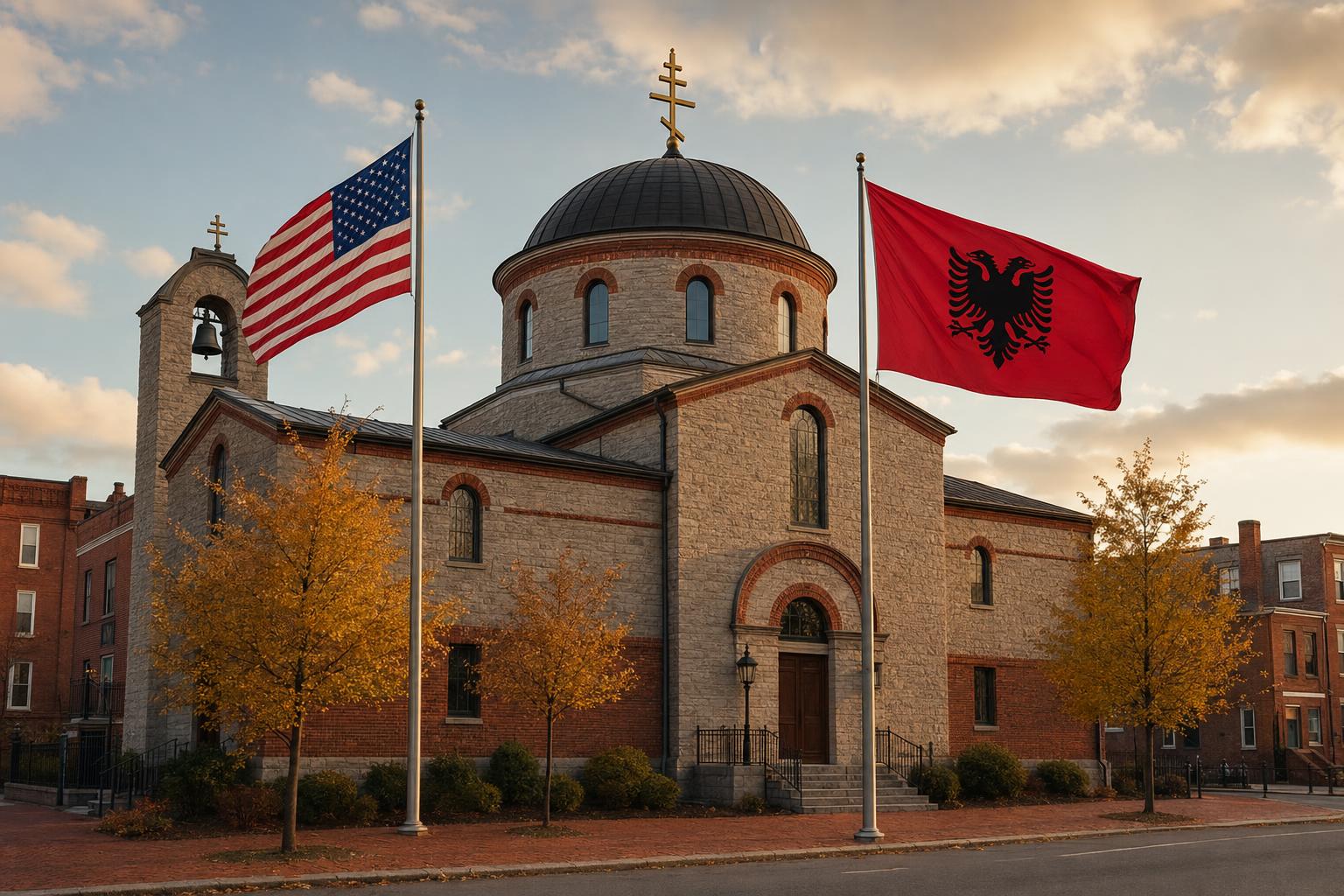
The Albanian Orthodox Archdiocese in America (AOAA) is the religious and community institutional anchor for Orthodox Christian Albanians in the United States. Its origin is one of the cleanest founding stories in Albanian-American history: Boston, March 1908, Fan S. Noli. Noli founded the first Albanian nationalist organization in America, briefly served as Prime Minister of Albania in 1924, and translated the Eastern Orthodox liturgy into Albanian for the first time. One man, one decade, four institutions that still shape Albanian-American life.
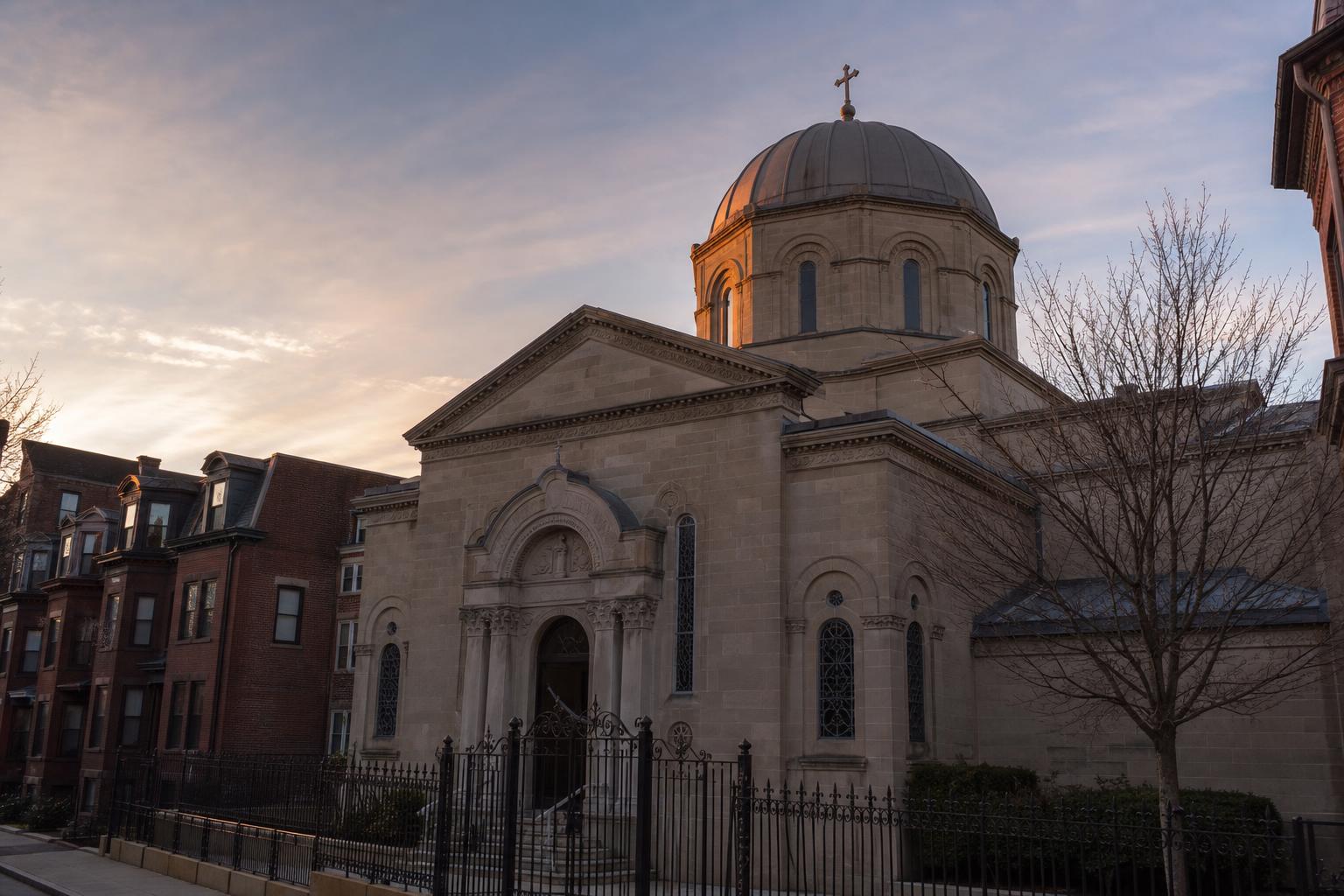
Today, the Archdiocese operates parishes across seven US states, headquartered at St. George Albanian Orthodox Cathedral in South Boston. It has been part of the Orthodox Church in America (OCA) since 1971. A separate, smaller body — the Albanian Orthodox Diocese of America under the Ecumenical Patriarchate of Constantinople — operates two additional churches and serves overlapping communities.
This piece does three things: tells the founding story (Fan Noli, Boston, 1908), describes the jurisdictional landscape without taking a side, and maps the network — every Albanian Orthodox parish we can verify, by metro, with the practical context a reader needs to find their nearest church.
We’ve written it factually and respectfully. Albanian-American religious life is plural — Orthodox, Catholic, Sunni, Bektashi, secular — and at NAR, we count all of it. This explainer focuses on the Orthodox Archdiocese because that’s the search query, but the broader picture matters and shows up where it should.
Fan S. Noli and the founding (1908)
Theofan Stilian Noli (1882-1965) is the towering figure of early Albanian-American institutional life. Born in Ibrik Tepe, in what was then the Ottoman Empire, to Albanian parents, he came of age in a generation that was inventing modern Albanian national identity in real time — and he came to the United States as a young man already steeped in the cause.
The compressed institutional record of his Boston decade is the easiest way to see what he did. In 1907, he founded Besa-Besën, the first Albanian nationalist organization in America, in Boston — its name a double-down on the Albanian code of honor (besa — the bond of one’s word). In 1908, he founded the Albanian Orthodox Church in America and celebrated the first-ever Divine Liturgy in the Albanian language on US soil, after being ordained a priest on March 18, 1908, by Archbishop Platon of the Aleutians and North America (Wikipedia: Albanian Orthodox Archdiocese in America). In 1909, he founded Dielli (The Sun), the Albanian-American newspaper that still publishes today. In 1912, he co-founded the Pan-Albanian Federation Vatra, the umbrella civic organization that became the most important Albanian-American body of the twentieth century. Four institutions in five years. All of them still exist.
Noli’s political career took him back to Europe. He served briefly as Prime Minister of Albania in 1924, leading a short-lived reform government during the country’s first democratic experiment, before being deposed by Ahmet Zogu later that year. He spent the late 1920s and early 1930s in exile in Western Europe, returned to the United States in the 1930s, and led the Albanian Orthodox Archdiocese for the rest of his life.
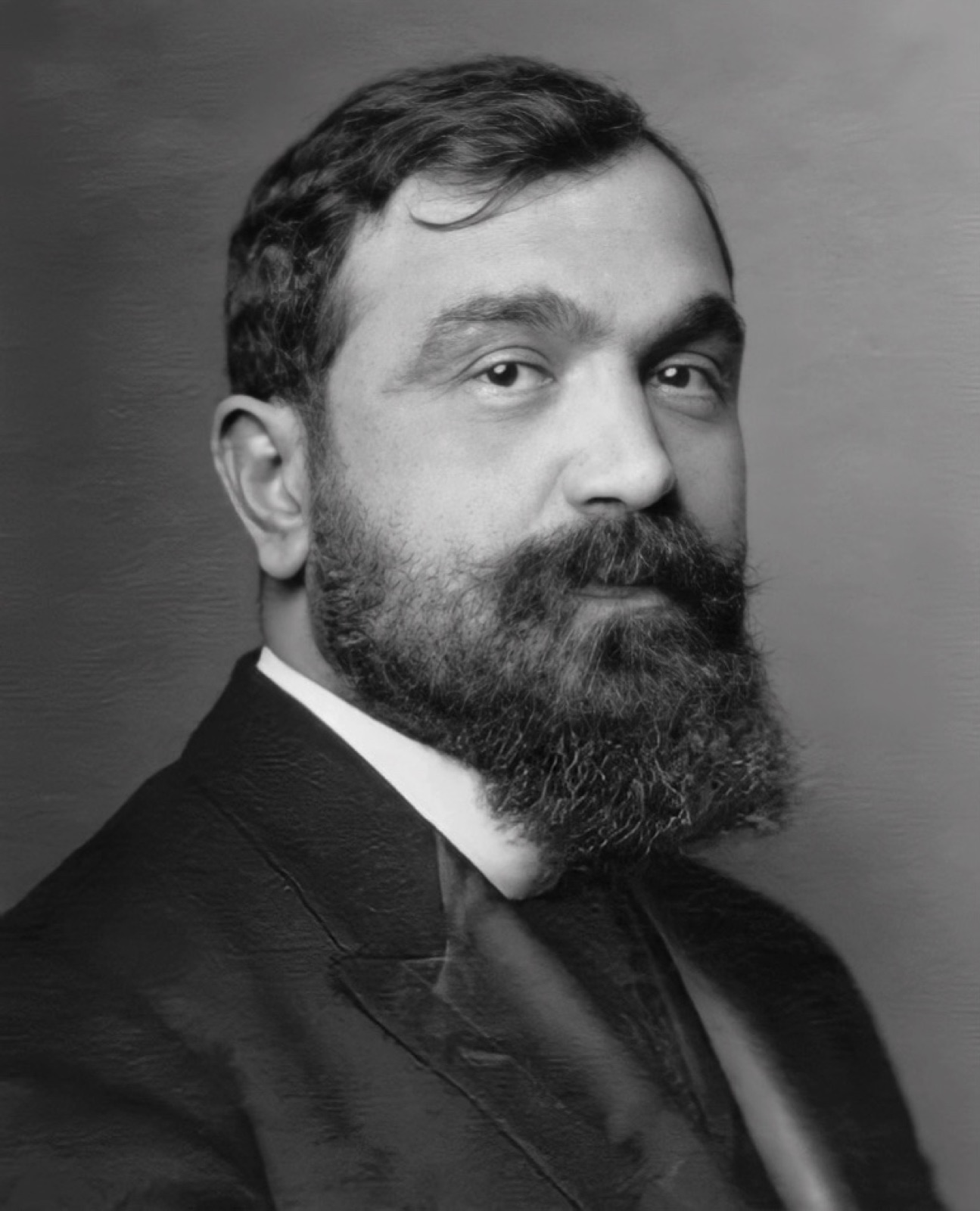 Fan Stilian Noli, c. 1924. Photo: public domain via Wikimedia Commons.
His liturgical-translation work is what most directly shaped the religious life of Albanian-American Orthodox Christians. He translated the Divine Liturgy of St. John Chrysostom, the Liturgy of St. Basil, the daily and festal hours, the Holy Week services, and the principal sacramental rites into Albanian — making the full Byzantine corpus available to a community that, for centuries, had heard those prayers only in Greek. He also produced literary translations of Shakespeare, Cervantes, and other canonical authors into Albanian during the same decades.
He died in Fort Lauderdale, Florida, in 1965. He is interred at Forest Hills Cemetery in Boston’s Jamaica Plain neighborhood — not at St. George Cathedral, the parish he founded fifty-seven years earlier (Wikipedia). The cathedral grounds and the cathedral hall remain the closest thing the Albanian-American Orthodox community has to a national shrine.
The 1908 founding moment — context
To understand why 1908 mattered, you have to understand what Albanian Orthodox Christians faced before it.
Before 1908, Albanian Orthodox Christians worshipped under the Ecumenical Patriarchate of Constantinople — the senior see of Eastern Orthodoxy, headquartered in Istanbul. In practice, that meant their services were in Greek, their parish records were kept in Greek, and the Patriarchate’s official ethnic category for them was Greek Orthodox. For Albanian-speaking faithful in the Ottoman south of Albania, in the diaspora villages of Italy and Egypt, and in the new immigrant neighborhoods of Boston, Worcester, and the Massachusetts mill towns, this was a slow erasure: their language was excluded from worship, and their ethnic identity was officially absorbed into someone else’s.
Fan Noli’s 1908 ordination and the first Albanian-language liturgy in Boston were therefore as much a political act as a religious one. They were a public declaration that Albanian Orthodox Christians had their own language, their own identity, and their own ecclesial standing. The choice to seek ordination through the Russian Orthodox Greek Catholic Church (now the OCA) — rather than the Patriarchate that had refused to ordain Albanian-speaking priests for Albanian-language liturgy — was the only available canonical path.
The jurisdictional consequences played out across the next several decades. Most Albanian Orthodox parishes in America affiliated with what would become the Orthodox Church in America (the autocephalous successor to the Russian Metropolia), which formally accepted the Albanian Orthodox Archdiocese as a constituent diocese in October 1971. A smaller group of parishes affiliated with the Ecumenical Patriarchate of Constantinople through a separate Albanian-Orthodox structure established in 1949-1950 (see next section). The two bodies have coexisted ever since.
The two Albanian Orthodox jurisdictions in America
Both jurisdictions are Eastern Orthodox in faith, sacraments, calendar, and liturgical tradition. The difference is administrative and jurisdictional, not theological. We don’t take a position on which arrangement is canonically preferable; we describe both because both are part of Albanian-American religious life.
Albanian Orthodox Archdiocese in America (AOAA) — the larger body. Founded by Fan Noli in 1908. Parishes across seven states (California, Connecticut, Massachusetts, Michigan, New York, Ohio, and Pennsylvania), organized into three deaneries: Great Lakes, Massachusetts, and Mid-Atlantic (Wikipedia). Headquartered at St. George Albanian Orthodox Cathedral, South Boston. Part of the Orthodox Church in America since October 1971. Currently led by Bishop Nikodhim (Preston), enthroned September 16, 2023.
Albanian Orthodox Diocese of America — the smaller body. Established by Bishop Mark Lipa in 1949-1950 and remains under the Ecumenical Patriarchate of Constantinople. Operates two parishes: Saint Nicholas Albanian Orthodox Church (Chicago) and Holy Trinity Albanian Orthodox Church (South Boston).
Together, the two bodies serve the US Albanian Orthodox community — concentrated in Massachusetts, New York, Connecticut, Michigan, Ohio, Pennsylvania, and Illinois — though neither jurisdiction publishes an official combined membership count. The communities overlap socially: families intermarry across the two jurisdictions, attend each other’s festivals, and cooperate on civic events like Flag Day and Independence Day.
The directory: Albanian Orthodox parishes by metro
The list below covers the major Albanian Orthodox parishes we can verify by name and location across both jurisdictions. Service times, clergy assignments, and parish boundaries change; treat them as approximate and confirm directly before traveling.
Boston metro / South Boston (the institutional center)
The most concentrated Albanian Orthodox footprint in the country.
- St. George Albanian Orthodox Cathedral — South Boston, MA. The mother church and headquarters of the Archdiocese. Founded by Fan S. Noli in 1908; the site of the first Albanian-language Divine Liturgy in the United States. Noli himself is interred at Forest Hills Cemetery in Boston’s Jamaica Plain neighborhood, not on the cathedral grounds. Today the cathedral hosts the Archdiocese’s primary liturgical calendar, ordinations, hierarchical visits, and major Albanian-American civic gatherings.
- Holy Trinity Albanian Orthodox Church — South Boston, MA. Under the Ecumenical Patriarchate (Albanian Orthodox Diocese of America). One of the two parishes of the smaller jurisdiction; serves Boston-area Orthodox Albanians who maintain that affiliation.
Worcester, Massachusetts
- St. Mary’s Assumption Albanian Orthodox Church — Worcester, MA. Worcester’s Albanian Orthodox community organized in the early twentieth century, making it among the oldest local Albanian Orthodox communities in America after the Boston founding. Worcester’s mill-town economy drew a substantial Albanian Orthodox population from southern Albania in that era, and the parish has anchored that community for more than a hundred years.
Greater New York City
- Bronx, Manhattan, and Queens parishes. New York’s Albanian Orthodox parishes are smaller and quieter than the Boston cluster but carry deep historical roots, dating to the early-twentieth-century immigration wave and reinforced by post-1990 arrivals. The Bronx and Queens communities sit alongside large Albanian Catholic and Sunni populations in the same boroughs — the Belmont, Pelham Parkway, Astoria, and Ridgewood neighborhoods — and joint Flag Day and Independence Day events draw clergy and families across all three traditions.
Detroit metro (Michigan)
- Sterling Heights and the Macomb County suburbs. Michigan’s Albanian Orthodox parishes are part of the Archdiocese’s Great Lakes Deanery and serve the broader Detroit-metro Albanian Orthodox community. The same metro is also home to the largest Albanian Sunni and Bektashi populations in the country, and inter-religious Albanian-American civic life in Detroit is unusually active because of that density.
Chicago
- Saint Nicholas Albanian Orthodox Church — Chicago, IL. Under the Ecumenical Patriarchate (Albanian Orthodox Diocese of America). One of the two parishes of the smaller jurisdiction; serves Chicago-area Orthodox Albanians. The Chicago metro’s Albanian community has grown steadily since the 1990s, with both Orthodox and Sunni institutions expanding.
Connecticut
- Waterbury parish. Connecticut has one of the largest per-capita Albanian-American populations in New England, concentrated in the Waterbury corridor. The Albanian Orthodox parish there serves a community that also supports a sizeable Albanian Sunni footprint.
- Hartford-area parish. A second Connecticut parish anchors the Hartford-area Albanian Orthodox community.
Other parishes (Lowell, New Jersey, Florida, Pennsylvania, Ohio, California)
- Lowell, MA. Mill-town Massachusetts has a long-tail of Albanian Orthodox parishes beyond Worcester; Lowell is the most prominent.
- New Jersey. Albanian Orthodox parishes in northern New Jersey serve the broader NYC-metro community alongside the New York parishes.
- Florida, Pennsylvania, Ohio, and California. Smaller parishes in these states fall under the Archdiocese’s Mid-Atlantic Deanery (Pennsylvania), the Great Lakes Deanery (Ohio), and the Massachusetts Deanery (California, despite the geographic name — a deanery reflects clergy clustering, not state borders).
For each of the parishes above, the practical pattern is similar: Sunday Divine Liturgy in a mix of Albanian and English, festival liturgies for Pashkë (Easter) and Krishtlindja (Christmas) drawing the largest crowds of the year, name-day commemorations (especially Saint George’s Day, which is also the cathedral’s patronal feast), and a community hall booked for weddings, baptisms, valle dancing at engagement parties, and post-funeral receptions and forty-day memorials.
What an Albanian Orthodox parish does beyond Sunday liturgy
Walking into an Albanian Orthodox parish on a non-Sunday afternoon, the first thing you notice is that it doesn’t look like a single-purpose religious building. There are folding tables, a coffee urn, a children’s-book corner, a whiteboard with class times.
Albanian Orthodox parishes in the US function as community institutions as much as houses of worship. The footprint typically includes:
Saturday school. Most parishes run a weekend program for children covering Albanian language, Orthodox religious literacy, hymnography, and Albanian history. For second- and third-generation kids whose parents worry the language won’t survive another generation, this is where it gets transmitted.
Festival days. Pashkë (Easter) and Krishtlindja (Christmas) anchor the liturgical calendar — Holy Week services, the midnight Easter Liturgy with red-egg cracking after, the Christmas Eve service. Saint George’s Day in late April is the patronal feast of St. George Cathedral and a major gathering across the Archdiocese. Name-day customs (emërdita) — celebrating the saint’s day shared with one’s given name — remain a meaningful part of Albanian Orthodox family life.
Weddings and baptisms. Traditional Albanian Orthodox weddings include the crowning ceremony (kurorëzimi), the Common Cup, and the Dance of Isaiah. Many parishes are booked months in advance for weddings, and the social hall functions as the reception venue.
Civic ties. Albanian Orthodox parishes maintain tight institutional ties to Vatra (the Pan-Albanian Federation Noli co-founded in 1912) and the Albanian American National Organization (AANO), and many parishes host or partner with these civic groups for Flag Day banquets, Independence Day commemorations, and scholarship galas. The shared identity is Albanian first; the religious institution is the venue, not the boundary.
Community organizations. Many Albanian Orthodox parish halls also host civic and community-organizing meetings — diaspora groups, professional associations, and Albanian-American chambers of commerce frequently meet in parish halls because the spaces, schedules, and cultural context align.
This is why getting counted matters across religion. NAR’s registry isn’t asking you to identify a denomination — it’s asking you to be counted as Albanian. The Orthodox parishes have done the institution-building work; the registry layers a national count on top.
Albanian Orthodox in Albania vs America
A common point of confusion: the Albanian Orthodox Archdiocese in America and the Orthodox Autocephalous Church of Albania are two different bodies, and they have different histories.
The American body has continuous institutional life since 1908. Through the twentieth century — including the decades when communist Albania officially banned religion (the 1967 atheism declaration through the 1990 reopening) — the Archdiocese in America preserved Albanian-language liturgy, clergy formation, parish life, and the institutional memory of Albanian Orthodoxy. It is part of the Orthodox Church in America, which is itself autocephalous (self-governing), and operates as a constituent diocese with its own bishop and parishes.
The Albanian body — the Orthodox Autocephalous Church of Albania, headquartered in Tirana — was effectively dismantled during the communist period. After Albania lifted its atheism policies in 1990, the Ecumenical Patriarchate sent Anastasios (Yannoulatos) to rebuild Orthodox life in Albania — first as Patriarchal Exarch in 1991, then as Archbishop of Tirana, Durrës and All Albania from 1992 until his death, overseeing the restoration of seminaries, parishes, monasteries, translation programs, and clergy training across the country. The current Albanian-domestic body has continuity of faith with the pre-communist Albanian Orthodox Church but had to be re-established institutionally after a fifty-year gap.
Both bodies are in full communion with each other and with the rest of canonical Eastern Orthodoxy. American Albanian Orthodox families with relatives in Albania routinely attend services in both countries; clergy occasionally cross between the two bodies for pastoral visits and study.
Finding your local Albanian Orthodox parish
Three honest paths:
- The Orthodox Church in America’s website (oca.org) maintains the canonical directory of Albanian Orthodox Archdiocese in America parishes. Search the OCA parish locator filtered to the Albanian Archdiocese, or browse the deanery pages (Great Lakes, Massachusetts, Mid-Atlantic).
- Vatra (the Pan-Albanian Federation) — the civic body Fan Noli co-founded in 1912 — maintains community contacts across Albanian-American religious institutions and can refer newcomers to nearby parishes regardless of jurisdiction.
- The National Albanian Registry is building a community-wide count that spans every tradition — Orthodox, Catholic, Sunni, Bektashi, civic, and cultural. If your community isn’t represented yet, contact us.
If you’re searching specifically for the historic center, the answer is St. George Albanian Orthodox Cathedral in South Boston — Fan Noli’s original 1908 parish and the institutional seat of the Archdiocese.
Get counted, regardless of faith
NAR exists to count Albanian Americans. All of us — Orthodox, Catholic, Sunni, Bektashi, secular, mixed-heritage, fluent or not. The official US Census records 230,000 Albanian Americans (2024 ACS). The community estimate is closer to a million. Closing that gap is what we’re here for.
The US Census records about 230,000 Albanian Americans. The real number is closer to a million, because the count misses most of us for reasons we’ve documented at length: mixed country-of-birth answers, skipped ancestry write-ins, and whole branches of a family the form never reaches.
Getting counted takes about three minutes, costs nothing, and keeps your data private. You don’t tell us your religion. You don’t have to. You tell us you exist, and we add you to the count. Get counted →
Sources: Wikipedia — Albanian Orthodox Archdiocese in America; Orthodox Church in America (oca.org); Wikipedia — Fan Noli; Wikipedia — Vatra (federation); Wikipedia — Orthodox Autocephalous Church of Albania. Where dates or congregation sizes are approximate, we’ve said so plainly.