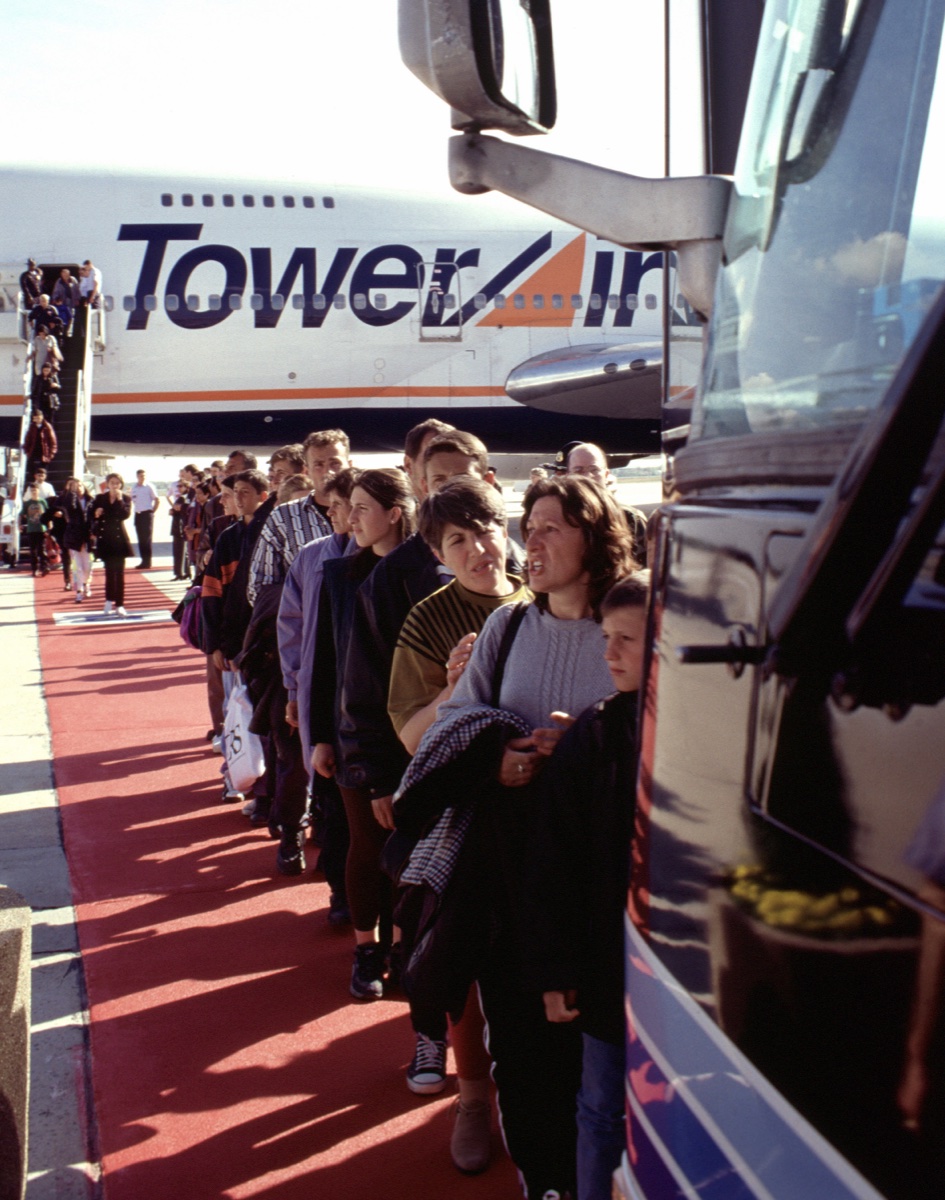
On 21 April 1999, US Vice President Al Gore announced that the United States would accept up to 20,000 Kosovar Albanian refugees. Two weeks later, on 5 May 1999, the first plane carrying more than 450 of them landed at McGuire Air Force Base in central New Jersey. Buses took the families two miles down the road to Fort Dix, where they spent about three weeks in barracks while caseworkers from the International Rescue Committee, Catholic Charities, and the US Conference of Catholic Bishops sorted out where each family would go next.
Of the roughly 14,000 Kosovars who were ultimately admitted under what the Pentagon called Operation Provide Refuge, about a quarter were processed through Fort Dix. The rest came in directly through resettlement agencies in cities where they had relatives. Most of those relatives lived in the Bronx, in northern New Jersey, in Yonkers, and in metro Detroit — places where earlier waves of Kosovar Albanians had been quietly building communities for decades.
That spring of 1999 is the moment most American readers think of when they hear “Kosovar American.” It is one chapter in a longer story. This article is about the diaspora itself — who came, when they came, where they live now, how they fit alongside Albanians from Albania, and how the second generation born in the US is figuring out its own identity. For the diplomatic side of the relationship — Camp Bondsteel, Bill Clinton Boulevard, the 2008 recognition — see Kosovo and the United States: A Foundational Alliance.
Who counts as a “Kosovar American”
The category needs a careful definition. Kosovar is a national term — it means someone from Kosovo. Albanian is an ethnic term — it means a member of the Albanian-speaking people. Roughly 93% of Kosovo’s population is ethnically Albanian, with smaller Serb, Bosniak, Turkish, Roma, Ashkali, Egyptian, and Gorani minorities. The Kosovar-American community in the United States is overwhelmingly ethnic Albanian; this article uses Kosovar Albanian and Kosovar American interchangeably to mean the same group, with the understanding that a small number of Kosovar Serbs and Roma also live in the US under different community structures.
In Albanian, the country is Kosova and a person from there is kosovar (lowercase, masculine) or kosovare (feminine). The Albanian self-name for the people — across Kosovo, Albania, North Macedonia, Montenegro, and the diaspora — is shqiptar (plural shqiptarë). Kosovar Americans use both: kosovar when they need to distinguish their region of origin, shqiptar when they are talking about the wider community.
For NAR’s purposes — and for any honest count of the US Albanian community — Kosovar Americans are part of one whole. They do not show up as a separate row on the US Census; they show up under “Albanian ancestry” alongside everyone else from the Albanian-speaking world. We will come back to that data limit below.
The earlier Kosovar arrivals (1960s-1990s)
The 1999 refugee wave is the most visible chapter, but it is not the first. Kosovar Albanians began arriving in the United States in meaningful numbers from the 1960s onward, when Yugoslavia’s loosened emigration rules let Kosovo Albanians take guest-worker visas to Western Europe and, in smaller numbers, family-sponsored visas to the US. Many of these earlier arrivals were men who came alone, found work, sent remittances home for years, and only later sponsored wives, children, and parents.
This earlier Kosovar wave settled in the same places earlier Albanian Americans had already built footholds — the Bronx, Detroit, Waterbury — and integrated into them. The Albanian Catholic parish Our Lady of Shkodra in the Bronx, for instance, served a population that was a mix of Albanians from northern Albania, Kosovo, and Montenegro from its founding decades. The community did not draw hard lines between “Albania-born” and “Kosovo-born” Albanians; the line that mattered to most members was that all of them were shqiptarë in the United States.
Through the 1980s the flow continued, accelerated by Slobodan Milošević’s revocation of Kosovo’s autonomy in 1989 and the parallel-state period that followed. Kosovars who could leave often did. Many headed to Switzerland, Germany, or the Nordic countries; a smaller number reached the US, usually on family-reunification petitions filed by relatives already here. By 1998, the year the Kosovo conflict turned into open war, there were already tens of thousands of Kosovar Albanians in metropolitan New York and a smaller but established community in Macomb County, Michigan.
The 1999 wave landed inside an existing diaspora. That detail matters for what came next.
The 1999 wave: Operation Provide Refuge
The Kosovo war displaced roughly 800,000 Kosovar Albanian civilians from their homes between March and June of 1999. Most fled to camps in northern Albania, in North Macedonia (especially around the Stenkovec and Brazda camps), and in Montenegro. A smaller number — about 96,000 — were evacuated to third countries under the UNHCR’s Humanitarian Evacuation Programme.
The United States took 13,989 of them. The decision to do so came from the Clinton administration on 21 April 1999, with Vice President Al Gore making the public announcement. The military piece was named Operation Provide Refuge (originally Operation Open Arms); the civilian resettlement piece was coordinated by the State Department’s Bureau of Population, Refugees, and Migration with the major US resettlement agencies.
The processing center was Fort Dix, New Jersey — a US Army Reserve installation in Burlington County, adjacent to McGuire Air Force Base. The first flight, carrying more than 450 refugees from Skopje, North Macedonia, landed at McGuire on 5 May 1999. Buses moved the families to Fort Dix barracks, where staff from the International Rescue Committee, Catholic Charities, HIAS, the US Conference of Catholic Bishops, Lutheran Immigration and Refugee Service, Church World Service, and others matched each family to a sponsor and a destination city. Fort Dix kept processing new arrivals from 5 May through 9 July, when roughly 4,025 had passed through — about a quarter of the 13,989 Kosovars admitted in total. The rest, roughly 9,964 Kosovars, were resettled directly into US cities through the same agency network without passing through Fort Dix.
The processing took about three weeks per family. Children received vaccinations, adults received TB screenings, every family received a Social Security number application and an I-94 document with the “Special Humanitarian Parolee” classification. Most were paroled into the US for one year, with the option to apply for asylum or adjust to permanent resident status from inside the country — which the vast majority did.
Where the resettlement agencies sent them
The resettlement-agency map of 1999 is the reason today’s Kosovar-American geography looks the way it does. Caseworkers at Fort Dix asked each family two questions: do you have relatives in the United States, and if so, where? When the answer was “yes,” the family was almost always placed in the same metro as the relative. When the answer was “no,” the agency picked from a list of partner cities with capacity — places where local affiliates had housing, English-as-a-second-language classes, and entry-level job referrals lined up.
The largest single placement region was the New York metro area, where most Kosovar arrivals already had cousins or in-laws. Caseworkers also placed substantial numbers in northern New Jersey (Paterson, Garfield, Passaic County), Westchester County (especially Yonkers), metro Detroit (Sterling Heights, Warren, Macomb County), Boston and Worcester, Waterbury, Connecticut, and Chicago. Smaller placements reached unexpected places — Fargo, North Dakota received Kosovar families through Lutheran Social Services; Atlanta, Phoenix, Charlotte, and Dallas each took dozens.
Some of those smaller placements held. Many did not. Within five years of arrival, secondary migration had pulled most non-traditional placements back toward the Bronx, Yonkers, Paterson, or Sterling Heights — the cities where the larger Kosovar and Albanian communities already lived. The 1999 wave reinforced existing concentrations; it did not redraw the map.
Where Kosovar Americans live today
The contemporary Kosovar-American footprint mirrors the older Albanian-American footprint, with the heaviest weight on the New York metro area.
The Bronx is the single largest Kosovar-American population center. The neighborhoods of Belmont, Pelham Parkway, Bedford Park, Morris Park, and Allerton carry the densest concentration of Albanian-owned bakeries, butchers, restaurants, and community institutions in the US, with Kosovar families part of every block. Our Lady of Shkodra Catholic parish, the Albanian American Society Foundation, and a network of soccer clubs, social clubs, and Albanian-language community schools anchor neighborhood life.
Yonkers and Westchester County carry the second-densest Kosovar population in the metro area, with families that moved north from the Bronx in the 2000s and 2010s as the Bronx became more expensive. Staten Island has a smaller but growing Albanian community concentrated in Dongan Hills, Tompkinsville, New Dorp, and Grant City — the borough is now nearly 1% Albanian by ancestry, much of it Kosovar.
Northern New Jersey is the second metro after New York. Paterson, Garfield, Wayne, and surrounding Passaic County towns absorbed both 1999-wave Kosovars and earlier Albanian arrivals; the area has Albanian Catholic and Sunni Muslim institutions and an Albanian-language school network.
Metro Detroit is the largest concentration outside the New York region. Sterling Heights, in Macomb County, is roughly 2.5% Albanian — about 3,500 people in a city of 134,000 — and the broader Macomb County Albanian population was estimated at 4,800 in 2014, making it the fourth-largest ethnic group in the county (according to Wikipedia’s History of the Albanian Americans in Metro Detroit). A meaningful share of that population is Kosovar Albanian, with families that came in the 1980s, the 1990s, and the 1999 wave living in the same suburbs as Albania-born families. The community there built the Albanian Islamic Center in Harper Woods, a Catholic parish in Detroit, and a chain of Albanian-owned restaurants, bakeries, and the now-iconic Albanian-run Coney Island diner network across the metro.
Smaller but visible Kosovar populations live in Waterbury, Connecticut; Worcester and Boston, Massachusetts; Chicago; Tampa Bay; Philadelphia; and the Dallas-Fort Worth metroplex. Each of those communities has at least one Albanian institution — a parish, a mosque, a cultural center, a soccer club — that anchors the local Kosovar-American population alongside Albanians from elsewhere in the Albanian-speaking world.
Kosovars and Albanians from Albania: same nation, different paths
The largest Albanian community in the US is Albania-born. The second largest is Kosovar. They are the same people — same language, same self-name, same alphabet, overlapping religion, intermarried at scale — and they arrived through different doors.
Albania-born Albanians mostly came after 1991, when Albania’s communist government collapsed and emigration restrictions ended. The dominant push factors were economic collapse, the 1997 pyramid scheme crisis, and political instability through the late 1990s. Most arrived on diversity visas, family-reunification petitions, asylum claims, or as overstayers who later regularized. They came from Tirana, Shkodër, Vlorë, Korçë, Durrës, and the smaller towns of central and southern Albania. Their dialect is largely Tosk in the south and Gheg in the north.
Kosovar Albanians had been arriving in smaller numbers for decades before the 1999 wave through Yugoslavia’s emigration system. The 1999 group came as war refugees under formal humanitarian parole, not as economic migrants. They came almost entirely from Kosovo’s cities and villages — Pristina, Peja, Gjakova, Prizren, Mitrovica, Drenica, Ferizaj — and they speak the Gheg dialect of Albanian, the same dialect spoken in northern Albania. (See Kosovo vs Albania for a fuller comparison of the two regions.)
In the United States the two groups overlap heavily. The Bronx, Sterling Heights, and Paterson all have Albanian institutions that serve both populations without distinction. Albanian-language schools mix kids whose parents came from Tirana, Pristina, Tetovo, and Ulcinj in the same classroom. Marriage across the line is common — a Kosovar groom and an Albania-born bride is an unremarkable wedding announcement in the community press. Vatra, the Pan-Albanian Federation of America (founded 1912), serves all of them. So does the Albanian American National Organization (AANO), the Albanian American Civic League, and the regional chambers of commerce.
Where the line still shows up is in food, slang, and football allegiance. Kosovars are more likely to make flija (a labor-intensive layered crepe dish from northern Albania and Kosovo) than southern Albania-born families, who are more likely to know fërgesë (a Tosk-region pepper-and-cheese stew). Kosovar slang carries more Serbian-derived loan words; Albania-born slang carries more Italian. On match day, fans of the Albania national team and fans of the Kosovo national team are often the same people, depending on the fixture. None of this rises to the level of “different community.” It is the texture of one community with internal regional variation.
The second generation: kids born in the US
The Kosovar Albanians who arrived in 1999 as adults are now in their fifties and sixties. Their children — born in the US in the early 2000s, or arriving in the US as small children — are in their twenties and thirties now. The kids born here are the first generation that has only ever known a Kosovo with a flag, a passport, and a seat at the IMF.
This second generation looks much like the second generation in any post-1990 immigrant community. They speak English fluently and Albanian to varying degrees. They went to American public schools, mostly in the Bronx, Yonkers, Sterling Heights, and Paterson. A meaningful share are now in college or in skilled professions — finance, medicine, law, engineering, real estate, hospitality, teaching, civil service. Many married inside the community; many married outside it. Most can locate Pristina on a map and many have visited; some make the trip every summer; others have never been.
The identity question they answer differs from the one their parents answered. Their parents arrived as Kosovar refugees and were defined for years by that status. The kids born in the US are American in every documentable sense — passport, accent, schooling, voting registration — and shqiptar in the way that matters at home. Whether they describe themselves as “Albanian American,” “Kosovar American,” “Kosovar Albanian American,” or just “American with Albanian roots” depends on the conversation. NAR’s count makes room for all of those forms.
Civic and business life
Kosovar Americans have built the same kinds of institutions that earlier Albanian-American waves built, often in partnership with them.
Religious institutions are the densest. Kosovar Albanians are mostly Sunni Muslim with a meaningful Catholic minority (concentrated historically in northern Kosovo and the Drenica region) and a small Bektashi Sufi presence. In the US, the Albanian American Mosque (Bronx), the Albanian Islamic Center (Harper Woods, Michigan), Our Lady of Shkodra (Bronx), the Albanian Catholic Church of Saint Paul (Warren, Michigan), and dozens of smaller parishes and xhamia (mosques) serve mixed Albania-born and Kosovo-born congregations. Religion is rarely the dividing line in this community; region of origin and family network are stronger predictors of which institution a family attends.
Business life is heavily small-business. Real estate, construction, restaurants, bakeries, butchers, supermarkets, livery and trucking, and the iconic Albanian-run Coney Island diner chain across metro Detroit are all sectors where Kosovar Americans are well-represented. The Bronx and northern New Jersey have a notable concentration of Albanian-owned residential and commercial real estate. Sterling Heights has a visible Albanian retail corridor along Schoenherr Road. Professional sectors — law, accounting, finance, healthcare — are growing fast as the second generation enters them.
Civic organizations include the Albanian American Civic League (Ossining, NY), the Albanian American National Organization (NY metro), the National Albanian American Council, the AAEA (Albanian American Educators Association), and a dense network of regional and city-level chapters. The NY Albanian Parade, held annually in Manhattan, draws Kosovars and Albania-born Albanians together in equal numbers. The Sunny Hill Foundation — co-founded by Dua Lipa and her father Dukagjin Lipa — funds education and youth programs in Kosovo through the annual Sunny Hill Festival in Pristina.
This is a community that is past its arrival phase. It is now in its institution-building, second-generation, professionalization phase — the same phase the broader Albanian-American community is in.
What the US Census sees, and what it misses
The US Census Bureau collects ancestry through the American Community Survey (ACS), table B04006. The 2024 ACS counts roughly 230,000 Albanian Americans. That figure is the official count for the entire ethnic Albanian population in the US — Albania-born, Kosovo-born, North Macedonia-born, Montenegro-born, Italian Arbëresh, and the US-born descendants of all of them combined.
The Census does not separate Kosovar from Albanian ancestry. There is no “Kosovar” line on the form. A Kosovar respondent who writes “Albanian” gets counted as Albanian. A Kosovar respondent who writes “Kosovar” or “Kosovo” gets counted under a smaller “Other” category or coded back into Albanian during processing. A Kosovar respondent who writes “Yugoslav” — which some older immigrants still do, reflecting the country they emigrated from — gets counted under Yugoslav ancestry. Some who came as small children write nothing at all.
The result is a structural undercount that NAR has documented elsewhere (see Albanian Americans). Community estimates that include Kosovars, North Macedonian Albanians, Montenegrin Albanians, and second- and third-generation Americans who do not always check the “Albanian” box run from 750,000 to 1,000,000. The 230,000 official figure is a floor, not a ceiling.
For Kosovar Americans specifically, no clean number exists. Community estimates put the Kosovar-American population at roughly 80,000 to 150,000, but those numbers are extrapolations from parish rolls, business directories, and resettlement-agency records — not from a clean ACS line. The honest answer is that the United States does not know exactly how many Kosovar Americans live here, because nobody has counted.
This is precisely the gap NAR was built to close. A community-led count that captures country of origin alongside ethnicity gives the diaspora the data its own institutions need.
If you are Kosovar Albanian and live in the United States, your registration adds you to a community-led count of the US Albanian diaspora — and lets us track Kosovo-origin numbers alongside Albania-origin, North Macedonia-origin, and Montenegro-origin numbers in the same dataset. Register at albanianregistry.org/register. The certificate you receive is a recognition document — not a government ID, not citizenship, not legally binding — and that is stated plainly on it.