
Before Tirana was anything more than a small Ottoman town, Shkodra was Albania’s city.
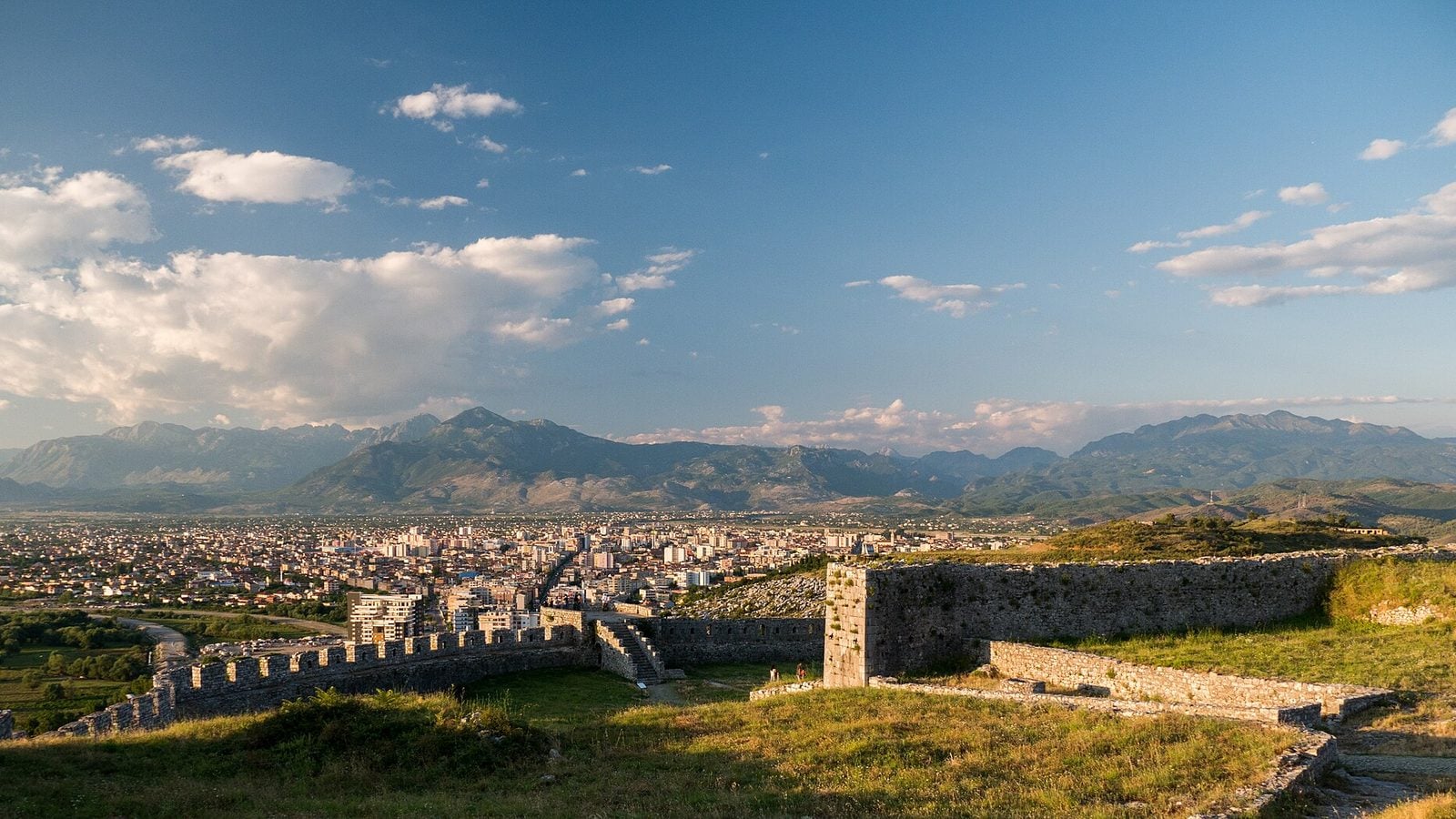
It sat at the meeting point of two rivers and a lake, with a castle on the hilltop and the Albanian Alps at its back. For centuries, it was the place where Albanian Catholicism had its seat, where the country’s literary tradition took root, and where the Bushati pashas governed a domain so autonomous it functioned as a state within the Ottoman Empire. When the first Albanian immigrants left for the United States in the early 1900s, a disproportionate number came from the Shkodra region — and the institutions they built in Detroit, Boston, and New York carried the imprint of the city they left behind.
Tirana became the capital in 1920. Shkodra had been the cultural capital for centuries before that, and in many ways still is.
Scodra: the Illyrian beginning
The city’s recorded history begins with the Illyrians. Ancient Scodra — the Latin form of the name — was the stronghold of the Labeates, an Illyrian tribe that controlled the lake and the river system around it. By the 3rd century BC, Scodra was a stronghold of the broader Illyrian kingdom. Queen Teuta, regent of the Ardiaei, held power in the 230s BC; King Gentius, the last Illyrian king, made Scodra his capital before Rome captured the city in 168 BC.
Under Rome, Scodra became a civitas in the province of Dalmatia. It sat on the road system connecting the Adriatic coast to the interior. When the empire split in AD 395, the city fell on the western side of the line — which is why northern Albania developed within the Latin-rite Catholic sphere while the south followed the Byzantine Orthodox tradition. That ecclesiastical divide still shapes Albanian identity today: Shkodra remains the heart of Albanian Catholicism; Korçë and Gjirokastër are the Orthodox south.
The medieval centuries brought a succession of rulers. The Balsha dynasty (Balshaj) governed the Principality of Zeta from Shkodra beginning in the 1360s. Venice gained control of Shkodra in 1396 and held the city until the Ottoman siege of 1478–1479. The same Venetian republic would later recruit Albanian stradioti cavalry from across the region after the Ottoman conquest.
The siege and the fall
The Ottoman siege of Shkodra in 1478–1479 was one of the hardest-fought episodes of the conquest of the Balkans. Sultan Mehmed II, the conqueror of Constantinople, personally led the siege beginning in 1478. The garrison, reinforced by Venetian and Albanian defenders, held the citadel for months. When Venice signed the Treaty of Constantinople in January 1479 and ceded Shkodra to the Ottomans, the city’s population largely evacuated rather than submit. The defenders marched out under terms; many resettled in Venice and along the Dalmatian coast.
The fall of Shkodra completed the Ottoman conquest of the Albanian lands that Skanderbeg’s resistance had delayed by a quarter century. Under Ottoman rule, the city became the seat of the Sanjak of Shkodra — a provincial district that would grow, under the Bushati family three centuries later, into something close to a state.
The Bushati pashas and a city within an empire
The Bushati pashalik transformed Shkodra from a provincial town into a regional power center. From 1757 to 1831, the Bushati family governed northern Albania, Kosovo, and parts of Montenegro from Shkodra with an autonomy that made their territory functionally independent. Kara Mahmud Pasha Bushati (r. c. 1775–1796) fought wars against Montenegro, dealt directly with European powers, and expanded the pashalik to its greatest extent.
The physical Shkodra that visitors see today is partly a Bushati-era city. The family commissioned the Mes Bridge — a 108-meter Ottoman stone span across the Kir River, about 8 kilometers northeast of the city — and invested in the city’s mosques, bazaar, and fortifications. The Lead Mosque (Xhamia e Plumbit), built in the 18th century with its distinctive lead-covered dome, dates from this period of Bushati patronage.
Sultan Mahmud II destroyed the pashalik in 1831 as part of his empire-wide centralization. The last Bushati pasha, Mustafa Pasha Bushatli, surrendered, and Shkodra was folded back into direct Ottoman administration. But the Bushati era had cemented the city’s status as the political and commercial center of northern Albania — a role it would not relinquish until Tirana’s selection as capital nearly a century later.
The seat of Albanian Catholicism
Shkodra’s Catholic identity is older than the Ottoman conquest, older than the Venetian period, older than the Balshaj. The Diocese of Shkodra traces its origins to the early centuries of Christianity in the Roman province of Dalmatia. When the East-West ecclesiastical split hardened in the 11th century, northern Albania — Shkodra’s sphere — remained Catholic while the south went Orthodox. The result is that Albania is the only country in the Balkans where both major Christian traditions have deep indigenous roots, and Shkodra is the epicenter of the Catholic half.
The Franciscan order arrived in Shkodra in the medieval period and became the institutional backbone of Catholic life in the Albanian highlands. Franciscan friars ran schools, preserved manuscripts, and served as intermediaries between the highland clans and whatever imperial power — Venice, the Ottomans, the Habsburgs — happened to claim sovereignty. The Albanian Catholic tradition produced some of the country’s most important intellectuals: Pjetër Bogdani (c. 1627–1689), whose Cuneus Prophetarum was the first original prose work in Albanian; Ndre Mjeda (1866–1937), the Jesuit-educated poet whose verse shaped the Gheg literary tradition; and At Zef Pllumi (1924–2007), the Franciscan friar whose memoir Rrno vetëm për me tregue documented decades of communist imprisonment.
St. Stephen’s Cathedral (Katedralja e Shën Shtjefnit), rebuilt in 1867 and restored after the communist period, stands in the city center as the seat of the Archdiocese of Shkodra-Pult. During the communist years (1967–1990), when Albania declared itself the world’s first atheist state and closed every mosque and church in the country, Shkodra’s Catholic community bore the worst of the persecution. Priests and friars were imprisoned, executed, or sent to forced-labor camps. The fact that Shkodra’s Catholic institutions survived the persecution and reconstituted after 1990 is itself a piece of evidence about how deep the roots go.
Shkodra is also a Muslim-majority city and has been since the Ottoman period. The Lead Mosque, the Great Mosque of Shkodra, and several tekkes coexist with the cathedral, the Franciscan church, and the Orthodox church of the Nativity. The city’s religious coexistence — three faiths in one small walkable center — is one of the things visitors notice first, and one of the things that makes it distinct from cities in the rest of the Balkans.
A city of letters and light
Shkodra’s claim as Albania’s cultural capital rests on a specific set of facts. Among the most important Albanian-language literary societies, the Bashkimi (Unity) Society, was founded in Shkodra in 1899. The Agimi (Dawn) Society followed. Together, these organizations nurtured the Gheg literary tradition during the final decades of Ottoman rule, producing journals, poetry, and translations that fed into the broader Albanian Renaissance (Rilindja Kombëtare).
The city’s literary output included some of the most important names in Albanian letters. Ernest Koliqi (1903–1975), the short-story writer and minister of education, was from Shkodra. Martin Camaj (1925–1992), the linguist and novelist who spent his career in Munich, was born in the Dukagjin highlands north of the city. The Gheg dialect that Shkodra’s writers used was the dominant literary Albanian until the communist government standardized the language on a Tosk base in 1972 — a decision that Shkodra’s intellectual class resisted and resented.
Then there is the Marubi. The Marubi National Museum of Photography holds one of the most important photographic archives in the Balkans. Pietro Marubi, an Italian political exile, opened a photography studio in Shkodra in 1856. His apprentice Kel Marubi (born Kel Kodheli) continued the practice, and the studio passed to Gegë Marubi. Together, the three Marubis produced over 500,000 negatives spanning from the late 19th to the mid-20th century — a visual record of Albanian life across the Ottoman twilight, independence, and the interwar kingdom. The collection includes portraits of pashas, priests, tribal chiefs, and ordinary families: the closest thing Albania has to a photographic national memory.
The siege of 1912–1913
Shkodra’s role in the Balkan Wars added a martial chapter to its cultural history. When the Balkan Wars erupted in October 1912, Montenegro laid siege to Shkodra with the goal of annexing the city and its surroundings. The siege lasted from October 1912 to April 1913 — six months during which the Ottoman garrison and Albanian irregular forces defended the city against Montenegrin and Serbian bombardment.
The city fell on April 23, 1913, after the garrison’s supplies were exhausted. But the Great Powers, meeting at the Conference of London, refused to let Montenegro keep Shkodra. An international naval demonstration forced King Nikola of Montenegro to withdraw in May 1913. Shkodra was assigned to the new Albanian state — a decision that reflected both the city’s Albanian character and the Powers’ interest in limiting Serbian and Montenegrin expansion to the Adriatic.
The siege left Shkodra physically damaged but symbolically fortified. The defense of the city became part of Albanian national memory — proof that the northern capital could hold under fire.
Lake Shkodra and the northern landscape
Below Rozafa Castle, where the Buna and Drin rivers merge, Lake Shkodra (Liqeni i Shkodrës, also known as Lake Skadar) spreads across the border between Albania and Montenegro. It is the largest lake in the Balkans, covering between 370 and 530 square kilometers depending on the season — the fluctuation is itself a notable feature, driven by the karstic limestone geology that feeds the lake through underground springs.
The Albanian shore of the lake includes wetlands, fishing villages, and the remains of island monasteries. The lake supports a commercial fishing tradition that has fed Shkodra for centuries — carp, bleak, and eel are the main catches. On the Montenegrin side, Lake Skadar National Park draws tourists; on the Albanian side, the lake is less developed but no less significant. The landscape — lake, rivers, castle, mountains — is what makes Shkodra one of the most photographed cities in Albania.
The Rozafa Castle that overlooks it all sits on a rocky promontory at the confluence of the rivers. The fortifications date from the Illyrian period, rebuilt by the Venetians and again by the Ottomans. The castle’s history spans the full arc of Albanian history — Illyrian kingdom, Roman province, medieval principality, Venetian outpost, Ottoman stronghold, national symbol. The legend of Rozafa — the woman walled into the foundations — is one of the most widely known stories in Albanian oral tradition.
Shkodra and the Albanian-American community
When Albanians began emigrating to the United States in significant numbers in the early 1900s, the Shkodra region was one of the primary sources. Catholic Albanians from the northern highlands — many of them Gheg speakers from the districts around Shkodra, Malësia e Madhe, and the Dukagjin plateau — settled in Detroit, Boston, Worcester, and New York.
The institutions they built reflected their Shkodran origins. The first Albanian Orthodox parish in America was founded by Fan Noli in Boston in 1908, but the Catholic Albanian-Americans from the Shkodra region established their own parishes and mutual-aid societies alongside it. The Albanian Catholic community in the United States — centered in Detroit’s Albanian neighborhoods and in communities across New England — carried Shkodra’s Franciscan tradition across the Atlantic. Albanian-language newspapers, cultural associations, and political organizations in the early 20th-century diaspora often had Shkodra-born founders or editors.
The connection is not just historical. Albanian Americans with roots in the Shkodra region still maintain family ties, send remittances, and visit. The nearest international airport is in Tirana, and the new highway has cut the drive north to Shkodra to under two hours. For diaspora families tracing their roots, Shkodra is often the first stop — the city their grandparents or great-grandparents left.
Modern Shkodra
Today, Shkodra is Albania’s fourth-largest city. The University of Shkodra “Luigj Gurakuqi,” founded in 1957, is the principal university in northern Albania. The city’s economy mixes light manufacturing, agriculture, tourism, and the service sector.
The pedestrianized city center — anchored by the Rruga Kolë Idromeno promenade, named for the 19th-century painter, photographer, and inventor who was part of the city’s cultural golden age — draws visitors who come for the castle, the lake, and the mountains. Shkodra is the gateway to the Albanian Alps (the Accursed Mountains / Bjeshkët e Namuna), and the ferry up the Koman reservoir — a journey through steep canyon walls that rivals any Scandinavian fjord — departs from the region.
The city’s architectural identity is a mix of Ottoman-era stone houses, Venetian-influenced buildings, communist-era blocks, and new construction. The bazaar, parts of which date to the Ottoman period, has been partly restored. The Lead Mosque has been rebuilt. St. Stephen’s Cathedral has been repaired. The Marubi archive has been digitized and exhibited internationally.
What hasn’t changed is the city’s sense of itself. Shkodra was the cultural capital before there was a political one, and it has never entirely conceded the title. The literary societies are gone, but the city still produces a disproportionate share of Albania’s writers, musicians, and intellectuals. The Catholic tradition endured 23 years of state atheism and came back. The Bushati pashalik is 200 years in the past, but the city’s civic pride has the same foundation: we governed ourselves, we educated ourselves, we built this.
For Albanian Americans — especially those with roots in the northern highlands — Shkodra is not just a city on the itinerary. It is the place where many of the things that define Albanian-American community life — the parish, the mutual-aid society, the literary tradition, the stubborn insistence on being counted — first took shape.