
More ethnic Albanians live in metropolitan Detroit than in any other single place outside Europe. That sentence surprises people who picture the Albanian-American story as a New York one, and it should reshape how you read the census. Michigan is the second-largest Albanian-ancestry state in the country — and the recorded number almost certainly captures a fraction of who lives here.
The American Community Survey records roughly 30,200 Albanian Americans in Michigan (Wikipedia: Albanian Americans), behind only New York (~52,000) and ahead of Massachusetts. Those figures are real, and they are also a floor. The community in metro Detroit — concentrated in Macomb, Oakland, and Wayne counties, with Sterling Heights as its center of gravity — is larger and denser than a single ancestry line on a survey can hold. This piece walks through the history that built it, the counties where it lives, the institutions that anchor it, and why the count matters.
A community that arrived in waves
Michigan’s Albanian story starts around 1912, the same year Albania declared its independence. The first arrivals reached the Detroit area after many had already spent time in New York and New England (History of the Albanian Americans in Metro Detroit). These early settlers came mostly from southern Albania, and the records of the era often listed them as Greek, Turkish, or from whatever port they sailed through — an early version of the undercount that still shadows the community today.
The first wave stayed small. By 1951, metro Detroit held about 3,000 Albanians. The community that you can see on the ground now was built by later, much larger movements.
From the 1960s through the early 1980s, Albanian families left Yugoslav-controlled North Macedonia and Kosovo under steady political and economic pressure. Most spoke Gheg, the northern Albanian dialect, and most settled in Macomb and Wayne counties. They came for what Detroit offered: union factory wages, housing big enough for extended families, and an Albanian community that was already organized enough to receive them. Chain migration did the rest — one family’s arrival pulled cousins, in-laws, and whole village networks across the next two decades.
Two more surges followed. The 1991 collapse of communism in Albania opened the borders and sent a new wave west. The 1999 Kosovo war brought refugee families, many resettled directly with relatives already in the metro. Some Catholic ethnic Albanians from Montenegro reached Detroit by way of Mexico in this period, taking a longer road to the same place. The result is a community layered by region and generation: a single Sterling Heights street can hold families with roots in Tetovë, Gostivar, Pejë, Gjakovë, Shkodër, and Korçë, plus their American-born children and grandchildren.
The layering matters because it shapes how the community shows up — or doesn’t — in official records. The families who arrived from Yugoslav territory in the 1960s and 1970s carried documents that listed them as Yugoslav citizens. Their children grew up American in Macomb County schools. Their grandchildren are now raising a fourth generation. Across those generations, the line that ties them together — Albanian — is exactly the line a single-answer ancestry survey is most likely to drop.
Where the Albanian community in Michigan lives
The geography is concentrated to a degree that surprises outsiders. The Albanian community Michigan is known for is, in practical terms, a metro Detroit community — and within the metro, it leans hard toward Macomb County.
Macomb holds the highest concentration of Albanians in the region. Estimates put roughly 4,800 ethnic Albanians in the county as of the mid-2010s, and the cluster has grown since. Sterling Heights is the unofficial capital, with several thousand Albanian residents — by some counts above two percent of the city — and a visible commercial footprint of Albanian-owned restaurants, cafés, markets, and bakeries along its main corridors. Warren, Shelby Township, and Macomb Township extend the cluster.
Oakland County follows, with established communities in Farmington Hills, Troy, West Bloomfield, and Bloomfield Hills — often the destination for families moving up from the first landing zones. Wayne County holds the oldest footprint: Harper Woods, Taylor, and historically Hamtramck, the dense immigrant city-within-a-city where Albanian families settled alongside Polish, Yemeni, and Bangladeshi neighbors. Albanians made up roughly three percent of Hamtramck’s population around 2000; that share had fallen to about 70 residents by the late 2010s. The city of Detroit itself now holds relatively few Albanian residents — fewer than two hundred by some counts; the community moved to the suburbs as it grew, a pattern familiar to most American immigrant histories.
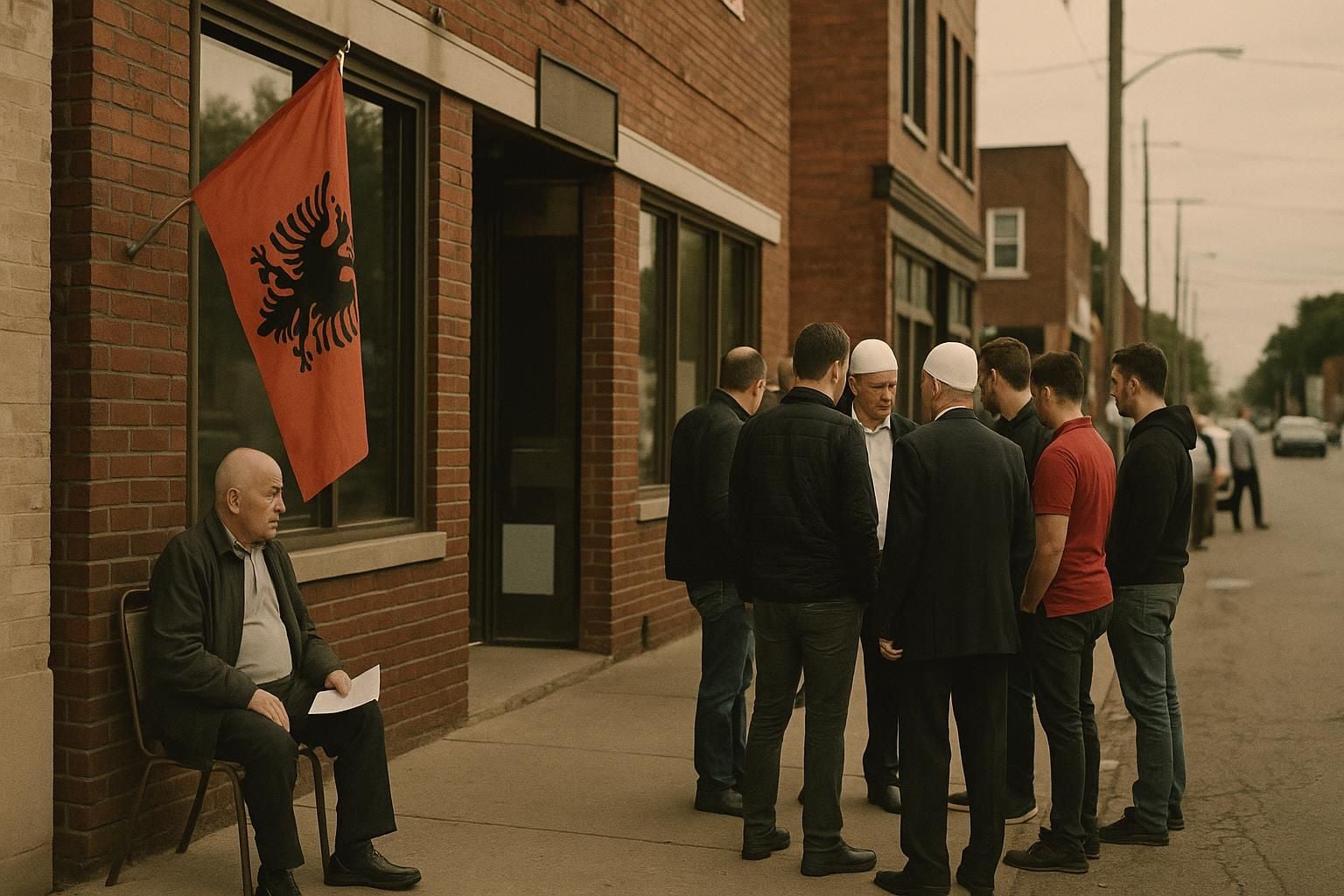
What makes the Macomb cluster distinctive is its scale relative to everything around it. Macomb holds the largest concentration of Albanians anywhere in Michigan — a quiet fact that rarely makes the national conversation about where Albanian America lives. The grocery aisles, the wedding halls, the soccer leagues, and the storefront signage in Albanian along stretches of Sterling Heights make the community visible in a way the official tally does not.
Outstate Michigan — Grand Rapids, Lansing, Ann Arbor, Kalamazoo — holds small Albanian populations, but the center of mass is unmistakably the seven-county metro.
The institutions that hold it together
A community this size builds institutions, and metro Detroit’s Albanian institutions are unusually dense and unusually plural. Four religious traditions sit within a short drive of one another, and most extended families include more than one of them.
The Sunni Muslim community is the largest and the earliest organized. The Albanian American Moslem Society was organized in 1949 and opened its first Detroit mosque under Imam Vehbi Ismail that same year; the Albanian Islamic Center in Harper Woods — built under the same congregation and opened in the early 1960s — became the institutional spine of mid-century Albanian Detroit. The Bektashi order, a Sufi tradition with deep roots in Albanian life, runs its US seat from a teqe in Taylor founded in 1954 by Baba Rexheb — the first Albanian Bektashi tekke in the United States and one of the most important Bektashi sites outside Albania.
The Albanian Orthodox community worships at parishes including St. Thomas in Farmington Hills, part of the archdiocese that traces back to the church organized in Boston in the early twentieth century. The Catholic community — drawn largely from northern Albania, Kosovo, and Montenegro — has its own parish life in the metro, including a congregation organized around Our Lady of the Albanians.
These buildings do more than host worship. They serve as wedding halls, funeral networks, Albanian-language Saturday schools, soccer clubs, and the civic meeting spaces where a dispersed community keeps its language and its ties intact across three and four generations. For a family scattered across three suburbs, the xhami or the kishë is often the one place the cousins still gather every week. It is where children pick up enough Gheg to talk to a grandmother, where a death is mourned by the whole community within a day, and where a newcomer from Gostivar or Gjakovë finds a foothold within an afternoon.
Where the institutions are strong, the community stays legible to itself — but it does not automatically become legible to a census form. That is the irony worth sitting with: metro Detroit has built one of the most complete Albanian institutional landscapes anywhere in the diaspora, and the official count of the people who built it still lands well short of the truth.
Why the count comes up short
Here is the gap that should bother anyone who cares about this community being seen accurately. Michigan’s recorded ~30,200 is the second-highest state figure in the country. Nationally, the census records about 230,000 Albanian Americans. The community’s own estimate — counting ethnic Albanians from across the Balkans plus the US-born generations — is closer to ~1 million. That second number is a community estimate, not a census-grade figure, and it should be read as a careful ceiling rather than a precise total. But the distance between the two is not noise. It is structural.
The American Community Survey asks one ancestry question and counts the first answer or two a person writes in. In Michigan, that method misfires in predictable ways. It misses families from Kosovo, North Macedonia, and Montenegro who answer with their country of origin — “Macedonian,” “Yugoslavian,” “Montenegrin” — instead of “Albanian.” It misses third- and fourth-generation Americans whose first instinct is to write “American.” And it undercounts recent arrivals still sorting out their status. Given that the metro Detroit community is overwhelmingly Gheg with roots outside Albania proper, the first gap alone is large.
So the recorded ~30,200 is best understood as the part of the community the census happened to catch — not its full size. For a state whose largest Albanian county — Macomb — sits alongside one of the densest Albanian institutional networks outside the Bronx, that undercount has real consequences. Funding formulas, language services, political representation, and the basic question of whether a community is “large enough to notice” all run on the recorded number. When the count is low, the community gets treated as smaller than it is — in the one part of the country where Albanian America is most concentrated.
Get counted
This is exactly the gap the National Albanian Registry exists to close. NAR is a community-led, opt-in count that any Albanian American living in the United States can join. It does not replace the census — it complements it, capturing the families and generations the ancestry question routinely misses. For a community like metro Detroit’s, where so much of the population sits in the census blind spots, an accurate self-count is the difference between being a footnote and being a number that institutions, journalists, and policymakers have to reckon with.
NAR is a nonprofit, not a government agency. Registration is free, takes about two minutes, and the data stays private. The certificate it issues is a recognition document — not citizenship, not legal ID. If you are Albanian American and live in Michigan, you are part of the largest Albanian community outside Europe, and the official record under-counts you. Adding your name does not change your status or cost you anything; it changes the number — and in Michigan, the number has the most ground to make up.
Get counted at albanianregistry.org/register.
Sources: Albanian Americans (Wikipedia), History of the Albanian Americans in Metro Detroit (Wikipedia).