

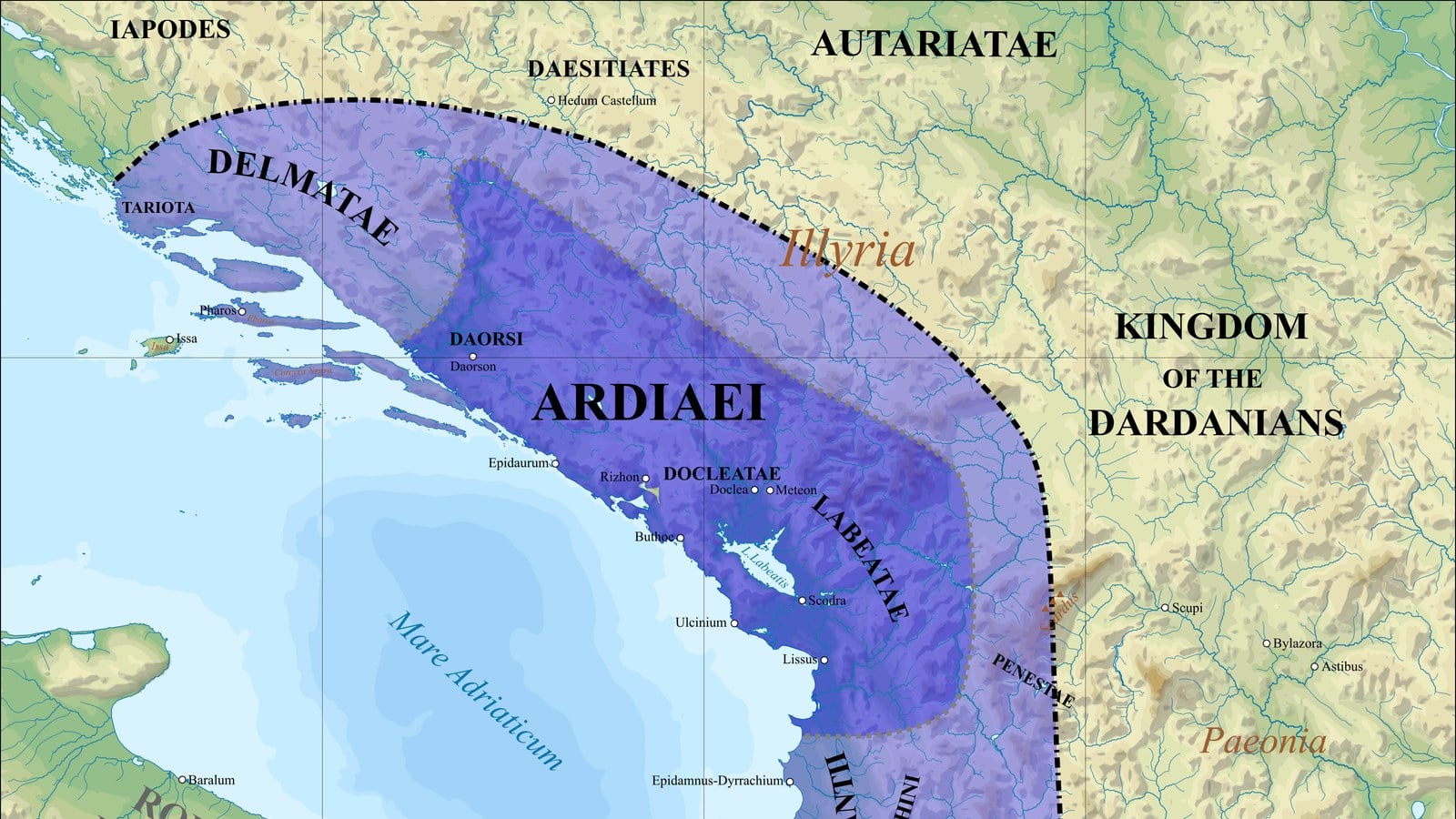
The Illyrian kingdom was not one thing. It was a succession of dynasties — Dardanian, Taulantian, Ardiaean — ruling overlapping territories across the western Balkans from the late 5th century to the mid-2nd century BC. The kings who led these states fought Macedon under Philip II and Alexander the Great, sheltered the young Pyrrhus of Epirus, minted their own coins, built navies that controlled the Adriatic, and held off Rome for a century before the last of them surrendered at Scodra in 168 BC.
These were not tribal chieftains. They commanded armies, conducted diplomacy with Greek city-states and Hellenistic kingdoms, and governed territories that map closely onto the Albania, Kosovo, and Montenegro of today. The Illyrian tribes that supplied their soldiers — Dardani, Taulantii, Ardiaei, Labeates — were the demographic foundation. The culture they built — art, religion, trade routes, fortified cities — was the infrastructure. The kings were the political expression of both.
Bardylis and the Dardanian rise (c. 393–358 BC)
Bardylis is the first Illyrian ruler whose career ancient sources describe in detail. He came from nothing: Greek and Roman writers record that he began as a charcoal-burner who rose to command through military skill and a reputation for dividing spoils impartially. His kingdom was centered in what is now western North Macedonia and eastern Albania, in the territory of the Dardani or the Enchelei — scholars still debate which.
What is not debated is the scale of his power. Over a reign of roughly 40 years, Bardylis made the Illyrian state a first-order problem for Macedon. In 385 BC he defeated the Molossians of Epirus, killing 15,000. He twice drove King Amyntas III out of Macedonia. In 359 BC he killed King Perdiccas III of Macedon along with 4,000 Macedonian soldiers — the single worst military defeat Macedon had suffered to that point.
The response came from Perdiccas’s younger brother. In 358 BC, Philip II marched into Illyria and met Bardylis at the Battle of Erigon Valley. Bardylis was defeated and killed. He was reportedly over 90 years old. Philip married an Illyrian princess, probably Bardylis’s granddaughter Audata, to seal the settlement — a diplomatic move that acknowledged the Illyrian royal house as a peer.
The generation after Bardylis (358–302 BC)
Bardylis’s death did not end Illyrian resistance to Macedon. His son or grandson Cleitus inherited the Dardanian kingdom and rebuilt it. Meanwhile, another dynasty held power on the coast: Grabos II, king of the Grabaei, briefly became the most powerful Illyrian ruler after Bardylis’s fall. In 356 BC, Grabos entered a formal alliance with Athens, the Paeonian king Lyppeius, and the Thracian king Cetriporis against Philip II — an anti-Macedonian coalition attested by an Attic inscription from the archonship of Elpines. Philip’s general Parmenion defeated the alliance within months.
In 335 BC, when Alexander the Great took the Macedonian throne, Cleitus organized a new coalition: the Autariatae under Pleurias and the Taulantii under Glaukias. They confronted Alexander at the Siege of Pelium, a fortress in the heart of Illyria. Alexander found himself caught between Cleitus inside the walls and Glaukias advancing from the south. He escaped the trap with a night attack, but the fact that two Illyrian kings had coordinated well enough to pin down Alexander’s army — even briefly — marked a level of military organization that Greek sources rarely attributed to the Illyrians.
Glaukias of the Taulantii outlasted them all. He ruled for over three decades (c. 335–302 BC), formed alliances with the Greek cities of Epidamnus and Apollonia, and made the most consequential decision of any Taulantian king: in 317 BC, he took in the infant Pyrrhus of Epirus, whose father had been deposed, and raised him in his own household. Glaukias’s wife Beroea, herself a Molossian of the Aeacidae dynasty, cared for the child. A decade later, Glaukias used military force to install Pyrrhus as king of Epirus. Pyrrhus went on to become one of antiquity’s greatest commanders — and he owed his throne to an Illyrian king.
Monunius and the first Illyrian coins (c. 290–231 BC)
After Glaukias, the Taulantian kingdom around Dyrrhachion (modern Durrës) passed to Monunius, the first Illyrian king known to have minted his own coinage. His silver staters, struck at the Dyrrhachion mint and marked with a boar’s jaw — a symbol of the Illyrian royal house — were modeled on Greek types but stamped with royal Illyrian authority.
Coins mattered beyond commerce. A king who minted coins controlled a treasury, paid soldiers on salary rather than in plunder, and projected sovereignty over the city that housed the mint. Monunius’s coinage marks the moment Illyrian kingdoms began to function as states in the Greek sense of the word.
His successor Mytilos continued the practice, striking bronze coins through a reign that lasted until roughly 231 BC. By that point, a new power was rising to the north.
The Ardiaean kingdom: Agron and the height of Illyrian power (c. 250–231 BC)
The Ardiaei were a coastal people centered on the eastern Adriatic, in what is now southern Croatia and Montenegro. Under Pleuratus II (c. 260–250 BC), they consolidated into a kingdom. Under his son Agron, they built the most powerful state in Illyrian history.
Polybius, the Greek historian who wrote the most detailed surviving account of the Illyrian wars, called Agron the king who “possessed the most powerful force, both by land and sea, of any of the kings who had reigned in Illyria before him.” The assessment was grounded in specifics: Agron expanded the kingdom from the Neretva River to Epirus, annexed Epidamnus, took the islands of Corcyra (Corfu) and Pharos, and defeated the Aetolian League — one of the strongest Greek military confederations of the period.
Agron died in 231 BC, reportedly from excessive celebration after the Aetolian victory. His young son Pinnes inherited the throne. Real power passed to his second wife, Teuta, as regent.
From Teuta to Gentius: the century of Rome (231–168 BC)
Teuta’s regency — her confrontation with Roman envoys, the First Illyrian War, and the terms Rome imposed — is covered in its own article. What matters here is where she sits in the dynasty: between Agron’s expansion and the long Roman entanglement that consumed the next six decades.
After Teuta’s defeat in 228 BC, Demetrius of Pharos — who had betrayed her by surrendering Corcyra to Rome — became the dominant Illyrian figure. He married Agron’s first wife Triteuta and made himself regent. When Rome was occupied with Hannibal, Demetrius built a fleet of 90 ships and raided south of the treaty line. Rome struck back in the Second Illyrian War (219 BC). Demetrius fled to the court of Philip V of Macedon, where he spent his remaining years urging the Macedonian king to confront Rome — advice that helped set in motion the Macedonian Wars.
Power passed to Scerdilaidas, one of Agron’s brothers, who reversed course and allied with Rome against Philip V. His son Pleuratus III deepened the alliance, supporting Rome in the Second Macedonian War (200–197 BC). For two generations, the Ardiaean-Labeatan dynasty survived by aligning with the rising power in the Mediterranean.
Gentius, son of Pleuratus III, ended the alignment. Ruling from Scodra (modern Shkodër), he initially maintained the Roman alliance. In 169 BC he married Etuta, a Dardanian princess, and accepted an offer from Perseus of Macedon: 300 talents to join a war against Rome. The Roman praetor Lucius Anicius Gallus invaded Illyria and besieged Scodra. Gentius surrendered within 30 days. He was captured, sent to Rome, and paraded in a triumph.
Rome divided the Illyrian kingdom into three administrative parts and imposed tribute. The Illyrian royal line was finished.
What the Illyrian kings mean for Albanian Americans
The territory these kings governed — the Adriatic coast from Durrës to Shkodër, the interior from Lake Ohrid to the Drin valley — is the territory Albania occupies today. The correspondence is not exact, and claiming unbroken political descent from Bardylis to the modern Albanian state would overstate what the evidence supports. But the geographic continuity is real, the cultural continuity is argued by serious scholars (see the Albanian-Illyrian continuity discussion), and the names of these kings are part of the living Albanian tradition: Bardhyli, Agroni, Genti, and Teutë are given names in Albania and Kosovo today.
For Albanian Americans, the Illyrian kings represent something specific: documented proof that the land their families come from had organized states, diplomatic networks, and minted currencies while Rome was still a republic. The Illyrians were not peripheral. They were actors in the central drama of the ancient Mediterranean — allies and adversaries of Macedon, Greece, and Rome in turn.
The kingdom they built did not survive Rome. But the people who populated it — the tribes who gave the kings their armies and their legitimacy — remained on the same land, under Roman rule and then Byzantine rule and then Ottoman rule, until a new Albanian state emerged in 1912. The kings are the earliest documented chapter of that continuity.