
The Balkan Wars of 1912–1913 produced two things for Albanians at the same time: a state and a partition. On November 28, 1912, delegates at Vlorë declared Albanian independence from the Ottoman Empire. Within months, the Great Powers at the Conference of London recognized that independence — and drew borders that left roughly half of all Albanian-inhabited territory on the other side.
That double outcome — sovereignty and dismemberment in the same nine-month window — shaped every major Albanian political question of the next century, from the Kosovo conflict to Chameria, from diaspora formation to the Albanian-American community’s founding cause.
The Balkan League and the First Balkan War
In the spring of 1912, Serbia, Bulgaria, Greece, and Montenegro signed a series of bilateral treaties forming the Balkan League. Their shared objective: to drive the Ottoman Empire out of southeastern Europe and divide its remaining European territories.
The timing worked in the League’s favor. The Ottomans had just lost Libya to Italy in the Italo-Turkish War (1911–1912) and faced simultaneous Albanian uprisings in Kosovo and northern Albania. The empire was stretched thin.
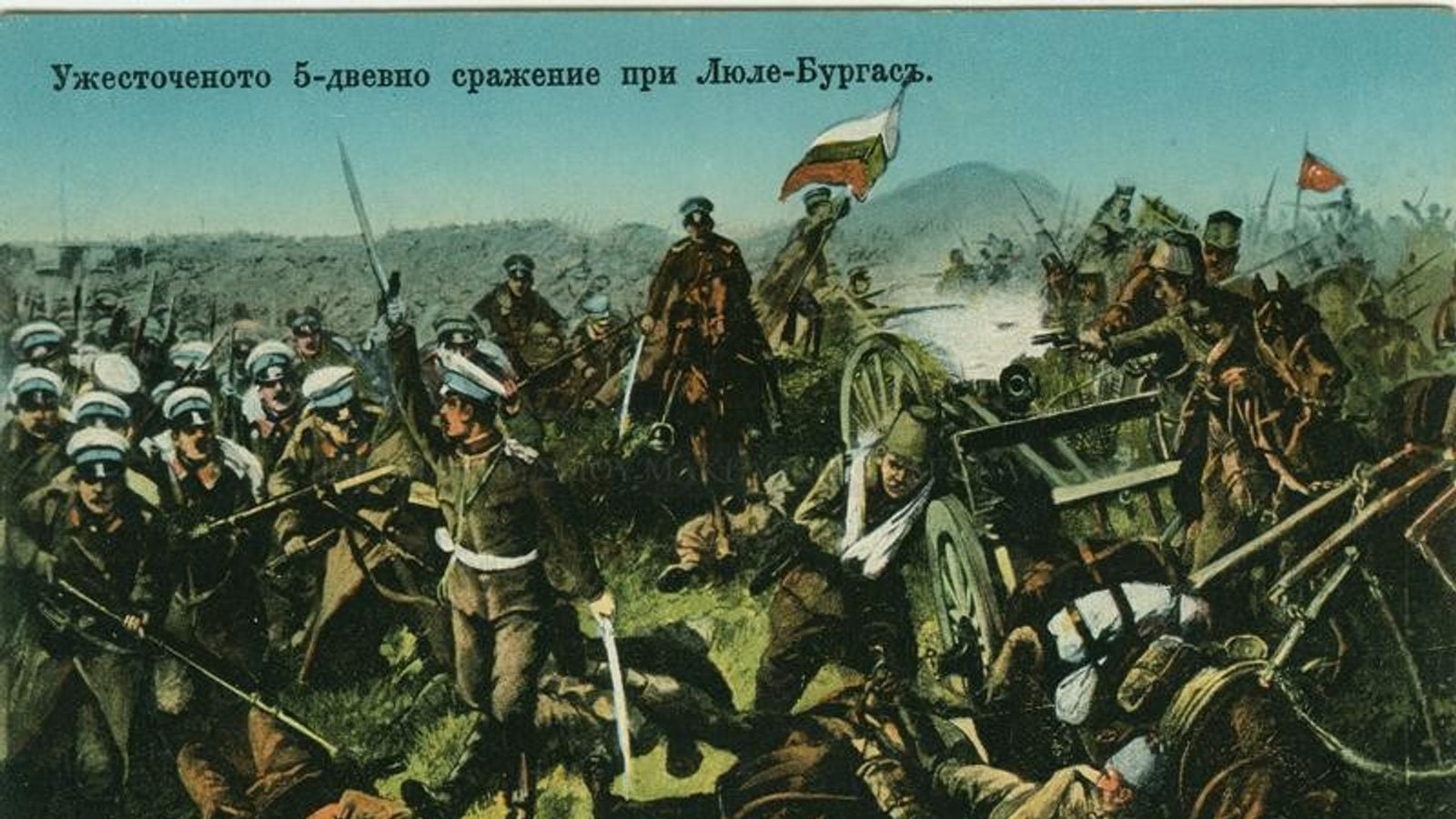
Montenegro opened hostilities on October 8, 1912. Serbia, Bulgaria, and Greece followed within days. The Ottoman collapse was swift. At the Battle of Kumanovo (October 23–24), the Serbian army defeated the Ottoman Vardar Army in the Kosovo Vilayet, opening the road to Skopje. By mid-November, the Battle of Monastir (Bitola) ended organized Ottoman resistance in Macedonia and western Kosovo.
Albanians — despite having just won concessions from Istanbul through their own 1912 uprisings — were excluded from the Balkan League. They were not partners in the war against the Ottomans. They were targets of the territorial ambitions behind it.
Military Campaigns in Albanian-Inhabited Territory
Kosovo and the North
The Serbian invasion of Kosovo began in October 1912, following the Ottoman collapse at Kumanovo. Albanian irregular forces, including fighters under Isa Boletini, mounted a losing defense. Serbian and Montenegrin forces overran the vilayet rapidly.
The occupation brought immediate and large-scale displacement. Serbian government records from the period documented the expulsion of hundreds of thousands of Albanians from “Old Serbia” (the Serbian term for Kosovo) between 1912 and 1914.
The Siege of Shkodër
The longest single engagement of the Balkan Wars in Albanian territory was the Siege of Shkodër (Scutari). Montenegro opened its siege on October 28, 1912, under Prince Danilo. Serbian reinforcements arrived later.
The Ottoman and Albanian garrison, first under Hasan Riza Pasha and then Essad Pasha Toptani, held the city for nearly six months. The siege caused extensive destruction to Shkodër and killed thousands of defenders and civilians. Essad Pasha had Hasan Riza Pasha killed on January 30, 1913, in what remains a contested episode — assassination by some accounts, a power struggle by others.
On April 23, 1913, Essad Pasha negotiated the city’s surrender to Montenegrin General Vukotić, reportedly receiving a large sum of money and safe passage for his troops. Many Albanians regarded this as betrayal.
The Great Powers intervened. Under pressure from Austria-Hungary, Montenegrin forces withdrew from Shkodër on May 14, 1913. The city was assigned to Albania — one of the few cases where Great Power diplomacy worked in Albania’s favor during the partition.
Epirus and Chameria in the South
Greek forces captured Ioannina on March 6, 1913, after the Battle of Bizani. The Greek army then occupied Gjirokastër, Korçë, and Himara — cities with substantial Albanian populations. Greece’s own 1913 military census data recorded the demographic reality: the overwhelming majority of Gjirokastër’s inhabitants were Albanian.
In March 1913, Greek forces and local committees arrested and killed dozens of Albanian Muslim leaders from Chameria villages near Paramythia. This episode, documented in contemporary Albanian and European periodicals, was one of multiple attacks on Albanian civilians during the Greek advance through Epirus.
The Civilian Toll and the Carnegie Commission
The Carnegie Endowment for International Peace dispatched an international commission in 1913 to investigate the conduct of the Balkan Wars. The commission — comprising scholars from France, Britain, the United States, Germany, Austria, and Russia — published its findings in 1914 as the Report of the International Commission to Inquire into the Causes and Conduct of the Balkan Wars.
The report documented a systematic pattern in the occupation of Albanian-inhabited areas. Serbian and Montenegrin forces burned hundreds of villages as part of what the commission described as a deliberate effort to change the demographic composition of Albanian-inhabited regions.
The commission found evidence of mass killings, mutilation of civilians, pillage, and forced displacement across Kosovo and northern Albania. In the months that followed, Serbian forces destroyed scores of additional villages and displaced tens of thousands more Albanians.
In the Plav–Gusinje region, according to contemporary reports and later research, Montenegrin military authorities killed hundreds of Albanian and Bosniak Muslims and forced thousands to convert to Orthodox Christianity between 1912 and 1913. The forced-conversion campaign ended only after Austro-Hungarian diplomatic intervention in April 1913.
Casualty estimates for the Albanian population during the Balkan Wars remain contested. Contemporary estimates of Albanian deaths varied widely, with some accounts citing figures as high as 120,000 killed by Serbian forces alone. Broader scholarly estimates range from 60,000 to 270,000 across the conflict zone. The Carnegie report remains a standard scholarly reference on the conduct of the wars.
The Treaty of London and the Conference of Ambassadors
The Conference of Ambassadors — representatives of Britain, France, Germany, Austria-Hungary, Russia, and Italy, chaired by British Foreign Secretary Sir Edward Grey — began in London in December 1912 to settle the territorial consequences of the wars.
On May 30, 1913, the Treaty of London formally ended the First Balkan War. The Ottoman Empire ceded nearly all its European territory west of the Enos–Midia line.
In the summer of 1913, the Conference of Ambassadors recognized Albania as a sovereign, hereditary Principality. But the borders were drawn to satisfy Great Power calculations, not Albanian demographics. Austria-Hungary and Italy supported a viable Albania to block Serbian access to the Adriatic Sea. Russia backed Serbian and Montenegrin territorial claims. The result was a compromise that served European balance-of-power logic at Albanian expense.
The Partition
The 1913 borders assigned:
- Kosovo to Serbia — despite an Albanian-majority population recorded in Ottoman census data
- Western Macedonia (Dibra, Gostivar, Struga, Ohrid) to Serbia
- Chameria and parts of southern Epirus to Greece
- Plav, Gusinje, and adjacent territories to Montenegro
- The Preševo Valley (Preševo, Bujanovac, Medveđa) to Serbia
Independent Albania was left with fewer than 30,000 square kilometers and a population of just over 800,000 — roughly a third of the territory and population of the four Albanian-majority Ottoman vilayets (Shkodra, Kosovo, Manastir, and Janina).
The Second Balkan War (June–August 1913), in which Bulgaria fought its former allies over Macedonia, further entrenched Serbian and Greek control over occupied Albanian territories. The Treaty of Bucharest, signed on August 10, 1913, confirmed the partition rather than revising it.
Roughly 30–40% of ethnic Albanians ended up outside the new Albanian state. These were not small border populations — many lived in areas where Albanians formed large majorities. The borders had been drawn to serve Great Power interests, and the ethnic reality on the ground was secondary.
Why This Matters for Albanians Today
The 1913 partition set in motion every major Albanian political question of the twentieth century.
Kosovo’s assignment to Serbia in 1913 created the political situation that produced decades of Serbian-Albanian conflict — through interwar colonization campaigns, World War II, the 1981 and 1989 crises, the 1998–1999 Kosovo War, and Kosovo’s 2008 declaration of independence. The roots of that conflict trace directly to the 1912–1913 border decisions.
The Chameria question follows a similar trajectory. The 1913 killings and subsequent Greek assimilation policies — no Albanian-language schools, restrictions on Muslim community life — set conditions for the mass expulsion of Cham Albanians from Greece in 1944–1945. That issue remains politically active in Albania today.
The partition also shaped the Albanian diaspora. Territorial loss and the instability of the post-1913 Albanian state accelerated emigration, particularly to the United States. The Albanian-American community, centered in Boston from the early twentieth century, became the primary base for independence advocacy abroad. The Vatra Federation of Albanians, founded in Boston in 1912 — the same year as the Vlorë declaration — lobbied the U.S. government and President Wilson on Albania’s behalf. Bishop Fan Noli’s Albanian Orthodox Church and publications like the newspaper Dielli (founded 1909) built a diaspora political identity shaped directly by the partition.
For Albanians, November 28, 1912, is both the nation’s founding date and the beginning of a partition whose effects persist today. The Balkan Wars gave Albanians a state — and then, through the same settlement, cut that state to roughly half the size of the territory Albanians actually inhabited. That contradiction is not a footnote. It is the frame within which Albanian politics, identity, and diaspora life have operated for more than a century.