
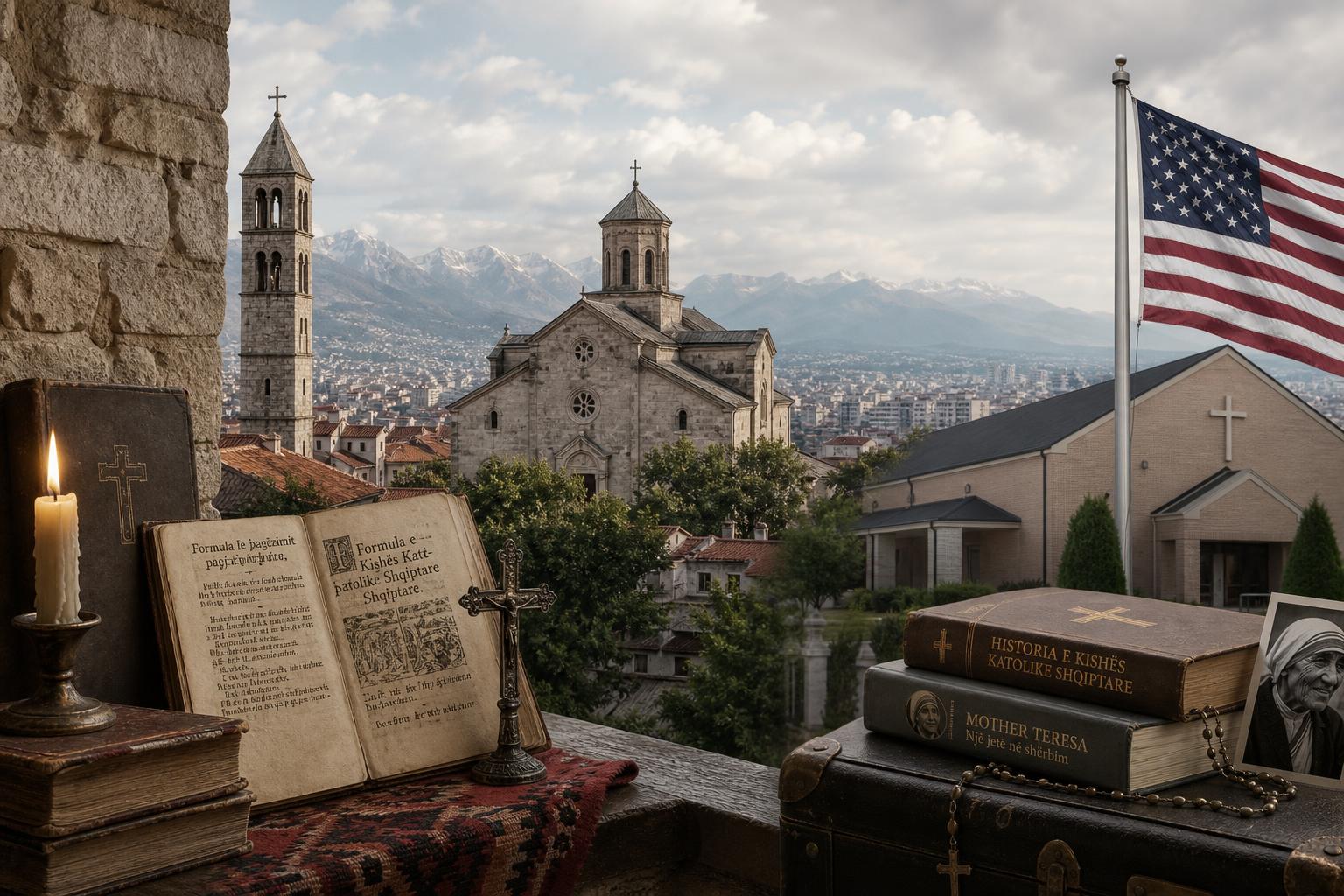
Most American readers meet Albanian heritage as a single thing — one flag, one language, one diaspora. The faith picture is richer than that. Albanians have been Catholic, Orthodox, Sunni Muslim, and Bektashi for centuries, often in the same family tree. Among those traditions, the Albanian Catholic Church is the oldest continuous institutional thread, anchored in the Malësia (the highlands) of the north and tied to Rome since long before the modern country existed.
This piece is a plain-language tour of that tradition for a US audience. It covers where Albanian Catholicism comes from, how it survived 500 years of Ottoman rule and one of the harshest religious bans of the 20th century, the household names it has produced — Skënderbeu (Skanderbeg), Pjetër Bogdani, Mother Teresa — and where Albanian Catholic communities worship in America today.
The aim is not to rank traditions or score history. NAR speaks for all Albanian Americans, Catholic, Orthodox, Muslim, Bektashi, and secular. The aim is to give Catholic Albanian-American readers a clean reference for their own heritage, and to give the rest of the community context for the parish down the road in Hartsdale or Waterbury or Sterling Heights.
Origins of Albanian Catholicism
The Catholic presence in what is now Albania predates the country, the modern church bureaucracy, and most of the names we use today. The Albanian-inhabited western Balkans were Christianized in the Roman era through the Adriatic coastline — Durrës (Roman Dyrrachium), Lezhë, Shkodër — well before the Great Schism of 1054 split Western and Eastern Christianity. When the Schism settled in, the line ran roughly through the Albanian lands: the north stayed Latin and looked to Rome, the south stayed Greek and looked to Constantinople.
That north–south religious geography held. The Gheg highlands — Shkodër, Lezhë, Mirdita, Malësia e Madhe, the Dukagjini plateau, much of what is now Kosovo — became and remained the Albanian Catholic heartland. The Tosk south stayed largely Orthodox until Ottoman conversions added a Muslim majority later. The shorthand “northern Albanian Catholic, southern Albanian Orthodox, central Albanian Muslim” oversimplifies but is not wrong as a first map.
By the late Middle Ages the Catholic Church in Albanian lands had organized into multiple dioceses with seats at Shkodër, Sapë, Pult, Lezhë, Durrës, and Tivar (Bar, in present-day Montenegro). The kisha katolike (Catholic church) of Shkodër — the Cathedral of St. Stephen — was rebuilt and reconsecrated repeatedly across centuries; today it remains the symbolic seat of Albanian Catholicism.
Liturgically and structurally, Albanian Catholicism is Latin-rite — the same Roman Rite practiced from Boston to Buenos Aires. There is a small Italo-Albanian Catholic Church among the Arbëreshë of southern Italy that uses the Byzantine Rite while remaining in communion with Rome, but inside Albania proper the tradition has been Latin-rite throughout (see our piece on the Arbëreshë for the Italian story).
Skanderbeg and Catholic Albania’s Resistance
If Albanian Catholicism has a founding-era figurehead, it is Gjergj Kastrioti Skënderbeu — Skanderbeg. Born around 1405 to the Catholic Kastrioti family in the Albanian highlands, taken to the Ottoman court as a hostage, trained as a soldier in Sultan Murad II’s service, he defected at the Battle of Niš in November 1443, returned to Krujë, and raised the family’s red banner with the double-headed black eagle over the citadel.
In March 1444 he gathered the Albanian principalities at the Kuvendi i Lezhës (League of Lezhë) and founded a coordinated Albanian defense. For the next 25 years, until his death on January 17, 1468, he held the central Albanian highlands against successive Ottoman campaigns, including two sieges of Krujë led personally by Sultan Mehmed II — the conqueror of Constantinople.
Skanderbeg’s resistance was simultaneously national and explicitly Catholic. Pope Calixtus III named him Athleta Christi (Athlete of Christ) in 1457. Pope Pius II planned in 1463 to make him captain-general of a pan-European crusade against the Ottomans; the pope’s death in 1464 ended the plan. Skanderbeg’s correspondence with the papacy and Venice frames his war as defense of Christian Europe at its southeastern edge.
For Albanian Catholics, Skanderbeg is the figure who proves that Albanian identity, Catholic faith, and political agency were once joined in one person and one banner. The flag of the modern Republic of Albania descends directly from his. For Albanian Catholic Americans, he is the anchoring memory that the tradition is not a borrowed faith — it is a faith their ancestors fought a 25-year war to keep. (For the full biography see our Skanderbeg piece.)
Pjetër Bogdani and the Albanian Catholic Literary Tradition
The Albanian language has Catholic clergy to thank for most of its earliest written form. The oldest surviving document in Albanian — the 1462 baptismal formula recorded by Pal Engjëlli, Archbishop of Durrës — was written by a Catholic prelate. The first printed Albanian book, the Meshari (Missal) of Gjon Buzuku in 1555, is a Catholic liturgical text. And the first sustained prose work in Albanian was written by another Catholic bishop: Pjetër Bogdani.
Bogdani (c. 1630–1689) was born in the Has region on what is now the Albania–Kosovo border and trained for the priesthood under his uncle Andrea Bogdani, Archbishop of Skopje. He studied at the Collegio di Propaganda Fide in Rome — the Vatican’s school for missionary clergy — and rose to become Archbishop of Skopje himself.
His major work, Cuneus Prophetarum (Albanian: Çeta e Profetëve — “The Band of the Prophets”) was printed in Padua in 1685. It runs to roughly a thousand pages in two parts, in parallel Albanian and Italian (with some Latin), retelling Old and New Testament history with theological commentary. It is the first substantial prose work in the Albanian language and a foundational text for the modern literary tradition.
Bogdani was also a soldier of his cause. During the Great Turkish War (1683–1699) he organized Catholic Albanian forces aligned with the Habsburg advance into the Balkans. He died of plague in late 1689, most likely in Pristina, while supporting the campaign. Ottoman and Tatar reprisals reportedly desecrated his grave.
Cuneus is why Albanian Catholic clergy occupy a place in Albanian intellectual history far out of proportion to the community’s numbers. From Gjon Buzuku in the 1500s through Bogdani in the 1600s to Ndre Mjeda and Gjergj Fishta in the late 1800s and early 1900s, the Catholic north preserved and modernized written Albanian during centuries when Ottoman policy did not encourage it. (See our full Pjetër Bogdani piece for more.)
Survival Under Ottoman Rule
The Ottoman conquest of Albanian lands, completed in stages through the late 1400s and 1500s, did not end Albanian Catholicism, but it reshaped it. Across the Ottoman centuries, large parts of central and southern Albania converted to Islam — both Sunni and the Bektashi Sufi order. The Catholic north, however, held on, largely by retreating into the mountains.
The Malësia — the highland zones of Shkodër, Mirdita, Dukagjin, Kelmendi, and the surrounding districts — became the geographic backbone of Albanian Catholic survival. Three forces kept it intact:
- Terrain. The mountains were defensible. Ottoman tax collectors and conversion pressure reached the lowlands and cities far more easily than the upland villages.
- Clan structure. The fis (patrilineal clan) system, codified in the Kanuni i Lekë Dukagjinit (Code of Lekë Dukagjini), gave the highlands an internal legal and social order that operated alongside, and sometimes against, Ottoman administration.
- Catholic clergy networks. Franciscan and Jesuit missions, supported from Italy and the Vatican, maintained parishes, schools, and clergy training even under restrictive conditions.
The Catholic Mirditë (Mirdita) tribe in the central north became the most famous of these communities — a self-governing Catholic principality of sorts that retained considerable autonomy under Ottoman suzerainty into the 19th century. The Kelmendi, the Hoti, the Kastrati, the Shkreli, and other northern tribes preserved Catholic identity in the same pattern.
This is the period when besa — the Albanian code of honor and given word — became a unifying ethic across religious lines (see our besa piece). Catholic, Muslim, and (in the south) Orthodox Albanians lived under overlapping versions of the same customary law. Inter-religious marriage, godparenthood, and mutual aid were common at the village level even when imperial politics tried to separate them.
The 20th Century, Communist Atheism, and the Martyrs
The 20th century delivered the hardest single blow to Albanian Catholicism. After World War II, Enver Hoxha’s Communist regime treated religion as a rival authority and a relic of foreign control. Catholic clergy, with their structural ties to Rome, were viewed with particular hostility — Rome was, by Hoxha’s logic, a foreign capital.
The crackdown built through the 1940s and 1950s with show trials, executions, prison sentences, and the closure of seminaries. Archbishop Vinçenc Prennushi of Durrës died under torture in 1949. Bishop Frano Gjini of Lezhë was executed by firing squad in 1948. Dozens of priests, religious sisters, and laypeople met similar fates across the late 1940s and 1950s.
In 1967, Hoxha completed the campaign by declaring Albania the world’s first officially atheist state. Every remaining church, mosque, and teqe (Bektashi lodge) was shut, repurposed, or demolished. Public religious practice of any kind became a criminal offense; possessing a rosary or a Bible could mean prison. The ban remained in force until 1990.
When churches reopened after 1990, Albanian Catholic life had to rebuild from memory and a handful of surviving elderly clergy. Pope John Paul II’s 1993 visit to Albania — the first papal visit ever to the country — restored the hierarchy formally and consecrated four new bishops at Shkodër’s cathedral. (Our piece on Pope John Paul II and Communism covers that visit in detail.)
In November 2016, Pope Francis recognized 38 Albanian Catholic martyrs of the Communist era at a beatification ceremony held in Shkodër. The list includes bishops, priests, seminarians, and laypeople killed for their faith between 1945 and 1974. For the Albanian Catholic community in America, the beatifications closed a long open question: the missing generation was named, documented, and venerated publicly.
Mother Teresa: The World’s Most Famous Albanian Catholic
Saint Teresa of Calcutta is, by an enormous margin, the most internationally recognized Albanian Catholic in history. The basic facts are these: she was born Anjezë Gonxhe Bojaxhiu in Skopje on August 26, 1910, to an Albanian Catholic family. Her father, Nikollë Bojaxhiu, was an Albanian merchant and nationalist activist; her mother, Dranafile (Drane) Bernai, was also Albanian.
Anjezë grew up speaking Albanian at home. She joined the Sisters of Loreto at 18, took the name Teresa, and was sent to India to teach. In 1950 she founded the Missionaries of Charity in Calcutta to serve “the poorest of the poor.” The Nobel Committee awarded her the 1979 Nobel Peace Prize. She died on September 5, 1997. Pope John Paul II beatified her on October 19, 2003. Pope Francis canonized her on September 4, 2016, in St. Peter’s Square as Saint Teresa of Calcutta.
She identified as Albanian her entire life. She had taken Indian citizenship in 1948, and at her state funeral in Calcutta in September 1997, her coffin was draped in the Indian flag. Albania, Kosovo, and North Macedonia all claim her — Tirana International Airport bears her name, Skopje’s central square holds her memorial house, and Pristina hosts a cathedral dedicated to her.
For Albanian Catholic Americans, Mother Teresa is the bridge between a small, historically rural community in the Balkans and one of the most-recognized religious figures of the modern era. She is also the reason many non-Albanian Americans first associate “Albanian” with “Catholic” at all. (See our full Mother Teresa piece.)
Albanian Catholic Communities in America
Albanian Catholic immigration to the United States ran in waves: a first wave from northern Albania and Kosovo in the early 1900s, a smaller post-WWII flow of political exiles, a large influx after the fall of Communism in 1991, and a continued Kosovar Catholic presence after the late 1990s. Communities settled mostly along the lines of broader Albanian-American settlement.
The flagship Albanian Catholic parish in America is Our Lady of Shkodra Albanian Catholic Church (Zoja e Shkodrës) in Hartsdale, New York, in Westchester County. It serves the large Albanian Catholic community of metro New York, northern New Jersey, and southern Connecticut. The parish runs Mass in Albanian and English, an Albanian-language school, and a calendar of community events around the major feasts — Christmas (Krishtlindja), Easter (Pashka), the Feast of Our Lady of Shkodra in April, and the Feast of St. Anthony in June.
Albanian Catholic communities also gather at parishes in:
- The Bronx and Yonkers, New York — the original urban core of Albanian Catholic settlement in metro NY.
- Northern New Jersey — Garfield, Clifton, and surrounding municipalities.
- Waterbury, Connecticut — long a center of Albanian Catholic immigration from Kosovo and northern Albania.
- Detroit and Sterling Heights, Michigan — Michigan has roughly 30,000 Albanian Americans by ACS count, with a significant Catholic share from Kosovo and the Albanian-inhabited regions of North Macedonia.
- Boston metro Massachusetts — though Massachusetts is the Orthodox population center via Fan Noli’s tradition, there is a Catholic Albanian presence too.
Most US Albanian Catholic parishes operate inside the structure of the local Roman Catholic diocese — there is no separate Albanian Catholic jurisdiction in the United States the way the Albanian Orthodox have the Archdiocese in America. Albanian Catholic Mass schedules, Albanian-language religious education, and feast days are typically arranged in cooperation with the diocesan ordinary.
Catholic, Orthodox, Muslim, Bektashi: One People, Four Traditions
The clean way to describe Albanian religious life is this: the Albanian people are ethnically and linguistically one community, and that community contains four major religious traditions. None of the four is more or less “Albanian” than the others. Each shaped a part of the country and the diaspora.
- Albanian Catholic — Latin-rite, in communion with Rome. Concentrated historically in the Gheg north (Shkodër, Mirdita, Malësia, Lezhë), in Kosovo, and in parts of northwestern North Macedonia. Approximately 10% of Albania’s population identified as Catholic in recent censuses.
- Albanian Orthodox — Eastern Christian, autocephalous since 1937, organized in the US by Fan Noli starting in 1908 (see our Albanian Orthodox Archdiocese in America piece). Historically Tosk and southern Albania, with strong presence in Korçë, Berat, Gjirokastër, and the Albanian villages of northern Greece.
- Albanian Sunni Muslim — the largest single religious identification in Albania today, the result of Ottoman-era conversions. Practiced across central Albania and most major cities.
- Albanian Bektashi — a Sufi order with its world headquarters in Tirana since the order was expelled from Turkey in 1925. Bektashism is a distinctive feature of Albanian religious life with no equivalent center elsewhere (see our piece on the Albanian American Islamic Center for one US expression).
What makes Albania genuinely unusual in European religious history is how peaceably these four traditions have coexisted at the village and family level. Religious intermarriage is common. Christmas trees go up in Muslim homes; iftar meals are shared with Catholic neighbors. The 19th-century Rilindja (Albanian Renaissance) writers, including the Frashëri brothers, explicitly framed Albanian identity above sectarian identity — “feja e shqyptarit asht shqyptarija,” in Pashko Vasa’s famous line: “the religion of the Albanian is Albanianism.”
For Albanian Catholic Americans, that pluralism is a feature, not a footnote. The Catholic parish in Hartsdale, the Orthodox cathedral in South Boston, the Bektashi teqe in Taylor, and the Sunni mosque in the Bronx are all serving the same community, just along different threads of the same braid.
A Note for Albanian Catholic Americans Doing Family Research
Because the Albanian Catholic Church kept written records continuously across the Ottoman centuries — in a place and time when written records were scarce — Catholic-line Albanian Americans often have a usable paper trail their Muslim and Orthodox counterparts lack. Baptismal, marriage, and burial registers in parish archives at Shkodër, Lezhë, Mirdita, Sapë, and Pult can sometimes reach back to the 1700s and occasionally earlier.
If you are researching family origins or considering Albanian citizenship by descent, parish records are one of the strongest civil documentation sources available for the northern Catholic regions. The Albanian state archives (AQSh) in Tirana hold microfilmed copies of many parish books, and the dioceses themselves can sometimes provide certified extracts on request.
Get Counted Alongside Your Albanian Catholic Community
The US Census records about 230,000 Albanian Americans. The real number is closer to a million, because the count misses most of us for reasons we’ve documented at length: mixed country-of-birth answers, skipped ancestry write-ins, and whole branches of a family the form never reaches.
The National Albanian Registry is building a community-led count of Albanian Americans across every tradition and region. Catholic Albanians from Shkodër, Mirdita, Kosovo, and Macedonia; Orthodox Albanians from Korçë and the Tosk south; Sunni and Bektashi Albanians from Tirana, Elbasan, and the diaspora cities — all of you belong in the same count. Register here and add your household to the record. The Certificate is a recognition document marking your place in the Albanian-American community; it is not a government ID or a citizenship document, but it is yours.
Note on sources: this piece draws on widely available historical reference material, parish documentation, and existing NAR articles. Direct fetches of Wikipedia source pages were unavailable at the time of writing; specific dates and names match the figures already cited in our linked biographies of Skanderbeg, Pjetër Bogdani, and Mother Teresa.