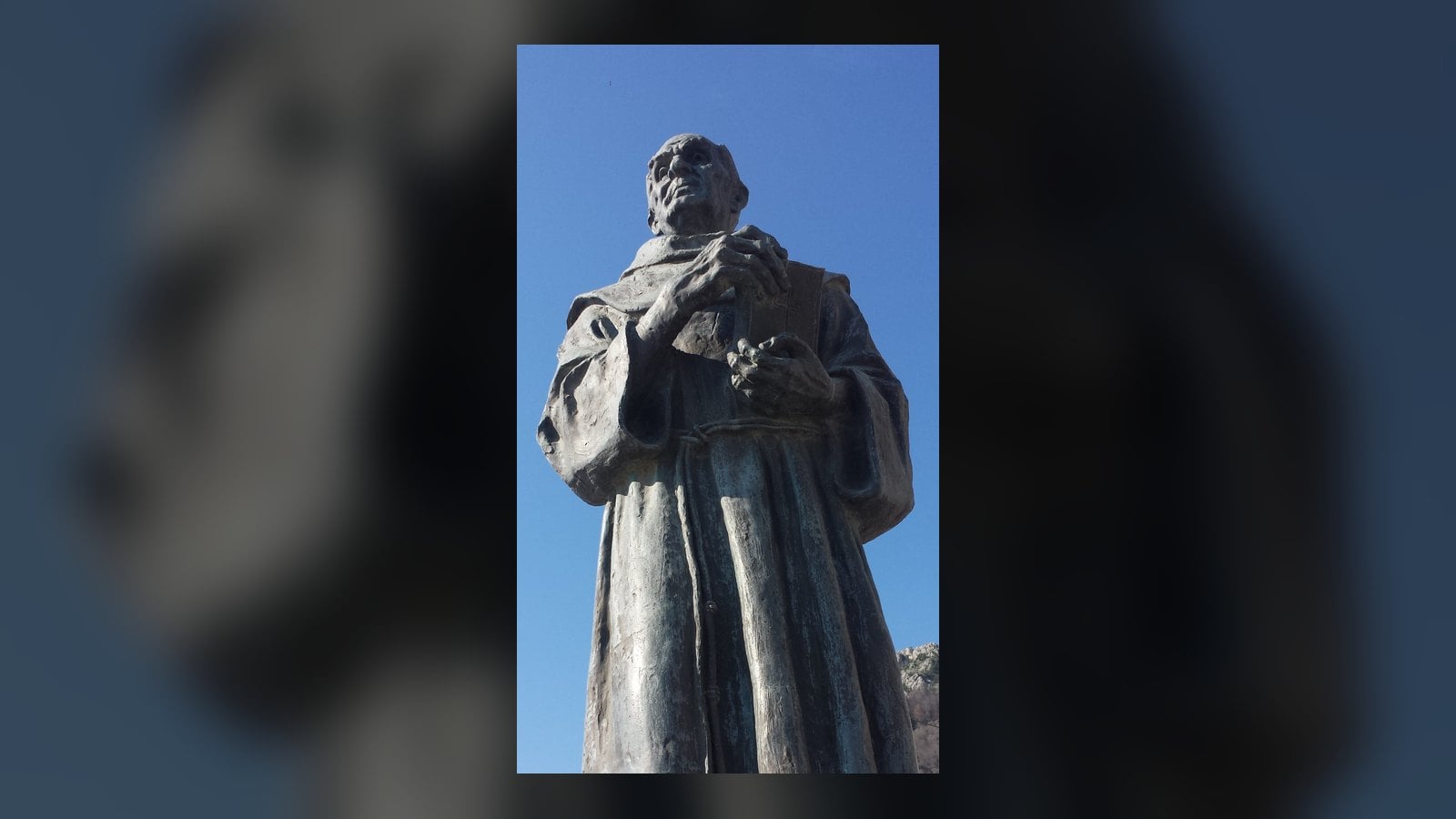
At Zef Pllumi — born 28 August 1924 in Mali i Rencit, a village in the Lezhë district of northern Albania, died 25 September 2007 in Rome — is one of the central documentary voices of religious persecution under the Hoxha regime. At is the Albanian honorific for “Father,” the title given to a Catholic priest; Pllumi entered the Franciscan order before the Second World War as a seminarian, was first arrested in 1946 before he was ordained, and did not become a priest until the mid-to-late 1950s, years after the new communist government had already begun dismantling the Catholic Church in Albania.
He was arrested for the first time in 1946 and again in 1967 during the regime’s violent campaign of atheism. Across the two periods he spent roughly twenty-six years inside the prison camps, including the copper-mining camp of Spaç in the mountains of Mirditë. He came out around 1989, one of the last political prisoners under Albanian communism.
What he wrote after release — the three-volume memoir Rrno vetëm për me tregue (Live Only to Tell), published between 1995 and 2001 — is one of the foundational testimonies of what the Albanian state did to its own people in the name of atheism. For Albanian Americans whose family memory includes a priest, a friar, a relative who simply stopped going to church under pressure, or a great-aunt who baptized a child in a kitchen with tap water, Pllumi is the witness whose work makes the granular texture of that period legible.
This piece is about who he was, what happened to him, what he wrote, and why his name belongs on Albanian-American shelves alongside Ismail Kadare, Visar Zhiti, and Martin Camaj.
A Franciscan who carried a story for twenty-six years
The simplest description of At Zef Pllumi’s life is also the most accurate: he was a Franciscan friar who was told, inside a prison camp, to stay alive long enough to come out and tell the story. He did. The story he told was not his own. It was the story of his fellow priests, the seminarians, the laypeople, the older friars who had taught him, the bishops who were shot in the early waves, the village women who hid hosts under floorboards, the prisoners of every religion who passed through the camps with him.
Pllumi’s gift, both as a person and as a writer, was patience and precision. He did not sensationalize. He did not write to score points against the regime that had spent four decades trying to kill him. He wrote with the steadiness of someone who knew the work would last longer than the polemics around it.
He matters today for three connected reasons. The first is historical: the Catholic Church in Albania was effectively destroyed as an institution between 1945 and 1990, and Pllumi is one of the last figures who knew it from inside, served as a priest before it was outlawed, and lived to describe both the destruction and the rebuilding. The second is literary: Rrno vetëm për me tregue is a major work of twentieth-century Albanian prose memoir, comparable in stature within Albanian letters to Visar Zhiti’s prison writing. The third is religious: his life is part of the arc that ran from the Hoxha regime’s atheism campaign to Pope Francis’s 2016 beatification of the Martyrs of Albania at the cathedral in Shkodër.
For families in the diaspora trying to teach US-born children what their grandparents lived through, Pllumi gives the texture that a textbook history cannot.
The Catholic north — Shkodër, the Franciscans, and Albania before 1944
To understand Pllumi, you have to understand the religious geography of northern Albania before the communist takeover. The country was, and is, multi-confessional: Sunni Muslim majority, with significant Bektashi, Orthodox Christian, and Catholic minorities. Catholicism was concentrated in the north, around Shkodër and the highland regions of Mirditë, Dukagjin, and Malësia.
Shkodër in the 1920s and 1930s, when Pllumi was growing up, was the cultural capital of Albanian Catholicism. It had Franciscan and Jesuit schools, printing presses, seminaries, parish networks running into the mountain villages, and a dense literary culture in the Gheg dialect of the north. The Franciscan order had been present in Albanian lands for centuries; by the early twentieth century its friars ran schools, parishes, and the Hylli i Dritës (Star of Light) literary review, a major venue for Gheg-language writing.
Mali i Rencit, where Pllumi was born in 1924, sits in that territory — a small mountain village in the Catholic country of the Lezhë district. He entered the Franciscan order as a young man and began studying for the priesthood, but his formation was interrupted by his first arrest in 1946; he was not ordained until the mid-to-late 1950s, roughly a decade later than most candidates of his generation.
The Franciscan formation he received was a generation older than he was: he was taught by friars who had been formed before the First World War, who had run the schools and presses of Catholic Shkodër in its institutional prime, and who carried a memory of a Church that still functioned freely. Most of those teachers were dead, in prison, or in exile within a decade of his ordination. Some of them are among the 38 figures Pope Francis would beatify as martyrs in 2016.
The world that produced At Zef Pllumi as a priest had stopped existing in any institutional form by the time he was forty.
The 1946 arrest and the first decade of persecution
The communist partisan government took power in Albania in November 1944. Within months it began moving against the institutional Catholic Church. The early targets were the foreign-trained clergy and the men who had run the schools and seminaries — figures who could be presented in show trials as agents of the Vatican, Italy, or the Anglo-American intelligence services. The Jesuit order was suppressed in 1946; the Franciscan order followed soon after.
Pllumi was caught up in the early wave. He was arrested for the first time in 1946, while he was still a young seminarian, years before his own ordination. The charges in this period followed a standard template — espionage, anti-state agitation, ties to foreign powers — applied indiscriminately to the priests, friars, and seminarians who could be reached.
The persecution of the Catholic clergy in those years is among the more sharply documented chapters of postwar Eastern European religious history. Bishops were shot. Older friars died under torture. Archbishop Vinçenc Prennushi of Durrës, a Franciscan and one of the principal figures of pre-war Albanian Catholicism, died in prison in 1949. The Catholic seminaries were closed; the printing presses were seized; the schools were nationalized. Younger clergy and seminarians — including Pllumi, who was still years from ordination — were sent into the system of forced-labor camps the regime was building across the country.
Pllumi’s first imprisonment lasted into the 1950s. He served physical labor under the conditions standard for political prisoners of that period — inadequate food, exposure, long shift work, no access to writing materials, no contact with family beyond heavily censored letters. The detail of what he saw and did during those years is documented at length in the first volume of Rrno vetëm për me tregue, published almost five decades after he came in.
What was already happening in those years was the slow disappearance of an entire institutional layer of Albanian Catholic life. By the time Pllumi was released and resumed quiet priestly work in the late 1950s and early 1960s, most of the senior clergy who had taught him were dead or in the camps. The Church survived as a memory carried inside surviving priests and inside lay families that still baptized children in private.
The 1967 atheist campaign and Pllumi’s second imprisonment
In 1967, the Albanian government under Enver Hoxha declared the country officially atheist — the first and only state in modern history to do so as a constitutional matter. The 1976 constitution would later formalize the ban; the 1967 declaration was the operational beginning. All religious practice was made a crime. Roughly 2,169 churches, mosques, monasteries, and shrines were closed, destroyed, or repurposed as warehouses, sports halls, and grain stores. The cathedral at Shkodër was turned into a sports arena.
The regime’s campaign against clergy intensified across every faith — Catholic, Orthodox, Sunni, and Bektashi. Possession of religious objects became a chargeable offense. Parents who baptized children faced jail. Christmas, Easter, Bajram, and Bektashi feasts were removed from the public calendar.
Pllumi was arrested again in 1967, in the early wave of the new campaign. He was a Catholic priest, and Catholic priests were now, by law, enemies of the state. He was sent into the regime’s system of forced-labor camps, including stretches at Spaç — the copper and pyrite mining camp in the mountains of Mirditë, the most notorious carceral site in Albanian communist memory.
Spaç operated from 1968 to 1991. Political prisoners worked underground in the mines on punishing shift schedules, alongside criminal inmates, in conditions that produced silicosis, accidents, and chronic injury. The poet Visar Zhiti, arrested in 1979 for an unpublished manuscript of poems, served part of his eight-year sentence at the same camp.
Inside Spaç, Pllumi did what priests do when their vocations are forbidden: he kept teaching, kept praying, and kept a memory. Paper was not available, but he carried the names, the dates, the small encounters that would later become the granular texture of Rrno vetëm për me tregue. According to his own later accounts, an older Franciscan in the camp told him, in essence, to stay alive: someone had to come out and tell the story. That instruction became the title of the book.
His second imprisonment ran into the late 1980s. He was released around 1989, in the final wave of releases as the Albanian communist system began to collapse. He was sixty-five years old and had spent most of his adult life in prison.
The 1990 opening — reopening churches, resuming the Franciscan ministry
The Albanian regime decriminalized religious practice in 1990, a year after Pllumi’s release and the year before the regime’s full collapse. The post-communist period that followed was chaotic — economic disintegration, mass emigration, the eventual 1997 pyramid scheme collapse — but it also opened a window in which the long-buried institutional life of the four Albanian religious communities could be rebuilt.
For the Catholic Church, the rebuilding ran on two parallel tracks. The first was the restoration of the hierarchy: Pope John Paul II’s single-day visit to Albania on 25 April 1993 consecrated four new bishops in Shkodër, replacing the entire Catholic episcopate the regime had killed off. The second was the reopening of parishes — the slower, ground-level work of restoring churches that had been turned into gymnasiums, finding the surviving sacramental records, ordaining new priests, and bringing back the daily rhythm of village Catholic life.
Pllumi was one of the central figures of the second track. As one of the surviving senior Franciscans, with priestly formation that predated the communist period, he carried legitimacy in two directions: into the Catholic communities that remembered him as a witness, and into the broader Albanian public that recognized him as a political prisoner who had refused to break.
He resumed the Franciscan ministry as the order itself was being reconstituted in Albania, serving as a priest at the Church of Sant’Antonio in Tirana until 1997 — one of the many quiet parish reopenings that restored ordinary Catholic life after four decades of suppression.
He also became a public voice. Albanian journalists and writers came to him for interviews about the camps. Younger priests came to him for the historical knowledge only the older surviving Franciscans had. He spoke in measured language. He never settled scores in public. He used the moral authority his life had earned to argue, again and again, for an honest national accounting of what had been done.
Rrno vetëm për me tregue — the trilogy and what it documents
The memoir was the central work of Pllumi’s later life. He wrote it in Gheg-inflected Albanian, in three volumes published between 1995 and 2001 by major Tirana houses. The phrase Rrno vetëm për me tregue — Live Only to Tell — is taken from the instruction the older Franciscan gave him in the camp.
The first volume, published in 1995, covers his childhood in Mali i Rencit, the Franciscan formation in Shkodër, the first arrest in 1946, and his eventual ordination in the mid-to-late 1950s. It establishes the world — the Catholic north before the regime — and the conditions under which it was dismantled.
The second volume, published in 1997, covers the long middle: the years between the two main imprisonments, the quiet pastoral work of the 1960s, and the second arrest and the camp system. Spaç appears in detail here. It is the heart of the trilogy.
The third volume, published in 2001, covers the final stretch of imprisonment, the 1989 release, and the post-1990 work of reopening parishes. It contains some of the most measured prose in modern Albanian about what it means to come out of a long imprisonment into a country that has just stopped being the country that imprisoned you.
The literary register across all three volumes is restrained. Pllumi writes with the discipline of someone who knows that the loudest claim is rarely the most credible. He names the priests he saw die. He names the camp guards who treated prisoners with unexpected decency. He names the informers, where he can. He gives dates. He gives places. He gives the names of the dead in a way that turns the book into something close to a martyrology in prose form.
He is also, throughout, a Franciscan. The book is not a polemic. It is a witness’s account, written by a priest, addressed to a country that has to decide what to do with the memory it now possesses.
The trilogy has been the subject of an Italian-language documentary and has appeared in French and Italian translation, with shorter selections in English. The Italian edition is the most widely available translation; the Albanian original remains the principal text. Within Albanian-language criticism it is now placed alongside the prison writing of Visar Zhiti and the broader corpus of post-1990 Albanian testimony literature.
The Martyrs of Albania beatification and Pllumi’s role in keeping memory alive
On 5 November 2016, Cardinal Angelo Amato presided, on Pope Francis’s behalf, over the beatification of 38 Martyrs of Albania at the rebuilt Catholic cathedral in Shkodër. The 38 were Catholic clergy and laypeople killed under the Hoxha regime between 1945 and 1974 — among them Archbishop Vinçenc Prennushi, who had died in prison in 1949, alongside Jesuits, Franciscans, diocesan priests, seminarians, and lay Catholics.
The cause for their beatification had been opened in 2002 under Pope John Paul II. The investigation that supported it ran across more than a decade, drawing on archival material from the Albanian state security files, parish records, testimony from survivors, and the documentary literature that had begun to appear in the 1990s.
Pllumi did not live to see the beatification. He died in 2007, nine years before the ceremony was held in Shkodër. But his decades of witness work — the trilogy itself, the interviews, the smaller essays, the public testimony — fed into the historical record on which the cause rested. Several of the 38 names beatified that day were figures he had known as a young Franciscan in pre-war Shkodër. The teachers and superiors who had formed him in his early religious life were, in many cases, the men whose deaths he had documented in the trilogy.
The continuity is direct. The 1993 visit by John Paul II reopened the institutional Catholic Church in Albania. The 2016 beatification gave a name and a date to the cost of its closure. Rrno vetëm për me tregue, written by a Franciscan who had survived twenty-six years of the regime that closed it, is one of the textual bridges between those two events.
Pllumi’s legacy in the Albanian Catholic community and the diaspora
Pllumi died on 25 September 2007 in Rome, where he had gone for medical treatment in his final illness. His body was returned to Shkodër and buried there, in the city that had been the center of his pre-war priestly formation and the city to which he had returned to do the rebuilding work of the 1990s.
His legacy inside Albania is now well established. Rrno vetëm për me tregue is a standard text in Albanian-studies and history programs at the universities of Tirana, Shkodër, and Pristina. His name appears in the secondary literature on the Hoxha-era persecution of religion and in the broader scholarship on Eastern European Catholicism under communism. The Franciscan order in Albania maintains his memory institutionally.
He is also part of the wider category of post-1990 Albanian witnesses — alongside the poet-prisoners Visar Zhiti and Pjetër Arbnori, the Orthodox figures who rebuilt their hierarchy in parallel, and the Sunni and Bektashi clergy who did the same for the country’s Muslim traditions. The frame across all of them is the same: people who lived through the long state-enforced silence of the atheist period and who, after 1990, did the patient work of putting the silence on record.
For the Albanian-American diaspora, his work travels less well than Ismail Kadare’s novels or Visar Zhiti’s translated poetry, for two reasons. The first is language: Pllumi wrote in Gheg-inflected Albanian, and the trilogy has appeared in full only in Albanian and Italian. The second is genre: a three-volume Catholic memoir of communist persecution is a more specialized text than a novel or a poem cycle, and the publishing economics of English-language translation have not yet caught up with it.
But the work is there for the diaspora reader who wants it. Albanian-American Catholic parishes in the Bronx, Detroit, Boston, and Worcester — communities whose older members come disproportionately from the same northern Catholic milieu that produced Pllumi — carry the book in parish libraries. Albanian-language bookstores in those cities stock it. The Italian translation is findable through Italian-American Catholic book channels. The scholarly literature on the 2016 beatification cites him at length.
For Albanian-American readers — why this story belongs in family memory
Many Albanian-American families carry a story about religion under communism. Sometimes it is about active faith — a grandmother who kept icons hidden, a great-uncle who was a priest, a relative who spent time in the camps for refusing to renounce. Sometimes it is about quiet erosion — parents who simply stopped practicing under the pressure of the regime and never returned to it. Sometimes it is about absence — a household that became secular two generations ago and is now trying to understand what was lost.
All of these stories are Albanian. NAR counts every one of them.
Pllumi’s work helps in three specific ways. First, it gives the texture: the daily detail of life inside Spaç, the conditions of a priest hearing confessions in a labor camp, the rhythm of a village waking up to find its church gone. Second, it gives the names. Albanian-American families with surnames from Shkodër, Mirditë, Dukagjin, or Malësia will sometimes find their own ancestors’ parishes and priests in the trilogy. Third, it gives the moral register. Pllumi wrote without bitterness — a useful counterweight, for a US-born grandchild trying to understand a grandparent’s silence, to both regime apologetics and post-1990 partisan polemic.
The 2016 beatification of the Martyrs of Albania closed a particular loop for the Catholic side of that family memory. Many names on the list of 38 are family names still living in US parishes. For relatives of the martyrs, the beatification was the first formal Catholic-Church recognition that what had happened was a religious persecution, not a political accident. For families whose relatives lived through the same conditions but were not on the list, it was a symbolic acknowledgment that the suffering had been seen.
Pllumi is the witness whose work made some of that recognition possible. He is also, for Albanian-American readers, a model of how a memory can be carried — patiently, accurately, without sensationalism — across decades and across an ocean.
If your family carries a piece of that history, it is part of the Albanian-American story NAR is documenting. You can register here and add one more name to the record — in honor of those who lived to tell, and in memory of those who didn’t.