
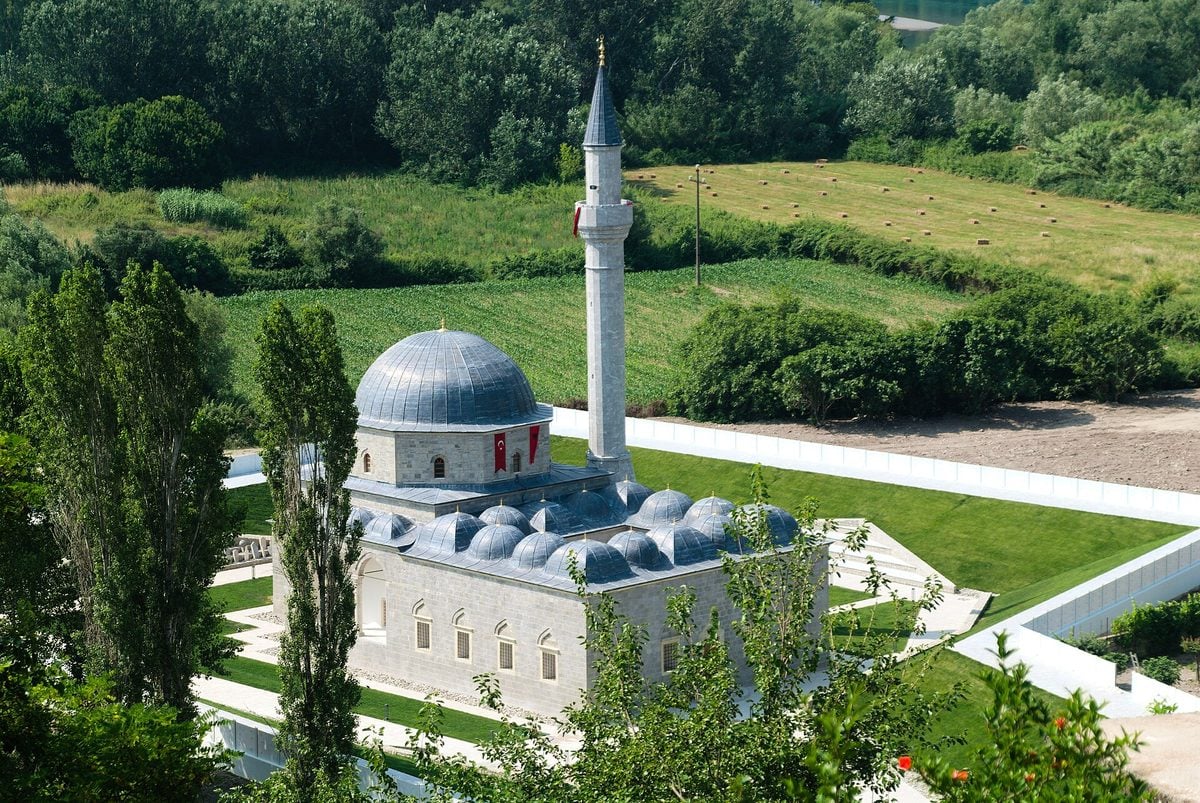
Xhamia e Plumbit (Lead Mosque) is an 18th-century Ottoman building whose nickname has outlasted its formal name in everyday Albanian speech. Plumbit (of lead) refers to the metal sheeting that once covered the domes, the same waterproofing material used on the great imperial mosques of Istanbul.
The mosque is one of the most architecturally significant Ottoman-era Islamic monuments in northern Albania. It was commissioned in 1773–1774 by Mehmed Pasha Bushati, the founder of a dynasty that governed much of the region as a semi-autonomous pashalik within the late Ottoman Empire. Its presence in Shkodër — a city more often associated outside Albania with its Catholic heritage — is part of what makes the building important: a reminder that northern Albanian religious history runs on more than one track.
This piece is a plain-language guide for a US audience to what Xhamia e Plumbit is, who built it, what happened to it during one of the harshest religious crackdowns in 20th-century Europe, and how it sits in the broader heritage landscape of Shkodër — alongside Rozafa Castle, the Shkodër Catholic Cathedral, and the smaller historical mosques and churches that share the same skyline. The aim isn’t to advocate for any tradition. It’s to put a real building, with a real history, in front of readers whose families may have walked past it.
Where the mosque stands
Xhamia e Plumbit sits on the southern outskirts of Shkodër (Scutari, in older Italian and English sources), the largest city in northern Albania. The historic city core is bounded on the south by the Buna River, the outlet of Lake Shkodër, and on the southeast by the limestone outcrop carrying Rozafa Castle. The mosque was built outside the dense historic çarshi (bazaar) quarter of the time, on relatively open ground near the river crossing.
That siting matters for two reasons. First, it gave the building its visual signature — the lead-domed silhouette could be seen from the castle hill, from the approach roads, and from the Buna crossings, making it one of the recognizable features of Shkodër’s skyline. Second, the open setting let the architect adopt a multi-domed plan more typical of imperial-scale Ottoman mosques in Istanbul or Edirne than of the smaller single-domed neighborhood mosques common across provincial northern Albania.
Shkodër is the historic capital of the Albanian north and one of the oldest continuously inhabited urban centers in the Balkans. The city has been an Illyrian settlement, a Roman municipium, a Byzantine outpost, a medieval Serbian and then Venetian holding, and from 1479 onward an Ottoman provincial center. The Lead Mosque was built nearly three centuries into that Ottoman period.
The Bushati pashalik
To understand who built Xhamia e Plumbit and why, it helps to understand the political setup of northern Albania in the late 1700s.
By the mid-18th century, central Ottoman authority over the western Balkans had loosened. Local strongmen consolidated hereditary control over significant territories while remaining nominally loyal to the Sultan. The two best-known of these formations are the southern Pashalik of Yanina under Ali Pasha of Tepelena (1788–1822) and the northern Pashalik of Shkodër under the Bushati family (1757–1831).
The Bushati pashalik was founded by Mehmed Pasha Bushati, who took control of Shkodër around 1757 and built a regional power base extending across much of present-day northern Albania, parts of Kosovo, and adjacent border zones. Under Mehmed Pasha and his successors — most notably Kara Mahmud Pasha Bushati (governed 1778–1796) and Mustafa Pasha Bushati (governed 1810–1831) — the pashalik ran an effectively autonomous administration with its own army, foreign correspondence, and public-works program.
Mosque-building was part of how Ottoman provincial rulers signaled both piety and legitimacy. The Bushati pashas commissioned a number of religious and civic structures in and around Shkodër during their seven-decade rule. Xhamia e Plumbit, attributed to Mehmed Pasha’s patronage around 1773–1774, is the most architecturally ambitious of these commissions.
The pashalik ended in 1831, when Sultan Mahmud II’s modernizing reforms forced a confrontation with the semi-autonomous provinces. Mustafa Pasha Bushati was defeated and exiled to Istanbul; the Pashalik of Shkodër was reabsorbed into direct Ottoman administration. The buildings outlasted the family.
Architecture: why “of lead”
The Albanian noun plumb — lead — gives the mosque its everyday name. The reason is on the roof.
Classical Ottoman mosque architecture, codified in the 16th-century works of the imperial architect Mimar Sinan and his successors, used sheets of lead to waterproof the masonry domes that defined the style. The same technique appears on the Süleymaniye and Selimiye mosques in Istanbul and Edirne, on countless Balkan-Ottoman provincial mosques, and on the imperial-scale mosques of Bursa and Sarajevo.
When applied to Xhamia e Plumbit’s multi-domed roofline, the metal weathered to a dull silver-gray that contrasted with the orange-tile roofs of the surrounding çarshi houses. From a distance, the building read as a single recognizable shape, and Albanian everyday speech named it for what it looked like rather than for any dedicatory inscription.
The plan features a central prayer hall covered by a large central dome surrounded by smaller half-domes and corner domes — the multi-dome solution Sinan-school architects used to span large square interior spaces without internal columns. Historic photographs and Albanian heritage documentation describe one main dome surrounded by several smaller domes across the main mass, plus a tall slender minaret on one corner. The interior would have included a mihrab (prayer niche) oriented toward Mecca, a minbar (pulpit), and a women’s gallery.
Building materials were local stone and brick, with the lead sheathing applied to the dome exteriors. The architecturally closest comparison in the region is the Mosque of Ethem Bey in Tirana (1794, completed 1821), which similarly adopted imperial Ottoman forms in a provincial setting and survives intact today. Xhamia e Plumbit was its older sibling in the north.
The mosque during Ottoman rule
For roughly its first 150 years, Xhamia e Plumbit functioned as one of the principal congregational mosques of Shkodër. It served the Sunni Muslim population of the southern districts, hosted Friday prayers, and operated alongside an associated medrese (Islamic school) and ancillary buildings in the Ottoman pattern of külliye — a religious complex with social functions attached.
Shkodër under the Bushatis was a religiously plural city. The historical population mix included Sunni and Bektashi Muslims, Catholic Albanians (the largest single confessional group in many counts), Orthodox Albanians and Serbs, and a small Sephardic Jewish community. The Catholic Kuvendi i Arbënit — the 1703 Council of Arbën — had been held in the region; the Catholic cathedral, the Orthodox churches, the Bektashi teqe lodges, and the Sunni mosques coexisted within a tight urban footprint.
The mosque continued to function through the late Ottoman period (which ended in Albanian lands with the 1912 Declaration of Independence), the interwar Kingdom of Albania (1928–1939), the Italian and German occupations of 1939–1944, and into the early communist period. Photographs from the 1930s and 1940s show the lead-domed silhouette intact above a still largely Ottoman-pattern urban fabric.
1967 and the atheism campaign
The hardest single break in the building’s history came in 1967.
In a February 1967 speech, Enver Hoxha announced an “ideological and cultural revolution” that included the elimination of organized religion from Albanian life. Over the months that followed, organized youth squads and state crews moved on religious buildings across the country. By the end of 1967 the People’s Republic of Albania had declared itself the world’s first officially atheist state, a position later written into Article 37 of the 1976 constitution, which read that “the state recognizes no religion and supports atheist propaganda for the purpose of inculcating the scientific materialist world outlook in people.”
Government and church records of the campaign put the total at roughly 2,169 religious buildings closed, repurposed, or destroyed across 1967, spanning mosques, Orthodox churches and monasteries, Catholic churches, and the country’s Bektashi teqes. Many were converted into warehouses, sports halls, cinemas, or party meeting houses. Others were dynamited outright.
Xhamia e Plumbit was caught in this campaign. Its minaret — itself a 1920 rebuild — was lost in 1967; Albanian sources differ on the cause, with one account attributing it to a lightning strike and another to the era’s anti-religious campaign. Religious function was ended, and the surrounding medrese and ancillary structures were variously cleared or repurposed. The lead-domed prayer hall itself, however, was not fully destroyed. The domed mass survived in altered form and is documented in Albanian heritage records of the period — partly because its structural form was massive enough that demolition would have required a major operation, and partly because the building was already recognized in pre-communist heritage cataloguing as architecturally significant.
This partial-survival pattern is not unique. The Et’hem Bey mosque in Tirana also survived the 1967 campaign in altered form, as did the cathedral in Shkodër (used as a sports arena for decades) and a small number of other monumentally-scaled religious buildings. The atheism era closed the doors and changed the use; it did not always finish the demolition.
The 1967 closure and the loss of the minaret are the single most documented events in the mosque’s modern history, and they shape the story of what came after: reopening, and eventually, restoration.
After 1990: preservation and reconstruction
Religious restrictions in Albania began to lift in late 1990, in the final months of the communist regime. The first public Catholic Mass since 1967 was celebrated in Shkodër on November 4, 1990. Xhamia e Plumbit reopened twelve days later, on November 16, 1990 — reportedly the first mosque in Albania to resume services after the atheism era, hosting one of the country’s first post-communist religious gatherings, led by Hafiz Sabri Koçi. Mosques and Orthodox churches reopened across the country in the following weeks. By 1992 the People’s Socialist Republic had ended and a multi-party democratic government had been seated.
For Xhamia e Plumbit, the post-1990 period opened decades of gradual repair, culminating in a formal government-to-government restoration: beginning in 2021, the Albanian and Turkish governments carried out a joint restoration of the building, addressing structural and flood damage that had accumulated since the communist period. Three threads ran through the broader preservation picture along the way:
- Restoration versus reconstruction. The building that reopened in 1990 was the lead-domed prayer hall in altered condition. The 2021 Albanian-Turkish restoration addressed structural repairs to the building; recovering interior elements (the mihrab, the minbar, original calligraphic decoration) where these can be documented remains a longer-term, separate question.
- Property and jurisdiction. Restitution of communist-era seizures has been a long-running issue across all four Albanian religious traditions. The Albanian Muslim Community (Komuniteti Mysliman i Shqipërisë) is the recognized national body for Sunni Muslim affairs and is the natural counterpart for any restoration program; the building also falls under Albanian state heritage protection through the Institute of Cultural Monuments.
- Documentation. Photographs, plans, and survey work from the pre-1967 period exist in Albanian state archives and in private collections, and form the documentary basis for any reconstruction discussion.
Funding has been the practical constraint on the fuller work that remains. Albania is a middle-income country with significant heritage-conservation needs across every period — prehistoric, classical, medieval, Ottoman, modern — and the Ottoman-era Islamic heritage of the north sits within a wider queue. International heritage organizations, and in this case the Turkish government directly, have engaged in Albanian conservation projects since the 1990s, but a full reconstruction of Xhamia e Plumbit to its original imperial-Ottoman condition remains a larger undertaking than the 2021 project alone addressed.
What exists today is an active mosque — reopened in 1990, structurally restored through the 2021 Albanian-Turkish government project, and identified in Albanian cultural-monument registers. Recovering the building’s finer pre-1967 details remains a longer-term preservation question. That is the honest reading of where the building stands at the time of writing.
Shkodër’s wider heritage landscape
Xhamia e Plumbit doesn’t sit alone. To understand its significance, it helps to see it in the company of the other major heritage anchors of the Shkodër region.
- Rozafa Castle. The fortification on the limestone outcrop south of the city is one of the oldest documented castle sites in Albania, with Illyrian foundations, Roman and Byzantine phases, Venetian-period walls (15th century), and Ottoman additions. The 1474 and 1478–1479 Ottoman sieges of Shkodër — the second of which delivered the city to Mehmed II — are central episodes in the Albanian–Venetian–Ottoman wars. The legend of Rozafa, the woman walled into the foundations to keep the castle standing, is one of the foundational stories in Albanian folklore.
- Shkodër Catholic Cathedral (St. Stephen’s). The 19th-century cathedral is the symbolic seat of Albanian Catholicism and the site where Pope John Paul II consecrated four new Albanian bishops in April 1993 — the first papal visit to Albania and the formal re-foundation of the Catholic hierarchy after the atheism era. The cathedral was used as a sports arena from 1967 to 1990 and was reconsecrated after the regime fell. (See our Albanian Catholic Church piece for more.)
- Marubi National Museum of Photography. The Marubi family archive, accumulated across three generations from 1858 onward, is one of the largest photographic archives in the Balkans and a unique visual record of Shkodër and northern Albania across more than a century — including images of Xhamia e Plumbit before and during the changes of the 20th century.
- Mes Bridge (Ura e Mesit). The 18th-century stone arch bridge over the Kir River, commissioned during the Bushati period, is one of the best-preserved Ottoman-era civil structures in Albania.
- The historic çarshi of Shkodër. The Ottoman-period bazaar district, partly preserved and partly redeveloped, retains the urban grain of the late-Ottoman northern Albanian town.
Read together, these monuments map the cultural overlay that makes Shkodër one of the most heritage-dense corners of Albania: prehistoric and Illyrian foundations, classical and Byzantine layers, medieval Christian institutions, an Ottoman administrative and religious overlay, and a 19th- and 20th-century Albanian-national layer on top. Xhamia e Plumbit is the most architecturally distinctive surviving expression of the Ottoman-Islamic stratum in this stack.
Islam in Albania: the broader context
Xhamia e Plumbit reads differently with the broader Albanian religious context in view.
By the time of the building’s construction in the 1770s, Albanian lands had been under Ottoman rule for approximately three centuries. Across that period, large parts of the central and southern Albanian-speaking population converted to Islam — both Sunni and the Bektashi Sufi order. The northern Catholic highlands retained their pre-Ottoman faith. The geography that emerged — Catholic north, mixed center, more heavily Muslim south, Orthodox southeast — is the same broad pattern that shaped 20th-century census returns.
Per the 2011 Albanian census, roughly 58.8% of the country’s population identified as Muslim (Sunni and Bektashi combined, with Bektashi sometimes counted separately at around 2%), 10.1% as Roman Catholic, 6.8% as Eastern Orthodox, and the remainder as believers without denomination, atheists, or unstated. The Bektashi Sufi order has had its world headquarters in Tirana since the order was expelled from Turkey in 1925, an unusual concentration of global religious authority in a country of fewer than three million people.
Within that picture, Shkodër stands out for two reasons. First, it has historically been the Catholic capital of Albania — Albanian Catholic intellectual life, clergy training, and the Catholic press were concentrated there from the 19th century onward. Second, it has also been a significant Sunni Muslim center, with multiple historic mosques (Xhamia e Plumbit, the Parruca Mosque, the Bazaar Mosque, and several smaller neighborhood mosques) serving the Muslim share of the city’s population. The “Catholic Shkodër” reputation is real but partial; the city has been religiously plural for centuries, and Xhamia e Plumbit is one of the most visible reminders of that fact.
For Albanian-American readers, the implication is concrete. Family histories from the Shkodër region cross confessional lines more often than the standard ethnic-religious shorthand suggests. The same village clan registers can record Catholic, Sunni, and occasionally Orthodox branches across a few generations. Heritage sites like Xhamia e Plumbit are part of the shared northern Albanian story regardless of which branch a given family ended up on. (Our piece on Islam in Albania covers the US side of that picture.)
Diaspora connections and the heritage record
Albanian heritage protection runs through the Ministry of Culture and the Institute of Cultural Monuments (Instituti i Monumenteve të Kulturës), which maintains the national register of cultural monuments. Xhamia e Plumbit is identified in this cataloguing as a historic mosque of the Bushati period; pre-1967 measured drawings, photographs, and descriptive surveys exist in Albanian state archives. Outside the state register, the building is referenced in academic studies of Balkan-Ottoman religious architecture and in documentation maintained by the Albanian Muslim Community. International heritage bodies, including UNESCO, recognize a range of Albanian heritage sites; individual mosques on the Albanian register operate under domestic protection rather than the World Heritage framework.
In plain terms: the building is documented, recognized as historically significant, and protected to the level the Albanian state extends to comparable monuments. Whether it will be fully restored, partially conserved, or maintained in its present documented state is a question of resources and priorities that remains open.
A meaningful share of US Albanian-American families trace origins to Shkodër and its surrounding districts — Malësia e Madhe, Postribë, the Buna plain, and the villages of the Albanian Alps north and east of the city. The 2024 American Community Survey records approximately 230,000 Albanian Americans across the United States; community estimates including third-generation and culturally identified Albanians put the figure closer to one million. That gap is not an accident; the Census misses most Albanian Americans for structural reasons we’ve documented. New York (~56,000), Michigan (~27,000), and Massachusetts (~21,000) host the largest concentrations.
For Catholic Albanian Americans, the Shkodër region is the spiritual and intellectual core of the Albanian Catholic tradition. Our Lady of Shkodra (Zoja e Shkodrës) in Hartsdale, New York is named for the Marian devotion centered at Shkodër.
For Sunni and Bektashi Muslim Albanian Americans, the Shkodër region’s mosques form one piece of a broader Albanian Islamic heritage. The Albanian-American Islamic Center in Harper Woods, Michigan (founded 1949) and the First Albanian Teqe in America in Taylor, Michigan are two of the older US institutions in this tradition. Heritage anchors in Albania include Xhamia e Plumbit alongside the Et’hem Bey in Tirana, the historic mosques of Berat (a UNESCO World Heritage city), and the Bektashi kryegjyshata (world headquarters) in Tirana.
For Orthodox Albanian Americans, the southern Tosk centers of Korçë, Berat, and Gjirokastër are the principal Orthodox heritage anchors, with Fan Noli’s Boston parishes serving as the founding US institutional thread.
For all four traditions, the diaspora is the part of the community where memory of the pre-1967 religious landscape has been continuously held. Family stories, photographs, and oral history about specific buildings — Xhamia e Plumbit among them — often survive in American living rooms more vividly than in the rebuilt civic life of Albania itself, where the chain of transmission was deliberately broken between 1967 and 1990.
Why the building still matters
Three things make Xhamia e Plumbit worth tracking as a heritage object rather than a footnote.
First, it is architecturally distinctive. The multi-dome plan, the imperial-scale ambition in a provincial setting, and the lead-sheathed roofline give the building a specific identity that doesn’t repeat elsewhere in northern Albania. There are other Ottoman-era mosques in Shkodër — the Parruca and Bazaar mosques among them — but the Lead Mosque is the most architecturally ambitious of the group.
Second, it is historically documented. The Bushati patronage line, the construction date, the architectural plan, the pre-1967 condition, and the post-1967 alterations are all matters of record rather than legend. That documentary base makes the building usable for serious historical work and for any future preservation program.
Third, it is a marker of religious pluralism in a city whose international reputation is overwhelmingly Catholic. The presence of a major Bushati-era Sunni mosque, a 19th-century Catholic cathedral, an Orthodox church, and Bektashi connections within the same urban frame is one of the cleanest illustrations of why “Albanian religious identity” has never resolved into a single tradition.
For Albanian Americans, none of this needs to translate into a particular religious position. The building is a heritage object whose loss or survival is part of the community’s longer self-understanding. NAR’s editorial line on religious heritage, set out in our first atheist country and Albanian Catholic Church pieces, is consistent: treat all four traditions as Albanian, and document the buildings on their own terms.
The National Albanian Registry is a community-led count of Albanian Americans across every region and tradition. Catholic, Sunni, Bektashi, Orthodox, secular, and the many families whose religious history runs across more than one line — all of you belong in the same record. Preserving Albanian heritage starts with knowing who and where the community is. Register here to add your household to the count; the Certificate is a recognition document marking your place in the Albanian-American community.
Sources: Albanian state heritage documentation through the Institute of Cultural Monuments; Albanian Muslim Community records; published scholarship on Balkan-Ottoman religious architecture; Wikipedia’s “Lead Mosque, Shkodër” and “Xhamia e Plumbit (Shkodër)” entries for the mosque’s 1990 reopening, 1967 minaret loss, and 2021 Albanian-Turkish restoration; the 2011 Albanian census; the 2024 American Community Survey for US demographic figures; and existing NAR articles on the first atheist country, Albanian Catholic Church, Albanian heritage, and Albanian history.