
Pjetër Bogdani — known in Italian church records as Pietro Bogdano — is the writer Albanian literature in prose dates itself from. He was born around 1630 in the Has region, in the mountains where today’s Albania and Kosovo meet, and he died of plague in late 1689 while supporting Habsburg forces in the long Catholic Albanian uprising against Ottoman rule. In between, he wrote Cuneus Prophetarum — The Band of the Prophets, in Albanian Çeta e Profetëve — published in Padua in 1685 and recognized for more than three centuries as the first Albanian prose work.
The reason that matters for an Albanian-American family in 2026 is straightforward. If your kids are learning Albanian on a Saturday in the Bronx, in Sterling Heights, in Worcester, or in Yonkers, they will meet Bogdani’s name early and they will meet it often. He is the first writer named in any survey of the Albanian literary canon. His name is on schools and streets in Pristina, Prizren, Tirana, and Shkodër. He is the figure that Albanian Catholic and Orthodox students alike read together, because he predates the religious-literary divisions that came later.
What follows is the long version of who he was, what he wrote, why the book mattered then, and why it still matters now. The community is multi-confessional — Catholic, Orthodox, Sunni Muslim, Bektashi, and secular — and Bogdani’s specific work was Catholic clerical, but the linguistic foundation he laid is shared by every Albanian who reads or writes today.
Who Pjetër Bogdani was
Bogdani lived from around 1630 to late 1689 — roughly sixty years that ran across the high Ottoman period in the western Balkans, the long Counter-Reformation campaigns of the Catholic Church among Albanian and Slavic communities under Ottoman rule, and the Great Turkish War (1683-1699) that briefly reopened the question of who would govern southeastern Europe.
He held a stack of identities at once: Catholic priest trained in Rome and Padua, Bishop of Shkodër (1656), Archbishop of Skopje and apostolic administrator of Serbia (from 1677 onward), Albanian-language writer, and political-military organizer of Catholic Albanian resistance to the Ottomans during the Great Turkish War. His Italian-language name Pietro Bogdano appears in Vatican and Habsburg archives; his Albanian name Pjetër Bogdani is the one that schoolchildren in Albania and Kosovo learn.
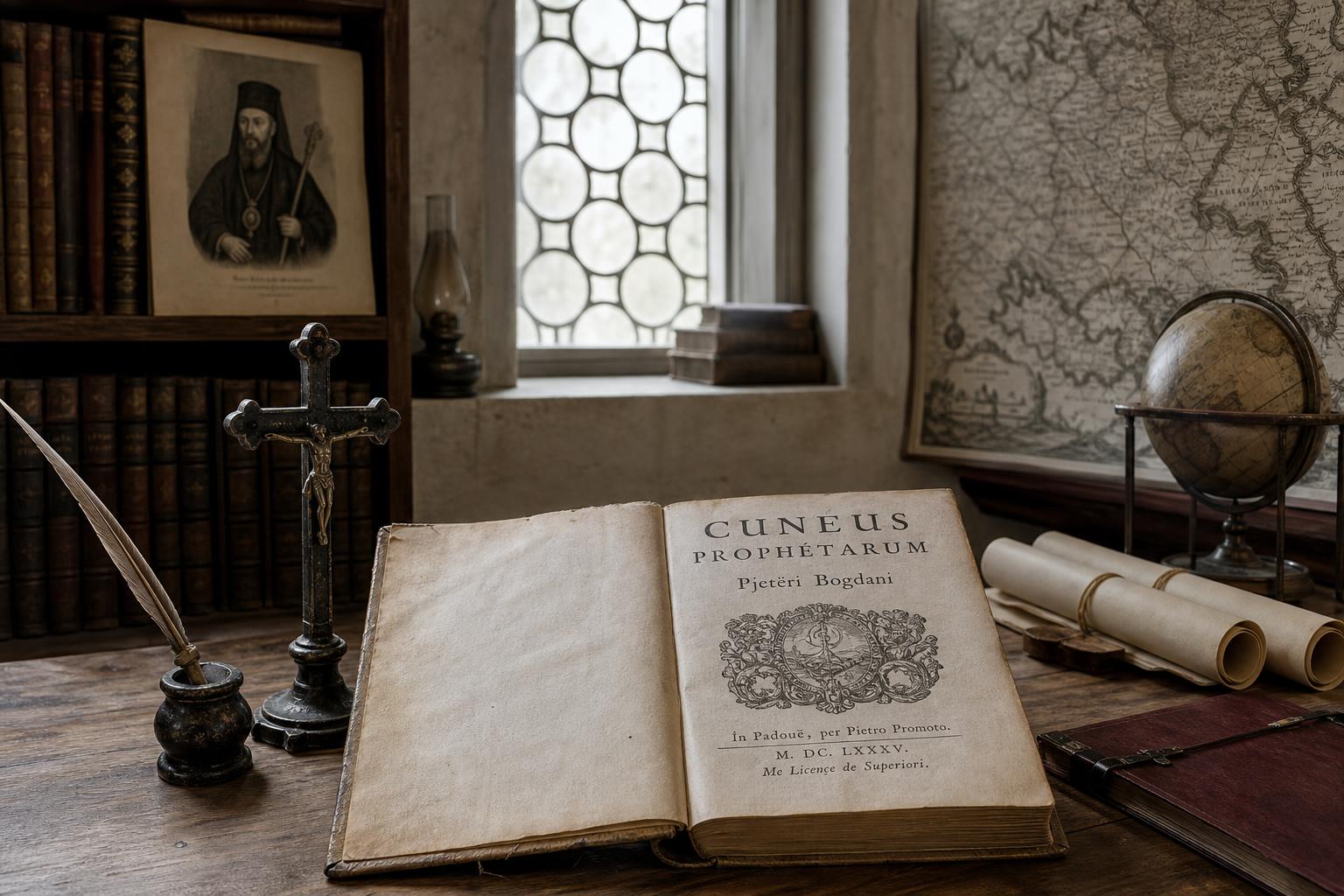
The single work he is remembered for is Cuneus Prophetarum, published in Padua in 1685. The book runs to 436 pages, structured in two parts, written in parallel Albanian and Italian columns, and it is the first sustained piece of Albanian prose ever printed.
The family and the Has region
Bogdani was born in Gur i Hasit, a village in the Has region — a mountainous district in the western Balkans that today straddles the Albania-Kosovo border. The area was part of the Ottoman Empire’s Sanjak of Dukagjin in the seventeenth century, but it had retained a significant Catholic Albanian population through more than two centuries of Ottoman administration.
His family was Albanian Catholic, with deep ecclesial connections. His uncle Andrea Bogdani (Albanian: Andrea Bogdani; Italian: Andrea Bogdano) served as Archbishop of Skopje before him, and it was Andrea who first steered the young Pjetër toward priesthood and toward study abroad. Throughout the article you will see this uncle-nephew pattern, in which an established cleric in a kin network sponsors the next generation’s education in a Catholic college in Italy. That pattern is how the small Albanian Catholic intelligentsia of the seventeenth century reproduced itself.
The kuvend (assembly or council) of Catholic Albanian clergy and lay leaders met under conditions that the Ottoman authorities tolerated rather than authorized. Albanian Catholic identity in this period was not a state-protected minority status; it was a network of priests, bishops, parishes, and family alliances connected to Rome through the Sacra Congregatio de Propaganda Fide — the Vatican’s missionary arm. Bogdani’s family sat near the center of that network on the western Balkan side.
Education: Loreto, Rome, Padua
Bogdani’s education followed the standard Catholic-Albanian-elite track of the period.
He studied first in Loreto, the Italian Marian shrine town that hosted an Illyrian College for seminarians from the western Balkans. He continued at the Pontifical Urban College of Propaganda Fide in Rome, the Vatican’s missionary seminary that trained Catholic priests for postings in the Ottoman Empire, the Russian Empire, and the European mission fields. He completed doctoral studies in philosophy and theology in 1656.
Italy was, in the 1650s, one of the most active intellectual environments available to Albanian Catholic clergy. The seminary network included Albanian, Slavic, Greek, and Italian classmates, and the languages of instruction were Latin and Italian. The teaching included scholastic theology, biblical Hebrew and Greek, philosophy in the Aristotelian and Thomistic frame, and the practical pastoral training needed to run parishes in Ottoman territory.
For Bogdani, Italian higher education had a second consequence beyond the formal degrees. It put him in regular contact with Albanian-language printing — already a small but real tradition. Gjon Buzuku’s Meshari (the Missal) had been printed in 1555, the first known book in Albanian; Pjetër Budi had published Albanian Catholic devotional works in 1618-1621; Frang Bardhi had compiled the first Latin-Albanian dictionary in 1635. Bogdani knew this tradition and was preparing, eventually, to extend it into prose.
He returned from Italy as a fully trained priest with a doctorate, fluent in Latin, Italian, and Albanian, with working knowledge of biblical Greek, Hebrew, and the major scholastic literature. He was 26 years old.
Bishop of Shkodër, Archbishop of Skopje
Bogdani’s ecclesiastical career advanced quickly. In 1656, the year he completed his doctorate, he was appointed Bishop of Shkodër — peshkop i Shkodrës — taking responsibility for a diocese that covered much of northern Albania under Ottoman administration. He held the Shkodër see for roughly two decades.
In 1677, after his uncle Andrea resigned the archbishopric because of illness, Bogdani succeeded him as Archbishop of Skopje — kryepeshkop i Shkupit — and named apostolic administrator of Serbia. The Skopje archdiocese in the seventeenth century covered a territory that today crosses Kosovo, North Macedonia, and parts of southern Serbia, with jurisdiction extended at various points across the western Balkans. We frame this as historical-geographic fact rather than as a modern political claim — the Ottoman administrative map and the Catholic ecclesiastical map of the 1670s overlapped only loosely with any of today’s borders.
The role of an Albanian Catholic archbishop under Ottoman rule was a managed kind of resistance. The Ottoman state classified Catholic Christians as a millet with limited self-administration, taxed them more heavily than Muslims, restricted church construction, and pressured conversion through legal and economic incentives. Bogdani’s job was to keep parishes open, train and ordain priests, defend church property where he could, and maintain the line of communication to Rome through couriers and through his own travel. He was, in effect, a regional Catholic prelate operating inside a Muslim empire that did not particularly want him there.
He used the position to do something else as well. He used it to write Cuneus Prophetarum.
Cuneus Prophetarum (1685): the book itself
The book that anchors Bogdani’s literary reputation is Cuneus Prophetarum de Christo salvatore mundi — The Band of the Prophets Concerning Christ, Savior of the World — published in Padua in 1685 by the seminary press of Padua, endowed by Cardinal Gregorio Barbarigo. The Albanian title of the work is Çeta e Profetëve. The Italian-language permission to print and the dedicatory matter are at the front of the volume; the body of the work runs to 436 pages of Albanian and Italian in parallel.
The structure is two parts.
Part one is a theological and biblical history of the Old Testament, from creation through the prophets, retold in continuous prose with extensive commentary, scholastic exposition, and references to classical and patristic authors. The prophets themselves are the çeta — the band, the company, the assembly — that the title names: a chorus of voices Bogdani reads as pointing forward toward the figure of Christ.
Part two turns to the New Testament, with the life of Christ at the center, followed by exposition of major theological themes — Christology, ecclesiology, eschatology — handled in a register that draws directly on the Roman scholastic tradition Bogdani had absorbed at the Urban College. The Albanian text and the Italian text run side by side on facing pages, allowing Italian-literate clergy to verify Bogdani’s renderings while Albanian-speaking lay readers and seminarians could read the Albanian column on its own.
The book also includes shorter framing material: a dedicatory epistle, a preface in which Bogdani discusses his motives, occasional Albanian-language verse, and an appendix with prayers, doctrinal summaries, and reference matter. The format — bilingual, learned, framed for both clerical and lay use — was deliberate. Bogdani was building a reference work that could function as catechism, as teaching tool, as doctrinal anchor for parish priests, and as a demonstration that Albanian was a language adequate to the full weight of Christian scholastic theology.
A second edition appeared in Venice in 1691, two years after Bogdani’s death, under the title L’infallibile verità della cattolica fede. Later editions and partial reprints continued through the eighteenth and nineteenth centuries.
The book as Albanian-language milestone
The literary-historical significance of Cuneus Prophetarum is hard to overstate, and it is worth being precise about what it is and is not.
It is not the first Albanian-language book. That honor belongs to Buzuku’s Meshari (1555), a missal — a book of Catholic liturgical texts — printed about 130 years before Bogdani. Pjetër Budi, Frang Bardhi, and a handful of other Catholic clergy had also published in Albanian before Bogdani.
What Cuneus Prophetarum is, is the first sustained prose work in Albanian — the first time an Albanian writer attempted a long, structured, original prose composition rather than a translation, a missal, a dictionary, or a short catechism. The earlier books were practical: liturgy, devotion, vocabulary. Bogdani’s book is discursive prose, where an author argues, narrates, frames, and reasons across hundreds of pages in his own voice.
That distinction matters because every modern Albanian prose tradition — the Rilindja Kombëtare essayists of the 1880s, the early-twentieth-century novelists, the writers of communist and post-communist Albania, and the journalists of today — descends from the moment a writer decided that gjuha shqipe could carry an extended prose argument. Bogdani is that moment.
He also worked deliberately on the vocabulary problem. Albanian in 1685 had no settled written standard, no agreed orthography, no expanded technical lexicon for theology or philosophy or natural science. Bogdani made hundreds of small lexical choices — coining or stabilizing terms for “soul,” “prophet,” “covenant,” “resurrection,” “creation,” “judgment” — and the parallel Italian text functioned as a kind of dictionary, letting any reader cross-check what the Albanian was meant to say. Many of his choices passed into later Albanian literary use. Some did not. Either way, Cuneus Prophetarum is the book where the Albanian theological and abstract vocabulary first gets worked out at scale.
The Great Turkish War and Catholic Albanian resistance
The last four years of Bogdani’s life ran in parallel with the Great Turkish War (1683-1699) — the long European war that began with the failed Ottoman siege of Vienna in 1683 and ended with the Treaty of Karlowitz in 1699. The war was the most significant Christian military advance into Ottoman Europe since the late Middle Ages.
Starting in 1688, the Habsburg armies of Emperor Leopold I pushed south through Serbia, taking Belgrade that September; by 1689 they had taken Niš and reached Kosovo. The Catholic Albanian populations of the western Balkans, including Bogdani’s archdiocese, saw the Habsburg advance as a chance to throw off Ottoman rule.
Bogdani — by this point a man in his late fifties, in poor health, and the senior Catholic prelate of the region — became the principal Albanian Catholic organizer of the uprising. He raised volunteers, opened communications with the Habsburg high command, and helped coordinate the entry of Habsburg forces into Kosovo. Albanian Catholic militia under his ecclesiastical authority joined the Austrian columns. He met with the Austrian general Enea Silvio Piccolomini as the Habsburg army advanced into Kosovo in late 1689, in what historians of the war record as a decisive moment of Catholic Albanian-Habsburg cooperation.
The strategic picture turned almost immediately. Plague swept through the Habsburg ranks. Piccolomini died of plague in Prizren in November 1689. The Ottoman counter-offensive, supported by Tatar cavalry, regained Kosovo in 1690 and triggered the Great Migration of the Serbs (Velika Seoba) under Patriarch Arsenije III as well as a parallel displacement of Catholic Albanians northward. The window in which the western Balkans might have changed hands closed within months of opening.
The political-military gamble of 1689 ended in defeat. The cultural fact of Catholic Albanian organized resistance, with Bogdani at its center, entered the historical record permanently.
Death in 1689 and the desecration of the grave
Bogdani died of plague in late 1689, during or just after the Habsburg occupation of Kosovo. The most widely cited location is Pristina, though some sources place the death in Prizren; the question is unsettled in the seventeenth-century records. He was approximately fifty-nine years old.
He was buried in the city where he died — by the most detailed contemporary account, in Pristina’s main mosque, which had been converted into a church during the brief Habsburg occupation, on the right side of the altar. After the Ottoman recapture of Kosovo in 1690, Ottoman and Tatar forces are reported to have disinterred his body and desecrated his grave in reprisal for his role in the Habsburg-aligned uprising. The desecration, taken as historical fact in modern Albanian literary scholarship, sits at the dark end of the Bogdani biography: a writer who had spent his life building Albanian prose and Catholic Albanian institutional life ended buried, then unburied, then scattered, by the same power he had spent thirty years navigating.
The seventeenth-century sources for the death and the desecration are limited and partly contradictory. The dating to late 1689, the cause as plague, and the fact of post-mortem reprisal are the points all major sources agree on.
Bogdani’s legacy in Albanian and Kosovar memory
Bogdani’s place in Albanian-language culture is unusually settled. Few writers from any period are claimed across so many institutional and political lines.
In Kosovo, he is a foundational figure of the national literary canon. Pristina has streets, schools, and a long-running theater carrying his name. The Pjetër Bogdani monument in central Pristina is a standard stop on any cultural tour of the city. Several smaller Kosovar towns have schools and cultural centers named for him, and the 300th anniversary of Cuneus Prophetarum in 1985 was marked by major commemorations across both Kosovo (then in Yugoslavia) and Albania.
In Albania, he is taught from primary school onward as one of the founders of the literary language. Tirana, Shkodër, and Durrës have schools and public institutions bearing his name; the Albanian Academy of Sciences has issued multiple scholarly editions of his work; and his name is carried in the standard literary histories alongside Buzuku, Budi, Bardhi, and the Frashëri brothers.
In North Macedonia, where the Albanian-speaking population of the country traces ecclesiastical history through the same Skopje archdiocese Bogdani led, he is part of the shared literary heritage of the Albanian community.
He is one of the very small set of Albanian historical figures whose memory bridges Catholic, Orthodox, and Muslim Albanian communities. His specific work was Catholic clerical; his linguistic and literary contribution belongs to all of them, and the schoolbooks treat it that way.
Reading Bogdani today: editions and translations
For a reader picking up Bogdani for the first time, the practical landscape is the following.
The 1685 Padua edition survives in a small number of research-library copies in Italy, the Vatican, Albania, and a few Western European university libraries. Facsimile reprints have been issued in the twentieth century and are accessible through the National Library of Albania and the National Library of Kosovo.
Modern Albanian editions in standard literary Albanian have been issued in Pristina and Tirana repeatedly since the 1970s. The standard scholarly edition for the contemporary reader is the multi-volume Cuneus Prophetarum with critical apparatus published by the Academy of Sciences of Kosovo and by Albanian academic presses. These editions modernize the orthography, supply notes, and let a contemporary Albanian-language reader work through the text without specialized seventeenth-century philological training.
English-language access is more limited. The late Robert Elsie, the Canadian-born albanologist who translated and anthologized Albanian literature for an English-reading audience for forty years, included Bogdani in Early Albania: A Reader of Historical Texts (11th-17th Centuries) and in Albanian Literature: A Short History. Both volumes are still in print and are the most accessible English entry point. A full English translation of Cuneus Prophetarum has not been published; the full Italian text is available alongside the Albanian in the early editions for readers who can work in Italian.
For Albanian-American readers without strong reading Albanian, the realistic starting point is Elsie’s anthology excerpts plus a survey chapter in any standard history of Albanian literature. From there, modern Albanian editions are the next step. Bogdani is hard, but he rewards rereading: the prose is dense, the theology is scholastic, and the historical layering of Old and New Testament narrative is closer to a medieval encyclopedia than to a modern essay.
Why Bogdani matters for Albanian Americans
For an Albanian-American family in 2026, the case for caring about a seventeenth-century Catholic archbishop is institutional, not sentimental.
Albanian language survival in the diaspora is the longest-running question the Albanian-American community has. First-generation immigrants brought the spoken language; second and third generations vary widely in fluency; and the Saturday Albanian-language school in the Bronx, in Sterling Heights, in Worcester, and in Yonkers exists precisely to push the written language one generation further. Every one of those schools teaches Bogdani’s name, because every standard Albanian curriculum starts the prose canon with him.
The Catholic thread of Albanian-American life — concentrated historically in northern New Jersey, in the Bronx, and in parts of Detroit, with deep ties to Kosovo and to the northern Albanian malësi — runs through Bogdani directly. The Albanian Catholic parishes in the United States read him as part of their own ecclesial heritage. The Orthodox and Muslim Albanian-American communities read him as a literary founder rather than an ecclesial one, which is the framing every modern Albanian school uses.
The book itself is also a diaspora object. It was written by an Albanian Catholic prelate, printed in Italy, smuggled back into Ottoman territory, copied by hand in the eighteenth century, reprinted in Venice, taught in the modern Albanian state, and now sits on the shelves of Albanian-American family homes from Pelham Parkway to Sterling Heights to Worcester to Anchorage. It has crossed borders and centuries, and it has crossed the Atlantic as part of the cultural baggage of every wave of Albanian immigration to the United States from the 1900s on.
For Albanian Americans who grew up speaking Albanian at home but reading in English, Bogdani is the writer the textbook in Pristina and the textbook in Tirana and the Saturday-school workbook in the Bronx are all teaching from. He is what the bilingual classroom dates the Albanian written language from. The case is not stylistic — Bogdani is not easy reading even for native speakers — the case is institutional. He is the foundation under everything later, including the Albanian Renaissance (Rilindja Kombëtare) generation that produced Naim Frashëri two centuries on.
The National Albanian Registry exists to count Albanian Americans across every state, every generation, every faith. Pjetër Bogdani gave the Albanian language its first sustained prose three hundred and forty-one years ago. NAR’s job is much smaller and much more practical: to count the community that still reads, writes, and teaches that language in the United States today.
If your family carries any of that thread — northern Albanian Catholic, Kosovar, Has, Macedonian Albanian, or any of the later waves that arrived speaking the language Bogdani helped seed — get counted at /register. It takes about a minute. We don’t sell anything. We never share data. We add one more name to the count.