

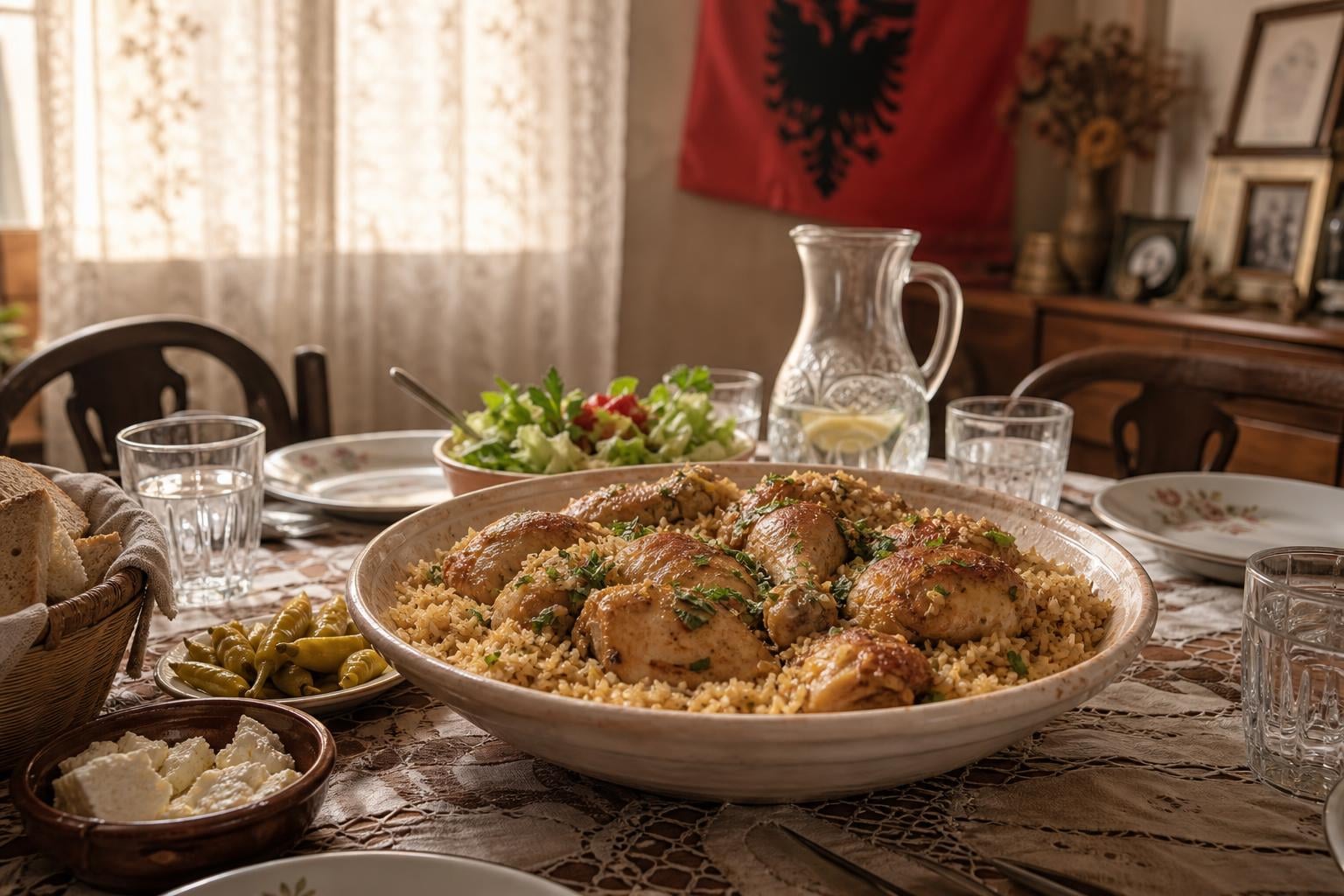
Pilaf me pulë — Albanian chicken pilaf — is the Sunday-lunch dish. In Albania, in Kosovo, in the Albanian villages of North Macedonia and Montenegro, and in the diaspora kitchens of New York, Detroit, Worcester, and Waterbury, this is the meal that says family is here, the table is full, the week can wait. Rice cooked in chicken broth. Butter. Salt. A whole chicken poached in the same pot. That is the dish.
It is also the recipe second- and third-generation Albanian Americans most often try to recreate from memory. The grandmother who made it cooked without measuring. The aunt who watched her cook never wrote it down. What survives is a memory of a smell — onions in butter, the lid lifted off a pot of fluffy yellow-white rice — and a feeling that this was the meal that mattered.
This piece writes the numbers down. Not as a recipe card, but as the kind of explanation a relative would give if you asked her how she does it: what the dish is, where it comes from, why every family’s version is a little different, the ratios that actually matter, the mistakes the diaspora kitchen tends to make, and what belongs on the table next to it.
What Pilaf me Pulë Actually Is
Pilaf me pulë (literally, pilaf with chicken) is rice cooked in chicken broth — lëng pule — and seasoned simply with salt, pepper, and butter or olive oil. The chicken is poached in salted water to make the broth, then either served whole alongside the rice or pulled and laid on top to absorb the steam.
This is not Italian-style risotto. There is no constant stirring, no gradual addition of liquid, no creamy finish. The rice goes into the pot once, the hot broth goes in once, the lid goes on, and the dish cooks itself. The texture target is fluffy and separate — every grain distinct, glossy with butter.
It is also not pilaf in the Persian aromatic sense. No saffron, no cardamom, no rose water. Albanian pilaf is plainer than its Iranian or Indian cousins. The flavor comes from the chicken and the butter. The only seasonings most families use are salt, black pepper, and sometimes a single bay leaf in the broth.
The closest culinary cousin is Turkish pilav — the Ottoman-era rice-cooked-in-broth tradition that traveled across the Balkans during the four centuries of Ottoman administration (Wikipedia: Albanian cuisine). The Albanian version dropped most of the Turkish flourishes — no orzo browned in butter first, no chickpeas, no currants. What remained is a leaner dish that lets the broth and the butter do the work.
Pilaf me pulë is what a family cooks when there is time. It takes about an hour and a half from raw chicken to plated rice, most of it hands-off — the chicken simmers 35 to 45 minutes, the rice cooks 18, and the dish rests another 10. It is the dish you start at noon for a one o’clock lunch with extended family at the table.
The Cultural Place
In Albania, pilaf me pulë is the Sunday dish. Sunday morning the chicken comes out of the freezer, the pot of water goes on the stove, and by midday the kitchen smells like onion, broth, and butter. The grandmother — gjyshja — leads. Children come in and out. Someone sets the table.
The dish also anchors bigger occasions. Albanian weddings across Albania, Kosovo, and the diaspora feature pilaf as the centerpiece of the seated meal. At rural weddings in Tropojë and the northern highlands, pilaf is served on huge communal platters, sometimes with a whole roasted lamb or chicken laid on top. The scale changes. The dish does not.
Holiday meals follow the same logic. Pashkë (Easter) tables include pilaf alongside roast lamb. Bajram (Eid) spreads have it with cold cuts, byrek, and yogurt. Christmas dinner in Catholic Albanian households often centers on a roast bird with pilaf underneath. Festa e emrit — the name day celebrations still observed in many Catholic and Orthodox families — almost always include a pilaf course.
The word for the gathering itself — gostia, the formal banquet or hosted feast — implies pilaf in the way an American Thanksgiving implies turkey. The dish is part of what tells the guest that the day is serious.
In the diaspora, this cultural weight crosses the ocean intact. NAR has spoken with Albanian-American families in Texas, Massachusetts, Michigan, and the Bronx whose Sunday-lunch tradition holds even when the original cooks are gone. The structure — rice in chicken broth, served on a Sunday with family at the table — survives.
Regional Variations
There is no single pilaf me pulë recipe. The dish is regional, and within each region it is familial — every grandmother makes it slightly differently, and the differences are part of how families locate themselves on the cultural map.
Tirana and central Albania. The capital region tends toward a lighter pilaf — less butter, more broth, a slightly drier finish. Onion is sometimes sautéed briefly in olive oil rather than butter, and the rice is sometimes basmati. The pilaf is the platform for the chicken, which sits on top in pieces or whole.
Korçë and the southeast. Korçë, in the Devolli valley, leans heavier — more butter, sometimes a small handful of grated kaçkavall cheese stirred in at the end. The rice often comes out a deeper golden color from the extra fat. Korçë cooks also tend toward a medium-grain rice, which holds the butter better than long-grain.
Tropojë and the northern highlands. In the northern Albanian highlands and across the border into northern Kosovo, pilaf me pulë is wedding food. The portions are huge — a communal platter mounded with rice, with whole roasted chickens or a young lamb laid across. The seasoning is plain, and the dish is built to feed thirty people at once. Diaspora versions in Detroit and the Bronx scale it down but keep the same logic.
Kosovar. The Kosovo variation often adds caramelized onion — yellow onion sliced thin, cooked slowly in butter until it turns deep amber, then mixed through the finished pilaf. A few cooks add a single clove or a small piece of cinnamon to the broth. The dish runs slightly sweeter and more aromatic.
Diaspora American adaptations. In the US, the dish has shifted to fit grocery realities. Long-grain rice from a US supermarket bag is the default. Store-bought broth, sometimes augmented with a fresh chicken to deepen it, is common on weeknights. Boneless skinless breast appears more often than the whole bird. None of these are wrong. The Sunday version, when there is time, still uses the whole chicken.
The diaspora muddies regional lines the way it muddies all the regional lines in Albanian cooking. A Tirana grandmother in Worcester and a Tropojë grandmother in the Bronx end up cooking with the same Goya rice and the same Perdue chicken, and the regional fingerprints get fainter with each generation.
Ingredients
For a Sunday lunch serving 6 to 8 people, the kitchen needs the following:
- One whole chicken (about 4 to 5 pounds), or 4 to 6 bone-in skin-on chicken pieces (thighs and drumsticks work well)
- 2 cups long-grain white rice (basmati or jasmine, unconverted)
- 4 cups water for the initial poach (more as needed)
- 1 medium yellow onion, peeled and halved
- 4 to 6 tablespoons unsalted butter
- 2 teaspoons kosher salt for the broth, plus more to taste
- ½ teaspoon black pepper
- 1 bay leaf (optional)
- A small handful of fresh flat-leaf parsley (optional, for serving)
Some families add a smashed garlic clove to the broth, or a single carrot or stalk of celery to the poaching water. The version above is the plain Albanian baseline. The flavor sits or fails on three things: the chicken (real bird, not boneless breast), the broth (well-salted, hot when it hits the rice), and the rice-to-broth ratio.
A note on the rice. Most Albanian and diaspora cooks use long-grain white rice — 1 cup rice to 2 cups hot broth is the standard ratio. Some southern and Tirana families prefer medium-grain with a 1 to 2.5 ratio for a softer finish. The one rice to avoid is converted or parboiled (the kind sold in the US as “Uncle Ben’s”). The texture never opens up properly when cooked in broth.
Method
The dish has three phases — make the broth, cook the rice, rest and serve — and each one matters.
Make the broth. Place the whole chicken (or pieces) in a heavy pot with the halved onion, bay leaf if using, and 2 teaspoons of salt. Cover with cold water by an inch, bring to a boil, then drop to a low simmer. Skim the foam that rises in the first ten minutes. Simmer uncovered, or partially covered, for 35 to 45 minutes for a whole bird, 25 to 30 minutes for pieces. The broth should taste seasoned but not over-salted — the rice will absorb a lot of it. Lift the chicken out, let it rest on a plate, and strain the broth into a heatproof bowl or pitcher. There should be roughly 4 cups of broth for 2 cups of rice.
Cook the rice. Wipe out the pot, melt 4 tablespoons of butter over medium heat, and add the rice. Stir gently for 2 to 3 minutes — the rice should glisten and turn slightly translucent at the edges, not brown. Pour in 4 cups of the hot strained broth (it must be hot — cold broth shocks the rice and makes the grains cook unevenly). Bring back to a low boil. Taste the liquid; it should be just slightly more seasoned than you would drink it, because the rice will pull salt out. Cover with a tight-fitting lid, drop the heat to its lowest setting, and cook 18 minutes without lifting the lid.
Rest and serve. Off the heat, do not remove the lid. Let the rice rest, covered, for 10 minutes. The grains finish cooking in the residual steam. After resting, lift the lid, drop in the remaining 2 tablespoons of butter, and fork-fluff gently — never stir with a spoon, which crushes the grains. Pile the pilaf onto a warm platter. Lay the chicken on top, whole or in pieces, or shred the meat over the rice and spoon a ladle of warm broth across to keep it moist. Scatter a small handful of chopped parsley if using. Serve hot, with bread and yogurt on the table.
A traditional Albanian touch worth knowing: some grandmothers pull the chicken into pieces, season the pieces with a little salt and butter, and tuck them on top of the rice for the final 10-minute rest. The chicken absorbs the steam coming up through the grains, and the pilaf takes on a deeper poultry flavor in those last minutes. This is the small move that distinguishes a careful cook from a hurried one.
What to Serve With It
Pilaf me pulë is rich, mild, and dairy-friendly, and the Albanian table around it leans into those qualities. The standard pairings are simple, cold, and acidic — the dish does not want a competing centerpiece, it wants supporting cast.
Tarator. Cold cucumber-yogurt sauce, sometimes thinned to a soup consistency. Diced cucumber, plain yogurt, garlic, salt, a splash of olive oil, sometimes dill or mint. A small bowl on the table for spooning over the pilaf or eating alongside. The acid cuts the richness of the butter.
Shtrydhur. Drinkable yogurt — plain yogurt thinned with cold water and salted lightly, served in small glasses. Some families call it dhallë or kos i hollë. A tall cold glass next to a hot plate of pilaf is the most common diaspora pairing.
Pickled peppers and pickled cabbage (turshi). Acidic, cold, sharp. Resets the palate between bites of rice and chicken.
A simple chopped salad. Cucumber, tomato, white onion, sometimes feta. Olive oil and a small splash of vinegar. The Albanian table almost never serves dressed leafy greens with pilaf.
Bread. Crusty white bread, bukë, on the table in chunks. Not optional.
Byrek sometimes appears on the same table at holiday meals — a slice of spinach or cheese byrek alongside. Roast vegetables — peppers, eggplant, zucchini — work for a lighter summer version.
For adults: a glass of raki before the meal, in the small thimble glasses, taken with the toast Gëzuar. With the meal, a young Mediterranean red — a Kallmet from northern Albania, a Vlosh from the south. Coffee — Turkish-style, in tiny cups — comes after.
Common Mistakes Albanian-American Home Cooks Hit
The dish is simple, which means the few things that can go wrong tend to go wrong consistently. Here are the most common failures NAR hears about in diaspora kitchens, and the fix for each.
Using converted or parboiled rice. The grains never open up properly and the dish tastes flat no matter how good the broth was. Fix: use unconverted long-grain — basmati, jasmine, or plain long-grain. Read the bag.
Using cold broth. Pouring cold or warm broth onto the buttered rice shocks the grains and makes them cook unevenly. Fix: keep the strained broth hot on a back burner. Pour it in steaming.
Under-salting the broth. The single most common failure. Cooks salt the broth like a soup, but the rice pulls salt out and the dish tastes bland. Fix: taste the strained broth before adding it to the rice. It should be just slightly more seasoned than you would want to drink it.
Lifting the lid mid-simmer. The 18-minute cook depends on a sealed steam environment. Fix: leave the lid on. A clear glass lid is fine if the cook insists on checking.
Skipping the rest. Pulling the lid off at minute 18 and serving immediately gives wet, slightly underdone rice. Fix: set a timer for the 10-minute covered rest and walk away from the pot.
Stirring with a spoon to fluff. A spoon crushes cooked rice grains; the texture goes from fluffy to gummy in three stirs. Fix: use a fork, lift gently from the bottom, separate without crushing.
The Diaspora Story
Pilaf me pulë travels well. The ingredients are available in any US supermarket. The technique is forgiving. The cultural meaning is portable. The dish shows up at every major Albanian-American gathering — weddings in Worcester, Easter dinners in Yonkers, name days in Waterbury, Eid lunches in the Bronx, family Sunday lunches in Sterling Heights.
It is also the dish most often subject to the diaspora-memory problem. The grandmother cooked without measuring. When that generation passes and no one wrote it down, what survives in a second-generation kid’s memory is something with rice and chicken, and there was butter, and gjyshja put the chicken on top for the last few minutes. That is a real memory and it is not enough to cook from.
NAR has spoken with second- and third-generation Albanian Americans who tell variations of the same story. I tried to make pilaf the way she did, and it never tasted right. I called my aunt. She said a handful of this and a feeling of that. The third try I got close. The first solo attempt is rarely a success. The fifth attempt usually is. By the tenth, the cook has internalized the ratios and starts to make small adjustments — and the dish becomes theirs.
Across the US, an estimated 1 million people are of Albanian heritage, with about 230,000 self-reporting Albanian ancestry in the most recent American Community Survey. Many grew up with this dish on Sundays, even if they don’t yet cook it themselves. The point of writing it down is so they can.
A Thread of Belonging
Food is one of the most durable threads of Albanian-American identity. The language fades across generations. The legal documents fade. The connections to specific villages and grandparents thin. But the smell of butter and onion in a pot on a Sunday afternoon — that survives. Every time a second-generation kid in Texas or a third-generation kid in Massachusetts puts a chicken in a pot of salted water with a halved onion, the line back to gjyshja gets a little stronger.
If you found this piece because you are trying to recreate a meal you grew up with, get counted with NAR. The community-led count of Albanian Americans is being built now, and the food you grew up with is part of why it matters — the dish is a thread, and the registry is the cloth those threads weave into.