
Why this article exists
Kosovo and Albania are two separate countries with two separate governments, two separate flags, and two separate — though closely intertwined — histories. Both are majority Albanian-speaking. Both populations overwhelmingly identify as Albanian ethnically. But “Kosovo” and “Albania” are not interchangeable, and treating them as one thing flattens a story that is more interesting in its real shape.
This piece is for diaspora readers who grew up hearing both names without always being told the difference, for journalists who need a quick sourced reference, and for curious outsiders who want the explanation without partisan slant. We are a 501(c)(3) nonprofit that counts Albanian Americans across every border the Balkans has drawn through them. We do not take positions on contested international questions. Where Kosovo’s status is disputed, we use the phrase the UN system uses: partially recognized internationally.
The two main reference articles for the facts below are Wikipedia’s entries on Kosovo and Albania. Where we cite specific population figures, areas, dates, or recognition counts, we draw from those entries. Where the Wikipedia summary itself is sourced to government censuses (Albania’s 2023 census, Kosovo’s 2024 figures) or to international bodies (UN, ICJ, EU), we say so.
The headline framing — Kosovo vs Albania — is for clarity, not for opposition. The two countries are partners. They share a language, a flag tradition, a national hero, and a population that crosses freely between them. The “vs” is a search-engine convention; the working relationship is one of close cooperation.
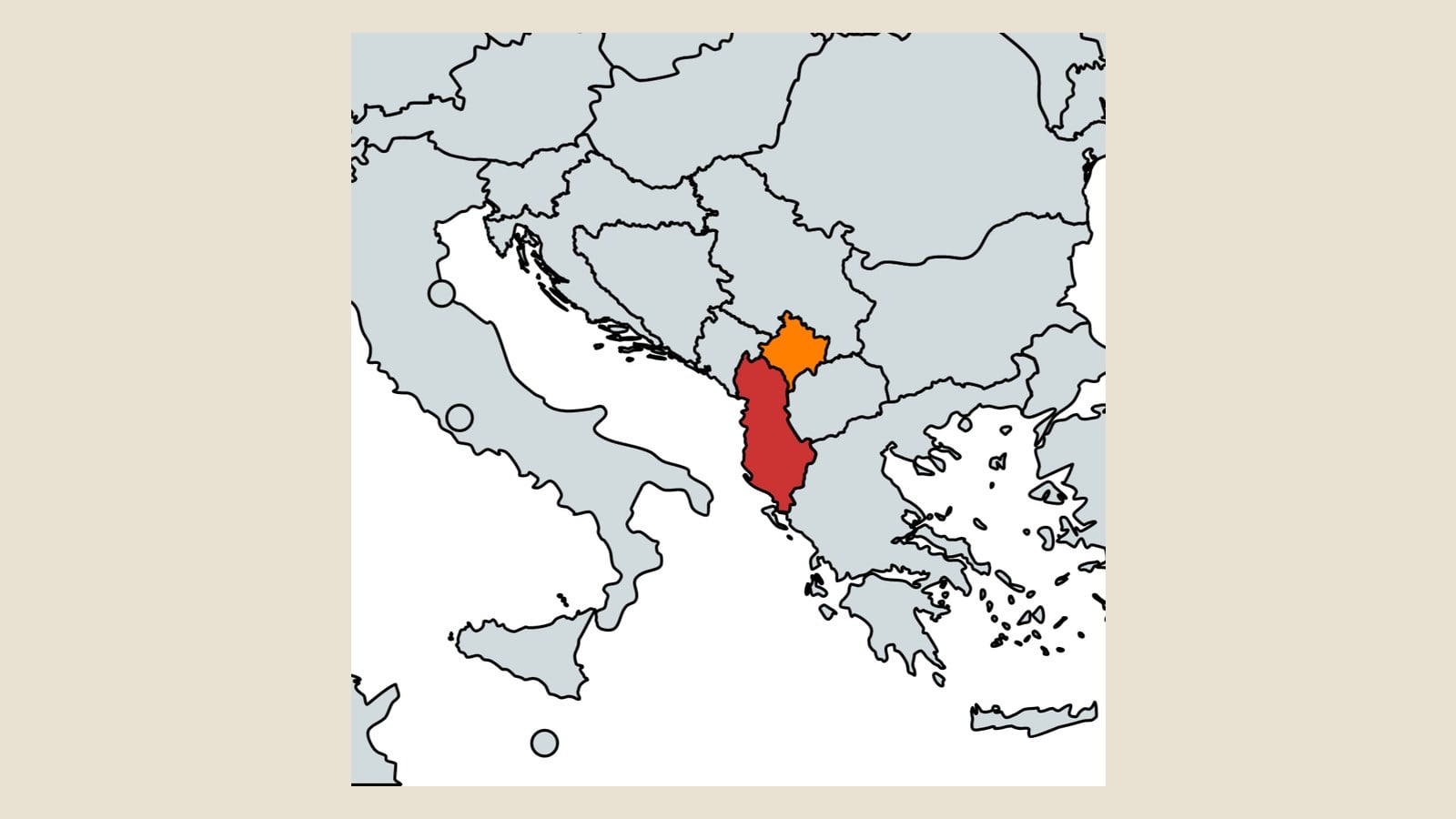
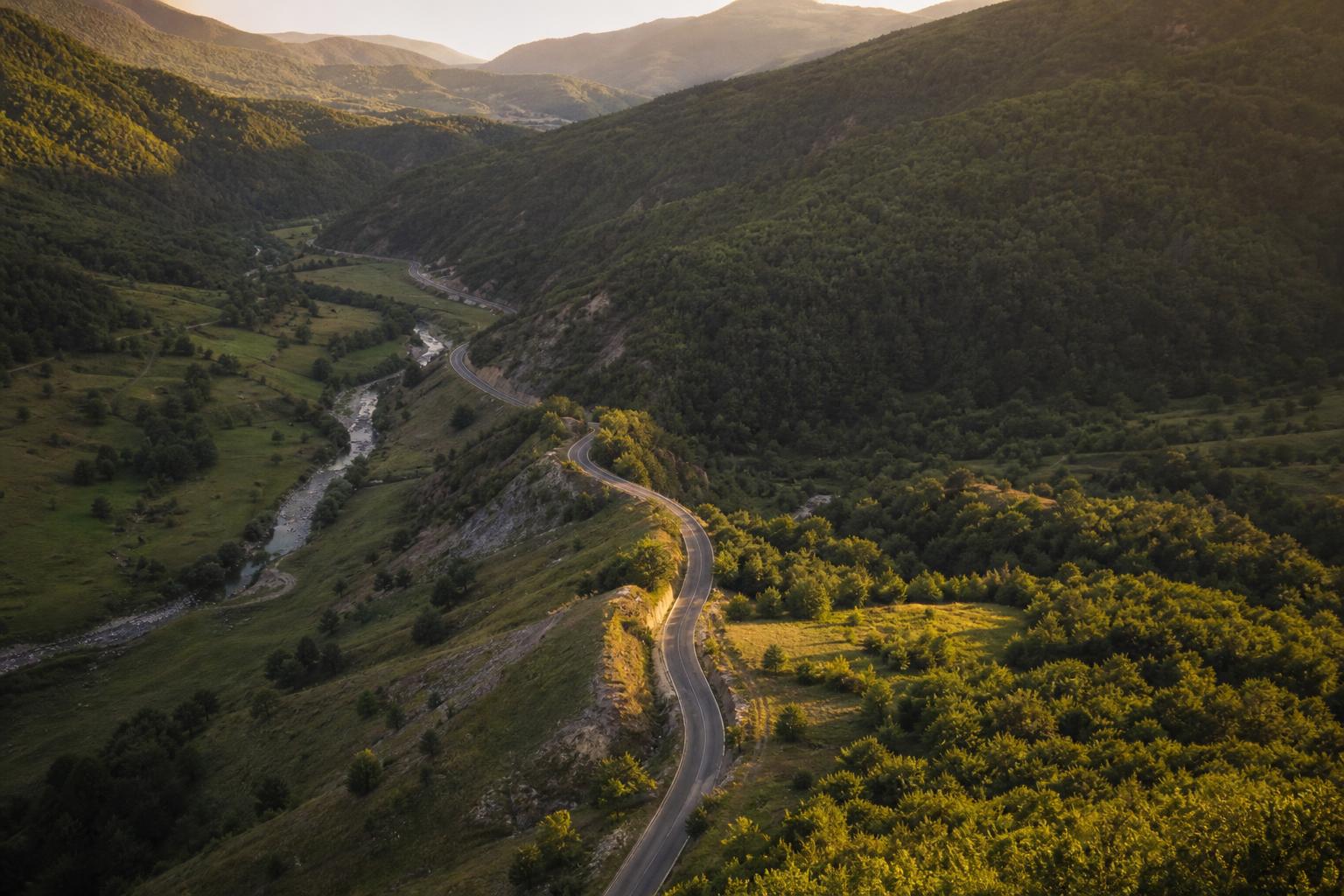 The roughly 114-kilometer Albania-Kosovo land border, open for ordinary travel since Kosovo’s 2008 independence — no visa, no passport stop for citizens of either country.
Graphic by NAR
The roughly 114-kilometer Albania-Kosovo land border, open for ordinary travel since Kosovo’s 2008 independence — no visa, no passport stop for citizens of either country.
Graphic by NAR
The basic facts
Albania is the Republic of Albania — Republika e Shqipërisë in Albanian. The country covers 28,748 km² (11,100 sq mi) and had a population of 2,402,113 at the 2023 census (Wikipedia: Albania). Its capital is Tirana. Albania declared independence from the Ottoman Empire on 28 November 1912 in the southern coastal city of Vlora.
Kosovo is the Republic of Kosovo — Republika e Kosovës in Albanian, Република Косово in Serbian (Kosovo recognizes both Albanian and Serbian as official languages). The country covers 10,887 km² (4,203 sq mi) and had a population of about 1.6 million in 2024 (Wikipedia: Kosovo). Its capital is Pristina. Kosovo declared independence from Serbia on 17 February 2008 following nearly a decade as a UN-administered protectorate.
To put the geography in scale: Albania is roughly the size of the US state of Maryland; Kosovo is roughly the size of Connecticut. Together they total just under 40,000 km² — smaller than Iceland — with a combined population around 4 million. The countries share a land border of about 114 kilometers that is open for ordinary travel. There are no visa requirements between them. Citizens of one country can live and work freely in the other.
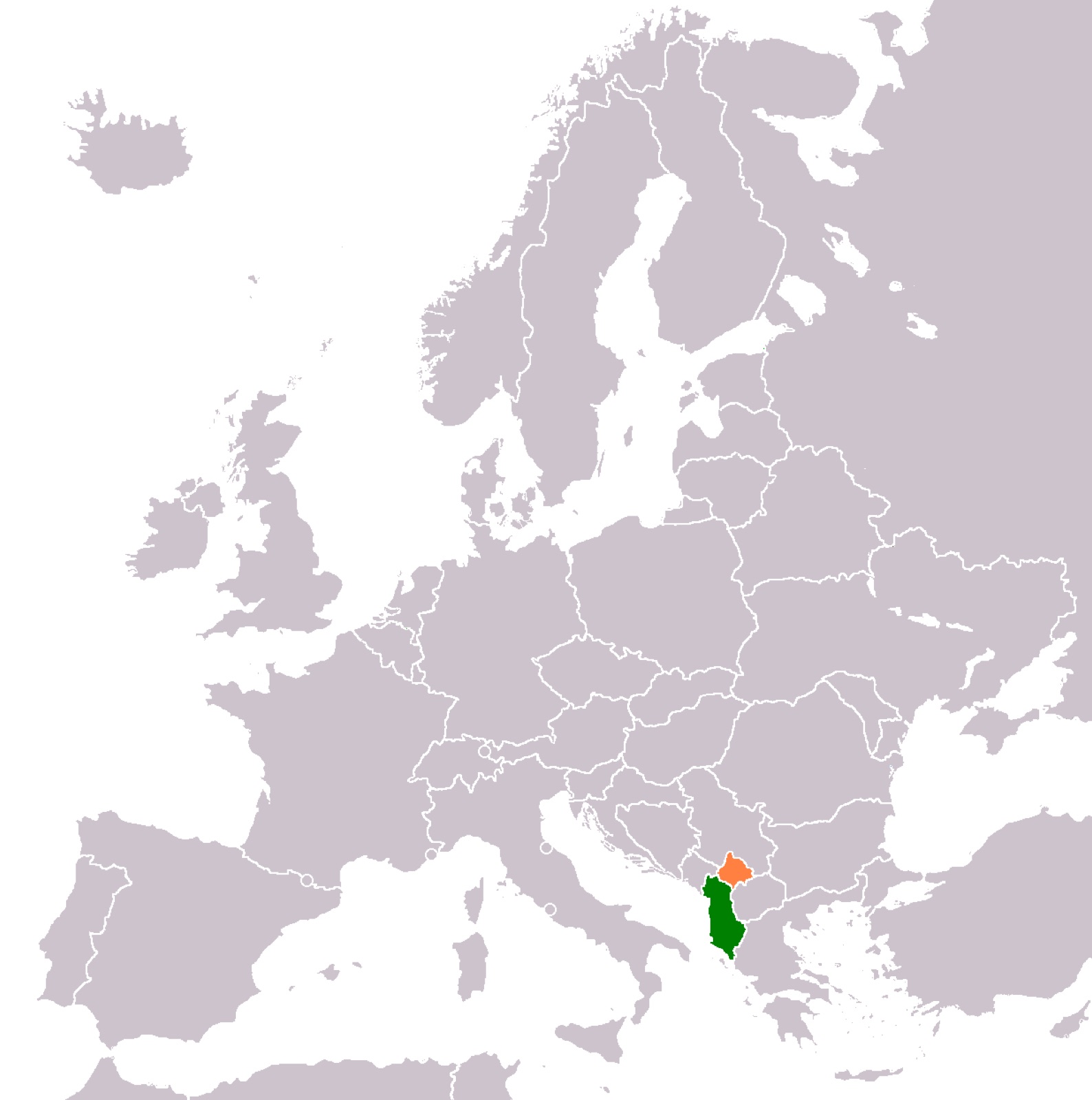 Albania (green) and Kosovo (orange) in southeastern Europe — two separate states, combined area roughly 40,000 km² and combined population around 4 million.
Map: Turkish Flame / Wikimedia Commons / public domain
Albania (green) and Kosovo (orange) in southeastern Europe — two separate states, combined area roughly 40,000 km² and combined population around 4 million.
Map: Turkish Flame / Wikimedia Commons / public domain
The euro circulates in some form in both countries (Kosovo unilaterally; Albania uses its own currency, the lek, but euros circulate widely in tourism and remittance corridors). Albanian is an official language in each. The same red-and-black double-headed eagle flies in cultural and ethnic contexts in both — but it is the state flag of only one of them.
The double-headed eagle is the symbol most often confused. We address it in the next section because the flags themselves are where most readers first sense that something distinct is going on.
The flags
Albania’s flag is one of the oldest national symbols in continuous use in Europe: a red field with a black double-headed eagle at the center. The eagle traces back to Byzantine imperial heraldry, was adopted by Gjergj Kastrioti Skanderbeg during his 15th-century resistance against the Ottoman Empire, and was carried through the Albanian national awakening of the 19th century. When Albania declared independence on 28 November 1912, the Skanderbeg banner became the state flag. It has changed only in small details since.
Kosovo’s flag is much younger. Adopted at the moment of Kosovo’s independence declaration on 17 February 2008, it is blue with a yellow silhouette of Kosovo’s territory and six white five-pointed stars arranged in an arc above the map. The six stars represent the country’s six officially recognized communities: Albanians, Serbs, Turks, Bosniaks, Roma, and Gorani.
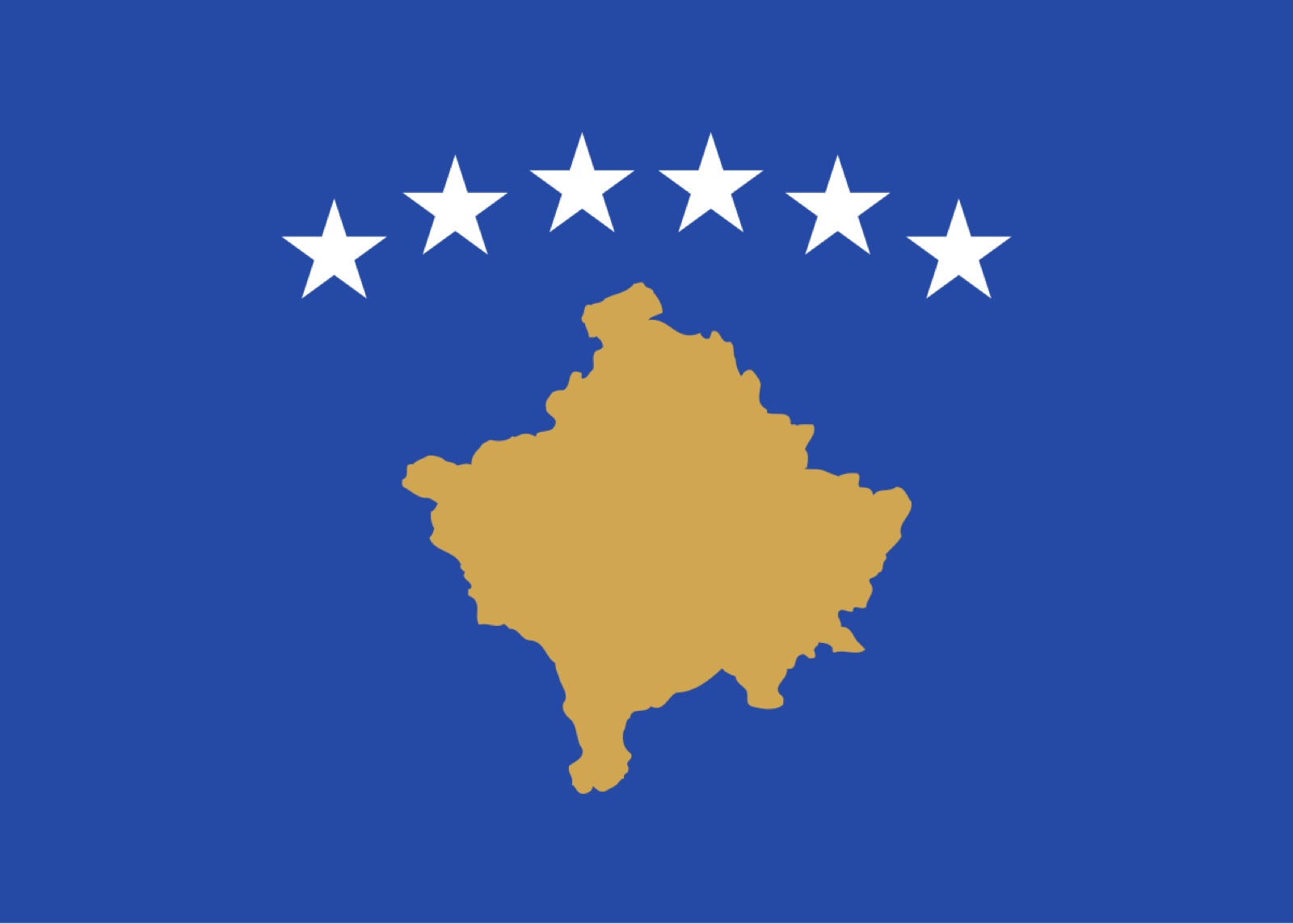 The flag of Kosovo, adopted 17 February 2008 — six white stars for the six recognized communities (Albanians, Serbs, Turks, Bosniaks, Roma, Gorani), deliberately chosen as a multi-ethnic civic symbol over the Skanderbeg banner.
Image: Cradel / Wikimedia Commons / public domain
The flag of Kosovo, adopted 17 February 2008 — six white stars for the six recognized communities (Albanians, Serbs, Turks, Bosniaks, Roma, Gorani), deliberately chosen as a multi-ethnic civic symbol over the Skanderbeg banner.
Image: Cradel / Wikimedia Commons / public domain
Why design a new flag instead of using the Skanderbeg banner that 92% of the population already identified with? The answer is deliberately civic. When Kosovo declared independence, its leadership chose multi-ethnic state symbolism to signal that the new state was not an ethnic Albanian project. The blue, yellow, and stars were closer in feel to the European Union flag than to any single ethnic banner. The choice was contested at the time inside Kosovo’s Albanian-majority population, some of whom would have preferred the Skanderbeg flag — but the civic rationale won, and the design has stuck.
In practice, the Albanian flag is everywhere in Kosovo — flown at football matches, at weddings, at concerts, on car windows during national holidays. It functions there as a symbol of ethnic and cultural identity. The Kosovo state flag flies at government buildings, on official documents, and at international events. Both are visible. They are not in competition; they answer different questions about who someone is.
Why two countries instead of one?
This is the question most diaspora readers eventually ask their parents and never get a complete answer to. The short version: when the borders were drawn, they were drawn in a way that divided the Albanian population.
The longer version runs through the late Ottoman period. By the 19th century, the western Balkans contained a large, contiguous Albanian-speaking population stretching across what is now Albania, Kosovo, North Macedonia, southern Montenegro, and small pieces of Greece and Serbia. The Ottoman Empire had ruled the region for roughly 500 years, and as Ottoman power declined, the question of who would inherit Ottoman territory became the central political problem of southeastern Europe.
The First Balkan War (1912) ended Ottoman rule over most of the southern Balkans. Albanian leaders, fearing partition by their Christian Balkan neighbors (Serbia, Montenegro, Greece, and Bulgaria), declared Albanian independence on 28 November 1912 in Vlora. The new state needed international recognition, and the Great Powers — Britain, France, Russia, Germany, Austria-Hungary, and Italy — convened to draw its borders.
The result was the Treaty of London (1913) and the subsequent Treaty of Bucharest (1913), which together set the borders that, with minor adjustments, still exist today. Those borders left roughly a third of the ethnic Albanian population outside the new state. Kosovo, with its Albanian-majority population, was assigned to Serbia. Çamëria in the south was assigned to Greece. Parts of present-day North Macedonia and Montenegro were assigned to those countries’ predecessors.
That 1913 settlement is the structural origin of the two-country reality. Kosovo did not become Albanian-by-state in 1913 because Kosovo did not become part of Albania.
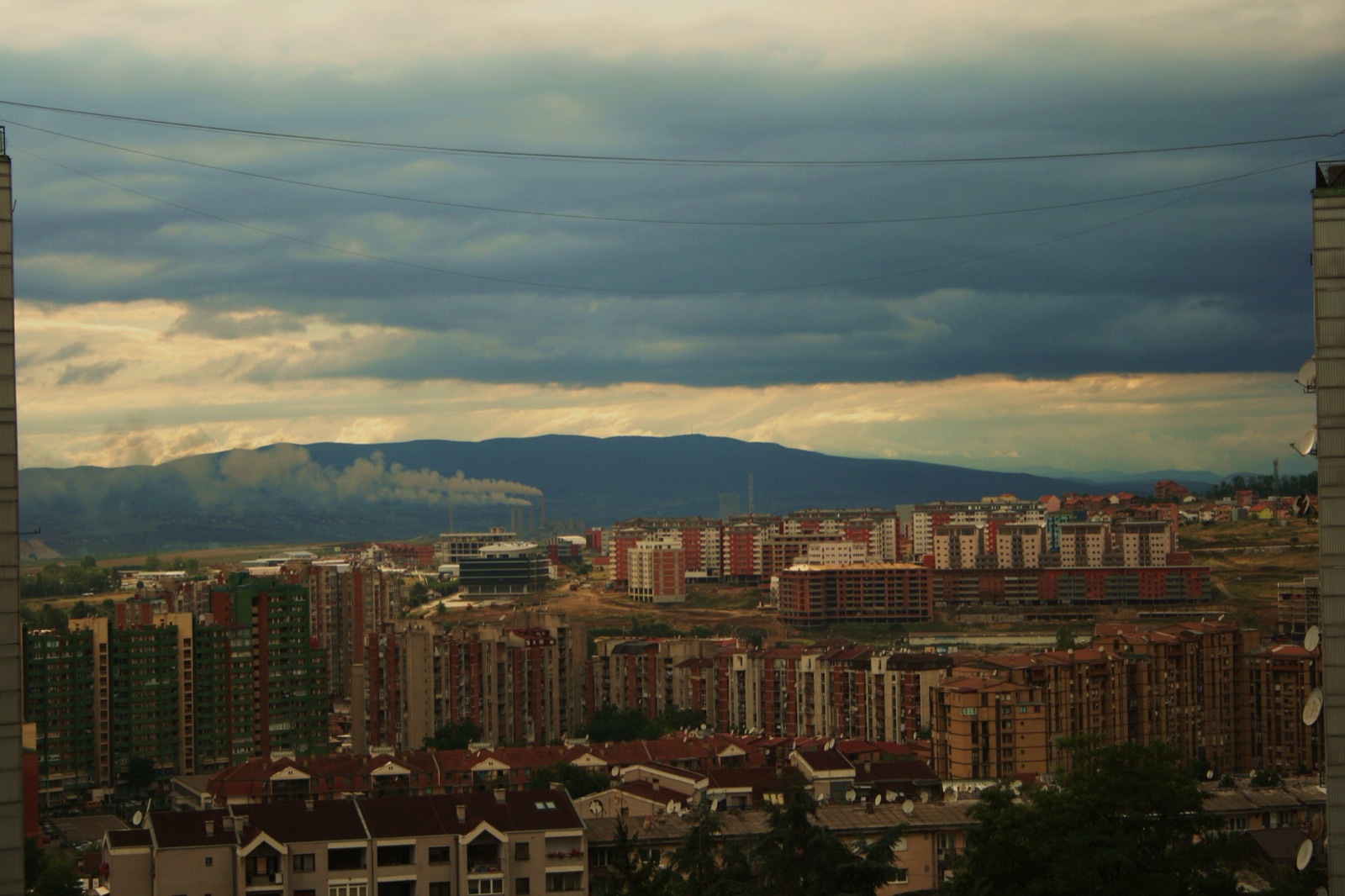 Pristina, capital of the Republic of Kosovo (population 1.6 million in 2024), viewed from the Cathedral of Saint Mother Teresa.
Photo: Flutur Gërbeshi / Wikimedia Commons / CC BY 3.0
Pristina, capital of the Republic of Kosovo (population 1.6 million in 2024), viewed from the Cathedral of Saint Mother Teresa.
Photo: Flutur Gërbeshi / Wikimedia Commons / CC BY 3.0
What followed was a century inside other states. After World War I, Kosovo was incorporated into the Kingdom of Serbs, Croats, and Slovenes — renamed Yugoslavia in 1929. Yugoslav-era policies favored Serb settlement in Kosovo and curtailed Albanian-language education. After World War II, Kosovo became an autonomous province within socialist Yugoslavia’s Republic of Serbia. The 1974 Yugoslav Constitution gave Kosovo substantial self-government, including its own university (Pristina, founded 1969), Albanian-language schools, and representation in federal institutions.
That autonomy was revoked in 1989 by Slobodan Milošević. The 1990s brought systematic discrimination, dismissal of ethnic Albanians from state employment, and the emergence of the Kosovo Liberation Army (KLA). The Kosovo War (February 1998 – June 1999) ended with NATO airstrikes, the withdrawal of Yugoslav forces under the Kumanovo Agreement, and the establishment of Kosovo as a UN protectorate under Security Council Resolution 1244. After nine years of UN-administered transition and negotiations that did not produce an agreed settlement with Serbia, Kosovo declared independence on 17 February 2008 (Wikipedia: Kosovo).
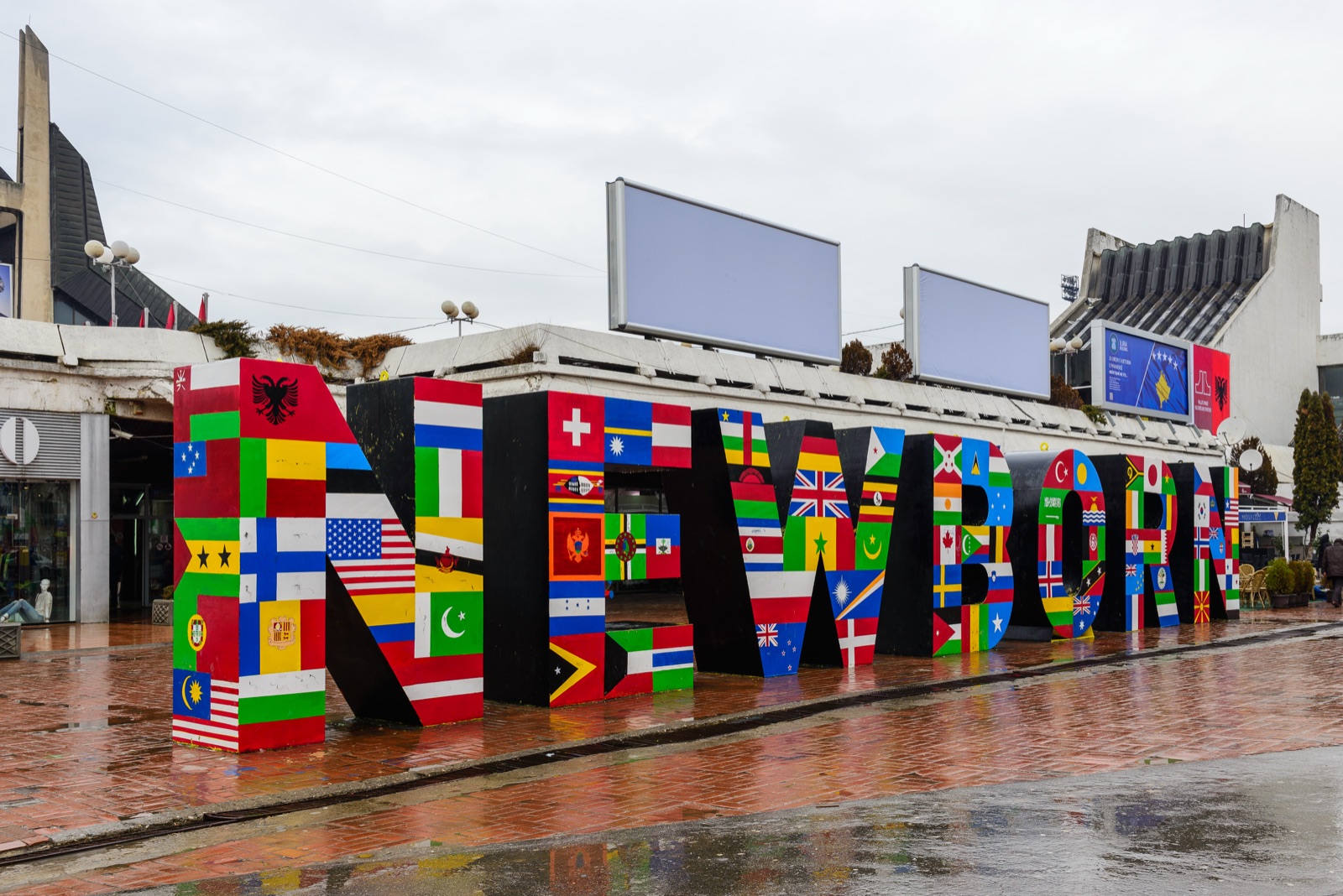 The Newborn monument in Pristina, unveiled on 17 February 2008 — the day Kosovo declared independence; the sculpture is repainted each year to mark the anniversary.
Photo: Arild Vågen / Wikimedia Commons / CC BY-SA 3.0
The Newborn monument in Pristina, unveiled on 17 February 2008 — the day Kosovo declared independence; the sculpture is repainted each year to mark the anniversary.
Photo: Arild Vågen / Wikimedia Commons / CC BY-SA 3.0
Two countries instead of one, then, because of one specific decision in 1913 and the cascade of 20th-century events that followed it.
Population and ethnic makeup
The two populations are similar but not identical.
Albania (2023 census, Wikipedia) is approximately:
- 91% ethnic Albanian
- ~1% Greek minority — concentrated in the south, especially around Gjirokastër and Sarandë
- ~3% other — including small Aromanian (Vlach), Roma, Egyptian, and Macedonian communities
Kosovo (2024 figures, Wikipedia) is approximately:
- ~92% ethnic Albanian
- ~2% Serb — concentrated in northern Kosovo (around North Mitrovica) and in scattered enclaves further south, including the towns of Gračanica and Štrpce
- ~6% other — including Bosniaks, Turks, Roma, Ashkali, Egyptians, and Gorani
The numerical similarity hides a structural difference. Albania’s minorities are dispersed and small; the country has been demographically Albanian for as long as records have existed, and its small minorities live in well-defined regional pockets. Kosovo’s minorities — particularly its Serb population — are politically central in a way Albania’s are not. The Serb community in northern Kosovo has its own institutions, its own political parties, and is a constant subject of EU-mediated dialogue between Pristina and Belgrade.
Religiously, the two countries diverge more visibly.
Albania is one of the most religiously plural states in Europe. The 2023 census reported approximately 51% Muslim (about 46% Sunni and 5% Bektashi Sufi), 8% Catholic, 7% Orthodox, about 4% atheist, and nearly 30% who did not state a religion (undeclared, declined, or not enumerated) (Wikipedia: Albania). The country recognizes Sunni Islam, Bektashism, Catholicism, and Albanian Orthodoxy as its four traditional faiths, and the Bektashi World Center is in Tirana. Mixed-faith villages are common; mixed-faith marriages are unremarkable. The unifying value, in the words of the Albanian Renaissance writer Pashko Vasa, is that “the religion of the Albanians is Albanianism.”
Kosovo is more uniformly Muslim. About 94% of the population is Muslim (Wikipedia: Kosovo), with small Catholic and Orthodox minorities. The Catholic community is concentrated among Albanians around Klina, Prizren, and Janjevo; the Orthodox community is concentrated among Kosovo Serbs and is served by the Serbian Orthodox Church (with significant medieval monasteries at Visoki Dečani, Peć, and Gračanica, all UNESCO World Heritage Sites).
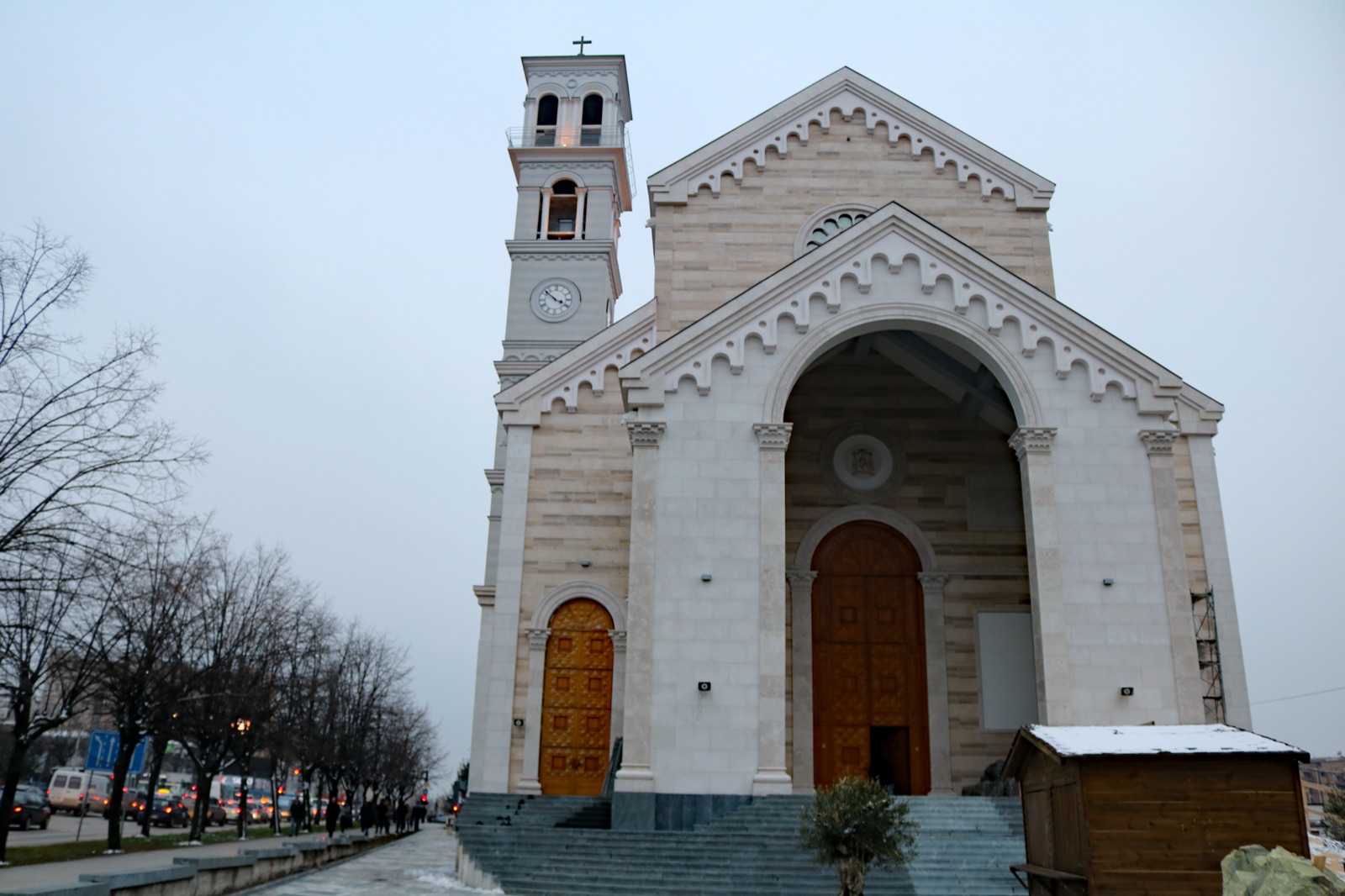 Cathedral of Saint Mother Teresa, central Pristina — completed in 2017 as the seat of Kosovo’s Catholic minority in a country that is roughly 94% Muslim.
Photo: Jeffrey Beall / Wikimedia Commons / CC BY 4.0
Cathedral of Saint Mother Teresa, central Pristina — completed in 2017 as the seat of Kosovo’s Catholic minority in a country that is roughly 94% Muslim.
Photo: Jeffrey Beall / Wikimedia Commons / CC BY 4.0
Neither country defines itself religiously. Both are formally secular. The diaspora that NAR counts includes Catholic, Orthodox, Sunni, Bektashi, and secular Albanians from both states.
Language: same Albanian, different dialects
Both countries speak Albanian (shqip), an Indo-European language and the sole surviving member of its own Albanoid branch. But Albanian has two main dialect groups, and the two countries sit on opposite sides of the dialect line.
The historic divide runs along the Shkumbin River in central Albania. South of the Shkumbin is Tosk — spoken in southern Albania, southern North Macedonia, parts of Greece, and by the Italian-Albanian Arbëresh communities. North of the Shkumbin is Gheg — spoken in northern Albania, all of Kosovo, parts of Montenegro, and northwestern North Macedonia.
The two dialects are mutually intelligible. A Gheg speaker from Pristina and a Tosk speaker from Vlora understand each other without difficulty, in roughly the same way a New Yorker and someone from Glasgow understand each other in English. Pronunciation differs (Gheg has nasal vowels and tends to drop final unstressed vowels; Tosk does not), some vocabulary is regional, and a few grammatical patterns differ — but the language is one language.
The standard literary form used in Albania today was set at the Albanian Orthography Conference in Tirana in 1972. The standard is Tosk-based, with some compromises drawn from Gheg. It is the form taught in Albanian schools, used in Albanian state media, and used in formal Kosovar institutions. Most published Albanian-language books in both countries use the 1972 standard.
The 1972 standard was not uncontroversial in Kosovo. It was adopted in Albania during the Hoxha communist period — when Kosovo was still inside Yugoslavia, and when Kosovar institutions had been developing their own Gheg-leaning literary practices. After 1972, Kosovar institutions formally adopted the Tirana standard, but everyday Kosovar speech, broadcast media, and informal writing remain Gheg. Some Kosovar writers and linguists in recent decades have argued for more space for Gheg in formal writing — a long, low-grade argument inside the Albanian-speaking world, never heated enough to fracture the language.
For the diaspora: an Albanian American whose family came from Korçë in southern Albania probably grew up hearing Tosk at home. An Albanian American whose family came from Prizren or Gjakova probably grew up hearing Gheg. Both are speaking Albanian. Both are Albanian. The dialect tells you where the family is from.
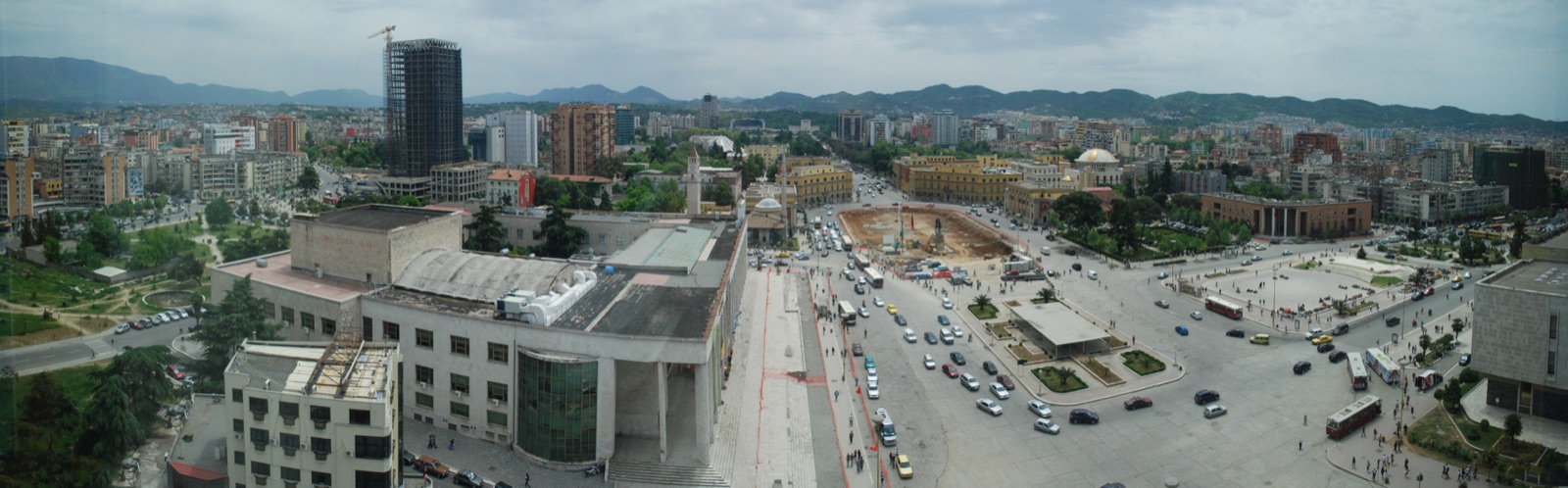 Tirana, capital of the Republic of Albania (population 2.40 million in the 2023 census), seen from the city’s elevated southeast.
Photo: Thomas Quine / Wikimedia Commons / CC BY 2.0
Tirana, capital of the Republic of Albania (population 2.40 million in the 2023 census), seen from the city’s elevated southeast.
Photo: Thomas Quine / Wikimedia Commons / CC BY 2.0
International recognition
The two countries’ international standing is the place where they most clearly diverge.
Albania is a full member of the United Nations (since 1955), recognized by every UN member state. It has been a NATO member since 2009. It became an EU candidate in 2014 and opened formal accession negotiations in 2022. It is a member of the Council of Europe, the OSCE, and most major multilateral institutions.
Kosovo is partially recognized internationally. It declared independence on 17 February 2008 and has since been recognized by roughly 100 to 115 of the 193 UN member states, depending on how contested withdrawals are counted (Wikipedia: Kosovo) — including the United States, the United Kingdom, Germany, France, Italy, Japan, Australia, Canada, and most of the European Union. It is not recognized by Serbia, Russia, China, India, Spain, Greece, Cyprus, Romania, or Slovakia.
On 22 July 2010, the International Court of Justice issued an advisory opinion that Kosovo’s declaration of independence did not violate international law. The opinion did not adjudicate the deeper question of whether Kosovo is a state under international law — only whether the act of declaring independence was lawful — but it removed one major legal argument against recognition.
UN membership is procedurally blocked. Admission to the UN requires a recommendation from the Security Council, where Russia and China — neither of which recognizes Kosovo — hold permanent seats with veto power. As long as that situation persists, Kosovo cannot become a UN member regardless of how many General Assembly votes it can muster. Kosovo is, however, a member of the International Monetary Fund, the World Bank, FIFA and UEFA, and the International Olympic Committee. It applied for EU candidate status in December 2022.
The phrase NAR uses for Kosovo’s status is “partially recognized internationally.” It is the most accurate short description and the one used by most academic and journalistic sources that are trying to be neutral.
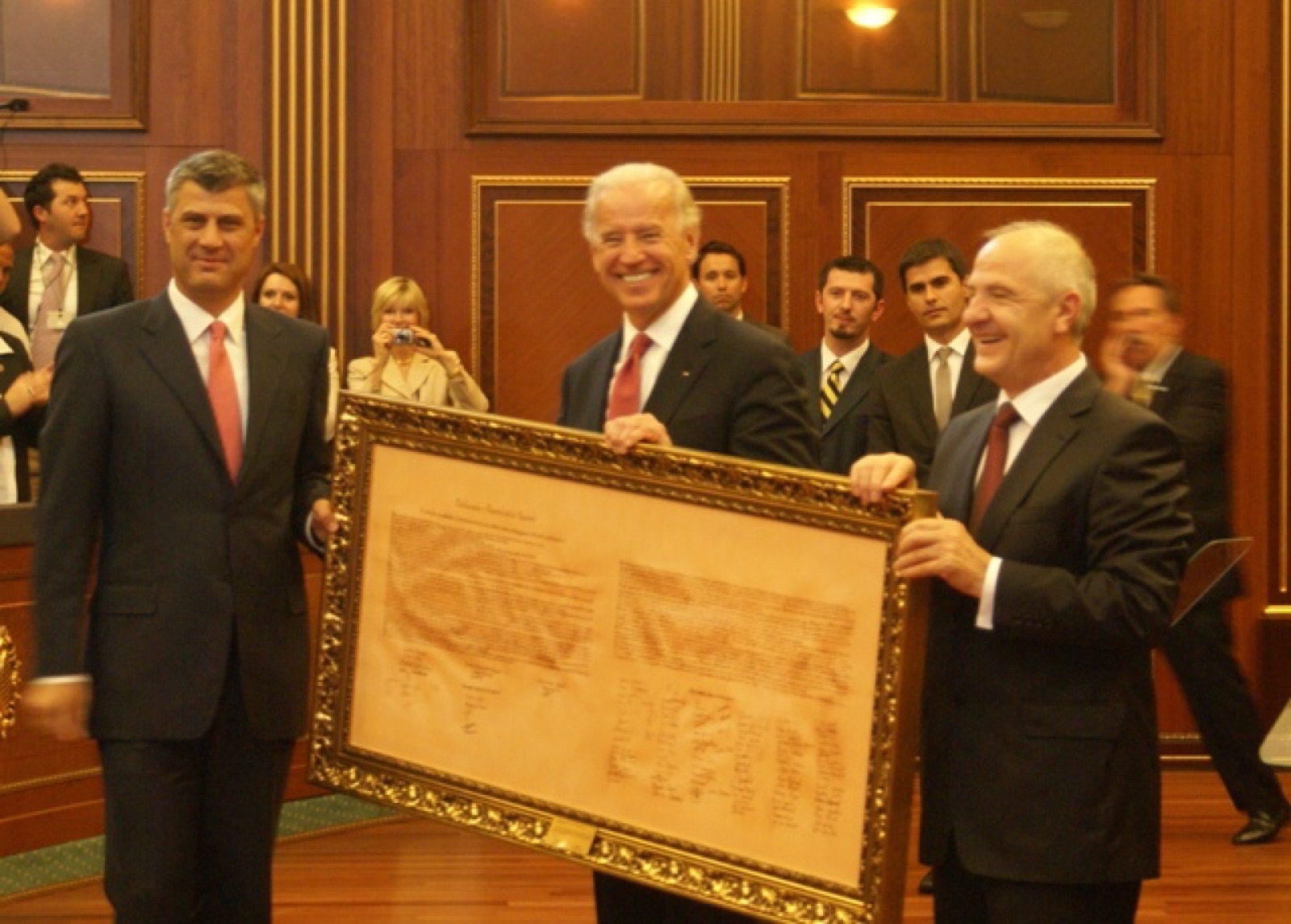 Kosovar PM Hashim Thaçi and President Fatmir Sejdiu with US Senator Joe Biden holding the 17 February 2008 declaration of independence; the United States recognized Kosovo the following day.
Photo: Office of the Prime Minister of Kosovo / Wikimedia Commons / public domain
Kosovar PM Hashim Thaçi and President Fatmir Sejdiu with US Senator Joe Biden holding the 17 February 2008 declaration of independence; the United States recognized Kosovo the following day.
Photo: Office of the Prime Minister of Kosovo / Wikimedia Commons / public domain
Politics and foreign policy
Kosovo and Albania have one of the closest bilateral relationships in Europe. Free travel between the two countries was established at Kosovo’s independence and has expanded since. Joint cabinet meetings between the Albanian and Kosovar governments have been held since 2014, with both prime ministers and most cabinet ministers attending and signing common positions on EU integration, infrastructure, and customs. Mutual diplomatic gestures — joint embassies in some third countries, common positions in international votes, shared cultural promotion abroad — are routine.
The two states also coordinate on the Belgrade–Pristina dialogue, the EU-mediated negotiation between Kosovo and Serbia that has been ongoing since 2011. The dialogue covers practical issues — license plates, customs, telecommunications, the status of Serb-majority municipalities in Kosovo — and is the main channel through which Kosovo–Serbia relations are managed. The Brussels Agreement (2013) was its most prominent product; implementation has been slow and incomplete on both sides. Albania has consistently supported Kosovo’s positions in the dialogue without formally participating.
A note on “Greater Albania.” The term refers to a hypothetical state that would unite all ethnic Albanians — including Kosovo, parts of North Macedonia, parts of Montenegro, and the Preševo Valley of southern Serbia — under a single political authority. It is sometimes raised as a fear in Serbian and Macedonian political discourse and as an aspiration by a small number of Albanian nationalists. It is not the policy of either Kosovo’s or Albania’s government. Both governments officially treat their states as separate sovereign entities and pursue separate paths to EU membership. Polling occasionally shows public sympathy for the idea, especially in Kosovo, but no major political party in either country campaigns for unification as a near-term policy. The dominant political project on both sides is EU integration, not merger with each other.
The pragmatic reality is open borders, deep economic ties, common diplomatic positions, and two separate states. Whether that arrangement evolves further is a matter for the next generation of voters in both countries.
The diaspora question
For Albanian-American readers, the difference between Albania and Kosovo is partly a story about which family came over when.
The historic Albanian-American community — the one that built the original Albanian-American institutions in Boston, New York, Connecticut, and the Detroit metropolitan area — is mostly from southern Albania, especially the Korçë region, and traces to immigration waves between roughly 1900 and 1940. These families are predominantly Tosk-speaking, and a large share are Albanian Orthodox (the Albanian Orthodox Archdiocese in America was founded by Fan S. Noli in 1908). Vatra, the oldest Albanian-American organization, was founded in 1912 in Boston by this generation.
The Kosovar-American community is mostly more recent. Some Kosovars arrived through Yugoslav-era migration channels in the 1960s through 1980s — workers, students, and chain migration through Yugoslav passport access. The largest single wave came in 1999, when Kosovar refugees who had fled the Kosovo War to camps in Macedonia and Albania were resettled in the US as part of that decade’s broader wave of Balkan war refugees — many processed through Fort Dix in New Jersey (via McGuire Air Force Base) (Wikipedia: Albanian Americans). Many of those families remained in the US after the war and built the Kosovar-American communities now visible in the Bronx, Yonkers, Westchester County, Staten Island, and the New Jersey suburbs, alongside additions to existing Albanian-American communities elsewhere.
The two communities are intermingled in everyday American life. They worship at the same parishes and mosques, send their kids to the same Albanian-language Saturday schools, and marry across the Albania–Kosovo line frequently. Albanian-American organizations almost always serve both communities; the major political organizations — the Albanian American Civic League, AANO, the National Albanian American Council — explicitly include Albanians from every country of origin.
There are differences, though, that show up in the diaspora. Tosk versus Gheg dialect inflects which side of the family someone trims for. The religious mix differs: the Albanian-American Orthodox community is mostly Albania-origin, while many Kosovar-American families are Sunni Muslim. The political memory differs: 1999 is a recent, lived experience for Kosovar-American families in a way it is not for fourth-generation Albanian-American families. And the connection to the homeland differs: Kosovar-Americans tend to maintain stronger and more active ties to their towns of origin, partly because the migration is more recent.
NAR counts both. Our registry includes Albanian Americans from Albania, Kosovo, North Macedonia, Montenegro, the Preševo Valley, the historic Arbëresh and Arvanite communities, and the global diaspora — and we treat them as one community across borders.
A note from NAR
We are a 501(c)(3) registry. Our job is to count Albanian Americans accurately and to build the infrastructure that connects the diaspora across generations. Our job is not to take positions on Kosovo’s status, on Albania–Kosovo unification, or on any contested international question. On those, we report what the parties say.
What we will say is this: the Albanian-speaking world is bigger than either country contains. It runs through Albania, Kosovo, North Macedonia, Montenegro, the Preševo Valley, Italy’s old Arbëresh villages, Greek Arvanitika, and the global diaspora that has been moving for more than 600 years. Two countries, one language, one extended community.
If you’re Albanian — by any of those routes — we would be honored to count you.
Sources
- Wikipedia — Kosovo
- Wikipedia — Albania
- International Court of Justice — Advisory Opinion on the Accordance with International Law of the Unilateral Declaration of Independence in Respect of Kosovo (22 July 2010)
- UN Security Council Resolution 1244 (1999)
- Government of the Republic of Kosovo — independence declaration and constitutional documents (17 February 2008)
- Government of the Republic of Albania — 2023 census data, as summarized in the Wikipedia entry above