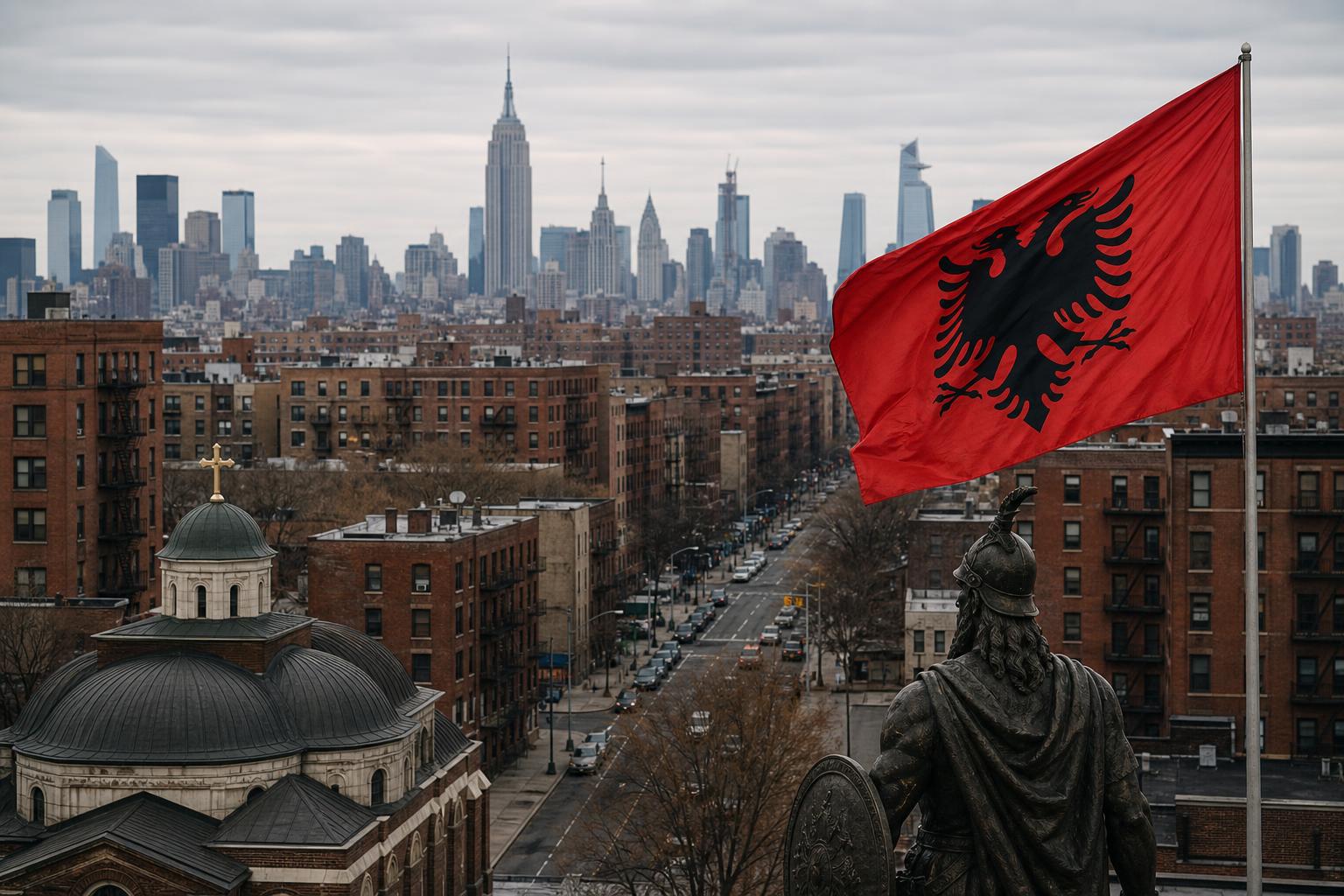
New York is the single largest Albanian-American population center in the United States. The 2024 American Community Survey counts roughly 52,000 to 56,000 Albanians in New York State (Wikipedia: Albanian Americans). Community organizations, parish rolls, and the visible footprint of Albanian-owned businesses put the metro number well above 100,000 once ethnic Albanians from Kosovo, North Macedonia, and Montenegro are counted alongside Albania-born and US-born descendants.
Most of that population lives in one borough. The Bronx — specifically the corridor from Belmont and Fordham east and north to Pelham Parkway, Bedford Park, and Morris Park — is what Albanian New Yorkers and their neighbors sometimes call Little Albania. It is not a single block. It is a stretch of about three square miles where Albanian is heard on the sidewalk, where the Catholic parish, the Sunni mosque, the bakery, the soccer club, and the funeral home are all within walking distance, and where the shqiptar (the Albanian self-name) presence has shaped the neighborhood for two generations.
This piece maps that geography — Bronx core, Staten Island secondary, Brooklyn and Queens pockets, Westchester extension — and explains how it formed. It is written for three readers: the New York Albanian who already lives there, the New York neighbor who passes the eagle decals on the storefronts and wonders, and the out-of-state Albanian American researching where the community actually concentrates.
The Bronx core: Belmont and Arthur Avenue
“Little Albania” is informal. There is no street sign, no business-improvement-district plaque, and no city-issued boundary. The name moves around in community usage, sometimes pinned to Belmont, sometimes to Pelham Parkway, sometimes to the whole Bronx corridor. What the term tracks, accurately, is the highest concentration of Albanian-American daily life in the United States.
The reason it sits in the Bronx and not elsewhere in the city is mostly housing and jobs. When Albanians arrived in larger numbers from the 1960s onward — first from Kosovo, North Macedonia, and Montenegro under Yugoslav-state pressure, then from post-communist Albania in the 1990s, then from Kosovo as refugees after the 1999 war — the affordable, family-sized rental stock was in the Bronx. Italian-American Belmont was already a working-class immigrant neighborhood with a building trades and small-business economy that hired newcomers. Pelham Parkway and Morris Park, just east, had the larger apartments and quieter blocks that growing families needed.
The Albanian footprint expanded outward from there over the next four decades. Today the corridor reads as a continuous Albanian residential and commercial belt, even where the city’s official neighborhood lines cut it into Belmont, Fordham, Bedford Park, Pelham Parkway, and Morris Park.
Belmont itself sits between Fordham Road to the north, East 181st Street to the south, the Bronx Zoo to the east, and Third Avenue to the west. Most outsiders know it as Arthur Avenue, the Italian-American commercial spine that has anchored the neighborhood since the 1890s. The Albanian community moved in alongside the Italian one, particularly from the 1970s, and the two have shared the strip for two generations.
What that looks like in practice: the Italian salumeria on one corner, the Albanian-owned grocery on the next; the 1918 Italian bakery still doing wedding cakes for both communities; Albanian families working in Italian-owned restaurants for a decade and then opening their own rooms a block over. The food map of Belmont — covered in detail in Albanian Restaurants in NYC — is the most visible artifact of that overlap, but the layered ownership runs through real estate, contracting, and small professional firms as well.
The cultural anchors in Belmont are tight to the four-block strip:
- Our Lady of Shkodra (West Hartsdale Avenue, Hartsdale). The first Albanian Catholic parish established in the United States, with community roots in the Bronx dating to 1969. Its main campus sits in Hartsdale in Westchester, but its congregation pulls heavily from the Bronx Albanian Catholic community and the parish is widely treated as the spiritual seat of Albanian Catholicism in the New York metro.
- Albanian-owned bakeries and cafes cluster around 187th Street and Crescent Avenue. The kafe (cafe) is the social unit Albanian men over 50 build their afternoons around, and the Belmont rooms function the way a kafeneja in Tirana or Prishtina would — strong coffee, no rush, a table that takes shifts through the day.
- The Enrico Fermi Cultural Center, a New York Public Library branch on East 186th Street, serves the broader Italian-Albanian neighborhood and runs programming for both communities.
The Belmont Albanian footprint is denser in commerce than in housing. Many of the shop owners and restaurant operators commute in from Pelham Parkway, Morris Park, or Yonkers; the families with school-age children largely live further east and north.
Pelham Parkway, Morris Park, and the western edge
If Belmont is the Albanian commercial heart of the Bronx, Pelham Parkway is the residential one. The neighborhood — bordered roughly by Bronx Park East to the west, Williamsbridge Road to the east, Morris Park Avenue to the south, and Pelham Parkway North to the north — has the largest concentration of Albanian-American households in New York City, by community estimate.
The housing stock is a mix of pre-war six-story apartment buildings along the parkway itself, two-family rowhouses on the side streets, and a smaller stock of single-family homes toward Morris Park. The buildings are big enough for the multi-generational Albanian household — gjyshi and gjyshja (grandfather and grandmother) on one floor, the parents and children on the next, a married son and daughter-in-law on the third — that remains common in first- and 1.5-generation families.
Walk Williamsbridge Road or Lydig Avenue on a weekday afternoon and the Albanian presence is audible. Mirëdita on the sidewalk, Albanian-language signage in the storefronts, the soccer match from Tirana or Prishtina playing on a TV inside a kafe. Dukagjini Burek on Lydig — a byrek (Albanian filo pastry) counter run by a family from the Dukagjin highlands of Kosovo and northeastern Albania — is one of several Albanian-owned food businesses anchoring the Pelham Parkway corridor; the rest of that map sits in the NYC restaurant guide rather than here.
Morris Park, just south of Pelham Parkway, is the eastern end of the same belt. The neighborhood has its own Albanian residential cluster, plus PS 105, the elementary school that became one of the first NYC public schools to offer Albanian language instruction in the late 2010s. That program is small in absolute terms but symbolically large: it is the first time the New York public school system formally recognized Albanian as a heritage language worth teaching to its students.
West of Belmont the footprint thins but does not disappear. Fordham — the corridor around Fordham Road, the Grand Concourse, and Fordham University — has Albanian-owned bodegas, pizza shops, and small construction firms scattered through a neighborhood that is now majority Latino and West African. Many of the building supers and managing agents along the Concourse are Albanian; that is a real piece of the New York Albanian economic map even if it isn’t visible from the street. Bedford Park, north of Fordham toward the Botanical Garden and the Mosholu Parkway, follows a similar pattern, with Albanian-owned auto-body shops, restaurants, and three-story walk-ups, and the heaviest residential concentration shading east toward the Pelham Parkway core. The Mosholu-Webster border is sometimes cited by community organizers as the western edge of Little Albania.
The pattern across this western corridor is the same one Italian-American Belmont went through a generation earlier: an immigrant community that buys the buildings it rented, opens businesses on the ground floor, and slowly turns the housing stock over to the next group while keeping its commercial and institutional roots in place.
Religious institutions: Catholic, Sunni, Orthodox, Bektashi
Albanian New York is religiously plural, and the institutional map reflects that. The 19th-century slogan from Pashko Vasa — “the religion of the Albanian is Albanianism” — was political rhetoric, not a description of how families actually practice. Plenty of New York Albanian families are devout Catholic, devout Sunni, devout Orthodox, or devout Bektashi. What the slogan still captures is that, at the community level, denomination rarely decides who counts as family.
Albanian Catholic. Kishe (church) life in the New York Albanian community centers on Our Lady of Shkodra, with roots in the Bronx dating to 1969 and recognized as the first Albanian Catholic parish established in the United States. The parish runs Albanian-language Mass, a Saturday school, weddings and funerals for a population that draws from the entire metro, and a feast-day calendar tied to northern Albanian Catholic tradition. Smaller Albanian Catholic communities meet at parishes in Yonkers and other Westchester towns.
Albanian Sunni Muslim. The Albanian Islamic Center of New York, located in the Bronx, is the long-established Sunni Albanian xhami (mosque) serving the Belmont and Pelham Parkway corridor. The Albanian American Islamic Center (with Queens and Staten Island operations) serves the East Shore Staten Island and Queens-side populations. Both are described in more detail in Albanian American Islamic Center. Friday xhumaja prayer is delivered in Albanian with English translation at most New York centers; second- and third-generation congregations are increasingly bilingual or English-first. Several smaller Sunni prayer rooms operate independently of any umbrella body.
Albanian Orthodox. The Orthodox community in New York is smaller than Boston’s and is served regionally by the Albanian Orthodox Archdiocese in America, headquartered at St. George Cathedral in South Boston. New York Orthodox Albanians often attend pan-Orthodox parishes when they want a closer commute, and gather as Albanians at archdiocese-wide events.
Bektashi. A Bektashi Sufi teqe (lodge) presence exists in the New York metro, smaller than the Detroit-area network anchored by the First Albanian Bektashi Tekke in Taylor, Michigan. The Bektashi tradition is its own clerical hierarchy — baba, dervish, kryegjysh — and operates separately from Sunni mosques.
A Bronx wedding will routinely pull Catholic, Sunni, Orthodox, and Bektashi family members to the same hall without anyone needing to explain it. That pattern is the everyday version of the slogan, and it holds.
Language: Albanian on the sidewalk and in the school
The American Community Survey estimates roughly 200,000 Albanian speakers in the United States, concentrated heavily in the New York and Detroit metros. A meaningful share of that figure speaks Albanian at home in the Bronx.
The variety spoken in New York is overwhelmingly Gheg — the northern Albanian dialect that includes Kosovo, North Macedonia, Montenegro, and northern Albania proper — because the post-1960s immigration waves to New York drew almost entirely from those regions. Standard literary Albanian, finalized in 1972 and based mostly on Tosk (the southern dialect), is the form taught in schools and used in writing. Most Bronx Albanian families code-switch between Gheg at home and standard Albanian or English in school and work.
Several institutions sustain the language in New York:
- PS 105 (Morris Park) added Albanian-language instruction in the late 2010s, the first NYC public school program of its kind.
- Fol Shqip School in Ridgewood, Queens, teaches roughly 60 children weekly through weekend classes — reading, writing, history, music.
- Saturday schools at Our Lady of Shkodra, the Albanian Islamic Center of New York, and several Albanian-American civic centers run their own Albanian-language curricula for community children.
- Mercy College (with a Bronx campus) has at points offered Albanian-language coursework, and Albanian-American student groups operate at Fordham, NYU, and CUNY campuses.
Language retention is the single most discussed worry inside the New York diaspora. The third generation is where the line bends — children of US-born Albanian-American parents who themselves grew up bilingual but raised their kids in mostly English. The Saturday schools, the public-school program, and the Fol Shqip model exist to keep that line from breaking.
The economic footprint: real estate, restaurants, construction
A short, accurate version of the New York Albanian economic map has three columns.
Real estate. A meaningful share of Bronx multi-family residential property — particularly in Pelham Parkway, Morris Park, and parts of Fordham — is owned by Albanian and Albanian-Kosovar families that bought into the borough through the 1980s and 1990s. The same families often run the property-management, supering, and contracting businesses that maintain those buildings. The pipeline from immigrant arrival to small-landlord status to a multi-building portfolio is a defining trajectory of the Bronx Gheg community.
Restaurants and food retail. The Bronx Belmont restaurant cluster — flagship Albanian-owned rooms within walking distance of Arthur Avenue — is the most visible piece. Outside Belmont, Albanian families also own a substantial number of New York pizza shops, diners, and Italian-American restaurants where the menu doesn’t say “Albanian” but the kitchen and ownership are. The community estimate, reflected in Albanians in New York City (Wikipedia), is that “many Italian American restaurants and pizza parlors” across the five boroughs are Albanian-run. The food map by name lives on the restaurants page; this piece won’t duplicate it.
Construction and the building trades. Albanian-owned construction firms, masonry contractors, and skilled-trade outfits — particularly drywall, carpentry, and concrete — are a steady presence in Bronx, Westchester, and Long Island residential and small-commercial work. The trades pipeline was one of the entry routes that converted the 1970s-1990s arrivals into stable households within a generation.
Smaller but real categories sit alongside: small professional firms (law, medicine, accounting) led by 1.5- and second-generation New Yorkers; a chamber-of-commerce footprint coordinated through Albanian-American business associations; and a consulting-and-finance presence in Manhattan that draws from the same families. Two or three Albanian-American chambers of commerce operate in the New York metro, with overlapping membership and varying activity levels.
Staten Island: the secondary cluster
Outside the Bronx, the largest Albanian residential concentration in New York City is on Staten Island, particularly the East Shore. The neighborhoods most often cited are Dongan Hills, New Dorp, and Tompkinsville, with a thinner footprint reaching south toward Great Kills. The Staten Island community skews Kosovar and post-1999 in arrival, and it grew sharply during the 2000s as families moved out of the Bronx looking for single-family homes and yard space.
The Staten Island Albanian footprint includes Sunni religious infrastructure (the Albanian American Islamic Center has historically operated facilities serving Staten Island and Queens populations under closely related names), Albanian-owned restaurants and bakeries on Hylan Boulevard and surrounding streets, and a community of small contractors and tradespeople similar in shape to the Bronx pattern. The institutional density is lower than in the Bronx, because Staten Island is less of an Albanian commercial hub and more of an Albanian residential outpost — many families still drive to Belmont or Pelham Parkway for a Sunday lunch or a parish event.
The Verrazzano Bridge cuts both ways. Some Bronx Albanian families with Brooklyn or Staten Island in-laws maintain a cross-borough household pattern that wasn’t common in earlier generations. The community is more dispersed across the metro than it was in 2000, and the Staten Island cluster is the clearest expression of that drift.
Brooklyn, Queens, and the Westchester extension
Brooklyn has Albanian families spread across a number of neighborhoods rather than concentrated in one. There is no Brooklyn equivalent of Belmont or Pelham Parkway. Bebe Rexha, the most-streamed Albanian-heritage musician working today, was born in Brooklyn to Albanian parents from North Macedonia (Bebe Rexha), and her family’s Brooklyn-Albanian pattern — Macedonia-born parents, Brooklyn-born children, the Bronx as the wider community center — is fairly typical. Bektashi institutional presence in the metro includes Brooklyn-area facilities, smaller in scale than the Sunni network.
Queens has two real Albanian footprints. The first is Astoria and Long Island City, where a smaller Albanian and broader Balkan community shares space with Greek, Italian, and Bosnian neighbors. The second is Ridgewood, where the Fol Shqip school opened in 2024 and now runs weekend classes for around 60 children, anchoring a Queens-side language and youth program that previously didn’t exist. Both Astoria and Ridgewood have Albanian-owned restaurants, bakeries, and small businesses, but neither rises to the density of the Bronx corridor. The Queens community is younger institutionally than the Bronx one — and likely to grow as second- and third-generation families move out of the Bronx into neighborhoods with newer housing stock and shorter commutes to Manhattan jobs.
North of the city line, the Bronx Albanian corridor continues into Westchester. Yonkers — particularly the southern and eastern parts closest to the Bronx — has a substantial Albanian residential community that has grown steadily since the 1990s. Mount Vernon, New Rochelle, and parts of White Plains carry smaller but established footprints. Hartsdale in central Westchester is the home campus of Our Lady of Shkodra, the Albanian Catholic parish whose congregation pulls from the entire metro. The parish’s location in Westchester rather than the Bronx itself reflects a broader pattern: Albanian families with means have moved north along the Hutchinson River and Bronx River corridors over the last two decades, while keeping their religious, social, and family ties to the Bronx core.
Further north, smaller Albanian communities exist in Putnam and Dutchess counties, in the lower Hudson Valley generally, and across the Tappan Zee in Rockland County. Northern Westchester is also where many Bronx Albanian small-business owners now live, even when their businesses remain in the city. The two-county Bronx-Westchester arc, taken together, holds the majority of New York State’s Albanian-American population.
The neighborhood today
Walk the corridor in 2026 and the things that stand out are continuity and change in roughly equal measure.
The continuity: the parish is still there, the xhami is still there, the Sunday lunch still pulls four generations of a family to a long table at Çka Ka Qëllu or a similar room, the kafe on Williamsbridge Road still has the same men playing the same card game at 4 PM. The 1969 founding of Our Lady of Shkodra is now closer in time to today than to 1912; the Albanian institutional layer in the Bronx is no longer new.
The change: the third generation is here. Children whose grandparents arrived in 1968 from Pejë or Tetovë, whose parents grew up in the Bronx, are now the ones running the businesses, teaching the Saturday schools, and choosing whether to stay in Pelham Parkway or move to Yonkers or White Plains or Westchester. The dialect at the dinner table is more often English than Gheg, with Albanian sprinkled in. The music at a wedding is as likely to be Bebe Rexha as Tallava. The community remains, but its center of gravity is shifting from immigrant household to American-born household.
That shift is what makes the count matter. New York’s Albanian community is not declining — it is growing, generationally — but its visibility on Census forms depends on choices the third generation makes about how to fill them out. The Bronx footprint is durable; the count is not automatic.
Get counted in the New York Albanian community
The 2024 ACS counts roughly 56,000 Albanians in New York. The community, on the ground, is closer to 100,000. NAR exists to close that gap with a count the community owns and runs. If you live in the Bronx, on Staten Island, in Yonkers, in Astoria, or anywhere else in the metro, get counted — three minutes, free, your data stays yours.