

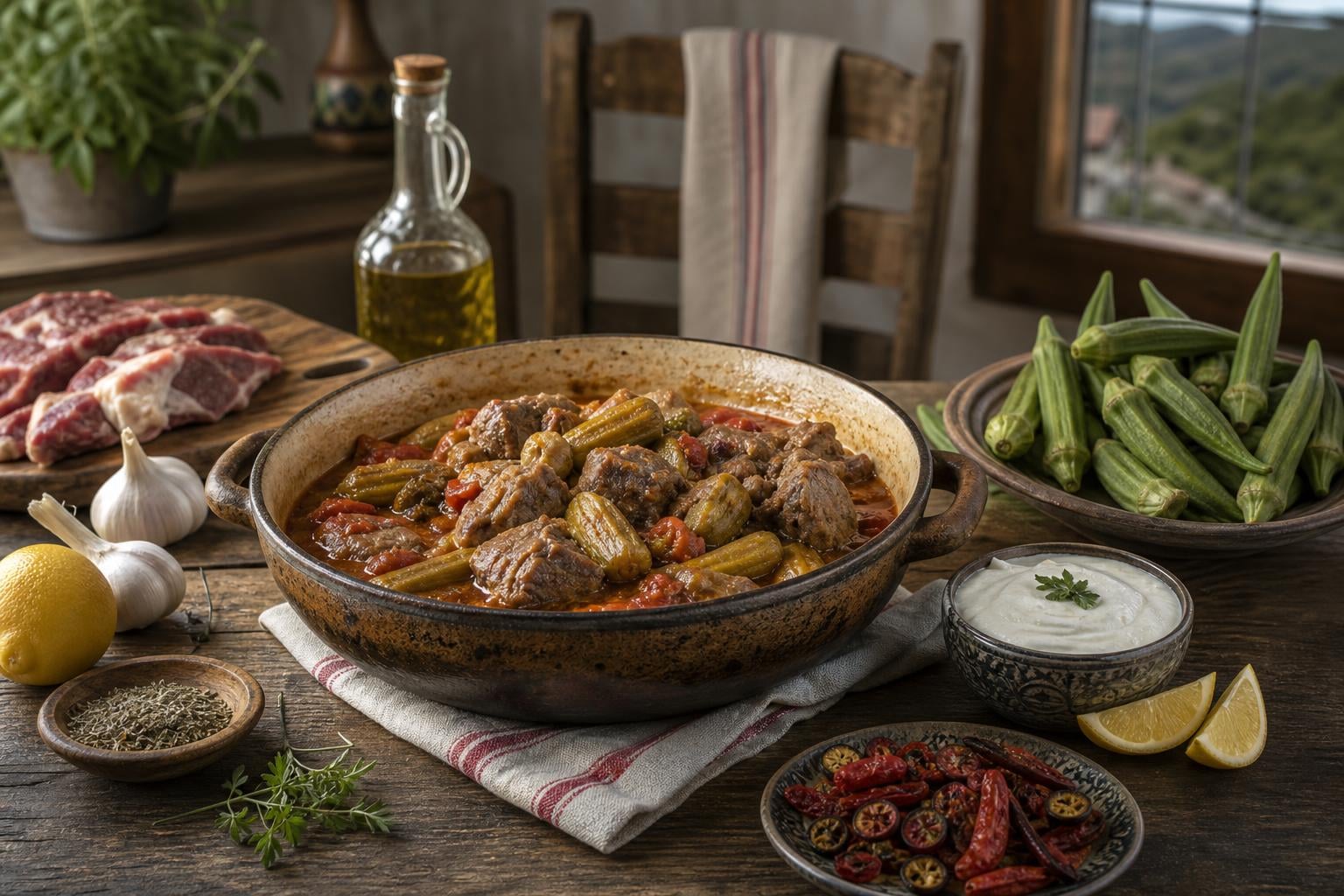
Bamje is the Albanian word for okra, and it is also the name of the dish built around it: lamb shoulder slow-braised with okra, tomato, onion, and a squeeze of lemon until the meat falls apart and the okra holds its shape. It is one of the late-summer dishes in the Albanian diaspora — the pot that anchors a Sunday lunch in August, the leftover that gets warmed up on Tuesday, the dish that signals the season has turned.
This piece covers what bamje is, where the name came from, the regional variations, the traditional recipe at home-kitchen scale, and the technique that separates a good bamje from a slimy one. The recipe serves four to six and takes about two hours, most of it hands-off.
The dish carries weight beyond dinner. It is one of the recipes most likely to drift between generations because the technique — the lemon timing, the okra prep, the braise temperature — does not write itself down. Writing the numbers down is part of how the dish survives.
What Bamje Is
Bamje is a slow-cooked lamb-and-okra stew built in three stages: brown the lamb, build the tomato base, add the okra and finish with lemon. The structure is simple, but the timing matters — the lamb needs time to break down, the okra needs to be added late so it does not turn to mush, and the lemon goes in twice (once with the okra to control the slime, once at the end for brightness).
The dish sits inside a family of Mediterranean and Middle Eastern okra stews. Egyptian bāmiyah, Turkish bamya, Greek bámies, Iraqi bāmiyah, Lebanese bāmiyah bi lahmeh — all share the same root word and the same general logic. What separates the Albanian version is the herb register and the pairing instinct. Bamje leans on dried oregano and a touch of fresh parsley rather than the cumin-and-coriander profile of the Levantine versions. The tomato base is straightforward — onion, garlic, ripe tomato or paste, olive oil — without the pomegranate molasses that defines the Iranian khoresh bamieh or the heavy spice of the Egyptian version.
The okra is the structural ingredient, but the lamb is the flavor anchor. A bamje made without enough fat in the meat comes out lean and hollow. A bamje made with the right cut and a long, slow braise has the kind of depth that makes the okra feel like a side player even though it is in the title.
The dish is one Albania shares with most of the eastern Mediterranean. The Albanian fingerprint is the simplicity of the seasoning — oregano, garlic, salt, lemon, olive oil — and the way the dish sits on a Sunday-lunch table next to a byrek, a chopped salad, and a small bowl of kos (yogurt). Bamje is rarely a solo plate. It is a stew that wants rice, bread, and company.
The Name and Where It Came From
The word bamje came into Albanian through the Ottoman period, like a long list of food and household words that arrived alongside the same period’s administrative and architectural vocabulary. The Albanian bamje descends from Turkish bamya, which descends from Arabic bāmiyah (بامية), which is the standard Arabic word for okra and traces back through medieval Arabic agricultural texts. Okra itself is an East African plant, native to Ethiopia, Eritrea, and eastern Sudan; the cultivation moved north through Egypt and the Levant in the medieval period and into the broader Ottoman world, the word traveling with it.
Albanian preserved the bamye/bamje form. Romanian (bamă), Serbian (bamija), Bulgarian (bamya), Greek (bámia), and the Levantine Arabic dialects all kept close cognates, which is why an Albanian grandmother and a Greek grandmother and a Lebanese grandmother can each say the word for the vegetable and recognize one another’s dish, even when the seasoning diverges.
The dish itself follows the word. Okra dishes turn up in the region’s culinary record as far back as a 12th-century Egyptian recipe, and the Albanian lamb-and-okra version sits inside that older Egyptian-and-Ottoman lineage, picked up and localized during the Ottoman centuries. The Albanian fingerprint — Mediterranean herbs, lemon-forward finish, no cumin — places it closer to the Greek and southern Italian register than to the Levantine or Iranian variants of the same dish.
The compound name bamje me mish — bamje with meat — is what the recipe is called when a cook wants to be specific. In everyday Albanian conversation, bamje alone usually means the dish, not just the vegetable. The vegetarian fasting-period version is called bamje pa mish — bamje without meat.
Regional Variations
Albanian bamje is not one recipe. The country splits between the south (Tosk) and the north (Gheg), and home cooking tends to split along similar lines. What follows tracks general patterns and family habit, not a fixed culinary standard — bamje varies household to household even within the same region.
South Albania (Tosk-style). More olive oil, lighter tomato base, lemon-forward finish. The southern version sits closer to the Mediterranean — olive oil, oregano, fresh tomato when in season, and a heavier squeeze of lemon at the end. Some southern cooks add a pinch of sugar to balance the tomato. The southern coastal kitchens, which trade fluidly with the Greek tradition, sometimes finish the dish with a handful of fresh dill or parsley.
North Albania (Gheg-style). Heavier tomato, sometimes tomato paste rather than fresh tomato, less lemon at the finish, more reliance on dried oregano alone. The northern version often comes out thicker and darker — closer to a Hungarian or western Balkan stew register than to the Aegean style of the south. Butter sometimes shows up alongside the olive oil.
Kosovar. Kosovo bamje leans toward the northern Albanian profile but with a touch of paprika and sometimes a fresh chili in the pot. The dish is closer to the broader western Balkan stew tradition — heartier, slightly sweeter from the paprika, and often served with a fluffier rice or with bread alone rather than over rice.
Çam and southern coastal. The Çam Albanian communities (originally from northwestern Greece) cook a bamje close in style to the Epirote Greek bámies — olive oil heavy, lemon forward, fresh tomato. The regions overlap geographically and the cooking traditions never respected the modern border.
Arbëresh. The Arbëresh communities of southern Italy keep a 15th-century Albanian foodway, but bamje is not strongly preserved there — okra was a later Ottoman-era arrival in the broader Albanian diet, after the Arbëresh migrations. Their okra dishes, when they exist, follow southern Italian rather than Albanian patterns.
The diaspora muddies these lines. A Kosovar grandmother in Detroit and a Tosk grandmother in Worcester end up shopping at the same Middle Eastern grocery, buying the same frozen okra and the same canned tomato, and the regional tells get fainter with each generation.
The Cultural Anchor
Bamje is a seasonal dish in a way most of the Albanian repertoire is not. Where byrek and tavë kosi and qofte appear year-round, bamje is anchored to the late summer and autumn — August through October in Albania, when fresh okra is at the markets, and roughly the same window in the US for cooks buying fresh from Balkan, Greek, or Middle Eastern groceries.
In the diaspora, the seasonality is partly real and partly ritual. Frozen okra is available year-round at any halal or Mediterranean grocery in the dense Albanian-American neighborhoods — the Bronx and Yonkers (NY), Waterbury and Bridgeport (CT), Detroit and Sterling Heights (MI), Worcester and Boston (MA). But most families still cook it heaviest in late summer, when the dish lines up with the harvest table and the long Sunday lunches that mark the end of the warm months.
Bamje also crosses religious lines, like most of the Albanian table. Catholic, Orthodox, Muslim, and Bektashi families all cook it, with the Orthodox Lent (Kreshma) being the period when the meatless bamje pa mish gets the most kitchen time. During the Lenten weeks, when meat and dairy are off the table, the vegetarian okra-and-tomato version becomes a structural part of the weekly menu — alongside fasule, bean stews, and other plant-based dishes that carry the table through the fasting period.
The dish is rarely the whole meal. A bamje plate on a Sunday Albanian-American table sits next to rice, bread, a chopped salad, sometimes a small piece of byrek, and a bowl of kos. It is the centerpiece in the way a stew is a centerpiece — the thing the rest of the table organizes around — but the table is the dish, not just the pot.
The Traditional Recipe
This is the lamb-and-okra version (bamje me mish), the everyday Albanian-American household recipe. It uses ingredients available in any US grocery — frozen okra works fine and is what most diaspora cooks use — and yields a heavy Dutch oven that serves four to six.
Ingredients
For the lamb and base:
- 2 lb (900g) boneless lamb shoulder, trimmed and cut into 1.5-inch cubes
- 3 Tbsp olive oil, divided
- 1 large yellow onion, finely chopped
- 4 cloves garlic, finely chopped
- 2 Tbsp tomato paste
- 1 14-oz can crushed tomatoes (or 4 ripe fresh tomatoes, peeled and chopped, when in season)
- 1½ cups water (approximate; you will use it in stages)
- 2 tsp dried oregano
- 1 bay leaf
- 1¼ tsp kosher salt, plus more to taste
- ½ tsp freshly ground black pepper
- ½ tsp sweet paprika (optional, traditional in Kosovar versions)
For the okra finish:
- 1.5 lb (680g) okra — fresh small pods, or frozen whole, thawed and patted dry
- 2 Tbsp white wine vinegar (or lemon juice) — for the slime control
- Juice of 1 lemon — for the final brightness
- 2 Tbsp finely chopped fresh parsley, to garnish
A note on the lamb: shoulder is the cut. It has the connective tissue that breaks down into tenderness during the braise, and the fat is what carries the tomato and oregano. Leg works but cooks drier. Bone-in shoulder, cut down by the butcher, gives extra body to the sauce — worth asking for.
A note on the okra: small pods, no longer than your finger, are the right size. Larger pods get tough and stringy. Fresh in season is best; frozen whole is a close second and what most diaspora cooks reach for. Avoid canned okra entirely — the texture has already collapsed.
Equipment
- A heavy-bottomed Dutch oven or large braising pot, 5 quarts or larger
- A wooden spoon
- A small bowl for the okra-vinegar prep
- A clean kitchen towel
How to Make Bamje
Step 1 — Prep the okra (10 minutes, plus optional 1-hour rest)
If using fresh okra, rinse and pat dry. Trim the stem ends, cutting the cap off carefully without slicing into the pod itself — opening the pod is what releases the slime. Leave the pods whole.
Toss the trimmed okra with the 2 Tbsp vinegar in a bowl. Some grandmothers also salt the okra here and let it weep for an hour, which helps further. Both moves attack the same problem: the mucilage that makes a poorly-cooked bamje gluey.
If using frozen okra, thaw fully in the refrigerator overnight. Drain any liquid and pat the pods dry with a kitchen towel. Toss with the vinegar the same way.
Set the okra aside while you build the base. The vinegar treatment is doing its work — the acid breaks down the mucilage proteins before the okra ever hits the heat.
Step 2 — Brown the lamb (10 minutes)
Heat 2 Tbsp olive oil in the Dutch oven over medium-high heat. Pat the lamb cubes dry with a kitchen towel — wet meat steams instead of browning. Add the lamb in a single layer, working in two batches if needed. Sear on at least two sides until deeply browned, about 4 to 5 minutes per batch. Move browned meat to a plate.
Browning is where the depth of flavor comes from. Do not skip it. A bamje built on un-browned lamb tastes thin no matter how long you braise.
Step 3 — Build the base (10 minutes)
Lower the heat to medium. Add the remaining 1 Tbsp olive oil and the chopped onion. Cook 6 to 8 minutes, stirring, until the onion is soft and translucent — not browned. Add the garlic and stir for 30 seconds, until fragrant. Do not let the garlic burn; bitter garlic is hard to recover from.
Stir in the tomato paste and cook for 1 to 2 minutes — the paste should darken slightly and smell sweeter. This step concentrates the tomato flavor before the liquid goes in.
Add the crushed tomatoes, oregano, bay leaf, salt, pepper, and paprika if using. Stir to combine.
Step 4 — Braise the lamb (1 hour)
Return the browned lamb and any juices to the pot. Add 1 cup of water — just enough to barely cover the meat. Bring to a gentle simmer, then reduce the heat to low, cover, and cook for 1 hour. The lamb should be tender enough to give to a fork but still hold its cube shape. It will finish cooking with the okra.
Check the pot at the 30-minute and 50-minute marks. Stir gently. If the liquid has reduced too far, add ¼ cup water to keep the meat just covered. If the sauce looks watery, leave the lid slightly ajar to let some moisture escape.
Step 5 — Add the okra (30 minutes)
Add the vinegar-treated okra to the pot, distributing it evenly across the surface. Do not stir aggressively — okra pods break easily, and broken okra is slimy okra. Press the pods gently into the sauce so they are about half-submerged. Add another ½ cup water if the pot looks dry.
Cover, reduce the heat to low, and cook 25 to 30 minutes, stirring once or twice with a gentle hand. The okra is done when it is tender to a fork but still holds its shape and color. Frozen okra cooks slightly faster than fresh — check at 20 minutes.
For the final 5 minutes, uncover the pot and let some moisture cook off. The sauce should look thick — coating the back of a spoon — not soupy.
Step 6 — Finish with lemon and rest (10 minutes)
Pull the bay leaf out and discard. Squeeze the juice of 1 lemon across the pot and stir very gently to incorporate. Taste and adjust salt — bamje almost always wants slightly more salt at the end than seems right at the beginning.
Pull the pot from the heat and let it rest, covered, for 10 minutes on the stove. Resting lets the flavors marry and the okra finish setting. Sprinkle the chopped parsley across the top just before serving.
Serve from the pot at the table, alongside plain rice, crusty bread, a chopped salad, and a small bowl of cold kos.
Critical-Path Notes
Three things separate a clean bamje from a gluey one. Get these right and the rest is forgiving.
- Trim the okra without cutting into the pod. The cap of the okra is where the slime escapes. Trim only the stem, leaving the conical cap mostly intact. Slicing the okra open turns the dish into a thickened mess.
- Vinegar or lemon on the raw okra. A tablespoon or two of acid on the okra before it hits the pot is the single most important slime-prevention move. The acid disrupts the mucilage proteins before they have a chance to dissolve into the sauce.
- Add the okra late. Okra cooked for 30 minutes holds its shape; okra cooked for 90 minutes turns to mush. Build the lamb stew first, add the okra in the last half hour, finish with lemon.
Two more notes that matter less but help.
- Stir the okra gently. Okra pods break under aggressive stirring, and broken pods release everything they were holding back. Use a wooden spoon and lift rather than scrape.
- Rest before serving. Ten minutes off the heat lets the sauce settle. A bamje pulled directly from a rolling boil to the table tastes harsher than the same dish ten minutes later.
Common Mistakes
- Cutting the okra into rings. Some American recipes call for sliced okra. Albanian bamje uses whole pods. Sliced okra releases far more mucilage and turns the sauce slimy. Trim only the stem cap, leave the pod whole.
- Skipping the acid prep. A vinegar or lemon-juice toss before the okra goes in the pot is what controls the texture. Without it, even careful cooking produces a stew with a thick, ropey sauce.
- Cooking the okra too long. Okra at 30 minutes is tender and structurally intact. Okra at 60 minutes has dissolved. The braise time belongs to the lamb; the okra is added late.
- Under-browning the lamb. A pale sear gives a flat stew. Brown the lamb hard on at least two sides before any liquid hits the pot.
- Using lean ground lamb instead of shoulder. This is a stew, not a meatball. The cut matters — shoulder gives the dish its body. Lean cuts produce a thin, hollow result no matter how long the braise runs.
- Forgetting the salt at the end. The okra and the long braise pull the salt out of the visible register. A final salt check after the lemon goes in is what brings the dish back into focus.
Variations
The same lamb-and-okra technique scales across a small family of related Albanian dishes.
- Bamje pa mish (vegetarian). Drop the lamb. Build the base the same way — onion, garlic, tomato paste, crushed tomato, oregano, bay leaf, salt, pepper. Add the okra and 2 cups of water. Simmer 30 minutes. Finish with lemon and parsley. Some families add a 14-oz can of chickpeas or white beans for body. This is the Lenten version, and it is the everyday vegetarian dish in Orthodox Albanian-American households during Kreshma.
- Bamje with beef. A common diaspora adaptation when lamb is hard to source or expensive. Use 2 lb beef chuck, cut into 1.5-inch cubes, and extend the braise in step 4 to 75 minutes — beef chuck takes longer than lamb shoulder to break down. Everything else stays the same. The dish is recognizable but slightly heavier and less aromatic.
- Bamje with chicken. Less traditional but works for a weeknight version. Use 2 lb bone-in, skin-on chicken thighs. Brown the same way. Reduce the braise time in step 4 to 25 minutes — chicken thighs hit tender quickly. The okra step is unchanged.
- Bamje me oriz (with rice in the pot). A southern Albanian variant cooks ⅓ cup of long-grain rice into the stew during the okra step. The rice absorbs some of the lamb juices and turns the dish into a one-pot meal — closer to a pilav than a braise.
Serving and Pairing
Bamje is rarely a solo plate. The Albanian table around it is the dish, not just the pot.
The standard accompaniments. Plain long-grain rice, sometimes plated separately, sometimes spooned underneath. Crusty white bread for the sauce. A chopped salad of cucumber, tomato, white onion, and feta with olive oil and red wine vinegar. A small bowl of cold kos (plain whole-milk yogurt) on the side — the cool yogurt cuts the richness of the lamb-tomato sauce.
For drinks. Kos i rrahur — beaten yogurt thinned with cold water and salt — is the traditional non-alcoholic pairing, structurally identical to Turkish ayran. With wine, a young Mediterranean red works; an Albanian kallmet if you can find it. As an opener, a small chilled glass of raki before the meal — the Albanian fruit brandy — sets the table.
For the broader meal. On a holiday table, bamje shares space with byrek, tarator (the cold cucumber-yogurt soup), a pickled-vegetable turshi, and a sweet at the end. On a weeknight, the bamje pot with rice, salad, bread, and yogurt is dinner.
Bamje reheats well. The right way is a covered pot on low heat for 10 minutes, with a splash of water added if the sauce has tightened in the fridge. The wrong way is the microwave, which heats unevenly and breaks the okra texture. The flavor is often better on day two.
A Note on Survival
Bamje is the kind of dish that lives or dies generation by generation. The grandmothers who cooked it without measuring are the same grandmothers who cooked tavë kosi, fasule, fërgesë, and the rest of the Albanian table. When that generation goes, the recipes can go with them — unless someone in the family writes them down and learns to make them. The technique on bamje is finicky enough that one missed cooking session in a generation is enough to lose the feel for it.
If you want to be counted in a community-led count of Albanian Americans, register with NAR. It takes a minute. Free, neutral, your data stays yours. Counting ourselves is the other way the diaspora keeps its shape.