
For most US Albanian families, November starts with one search query. Sometime in the third week, someone — a teenager prepping a school presentation, a parent confirming the parade date, a third-generation cousin trying to figure out what their grandfather kept saying every year — types 28 nentori into Google and starts piecing it together.
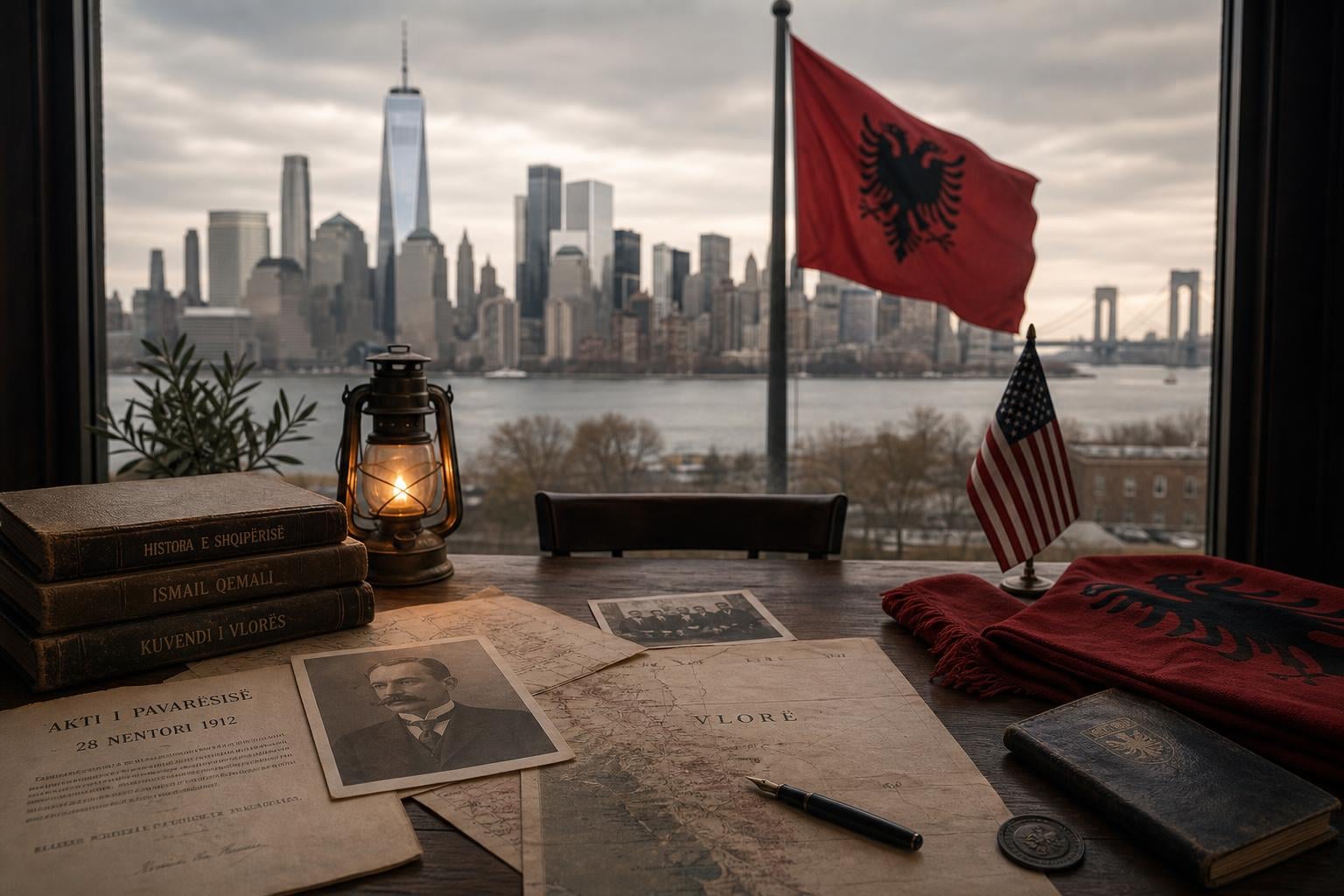
The date is November 28, 1912. The place was Vlorë, a port city on the Adriatic coast of what is today southern Albania. The act was a declaration of independence from the Ottoman Empire, read aloud from a balcony by a 68-year-old former Ottoman official named Ismail Qemali. The flag he raised that afternoon — red field, black double-headed eagle — has been the national flag of Albania, in one form or another, ever since.
In Albania, 28 Nëntori is a public holiday. In the United States, it is something a little different and, in some ways, more vivid: the one day a year the diaspora becomes legible to itself. Parades in Manhattan. Dinners in Sterling Heights. Flag-raisings at city halls in Worcester and Waterbury. Raki toasts in Bronx living rooms. Family group chats lit up with red-and-black emoji. This piece is a diaspora-first guide to the date — what it means, what happened in 1912, why November 28 carries both independence and flag weight, how it differs from November 29 Liberation Day, and how Albanian Americans across generations mark it.
What 28 Nëntori means
28 Nëntori is Albanian for 28 November. Nëntori is November; 28 Nëntori is shorthand for the date itself. Albanians refer to the holiday the way Americans refer to the Fourth of July — by the calendar entry, not by a translated name. You will see it spelled 28 Nëntori, 28 Nentori (without the diaeresis when keyboard input is limited), or written in full as Njëzet e tetë Nëntori on more formal programs.
The date carries two official names. Dita e Pavarësisë — Day of Independence — points at the 1912 political declaration. Dita e Flamurit — Day of the Flag — points at the act of raising the red and black banner that accompanied it. Modern Albania uses both. Diaspora communities use both. In casual speech, 28 Nëntori covers them at once, and that is the phrase most likely to surface on a Bronx storefront or a Detroit parish bulletin board.
For the Albanian American reader who grew up hearing the date pronounced in family conversation but never quite mapping it to a textbook event, the short answer is: November 28 is Albania’s birthday. Everything else — flag, parade, dinner, anthem — is built on top of that one foundational fact.
The 1912 declaration in Vlorë
The First Balkan War broke out in October 1912. The Balkan League — Serbia, Montenegro, Greece, and Bulgaria — moved against the Ottoman Empire, and the four powers fully intended to partition the Albanian-speaking territories among themselves. Albanian leaders faced a closing window: declare a state inside weeks, or watch the homeland get divided across four borders.
Ismail Qemali was the figure the moment converged on. Born in Vlorë in 1844, he had spent decades as an Ottoman official before turning toward Albanian national politics in exile. In the autumn of 1912 he traveled from Bucharest — where he had been coordinating with the Albanian community in Romania — to Vienna, where he secured a wary understanding with Austria-Hungary, then on to Trieste and across the Adriatic. With Ottoman officials still controlling Durrës and Serbian forces approaching, he diverted south and landed in Vlorë on November 26.
Two days later, on November 28, 1912, the Assembly of Vlorë convened. Delegates had been summoned from every region of the Albanian-speaking world able to send one in time — Catholic notables from the north, Orthodox figures from the south, Sunni and Bektashi delegates, merchants, beys, exiled writers. Forty signatories signed the founding document. Roughly 83 registered delegates attended what is remembered in Albanian sources as the All-Albanian Congress. They unanimously elected Qemali to lead a provisional government.
That afternoon, from the balcony of the house known in the city’s memory as the flag-raising house, Qemali and Luigj Gurakuqi raised the flag and read the declaration aloud. Albania, after more than four centuries of Ottoman rule, was e lirë dhe e pavarur — free and independent. Within days a provisional government was sworn in, with Qemali as the first prime minister. He served until early 1914, when the brief Vlorë government gave way to the short-lived Principality of Albania under Prince Wilhelm of Wied.
The international recognition followed quickly; the territorial settlement followed slowly and unevenly. The Treaty of London (May 1913) recognized an independent Albanian state and left the border question to the Great Powers; the Florence Protocol (December 1913) then drew boundaries that left roughly half of the Albanian-speaking population outside the new state. Kosovo went to Serbia. Çamëria went to Greece. Significant Albanian populations remained in what is today North Macedonia and Montenegro. That uneven settlement is the reason the Albanian world has never fit inside a single country — and the reason the diaspora has stayed politically active through every generation since.
Why November 28 carries Flag Day weight too
The choice of November 28 in 1912 was not arbitrary. According to long-standing tradition, Gjergj Kastrioti — Skanderbeg, the 15th-century Albanian commander who fought a 25-year campaign against Ottoman expansion — raised a red banner with a black double-headed eagle over the fortress of Krujë on November 28, 1443, after abandoning the Ottomans at the Battle of Niš and returning to his ancestral lands. The 1912 assembly deliberately aligned the modern declaration with that earlier flag-raising, knitting the new state symbolically to roughly five centuries of Albanian resistance.
That is why the holiday folds two meanings into one date. The political act — the declaration of independence — is inseparable from the symbolic act — the raising of the flag — because the flag itself is older than the state, and the state’s founders meant to claim that lineage. Modern Albania makes both meanings explicit. The day is officially Dita e Pavarësisë and officially Dita e Flamurit, and government calendars treat them as a single public holiday.
In the diaspora the two labels are also used together, though emphasis shifts by generation and region. Older Albanian Americans, particularly those who arrived through Vatra networks in the early 20th century, often default to Festa e Flamurit (Flag Festival). Younger Albanian Americans tend to say 28 Nëntori and let the listener fill in which meaning is most relevant. A separate NAR piece on the Albanian flag covers the symbol itself in depth — what it means, how it has changed across regimes, and the heraldic history behind the double-headed eagle. This piece stays focused on the date.
How it differs from November 29 Liberation Day
November 29 is a separate Albanian national holiday — Dita e Çlirimit, Liberation Day — commemorating the end of Nazi German occupation in 1944.
Italy occupied Albania on April 7, 1939. After Italy’s surrender to the Allies in September 1943, German forces took over and held the country for about fourteen months. The Albanian National Liberation Army, an indigenous partisan force that grew to roughly 70,000 fighters by October 1944, led the resistance. Tirana was liberated on November 17, 1944; the final German units were pushed out of Shkodër and the surrounding north on November 29, 1944. That date is what Dita e Çlirimit marks.
The two holidays sit back-to-back on the calendar — November 28 and November 29 — and they are sometimes confused by people new to the topic. The clean distinction:
- November 28, 1912 — Albania declares independence from the Ottoman Empire after more than four centuries of imperial rule.
- November 29, 1944 — Albania is liberated from Nazi German occupation at the close of World War II.
In contemporary Albania both are public holidays. In the diaspora, almost all the cultural energy attaches to November 28. Liberation Day is observed more quietly, often through wreath-laying at the National Martyrs’ Cemetery in Albania itself rather than through diaspora-wide programming. Many US-based Albanian organizations bundle the two dates into a single late-November observance, with the parade, dinner, and flag-raising falling on the weekend nearest November 28 and a shorter commemoration on the 29th.
How Albanian Americans observe 28 Nëntori
For the roughly 230,000 Albanian Americans recorded in the 2024 American Community Survey — and the larger community estimate of around one million counting ethnic Albanians and second- and third-generation descendants — November 28 is the one date that puts the diaspora on the same calendar at the same time. The observance varies by metro but the rhythm is consistent.
The flag goes up. Albanian American households fly the red and black from front porches, balconies, garages, and parked cars. In Albanian commercial corridors — Arthur Avenue and Morris Park in the Bronx, 14 Mile Road in metro Detroit, Shrewsbury Street in Worcester — small flags line storefronts for the full week leading into the date. Several US cities with significant Albanian populations, including Sterling Heights, Hamtramck, and Yonkers, have formally raised the Albanian flag at city hall on or around November 28 in recent years.
Community dinners. The diaspora dinner is the central social form of the holiday. Parishes, mosques, regional societies, and umbrella organizations like the Vatra Federation, the Albanian American National Organization (AANO), the Albanian American Civic League (AACL), and the Albanian American Education Association (AAEA) host annual banquets ranging from parish-hall potlucks to plated galas of 500-plus. The menu is recognizable across every event: tavë kosi (baked lamb with yogurt), byrek (filo pastry with cheese, spinach, or meat), grilled meats, bakllava, and trilece. Toasts run on raki, the Albanian fruit brandy. Speeches run a little long.
Folk dance and the anthem. Valle — the Albanian folk dance, performed in a hand-linked circle — anchors every event. Çifteli (two-string lute), def (frame drum), clarinet, and accordion are standard. Children in fustanella (the pleated white skirt of southern folk dress) recite Skanderbeg verses and lead the room in Himni i Flamurit, the national anthem. The youngest kids in the room usually carry the night.
Family observance. Even Albanian American households that do not attend a formal event mark the day. Phone calls home to relatives in Albania, Kosovo, North Macedonia, Italy, or Switzerland. Three-generation dinners in the older relative’s house. The grandfather in a qeleshe (white felt cap) and a sport coat with a flag pin on the lapel. The kids learning the anthem because they will be expected to know the first verse by the next year.
Press and broadcast. Dielli — founded in 1909 and the longest-running Albanian-language newspaper in the United States — and Illyria, founded in 1991, both run dedicated 28 Nëntori editions every year. Albanian-language radio programs and community television (ACTV Michigan, AlbaNYC) carry live coverage of the larger events. Albanian American social media — Facebook groups, WhatsApp threads, Instagram — saturate with parade footage, dinner photos, and Gëzuar 28 Nëntorin greetings for most of the week.
The Albanian-American parade in New York
The Albanian-American Independence Day Parade in New York is the single most visible public expression of the holiday in the United States. It runs annually on or near November 28 — typically the Sunday closest to the date — and brings together delegations from every corner of the metro Albanian community: parishes, mosques, soccer clubs, regional societies named for specific cities in Albania and Kosovo, scholarship organizations, chambers of commerce, motorcycle clubs, youth folk-dance ensembles, and elected officials. The crowd lining the route is its own event. Three generations of one family on a single curb is not unusual.
The Manhattan parade is organized through the Albanian American National Organization (AANO) in coordination with regional civic groups and city permitting offices. Exact date, route, and start time shift year to year and are typically confirmed four to six weeks ahead of November 28 on AANO channels and in Illyria and Dielli. Parade dates are best verified through current community sources rather than fixed in a single article; the historical pattern is Sunday closest to November 28, but city permitting can move it.
Smaller parades and public observances run in metro Detroit, Boston and Worcester, Connecticut, Paterson in New Jersey, and Chicago, with newer chapters running smaller programs in Florida and Texas. The format ranges from full street parades to flag-raisings at city hall to parish processions and banquet-anchored programs. A separate NAR piece on the Albanian parade tradition covers the history and the regional events in depth.
28 Nëntori for second- and third-generation Albanian Americans
A meaningful share of Albanian American readers were not raised with a formal 28 Nëntori observance. The reasons are familiar to anyone who has watched a diaspora generation assimilate: parents focused on English fluency and US schooling, grandparents who carried the holiday but did not always pass on the rituals, geographic distance from Albanian-dense metros like the Bronx or Sterling Heights, and the simple fact that November 28 is not a US public holiday and competes with Thanksgiving for the same long weekend.
If that is the household you came up in, the diaspora calendar is forgiving. A few first steps that work:
- Learn the date and the greeting. 28 Nëntori is 28 November. Gëzuar 28 Nëntorin is Happy 28 November. Text it to a relative on the day; they will return the greeting and the door is open.
- Find a local event. Search Albanian American plus your metro on Facebook, or check parish bulletins for the Albanian Catholic, Orthodox, and Sunni congregations near you. The closer you live to NYC, Detroit, Boston, Worcester, or Waterbury, the easier this is — but smaller programs in Dallas, Houston, Tampa, Charlotte, and Phoenix have grown noticeably in the last five years.
- Wear red and black. A flag pin on a lapel or a scarf in red and black is enough. Most events have a table by the door selling pins for a few dollars to fund the next year’s program.
- Bring a child if you have one. Children are not just tolerated at 28 Nëntori events; they are central to the program. A kid in folk dress will absorb the holiday faster than any explainer can deliver it.
- Call the relative who carried it. A grandparent, an aunt, a cousin in Tirana or Pristina or Skopje — the holiday is a built-in reason to make the call you have been meaning to make.
The community does not gatekeep the date. Albanian American identity is not pass-or-fail; it is participation, in whatever measure you have to give. November 28 is the most accessible entry point in the year.
How to greet someone in Albanian on the day
The standard greeting is Gëzuar 28 Nëntorin — literally happy 28 November. Gëzuar (gay-ZOO-ar) is the all-purpose Albanian happy or cheers; it works for birthdays, holidays, and toasts. The full phrase Gëzuar 28 Nëntorin! is what fills text messages, Instagram captions, and the inside of greeting cards on the day.
Variants you will also see and hear:
- Gëzuar Festën e Flamurit — Happy Flag Festival — the older, more formal Vatra-era phrasing.
- Gëzuar Ditën e Pavarësisë — Happy Independence Day — used in more formal speeches and printed programs.
- Gëzuar Pavarësinë — Happy Independence — the shortest version, common in spoken toasts.
- Rroftë Shqipëria — Long live Albania — used at the end of a toast or a speech, particularly after a raki shot.
- Rroftë Kombi Shqiptar — Long live the Albanian Nation — explicitly inclusive of Kosovo, North Macedonia, Montenegro, Arbëreshë, and the diaspora.
Pair any of these with a red-and-black flag emoji and the hashtag #28Nentori (or #DitaEFlamurit, #DitaEPavaresise) and you have the standard social-media post for the day. The community will recognize it instantly.
A note on getting counted
The diaspora helped will the 1912 declaration into being. Vatra — Federata Panshqiptare e Amerikës, the Pan-Albanian Federation of America — was founded in Boston in April 1912, seven months before the Vlorë assembly. Albanian Americans funded the independence project, lobbied in the international press, and coordinated with Qemali through his European travels in the months leading up to November 28.
That continuity — diaspora work supporting homeland recognition, year after year, for over a century — is the line the National Albanian Registry sits on. NAR is a free, community-led count of US Albanians, run by a 501(c)(3) nonprofit, that runs alongside the Census ACS so the Albanian-American community is visible to the institutions that decide language access, federal data categories, and cultural recognition. Get counted at albanianregistry.org/register — and we will see you at 28 Nëntori.