What the parade is, and why it exists
For most of the twentieth century the Albanian-American community was nearly invisible in American civic life. The numbers were small, the press wasn’t paying attention, and the homeland was sealed behind the most isolated regime in Eastern Europe. Communities organized — parishes, mosques, mutual-aid societies, the Vatra federation in Boston, the Albanian American National Organization in Worcester — but the work happened indoors. There was no day a stranger walking through Manhattan or Detroit would see Albanians as Albanians.
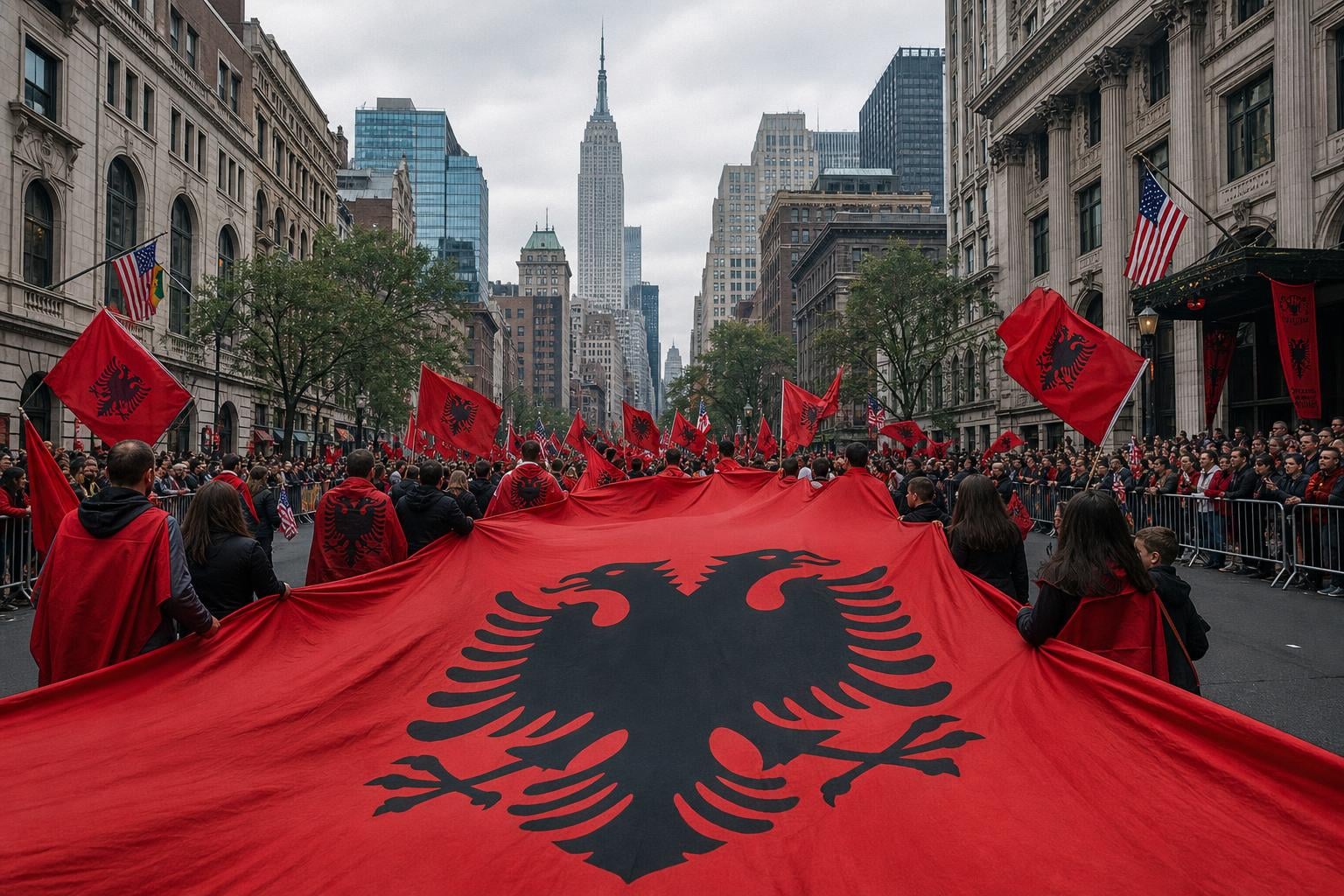
The parade changed that. Once a year, on the weekend nearest November 28, the diaspora puts the red flag with the black double-headed eagle on the street. Folk-dance groups in kostume kombëtare (national costume) walk the route. Soccer clubs in red jerseys carry banners from Tirana, Pristina, Tetovo, and Ulcinj. Parish delegations, regional societies, motorcycle clubs, chambers of commerce, and elected officials walk together. The crowd lining the curb is itself an event — three generations of one family, the gjyshi in a plis (white felt cap) holding a grandchild’s hand.
This piece is a diaspora-first guide to the Albanian-American parade tradition: the Manhattan parade as the largest, the Michigan observances, the Boston-Vatra lineage, the Worcester traditions, and the smaller events from Connecticut to Florida to Texas — what happens at them, who organizes them, and why a recurring civic ritual on a public street matters more than the dinner inside a banquet hall could.
The day behind the parade: November 28, 1912
To understand why the parade exists you have to start with what it commemorates.
On November 28, 1912, Ismail Qemali — a 68-year-old former Ottoman official who had spent years in exile — raised a red flag with a black double-headed eagle from the balcony of a house in Vlorë, on the Adriatic coast of what is today southern Albania. He read aloud a proclamation declaring Albania, after more than four centuries of Ottoman rule, e lirë dhe e pavarur — free and independent. Forty delegates signed the founding document; the wider assembly counted 79 registered delegates from across the Albanian-speaking world.
The diaspora’s role was real. Vatra — Federata Panshqiptare e Amerikës, the Pan-Albanian Federation of America — was founded in Boston on April 28, 1912, seven months before the Vlorë declaration, by Faik Konitza, Fan Noli, and other Albanian-American organizers. Vatra fundraised for the independence project, lobbied in the international press, and coordinated with Qemali during his European travels in the months leading up to November 28. The first major diaspora commemoration happened the next year, in 1913, at Vatra’s Boston operations. Boston was the back office.
The full history of the date — the All-Albanian Congress, the international recognition, the territorial settlement that left half of the Albanian-speaking population outside the new state — lives in the Albanian Flag Day explainer. What matters for the parade is this: the date is fixed, the diaspora has been observing it continuously since 1913, and the modern street parade is the most public expression of a commemorative tradition that is now well over a century old.
The NYC Albanian-American Independence Day Parade: history and rhythm
The largest single Albanian-American public event of the year is the Albanian-American Independence Day Parade in Manhattan. It is held annually on the weekend closest to November 28 and runs through midtown, with the route varying year to year — Madison Avenue or Fifth Avenue depending on permitting and city coordination, ending near the United Nations.
The NYC parade emerged in the 1980s, as the Bronx and Westchester community reached the size and confidence to take a midtown street for an afternoon. The post-1960s wave from Yugoslav-controlled Kosovo, North Macedonia, and Montenegro had built the Bronx footprint detailed at Little Albania in New York, and the institutional layer was in place — parishes, mosques, mutual-aid societies, the Albanian American Civic League (AACL, founded 1989 by Joe DioGuardi, headquartered in Westchester), and an active Albanian American National Organization (AANO) chapter network. AANO organizes the parade today, with partner organizations including AACL, regional societies, religious institutions, and the chambers of commerce.
The rhythm of the day is consistent year to year. Delegations gather mid-morning at the staging point — banners, flags, vehicles in red and black, folk-dance groups stretching against the cold. Manhattan in late November is rarely warm. Wool coats over kostume kombëtare (national costume), scarves over jerseys.
Early afternoon, the parade steps off. The sequence opens with a flag bearer carrying the Albanian flag, followed by the Kosovo flag, U.S. and city colors. Marching bands cycle through folk repertoire and the Himni i Flamurit (national anthem). Folk-dance ensembles break into valle (the Albanian circle dance) at the busiest intersections. Soccer clubs from the Bronx, Westchester, and New Jersey march in matching kits. Motorcycle clubs escort the procession with engines that announce themselves a block ahead. Parish delegations from Our Lady of Shkodra in Hartsdale and Sunni congregations from the Bronx walk together. Regional societies named for Shkodër, Pejë, Tetovo, and Ulcinj carry banners with their cities of origin.
The crowd includes families from the Bronx, Yonkers, Westchester, Staten Island, Queens, New Jersey, and Connecticut. Some come every year. Some bring their kids for the first time. By late afternoon the parade ends near the United Nations with speeches from community leaders, elected officials, and occasionally a visiting figure from Albania, Kosovo, or North Macedonia. Then the dinner circuit opens — Vatra galas, AACL banquets, parish dinners, family gatherings through the rest of the weekend.
Michigan, Massachusetts, and the regional observances
Manhattan is the largest event but not the only one. Several regional observances are older, equally rooted, and central to the Albanian-American calendar in their metros.
Detroit and metro Michigan. Michigan holds the second-largest Albanian-American concentration in the country — an estimated 30,000 by American Community Survey ancestry data, with community estimates considerably higher. Observances cluster in Sterling Heights, Warren, Hamtramck, and the western suburbs. AANO’s Detroit chapter holds an annual Independence Day dinner that draws several hundred. Parish processions anchor the religious side — St. Paul Albanian Catholic Church in Warren and Our Lady of the Albanians in Beverly Hills are the two largest Catholic anchors, with Sunni congregations and a Bektashi teqe network (the First Albanian Bektashi Tekke in Taylor is the senior institution) running parallel programming. Sterling Heights and Hamtramck have raised the Albanian flag at city hall on November 28 in recent years.
Boston and Worcester. New England is where the diaspora began institutionally, and the Independence Day observance lineage is the oldest in the country. Vatra’s first commemoration happened in Boston in 1913, on the first anniversary of the Vlorë declaration. The Boston-area Vatra gala has been one of the longest continuously running Independence Day events in the United States. AANO, founded in 1946 by the post-WWII anti-communist refugee wave, runs the Worcester observance — anchored to the Saturday school program where children in kostume kombëtare recite Skanderbeg poems and the national anthem. Worcester leans banquet-and-program rather than street parade; New England’s march tradition is smaller than New York’s but older in continuity.
Connecticut and New Jersey. Waterbury hosts a long-running parish dinner tied to the Albanian community that grew during the 1960s–1980s factory wave. Bridgeport is home to the Albanian American Education Association (AAEA) scholarship night, held on or near Flag Day. Paterson — the second-largest Albanian-American city by community estimate — runs Independence Day programming through the parishes, mosques, and Passaic County civic organizations that absorbed much of the post-1999 Kosovar wave.
Chicago, Florida, and Texas. AACI USA runs a Chicago-area Flag Day program. AANO has opened chapters in South Florida and Dallas–Fort Worth in recent years. Events in the newer metros are smaller — dozens to low hundreds — and are the seed-stage version of what Detroit looked like 50 years ago. A street parade is still a few growth cycles away, but the flag-raising and the banquet program already exist.
Inside metro New York, the Manhattan parade is the headline but not the only street tradition. Belmont’s Arthur Avenue has hosted Albanian-flag processions during Independence Day weekend for decades. Pelham Parkway and Williamsbridge Road see flag-bearing cars and motorcycle clubs roll through on November 28 weekend. Yonkers has its own municipal flag-raisings and parish processions. These are smaller — no permits for entire avenues, no out-of-state delegations — but they are the local face of the same observance.
What you’ll see: the flag, the costumes, the dance
The visible vocabulary of the parade is consistent from city to city. If you’ve never been to one, here’s what you’re looking at.
The flag. Red field, single black double-headed eagle, no stripes or stars — one of the simplest national flags in Europe, traced to medieval Albanian noble houses and most famously to Skanderbeg, the 15th-century leader who fought the Ottomans under a black double-headed eagle on a red banner. At a parade you’ll see it on banners, scarves, jackets, lapel pins, car windows, jerseys, and balloons. The Kosovo flag — blue with a gold map and six white stars, adopted in 2008 — flies alongside; the two answer different questions and are not in tension.
The kostume kombëtare (national costume). For men: the fustanella (white pleated skirt) for ceremonial groups, the plis (white felt cap), an embroidered vest, a sash. For women: the xhubleta (bell-shaped felt coat from the northern highlands) for ceremonial groups, regional embroidered gowns from across Albania and Kosovo, head scarves, and gold jewelry. Children march in scaled-down versions; folk-dance schools spend weeks making sure the kids’ fits are right.
The valle (circle dance). Performed in a hand-linked circle that rotates clockwise, led by a dancer waving a white handkerchief. Regional variations run into the dozens — valle e Tropojës, valle çame, valle e burrave (the men’s circle, with leaps and squat-kicks). At a parade the valle breaks out at intersections and at the closing rally. Anyone who knows the steps can join. It is one of the simplest entry points the diaspora offers a non-Albanian guest.
The music. Live bands cycle through çifteli (two-string lute), def (frame drum), clarinet, and accordion. The Himni i Flamurit is sung at the flag-raising and the closing rally. Folk songs from northern Albania, Kosovo, and the Çamëria diaspora rotate through. The contemporary soundtrack has expanded — a parade today might include a marching-band cover of a Bebe Rexha hook or an Era Istrefi single alongside the older repertoire. The music is one of the places the third generation has visibly added to the tradition rather than just received it.
The eagle salute. Hands crossed at the wrists, fingers spread, thumbs locked, forming the silhouette of a double-headed eagle. Most visible from Albanian and Kosovar soccer players after goals, but it shows up everywhere at the parade — in the crowd, on the floats, in the family photos at the end of the day.
Who organizes: AANO, Vatra, AACL, regional councils
The institutional infrastructure behind the parade is older than the parade itself.
Vatra — Federata Panshqiptare e Amerikës, the Pan-Albanian Federation of America — was founded in Boston on April 28, 1912 by Faik Konitza, Fan Noli, and others. It is the oldest Albanian-American institution. Vatra publishes Dielli (The Sun), founded in 1909 and still in print. Its role today is concentrated in New England Independence Day programming and the Boston gala.
AANO — the Albanian American National Organization — was founded in 1946 by the post-WWII anti-communist refugee wave. It operates as a cultural and mutual-aid network across New England and the New York metro, with chapters in Detroit, South Florida, Dallas–Fort Worth, and other newer metros. AANO is the lead organizer of the New York Albanian-American Independence Day Parade.
AACL — the Albanian American Civic League — was founded in January 1989 by Joe DioGuardi, the former U.S. congressman from Westchester, and is headquartered in Ossining, Westchester County. AACL has the strongest record of US-policy advocacy on Balkan questions over the last three decades and runs an annual program around Independence Day that includes the New York parade and a Westchester banquet.
Regional societies and religious institutions. Below the national federations sit the city-of-origin societies — Shoqata e Shkodranëve, Shoqata e Tropojanëve, Shoqata e Tetovarëve — that organize Albanian-Americans by the city or region their families came from. They march as named delegations and are the building blocks of the parade roster. Albanian Catholic, Sunni, Orthodox, and Bektashi institutions — Our Lady of Shkodra in Hartsdale, the Albanian Islamic Center of New York, the Albanian Orthodox Archdiocese (St. George Cathedral, South Boston), the Bektashi teqe network — all participate. The shared identity is shqiptar (the Albanian self-name) first; the religious institution is the venue, not the boundary.
From kafe to Fifth Avenue: how the diaspora became visible
For most of the twentieth century, Albanian-American visibility was low for structural reasons. The community was small. The homeland was sealed. The American press paid no attention to a country most editors couldn’t have placed on a map. Inside the community, life happened — at the parish, at the kafe (cafe) on an Italian-American block in the Bronx, at the xhami (mosque) on a side street in Detroit, at the Vatra gala in Boston — but it happened indoors and in Albanian.
What changed is partly size and partly the timing of three shifts. The post-1960s wave from Yugoslav-controlled Kosovo, North Macedonia, and Montenegro grew the Bronx, Detroit, and Paterson populations sharply. The 1991 collapse of communism in Albania opened the country and added the post-1991 wave. The 1999 Kosovo war turned American attention to the Albanian world for the first time in any sustained way, and the diaspora — already organized through AACL, the parishes, and the chambers — became the community’s public face in front of policy-makers, donors, and the press.
The parade is what those shifts produced. The first parades in the 1980s drew hundreds. By the 2000s the New York parade was drawing thousands. By the 2020s it was a multi-organization production with Manhattan permits, Kosovo and Albania flags side by side, marching bands, regional delegations, and elected officials walking the route.
The community went from invisible to visible on the street. That visibility has consequences. It changes what neighbors see. It changes what city halls budget for cultural programming. It changes what local press covers in November. It changes what an Albanian-American kid in the Bronx, Sterling Heights, or Paterson knows is normal — that there is a day each year when the people in your metro show up to say shqiptar out loud in public.
Bringing kids: why parades work as identity transmission
Identity in the diaspora is not transmitted through textbooks. It is transmitted through repeated experiences that a child remembers later as having been important.
A 25-year-old Albanian American who grew up in Yonkers won’t remember every page of the Albanian Saturday school workbook. She will remember that her father drove the family down to Manhattan every November, that her grandfather wore the plis he hadn’t worn in a decade, that there was a folk-dance group of girls her age in xhubleta and that her mother said, “next year you’re walking with them.” She will remember the çifteli on a speaker outside a flatbed truck. She will remember that the day mattered enough for the whole adult world she knew to take a Sunday off for it.
This is why parades work as identity transmission. A banquet teaches you that the community gathers. A parade teaches you that the community claims a public street. The second lesson is harder to forget.
For the third generation — children of US-born parents who themselves grew up bilingual but raised their kids in mostly English — the parade is one of the few experiences that holds up against the weight of full assimilation. Saturday school competes with soccer practice. Parish service competes with sleeping in. The parade competes with nothing, because it happens once a year on a street that is closed for it.
If you have kids, bringing them is the highest-return thing you can do for their connection to the community. They will remember it. They will also be the ones organizing it in 2055.
The civic moment beyond the march
The parade is also when most Albanian-American organizations launch their annual fundraising, announce scholarship recipients, install new board members, and align on the year ahead. The atdhetare (patriotic, homeland-loving) tradition that the 1912 generation passed down is alive in the diaspora not as nostalgia but as ongoing civic work — schools, parishes, scholarships, regional chambers, and advocacy.
The day reminds us of two things at once. First, that an Albanian state exists at all because the diaspora helped will it into being in 1912 — the Boston Albanians who funded Vatra, the New York and Worcester families who sent money home and pressure to Washington. Second, that the public-facing work didn’t end with the flag-raising. The Treaty of Bucharest left half the Albanian-speaking world outside the new borders. Every generation since has had to keep finding ways to stay visible across those lines.
The parade is one answer. The registry is another.
Get counted, then get on the route
Parades make the diaspora visible on the street. The registry makes it visible in the data. Both matter — both are how a community of 230,000 by ACS count and roughly a million by community count moves from invisible to seen.
If you’ve read this far and you haven’t yet been counted, that’s the action. Get counted at /register — three minutes, free, your data stays yours — and meet us on the route in November.