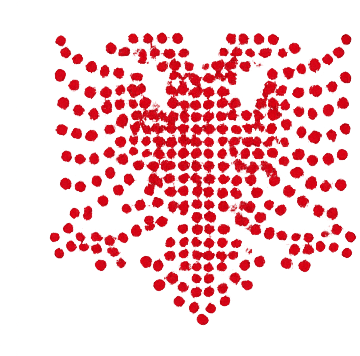

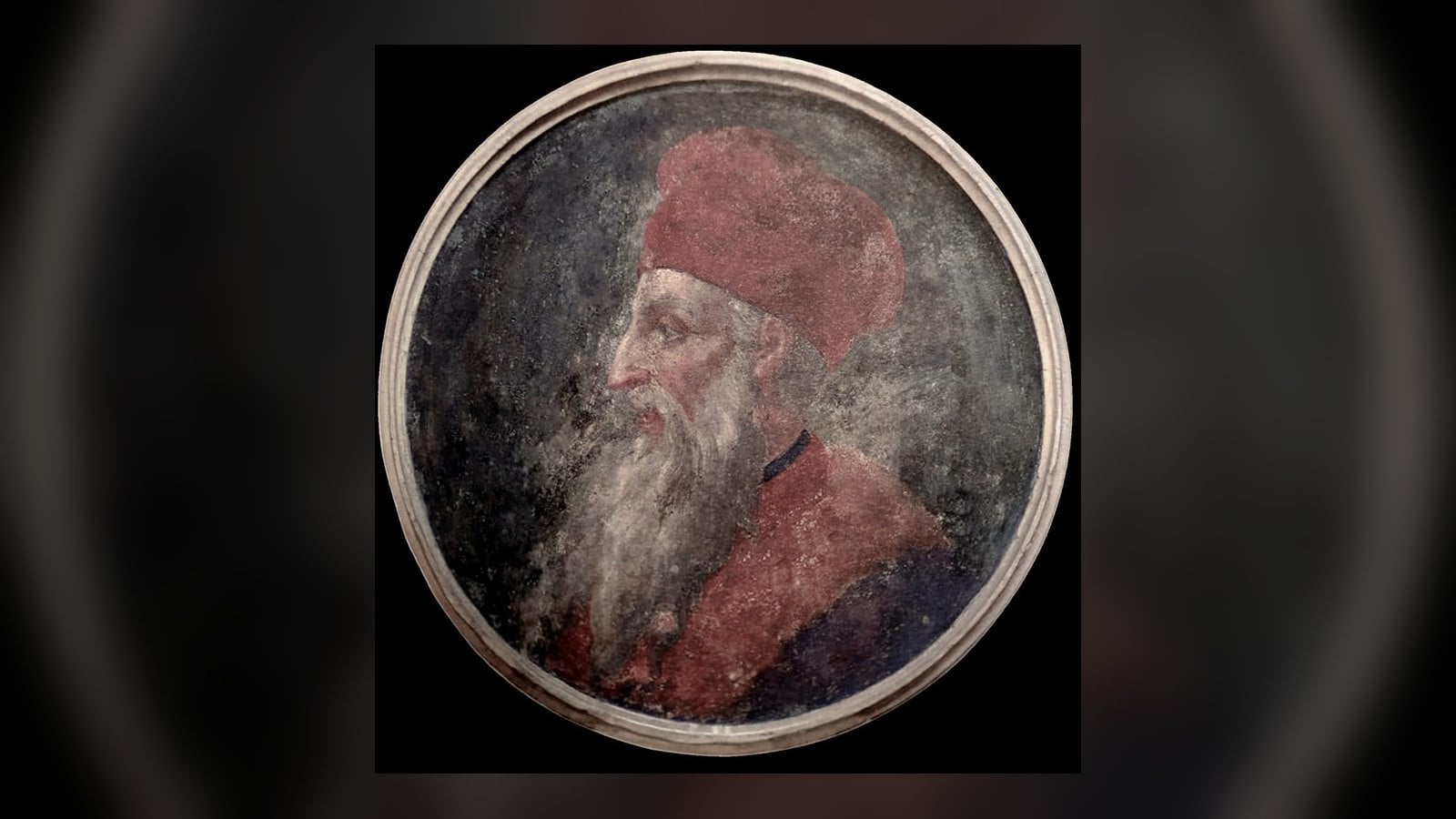
Gjergj Kastrioti — known by his Ottoman-given title Skanderbeg, İskender bey, “Lord Alexander” — was the medieval Albanian noble who held off the Ottoman Empire for 25 years between 1443 and his death in 1468. His double-headed eagle banner is the direct ancestor of the modern Albanian flag, raised over the declaration of independence at Vlorë in 1912 and flown today at every Albanian-American organization, every Flag Day gathering, and every restaurant in the Bronx with Skënderbeu over the door.
He is, without exception, the most important figure in Albanian history.
The Albanian historical canon is short on figures who can be discussed with both confidence and documentation. Most pre-modern Albanian leaders survive only in fragments — a Venetian dispatch, a chronicler’s aside, a single Latin charter. Skanderbeg is the exception. Contemporary Byzantine historians wrote about him. Venetian and Neapolitan archives logged his treaties. Two popes corresponded with him. Sultans Murad II and Mehmed II — the latter the conqueror of Constantinople — campaigned against him personally. His primary biographer, the priest Marin Barleti, published a 500-page Latin life of Skanderbeg around 1508, four decades after his death (Wikipedia: Skanderbeg). The Renaissance built him into legend. Modern scholarship has trimmed the legend back to the documentary core. Both versions still describe a remarkable life.
This is what we know about Skanderbeg: where he came from, how he ended up in the Ottoman military, how he turned against it, what he did with the next 25 years, and what he means to Albanians — in Albania, in Kosovo, in the Arbëreshë villages of southern Italy, and in the American diaspora — five and a half centuries later.
Background: the 15th-century Balkans
To understand Skanderbeg, you have to understand the world he was born into.
The 15th-century Balkans were a contested borderland. The Byzantine Empire, after a thousand years, was in its final collapse — Constantinople would fall to Mehmed II in 1453. The Ottoman Empire, founded around 1299, had spent the 14th century expanding out of Anatolia and across the Balkans through a combination of military conquest and the absorption of vassal states. The decisive moment had come at the Battle of Kosovo on 28 June 1389, where an Ottoman force under Sultan Murad I defeated a Serbian-led Christian coalition. Both Murad and the Serbian prince Lazar died on the field. The Ottoman victory shattered organized Christian power in the central Balkans and opened the road north.
A second Christian coalition tried to reverse the tide at the Battle of Nicopolis in 1396 — French, Hungarian, Burgundian, and Wallachian knights under King Sigismund of Hungary. The Ottomans destroyed it. From that point forward, no Christian power could expel the Ottomans from the Balkans on its own.
What remained were the smaller principalities — among them the Albanian ones.
In the early 15th century, the Albanian-speaking territory was not a unified state but a patchwork of noble houses, each controlling a fortress, a stretch of coast, or a mountain valley. The principal families were the Thopia (around Krujë and Durrës), the Muzaka (Berat and the central plain), the Arianiti (the south), the Dukagjini (the northern highlands), and the Kastrioti (the small mountainous principality around Mat and Dibra in the central north). Some were Catholic, some were Eastern Orthodox; all spoke Albanian; most paid some form of tribute or fealty to the Ottoman court by the 1420s.
Cutting across all of this was the devshirme — the Ottoman “blood tax.” Christian boys were periodically taken from Balkan villages, converted to Islam, and trained either as palace administrators or as elite infantry, the Janissaries. The system produced a class of capable, religiously and ethnically detached soldiers and officials loyal to the sultan personally. It was the gate through which a young Gjergj Kastrioti would pass.
Early life and Ottoman service (1405-1443)
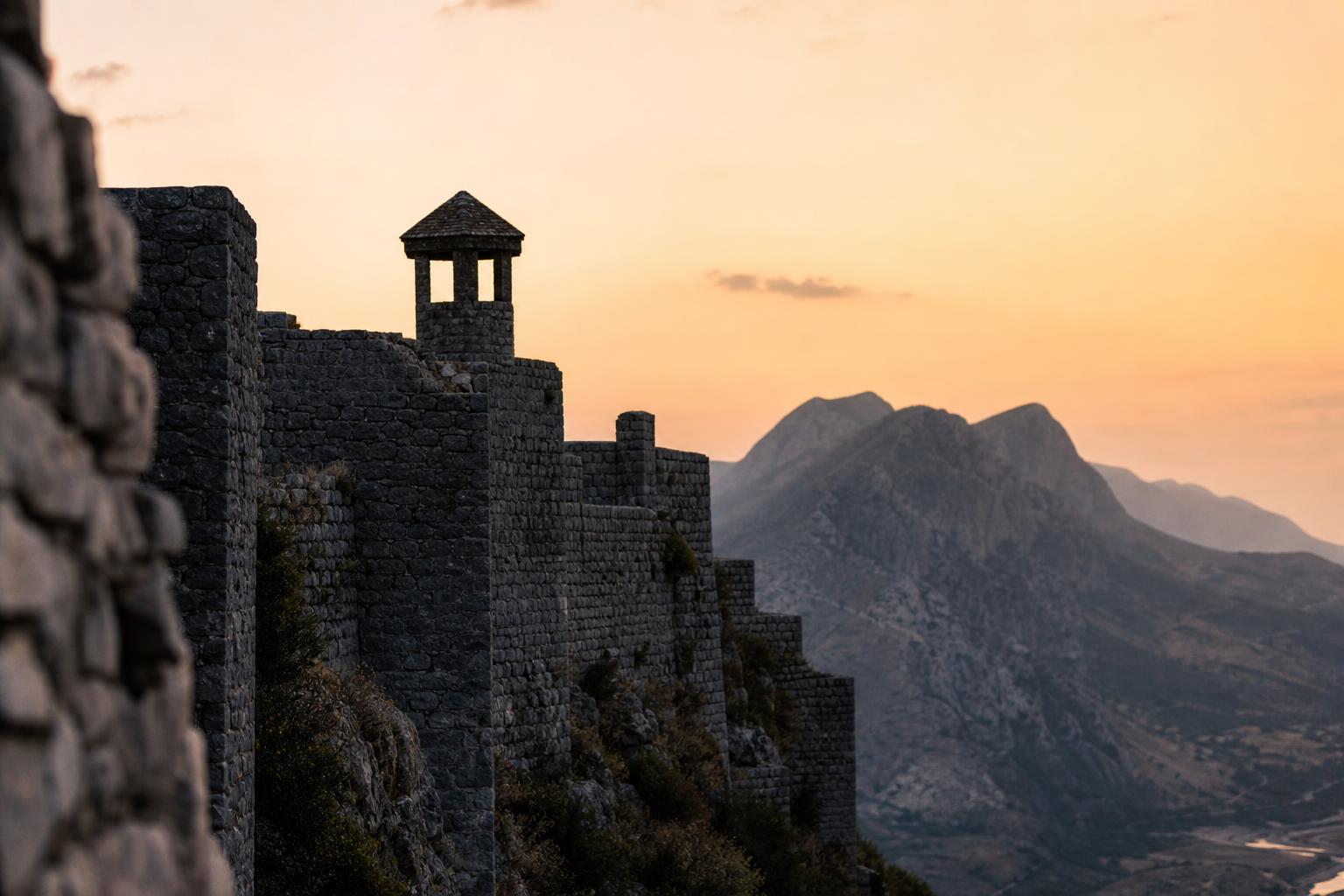
Skanderbeg was born around 1405 in the Principality of Kastrioti — possibly at Sinë, in modern north-central Albania — to Gjon Kastrioti, a regional prince who controlled a small stretch of mountain country, and to Vojsava Tribalda, a noblewoman of contested origin. He had at least three older brothers and four sisters.
The Kastrioti principality was small enough that, by the 1410s, Gjon was paying tribute to the Ottomans. As part of the arrangement, he was required to send his sons as hostages to the sultan’s court — the standard Ottoman device for keeping a vassal prince obedient. Skanderbeg was sent in 1415 as a young child and again in 1423, by which point he was around 18 (Wikipedia: Skanderbeg).
At the Ottoman court he was raised in the Enderun School under Sultan Murad II — the palace academy that trained the empire’s military and administrative elite. He was converted to Islam, learned Turkish, Arabic, Greek, Italian, and Slavic, and was eventually commissioned into the Ottoman military. He distinguished himself in the field — Ottoman service kept him on campaign across the Balkans and in Asia Minor — and earned the title İskender bey, “Lord Alexander,” reportedly because his commanders compared his battlefield ability to Alexander the Great. The Albanian rendering of the same title — Skënderbeu — is the name history remembers. That Albania’s Christian national hero is known worldwide by an Ottoman-Turkish name, and no Albanian finds it a contradiction, is a small proof of a larger rule: Albanian nationhood has always run on language, not religion.
In 1440 he was appointed sanjakbey of the Sanjak of Dibra, an Ottoman provincial governor in territory adjacent to his ancestral lands (Wikipedia: Skanderbeg). For roughly 20 years he served the Ottoman state in good standing.
His father Gjon Kastrioti died in 1437. His older brothers had either died young or died in Ottoman service; the principality of Kastrioti was absorbed into Ottoman direct rule. By the early 1440s, Skanderbeg — a Muslim Ottoman officer in his late thirties — was the last surviving male heir to a principality that no longer formally existed.
He was, on paper, a successful Ottoman commander with a foreign past. What he became was something else.
The defection (1443)
In November 1443, an army of Hungarian, Polish, and Wallachian Christian forces under János Hunyadi — the Hungarian regent and the most capable Christian commander of the era — pushed south into Ottoman-held territory in what is now Serbia. The Ottomans met them outside the city of Niš.
Skanderbeg was on the field as an Ottoman officer.
During or immediately after the battle — accounts differ in detail, but the outcome is clear — Skanderbeg defected. He left the Ottoman lines with about 300 Albanian compatriots and rode south into the Albanian highlands. He arrived at his ancestral fortress of Krujë on 28 November 1443 and took control of the city, reportedly using a forged letter of authority from the sultan to convince the Ottoman garrison commander to hand it over (Wikipedia: Skanderbeg).
Once inside, he raised over the walls of Krujë the red banner with the double-headed black eagle — the heraldic device of the Kastrioti family. He renounced Islam, returned to Catholic Christianity, and declared the principality of Kastrioti restored.
It was the act of a man burning every bridge behind him. The Ottoman state did not forgive defection by a senior officer, and there was no plausible path back. Whatever Skanderbeg’s reasons — recovery of family inheritance, religious reversion, calculation that the Ottomans were extending too far for too long — the decision committed him to fighting the empire that had raised him until one of them fell.
The empire would survive him. He would not survive the empire. But he would not lose, either, in his own lifetime.
The League of Lezhë (1444)
A single fortress with a few hundred men could not hold the central Balkans against the Ottomans. What Skanderbeg needed — and what the Albanian principalities had never had — was unity of command.
On 2 March 1444, he convened the heads of the major Albanian noble houses at the cathedral of Saint Nicholas in Lezhë, a Venetian-controlled coastal town in the north. The princes who came included representatives of the Thopia, Muzaka, Arianiti, Dukagjini, Spani, Balsha, and Crnojević families — the assembled political class of Albanian-speaking territory (Wikipedia: Skanderbeg).
They agreed to a military league under Skanderbeg’s command. Each prince retained his own lands and his own household troops, but contributed men, supplies, and money to a unified field army. Skanderbeg was elected commander of the league’s forces. Venice — interested in keeping the Ottomans away from its Adriatic coast — did not formally join but tolerated the arrangement.
The League of Lezhë raised a combined force of roughly 10,000 to 15,000 soldiers at full strength, with Skanderbeg’s directly commanded core numbering around 10,000 throughout the 25-year resistance. The army was a mix of regular cavalry, mountain infantry, and irregular highlanders. Its tactics were built around mobility, ambush, and intimate knowledge of the Albanian terrain — narrow passes, forested ridges, and fortified strongpoints where a smaller force could neutralize a larger one.
The League of Lezhë is the founding moment of organized Albanian political resistance. It would not last beyond Skanderbeg’s death, and not all the princes stayed loyal across the full 25 years. But the precedent — Albanian nobility unified under a single commander against a foreign empire — became the template Albanian nationalists would invoke five centuries later.
The campaigns (1444-1468)
What followed was 25 years of nearly uninterrupted warfare, with brief intervals of treaty and truce. The major engagements:
Battle of Torvioll (summer 1444). Skanderbeg’s first major victory. With approximately 7,000 infantry and 8,000 cavalry, he defeated an Ottoman army of about 25,000 under Ali Pasha; Ottoman losses are reported at around 8,000 (Wikipedia: Skanderbeg). The victory established the league as a credible military force.
Battle of Mokra (10 October 1445). A second major win against an Ottoman force of 9,000 to 15,000 under Firuz Pasha, who was killed in the action.
Battle of Otonete (27 September 1446). Another field victory. The pattern by this point was set: the Ottomans sent a regional army, Skanderbeg met it on terrain of his choosing, and the Ottomans took disproportionate losses.
First Siege of Krujë (1450). The Ottomans escalated. Sultan Murad II personally led a force of approximately 100,000 against Krujë. The fortress was held by an Albanian garrison of around 1,500 under Vrana Konti. Skanderbeg, with his field army, harassed the Ottoman supply lines and rear from the surrounding mountains while the garrison repelled three major assaults. After roughly five months of siege, with 20,000 Ottoman casualties and winter approaching, Murad II lifted the siege in October 1450 (Wikipedia: Skanderbeg). It was one of the largest Ottoman field failures of the era. Murad II died less than four months later, on 3 February 1451.
Battle of Albulena (2 September 1457). A near-mythical victory in which Skanderbeg defeated an Ottoman force reported at 70,000 under Isak-Beg and his own defected nephew Hamza Kastrioti. Reported Ottoman losses: 15,000 killed, 15,000 captured, 24 standards taken (Wikipedia: Skanderbeg). The numbers are likely inflated by Renaissance chroniclers, but the Ottoman defeat was significant enough that Pope Calixtus III responded by naming Skanderbeg Captain-General of the Curia and conferring on him the title Athleta Christi — “Athlete of Christ.”
Italian expedition (1460-1462). Briefly diverted by request of King Ferdinand I of Naples, Skanderbeg landed in Apulia in late August 1461 with 1,000 cavalry and 2,000 infantry, defeated Ferdinand’s enemies at the Battle of Troia, and returned to Albania. The expedition cemented an alliance with the Kingdom of Naples that would matter to his descendants.
Battle of Mokra (1462) and Battle of Ohrid (14-15 September 1464). Continued field victories, the latter alongside Venetian forces.
Second Siege of Krujë (1466-1467). Sultan Mehmed II — the Conqueror, who had taken Constantinople 13 years earlier — led the next major assault on Krujë personally. Like his father before him, he failed to take the city. Skanderbeg again kept his field army outside the siege lines, harassing Ottoman supply, while the garrison held the fortress walls.
It was his last major campaign.
Skanderbeg died of malaria on 17 January 1468 in Lezhë, at age 62 (Wikipedia: Skanderbeg). He had been in continuous arms against the Ottoman Empire for just over 24 years, since his defection at Niš in November 1443. He was buried in the Church of Saint Nicholas in Lezhë — the same church where the league had been founded.
Death, the fall of Krujë (1478), and the Albanian exodus
Skanderbeg’s death was the beginning of the end of the resistance, but not the end itself.
His son Gjon Kastrioti II, then 12 years old, inherited his father’s title and lands. Skanderbeg’s lieutenants and the surviving league commanders held the central highlands for another decade. Krujë did not fall to the Ottomans until 1478 — ten years after Skanderbeg died, under Sultan Mehmed II’s renewed campaign. Lezhë fell shortly after, and Shkodër in 1479, ending Venetian and Albanian-Christian control of northern Albania.
What followed was the largest Albanian migration of the medieval era. The exact scale is not reliably quantified, but thousands of Albanians fled rather than live under direct Ottoman rule. Most went to the Kingdom of Naples and to Sicily, where King Ferdinand I — whose throne Skanderbeg had helped secure in 1462 — settled them in mountain villages of Calabria, Basilicata, Apulia, Sicily, and Molise.
Their descendants are the Arbëreshë — the Italian-Albanian communities still present today, more than 500 years later, in roughly 50 villages across southern Italy. They speak a 15th-century form of Albanian (arbërisht), retain Byzantine-rite Catholicism, and remain culturally distinct from their Italian neighbors. Several US-based Albanian-American figures, including Joe DioGuardi, the first Albanian-American in the US Congress, are of Arbëresh descent.
Skanderbeg’s son Gjon Kastrioti II emigrated to Naples, where Ferdinand granted the family the Duchy of San Pietro in Galatina, the county of Soleto, and the lordships of Monte Sant’Angelo and San Giovanni Rotondo (1485), and, a decade later, the lordships of Gagliano del Capo and Oria (1495). The Castriota line continued in Italian nobility for centuries, occasionally appearing in European diplomatic and military history through the 17th and 18th centuries.
Legacy: the symbol and the flag
The double-headed black eagle on red is older than Skanderbeg. It appears in Byzantine heraldry from at least the 13th century and was used by various Balkan Christian dynasties before him. What Skanderbeg did was attach it permanently to the Albanian national project.
When the Albanian nationalist movement formed in the late 19th century — among intellectuals in Italy, Romania, Egypt, and the Ottoman cities of Istanbul and Bucharest — Skanderbeg’s banner became its symbol. When Ismail Qemali declared Albanian independence at Vlorë on 28 November 1912, the flag he raised was Skanderbeg’s: red field, double-headed black eagle. Every Albanian state since — the principality of 1914, the kingdom of 1928, the republic of 1925, the People’s Republic of 1946, the post-communist republic from 1992 — has flown a variation of the same flag.
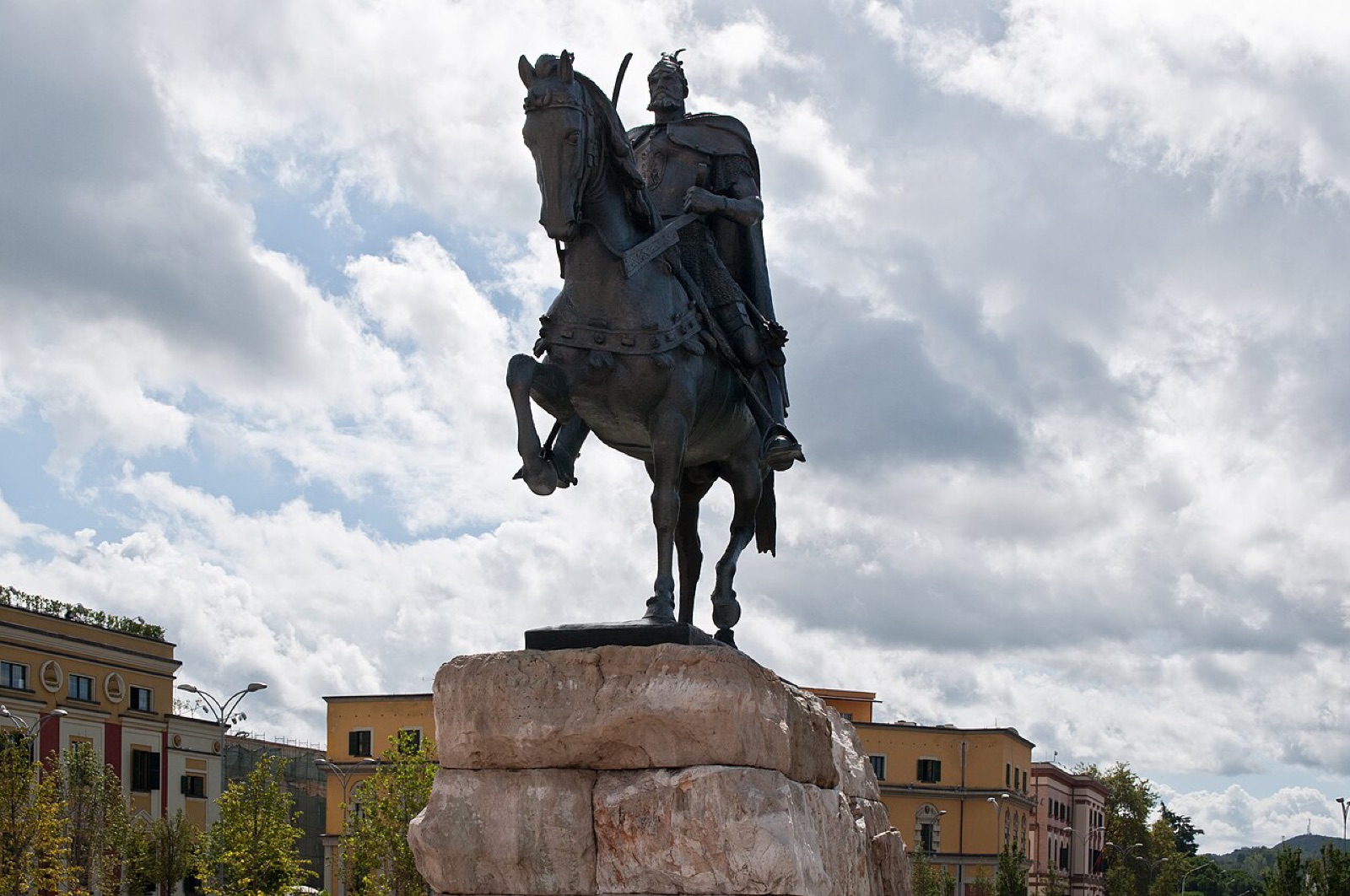
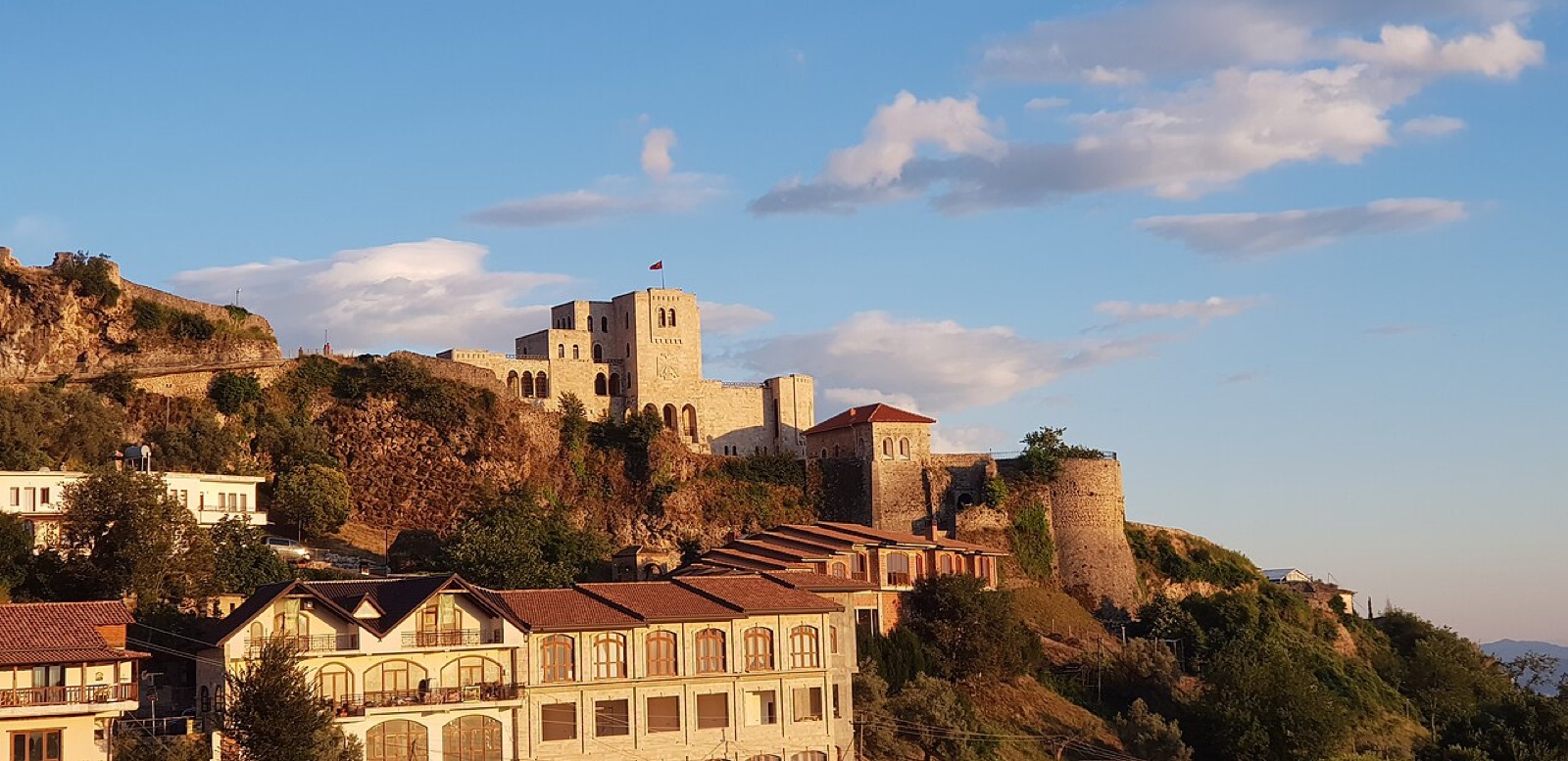
The legacy beyond the flag is everywhere. Skanderbeg statues stand in central squares in Tirana, Pristina, Skopje, Rome, and Detroit (the equestrian statue at the Albanian Cultural Center in Hamtramck). The main square of Tirana is Sheshi Skënderbej — Skanderbeg Square. Krujë preserves a Skanderbeg museum inside the reconstructed citadel where he held off two sultans. The Order of Skanderbeg is one of Albania’s highest civilian honors. Albanian schools, universities, scholarships, sports clubs, and military units carry his name. The Albanian general staff awards the Mjeshtër i Madh i Punës “Skënderbeu” — the Skanderbeg Master Medal — to its highest-decorated officers.
In Italian, his memory is kept by the Arbëreshë communities and through the sustained 17th- and 18th-century interest in Skanderbeg as a Christian-resistance figure — Vivaldi composed an opera, Scanderbeg, in 1718. In English, the Romantic poet Henry Wadsworth Longfellow wrote a Skanderbeg in the third part of Tales of a Wayside Inn (1873).
Skanderbeg in the diaspora
For Albanian Americans, Skanderbeg is the most invoked historical figure in civic life. He is not a folk reference but an institutional one — the name appears wherever Albanian-American organizations build something durable.
The Gjergj Kastrioti Scholarship Fund (GKS Fund), based in Michigan, awards scholarships to Albanian-American students each year and is named directly for him. Statues and busts stand at Vatra, the Pan-Albanian Federation of America, and at the Albanian American National Organization (AANO) building in New York. Restaurants, cafes, and small businesses across Albanian-American neighborhoods in the Bronx, Detroit, Worcester, and Boston carry the name Skënderbeu, Skanderbeg, or Kastrioti.
He is mentioned in nearly every Flag Day speech on 28 November, in nearly every dedication of a new Albanian-American institution, and in nearly every funeral oration for an elder of the community. The framing is always the same: a single Albanian who held against an empire for 25 years, and whose banner the assembled crowd is still flying.
For a community whose first organized US presence dates to 1908 — when Fan S. Noli founded the first Albanian Orthodox parish in Boston — Skanderbeg is the deep anchor. The League of Lezhë is the historical model the Albanian American advocacy organizations explicitly cite for their own work: pluralistic in religion (Catholic, Orthodox, Muslim, Bektashi, secular), unified in purpose, regional in basis but national in aim.
The Wikipedia and historical record
The Skanderbeg we have access to is largely the Skanderbeg constructed by Marin Barleti, the Albanian Catholic priest from Shkodër who published Historia de Vita et Gestis Scanderbegi in Latin around 1508-1510, four decades after Skanderbeg’s death (Wikipedia: Skanderbeg). Barleti’s book — long, dramatic, and steeped in Renaissance humanist conventions — was translated into Italian, French, German, English, Spanish, and Portuguese over the next two centuries, and it shaped the European image of Skanderbeg as a Christian-resistance archetype on a scale comparable to El Cid.
Barleti’s account is documentary on its frame and embellished in its interior. Numbers of Ottoman casualties are inflated. Speeches are invented in the Renaissance manner. Some of the more colorful episodes — the duels, the personal exchanges with Murad II — are Renaissance literary convention rather than reportage.
Modern Skanderbeg scholarship has done the work of separating the records from the embellishments. The two most important modern biographies are Oliver Jens Schmitt’s Skanderbeg: Der neue Alexander auf dem Balkan (2009, in German; Albanian translation 2009), and Harry Hodgkinson’s Scanderbeg: From Ottoman Captive to Albanian Hero (2005). Both work from Venetian, Neapolitan, Ottoman, and Vatican archival material that Barleti either did not have or did not use, and both produce a sharper, slightly less mythological Skanderbeg — a brilliant frontier commander rather than a Christian saint, a calculating dynastic noble rather than a religious crusader.
The frame holds in either telling. A Kastrioti prince taken to the Ottoman court as a child, raised into the Ottoman military, defected at the highest possible cost to his own personal safety, returned to his ancestral lands, unified a fractious nobility, and held off two of the most powerful empires of the medieval world for 25 years from a fortress in the mountains of central Albania. The records say so. The names of the battles say so. The flag flying over every Albanian-American banquet hall in the United States, 558 years after Skanderbeg’s death, says so.
If you’re an Albanian American descended from any of those League of Lezhë families, from any of the Arbëreshë villages in southern Italy, from a Krujë stonemason or a Lezhë merchant or a Dibra shepherd or a Kosovar Albanian who carried Skanderbeg’s name forward through five centuries of Ottoman rule — the National Albanian Registry exists to count you.
Add your name at /register — free, encrypted, community-led. The community-led count of Albanian Americans starts with the people who claim the inheritance.