
In April 1912, seven months before Albania itself declared independence from the Ottoman Empire, a group of Albanian immigrants gathered in Boston, Massachusetts, and founded a civic federation. They named it Vatra, the Albanian word for “the hearth.” Its founding organizers included Faik Konitza, the most consequential Albanian literary intellectual of his generation, who became the federation’s president in 1921. Its most consequential later leader was Fan Noli, Orthodox bishop and briefly prime minister of Albania.
One hundred and fourteen years later, the federation is still operating.
That continuity is the headline. Vatra, the Pan-Albanian Federation of America, is the oldest continuously-operating Albanian-American organization in the United States. It predates the Albanian state. It predates almost every other Albanian civic institution anywhere in the world. Vatra has survived two world wars, the Italian occupation of Albania, a forty-year communist blackout, the 1990s transition, and the post-1999 Kosovo settlement. It has not folded.
This article is the reference. What follows is what Vatra is, how it came to be, the people who built it, the role it played in the most consequential decade of Albanian history, and why a Boston federation founded in 1912 still matters to today’s roughly 230,000 Albanian Americans (and a community that, counting ethnic Albanians from Kosovo, North Macedonia, and Montenegro, runs closer to a million).
What Vatra is
Vatra is a civic federation in the strict institutional sense of that phrase: a member-based, nonprofit, non-partisan organization that exists to represent, organize, and serve the Albanian-American community.
It isn’t a government body, a church, or a new advocacy group. It is the central civic federation of the Albanian-American diaspora, organized as a federation of local chapters, headquartered in Boston, and continuously active since April 1912.
The federation’s stated mission has been stable across its history: support Albanian-American community life in the United States, advance Albanian national and cultural interests, and speak for the diaspora to American institutions and the Albanian state. The mechanisms have shifted (chapter network, newspaper, lobbying, scholarship, cultural programming), but the posture has not.
Vatra’s name encodes the choice. Vatra, the hearth, is the warm center of an Albanian household, the place a family gathers around. The 1912 founders chose the word deliberately. They were building a hearth for a community that was scattered across a hundred American mill towns and that had, in many cases, never met one another. The federation was the room where Albanians from Korçë could sit next to Albanians from Shkodër, where Orthodox could sit next to Muslims and Catholics and Bektashi, and where a community could become a community.
For a small, geographically dispersed, multi-confessional diaspora, that civic-federation model has been the thing that holds.
Boston, 1912: the founding
The founding date is April 1912. The city is Boston. The principal founders are Faik Konitza and Fan Noli, working with a circle of Albanian-American leaders drawn primarily from the Massachusetts mill towns and the small Boston-area Albanian community.
Boston was the natural site. By 1912, the city was already the educational, ecclesial, and editorial center of Albanian-American life. Fan Noli had founded the Albanian Orthodox Church in America there in March 1908, and had launched the Albanian-language newspaper Dielli there in February 1909; Faik Konitza took over as the paper’s chief editor later that same year. The Massachusetts mill belt (Worcester, Lowell, and the smaller mill cities) held the largest concentration of first-generation Albanian immigrants in the country, drawn primarily from the southern Albanian region of Korçë and from Albanian-speaking Orthodox communities in Ottoman Thrace.
The April 1912 founding meeting brought the existing Albanian-American patriotic societies (small, scattered, mostly chapter-sized organizations that had been operating in Boston, Worcester, and several other Northeast cities since the mid-1900s) under a single federated structure. Fan Noli served as the new federation’s secretary, and Faik Konitza took on an organizing role as one of its founding branch managers; Konitza would go on to become Vatra’s president in 1921. Dielli was adopted as the federation’s official organ within months. The newspaper has held that status continuously since (Wikipedia: Vatra).
The timing was not accidental. The Albanian-American community in 1912 was reading the news from the Ottoman Balkans with sharp attention. The Albanian National Awakening (Rilindja Kombëtare), the late-nineteenth and early-twentieth-century movement for Albanian language standardization, cultural recognition, and political independence from the Ottoman Empire, was at its peak. The Congress of Manastir had standardized the Albanian alphabet in November 1908. Diaspora intellectuals in Bucharest, Cairo, Sofia, Istanbul, and Boston were arguing in print about independence. The April 1912 founding of Vatra is best understood as the Albanian-American diaspora institutionalizing itself for a fight that everyone knew was coming.
Seven months later, on November 28, 1912, Albania declared independence from the Ottoman Empire in the southern port city of Vlorë. The federation Vatra had been built precisely in time.
Faik Konitza and Fan Noli
The two figures most associated with Vatra’s founding identity are Faik Konitza and Fan Noli, the same two men who would jointly anchor the early Albanian-American intellectual scene through the 1910s and 1920s.
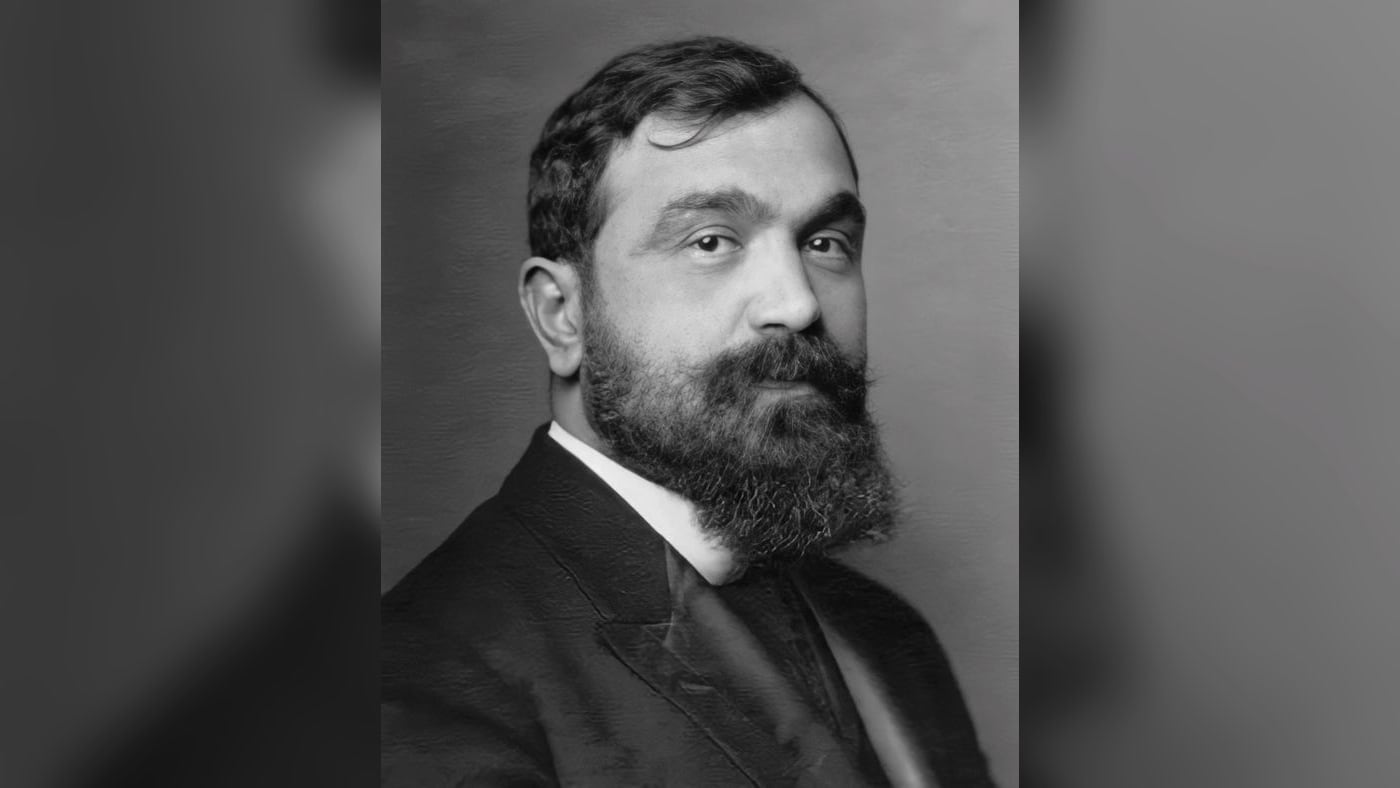
Konitza was the prose stylist and the polemicist. Born in 1875 (his pen name comes from the town of Konitsa, in what is now northwestern Greece), educated at Harvard and in Paris and Brussels, fluent in seven languages (Albanian, Greek, Italian, French, German, English, and Turkish), he had already been editing Albanian-language periodicals in Brussels and London before he moved to Boston. His prose set the register for modern literary Albanian: dry, exact, ironic, classical in its references, and allergic to sentimentality. He served as one of Vatra’s founding officers in 1912 and became the federation’s president in 1921, and later, much later, as Albania’s ambassador to the United States, appointed in 1926 and serving until Fascist Italy’s 1939 invasion of Albania ended the post; he remained in Washington, where he died in December 1942.
Noli was the orator and the institutional organizer. Born in Ibrik Tepe in Ottoman Thrace in 1882, he was ordained an Orthodox priest in 1908, founded the Albanian Orthodox Church in America that same year, briefly served as prime minister of Albania in 1924, and became the canonical Albanian translator of Shakespeare and Cervantes. His range across religious, political, and literary work made him Vatra’s most consequential single leader over the long run. He served multiple non-consecutive terms as Vatra’s president across the following decades and shaped its political identity through the 1920s and 1930s.
The two men had different temperaments and would clash periodically, most sharply during and after Noli’s brief 1924 government, which Konitza criticized. But the architecture they built together at Vatra’s 1912 founding has held for more than a century. It was civic rather than religious, inter-confessional, pan-Albanian by name and design, and organized as an American membership body rather than a foreign auxiliary. The name Pan-Albanian Federation was a choice, not decoration.
That choice, to address the whole Albanian-American community across confessional lines and to do so as an American civic body rather than as a branch of a homeland organization, is part of the legacy the federation still carries.
The 1919 Paris Peace Conference and the diaspora lobby
Vatra’s most consequential single episode came in 1919-1920, around the Paris Peace Conference and the post-First-World-War settlement of Albania’s borders.
The situation in 1919 was dire. Albania, which had declared independence in November 1912, had been occupied at various points during the First World War by Italian, Greek, French, Austro-Hungarian, and Serbian forces. The country was effectively partitioned by 1918. At the Paris Peace Conference, formal proposals were on the table to divide the Albanian-inhabited territories among Italy, Greece, and the new South Slav state of Yugoslavia. The young Albanian state was, in 1919, in serious danger of being erased from the map.
Vatra mobilized in response. The federation organized the Albanian-American community, perhaps the largest organized Albanian community outside the Balkans at that point, to lobby Washington and the Allied powers. Fan Noli’s own diplomatic advocacy for Albania’s borders was conducted from the United States and Geneva. The federation raised funds for the cause. Vatra’s official organ Dielli editorialized weekly in support of Albanian territorial integrity. The federation’s chapter network across the United States generated letters, petitions, and political pressure on members of Congress and on the Wilson administration.
President Woodrow Wilson’s reported opposition to partition is sometimes credited as decisive in keeping Albania intact. The diaspora pressure Vatra organized was a meaningful part of how that opposition was sustained. Albania survived the conference with reduced but contiguous borders (the 1913 Treaty of London boundaries had already excluded large Albanian-speaking populations in Kosovo and what is now North Macedonia, and Paris confirmed rather than reversed that loss) and was admitted to the League of Nations in December 1920.
The 1919-1920 lobbying is one of the under-told episodes of immigrant-diaspora foreign-policy influence in American history. A small immigrant community, perhaps 30,000-40,000 first-generation Albanians in the United States at the time, organized through a single Boston federation, and in coordination with a tiny home-country delegation in Paris, helped keep an independent Albania on the post-war European map. That episode is the high-water mark of Vatra’s geopolitical relevance and a load-bearing part of why the federation still commands the respect it does in Albanian-American civic life.
The chapter network, 1912-1939
The interwar period was Vatra’s most ambitious phase in terms of geographic reach.
By 1919, the federation had grown into a network of chapters across the United States. Concentrations were in Massachusetts (the Boston headquarters plus Worcester, Lowell, and smaller mill cities), New York (Manhattan and the Bronx), the Great Lakes industrial belt (Detroit, Pontiac, and the Michigan auto and iron towns), and the Pennsylvania coal country (Pittsburgh and the small towns of the western Pennsylvania bituminous belt). Smaller chapters existed in Ohio, Connecticut, Illinois, and several other Northeast and Midwest states.
The chapter model was the standard American immigrant federation pattern of the period; Greek-American, Italian-American, Polish-American, Armenian-American, and Lithuanian-American communities all had something analogous. A local chapter met monthly, collected dues, held social events, ran fundraising drives for the home country, supported new arrivals, and sent delegates to the federation’s annual convention. The chapter house in a mill town might be a rented hall or a back room of an Albanian-owned restaurant or coffeehouse. The federation’s annual convention, held in different cities in different years, was the moment the diaspora caught up with itself.
Through the 1920s and 1930s, the chapter network supported the Dielli daily edition (the paper expanded to daily publication during this period), funded scholarships for Albanian-American students, sent relief funds to Albania during economic crises and political upheavals, and served as the principal social and civic infrastructure of organized Albanian-American life.
Membership numbers across the federation’s history are imprecise. The federation kept records, but those records have not been fully transferred into modern accessible archives. The interwar peak is generally estimated in the low five figures of dues-paying members across the chapter network, with a broader community reach considerably larger. For a first-generation immigrant community whose total US population in the 1930s was perhaps in the tens of thousands, that level of organized federation membership is high.
Postwar contraction and Cold War continuity
The Second World War and the postwar consolidation of communist power in Albania reshaped Vatra’s operating environment.
Albania was occupied by Italy in April 1939 and then by Germany after Italy’s 1943 capitulation. The National Liberation War ended in 1944 with the communist-led partisans in power. By 1945, Enver Hoxha had consolidated single-party rule, and Albania entered what became the most isolated communist regime in Europe, breaking first with Yugoslavia in 1948, then with the Soviet Union in 1961, then with China in 1978.
For Vatra and the Albanian-American community, the postwar period meant near-total separation from the home country. Letters home went unanswered or were censored. Travel was nearly impossible in either direction. Family members on the Albanian side could be, and were, persecuted for having relatives in the United States.
Vatra’s editorial and political line through the Cold War decades was firmly anti-communist and pro-democratic, in alignment with the broader Albanian-American diaspora. The federation provided community continuity during a period when the homeland itself was inaccessible. Chapter activity contracted from the interwar peak. The first-generation immigrant cohort was aging, second-generation Americans had different civic priorities, and the lack of new immigration through the closed decades meant the membership base was not replenishing. Dielli contracted from daily back to weekly publication. Several chapters folded.
But the federation kept operating. The Boston headquarters stayed open. Dielli kept publishing. Annual conventions continued. Scholarships continued to be awarded. For Albanian-Americans of the second and third generations growing up in the 1950s, 1960s, and 1970s, Vatra was the thread that kept the community in touch with itself when contact with Albania was effectively impossible.
When Albania’s communist regime fell in 1991-1992 and the country reopened, Vatra was the diaspora institution best positioned to rebuild relationships across the Adriatic, because it had not stopped existing.
Vatra in the 21st century
The post-1991 period brought a large new immigration wave from Albania and a separate large wave from Kosovo after the 1999 Kosovo war. Those waves changed the composition of the Albanian-American community substantially. The first-generation mill workers from Korçë and Thrace who had built Vatra in 1912 were several generations gone. Today’s Albanian-American community includes their descendants in Massachusetts, New York, Michigan, Illinois, and the South, plus large post-1990s immigrant cohorts from Albania proper, plus large Kosovar-Albanian and Macedonian-Albanian communities concentrated in New York, Detroit, Worcester, Chicago, Texas, and elsewhere.
Vatra in the 21st century operates as a smaller institution than at its interwar peak, but as a continuously active one. Its headquarters relocated from Boston to the Bronx, New York, in the 1990s. Its website (vatraboston.com) carries federation news, Dielli publishes online at gazetadielli.com, and the federation continues to hold conventions and award scholarships, and remains the reference point for organized Albanian-American life.
The contemporary Albanian-American organizational field is broader than it was in 1912. The Albanian American National Organization (AANO), the Albanian American Civic League (AACL), the Albanian American Educators Association (AAEA), regional civic groups in Detroit, New York, and the Texas metroplex, religious bodies including the Albanian Orthodox Archdiocese and the Albanian Catholic communities, and a growing list of professional and cultural associations all play roles. Vatra is no longer the only institution in the room. But it is the oldest one, and its standing reflects that.
For the contemporary diaspora, Vatra’s value is part historical anchor, part active federation, and part archive. Its records, incomplete as they are, are among the most important primary sources of twentieth-century Albanian-American civic life in any single place. The federation that organized the 1919 diaspora lobby is the same federation, by an unbroken line of continuity, that operates out of the Bronx today.
Why Vatra matters to today’s Albanian-Americans
The case for Vatra’s centrality is institutional, not sentimental.
Vatra is the continuously-operating civic body that connects the immigrant generation of 1912 to the diaspora of 2026. Every major event in organized Albanian-American life has run through Vatra’s records, its leadership, or the pages of Dielli: the 1912 declaration, the 1919 Paris Peace Conference lobby, the interwar chapter network, the Cold War preservation period, the post-1991 reconnection with Albania, the post-1999 Kosovo settlement, and the post-2020 surge of interest in Albanian citizenship by descent.
For a small, geographically scattered, multi-confessional community, that continuity is the thing that is hard to replicate. Churches, mosques, teqe (Bektashi lodges), social clubs, regional federations, sports leagues, business networks, and family connections all play their roles. But the federated civic body that runs from a Boston meeting hall in April 1912 to vatraboston.com in 2026 has no peer in length of continuous existence. The next-oldest Albanian-American civic body is decades younger.
Vatra also defines, in practice, the inclusive operating definition of “Albanian-American” that most modern community institutions have inherited. The federation’s 1912 founders made an explicit choice: Vatra would address the whole Albanian-American community across confessional lines (Orthodox, Catholic, Sunni Muslim, Bektashi, and secular) and would treat the Albanian-American community as a single civic body regardless of region of origin in the Balkans. That choice has aged well. It is the same operating definition the National Albanian Registry uses today: Albanian Americans broadly defined, including ethnic Albanians from any Balkan country of origin, of any faith or no faith, of any generation.
That definition exists, in part, because Vatra chose it in April 1912 and held to it for more than a century.
The National Albanian Registry exists to count Albanian Americans across every state, every generation, every faith, and every Balkan country of origin. Vatra has been the institutional hearth of that community for 114 years; NAR is now its community-led headcount. Add your name at /register: it’s free, takes about a minute, and is a community-led count of the US Albanian diaspora.