
What November 28 means
November 28 is the most important day on the Albanian calendar. Dita e Flamurit — “Day of the Flag” — commemorates the 1912 declaration of independence from the Ottoman Empire, when Ismail Qemali raised the red-and-black double-headed-eagle flag from a balcony in Vlora and read the proclamation that, after more than 400 years of Ottoman rule, Albania was on its own.
In the homeland it is the day of the official parade, the presidential address, and a national pause. In the diaspora it is the most-attended community event of the year — bigger than New Year’s, bigger than Independence Day in either country of residence — because it is the one date when Albanians from every region, every faith, and every generation show up in the same room wearing the same colors.
This piece covers what happened in 1912, what the flag itself means, what the day looks like in Tirana, and how the US diaspora marks it from the Bronx to Detroit to Worcester. We close with a note on the civic moment that Flag Day has become — and a short ask for anyone reading who hasn’t yet been counted.
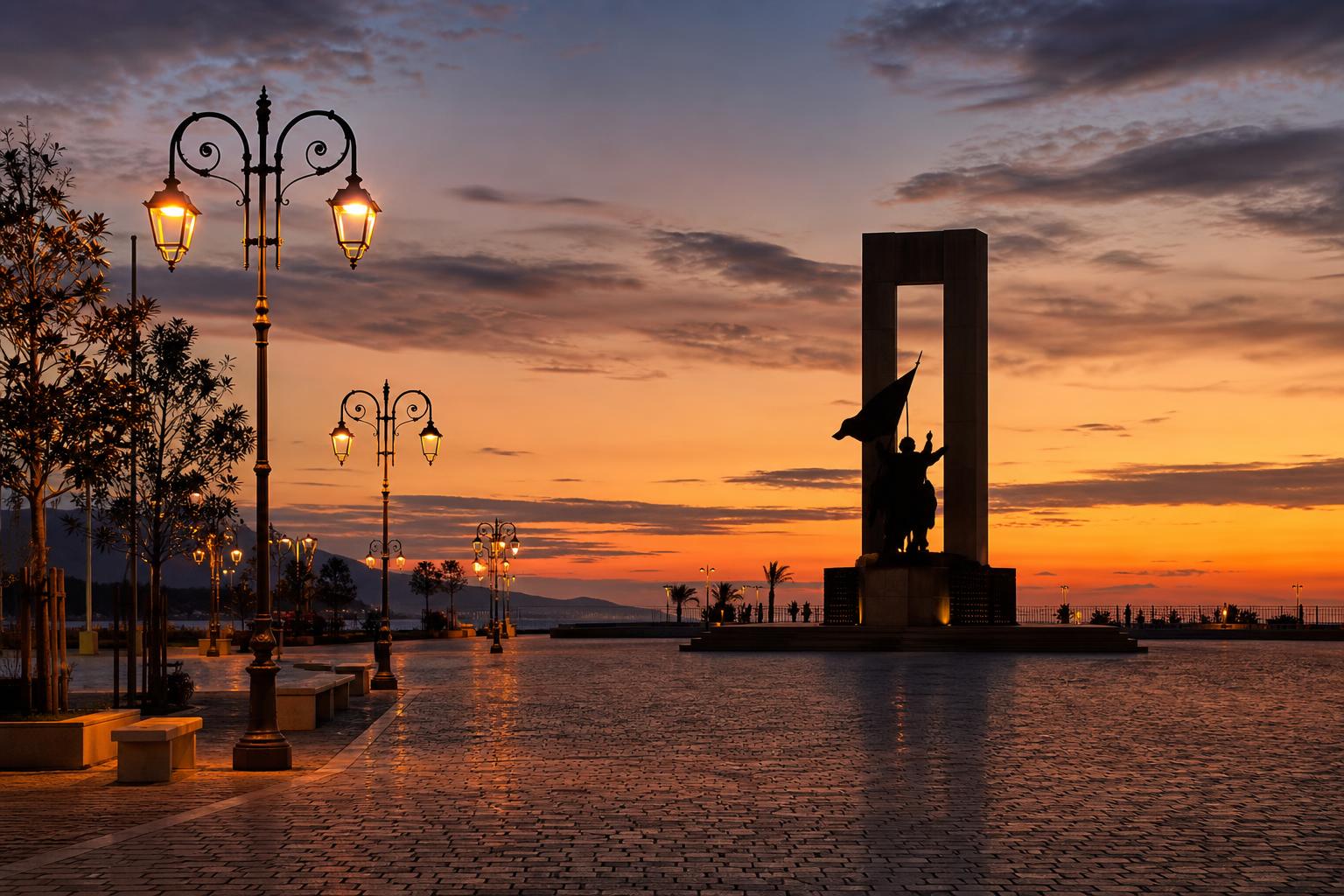 Independence Square, Vlorë, at dusk — the city where Ismail Qemali declared Albanian independence on November 28, 1912.
Graphic by NAR
Independence Square, Vlorë, at dusk — the city where Ismail Qemali declared Albanian independence on November 28, 1912.
Graphic by NAR
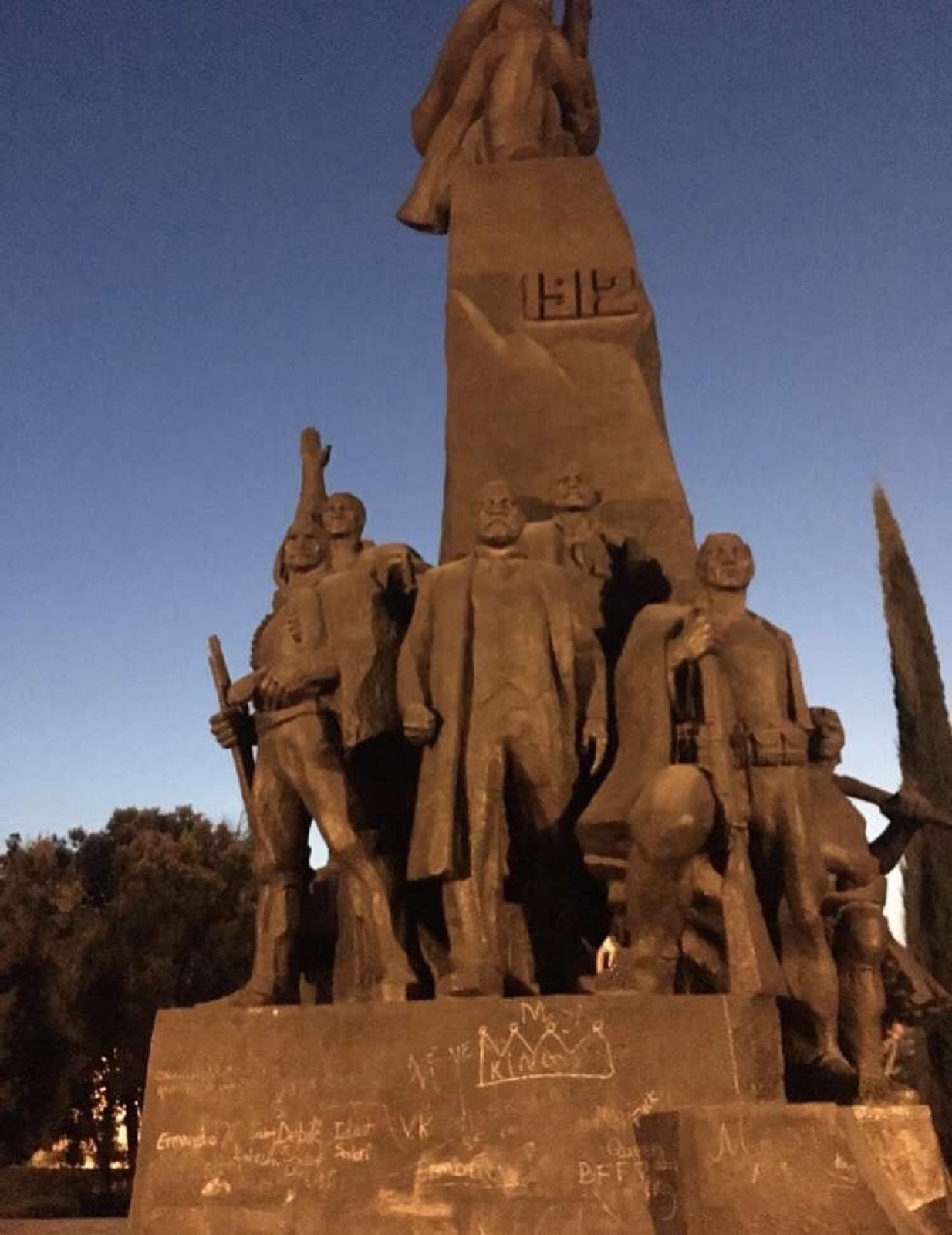 Independence Monument, Flag Square, Vlorë — bronze ensemble by sculptors Kristaq Rama, Mumtaz Dhrami, and Sh. Hadëri, completed 1972, depicting Ismail Qemali and the assembly that declared independence on November 28, 1912.
Photo: Wikimedia Commons / CC BY-SA
Independence Monument, Flag Square, Vlorë — bronze ensemble by sculptors Kristaq Rama, Mumtaz Dhrami, and Sh. Hadëri, completed 1972, depicting Ismail Qemali and the assembly that declared independence on November 28, 1912.
Photo: Wikimedia Commons / CC BY-SA
What happened on November 28, 1912
The First Balkan War began in October 1912. The Balkan League — Serbia, Montenegro, Greece, and Bulgaria — moved against the Ottoman Empire, and the four allies had every intention of partitioning the Albanian-inhabited lands among themselves. For Albanian leaders, the choice was narrow: declare independence inside a window of weeks, or watch the homeland disappear into someone else’s map.
The push came from two directions at once. Inside the territory, local notables and çetas (irregular fighters) were already in revolt. Outside it, the diaspora — especially the Albanian community in the United States, organized through the Vatra Federation in Boston, founded by Fan Noli and Faik Konitza — was lobbying, fundraising, and pressing the case for independence in the international press. Boston was, in a real sense, one of the back offices of the independence project.
Ismail Qemali, a 68-year-old former Ottoman official who had spent years in exile, was the figure the moment converged on. In November 1912 he traveled with Luigj Gurakuqi from Bucharest — where he had been coordinating with the Albanian community in Romania — to Vienna, securing a wary understanding with Austria-Hungary. From Trieste he sailed for the Adriatic coast, intending to land at Durrës. With Ottoman officials still in Durrës and Serbian forces approaching, he diverted south and reached Vlora on November 26, two days before the assembly.
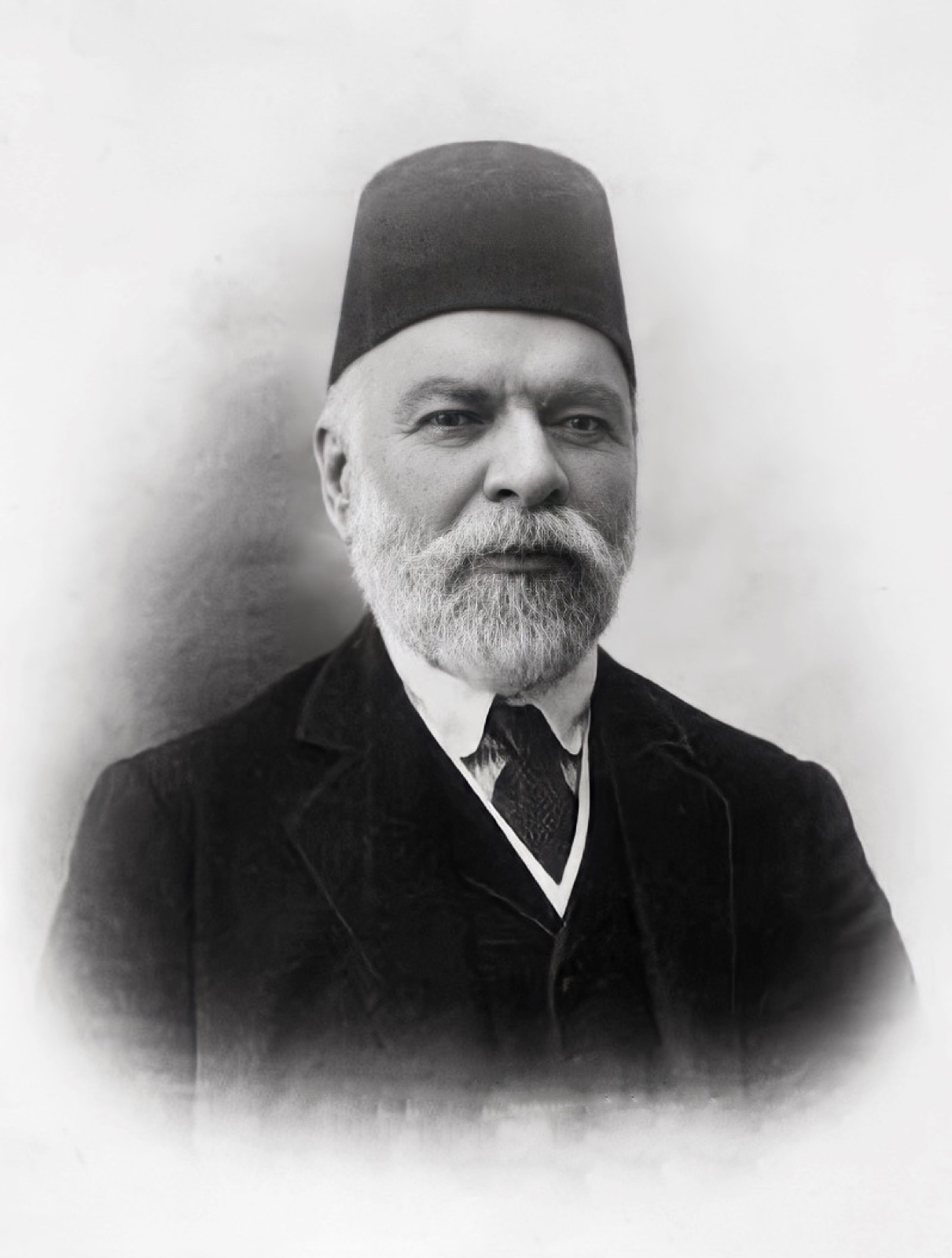 Ismail Qemali (Ismail Qemal Bey Vlora, 1844–1919), official portrait c. 1917 — first prime minister of independent Albania; raised the flag and read the declaration in Vlorë on November 28, 1912.
Photo: Wikimedia Commons / public domain
Ismail Qemali (Ismail Qemal Bey Vlora, 1844–1919), official portrait c. 1917 — first prime minister of independent Albania; raised the flag and read the declaration in Vlorë on November 28, 1912.
Photo: Wikimedia Commons / public domain
His son Ethem had already summoned Albanian representatives from across the territory. They convened in Vlora on November 28, 1912, in what is remembered in Albanian sources as the All-Albanian Congress — the assembly of delegates from every region that could send one in time. Catholic notables from the north, Orthodox figures from the south, Sunni and Bektashi delegates, beys and merchants and exiled writers. Forty signatories signed the founding document; the broader assembly counted about 80 registered delegates (counts vary from roughly 79 to 83 across sources). They unanimously elected Qemali to lead a provisional government.
That afternoon, from the balcony of the building remembered in the city’s collective memory as the flag-raising house, Qemali and Gurakuqi raised the flag and read the declaration aloud: Albania, today, is on its own — e lirë dhe e pavarur (free and independent). Within days the provisional government was sworn in, with Qemali as the first prime minister.
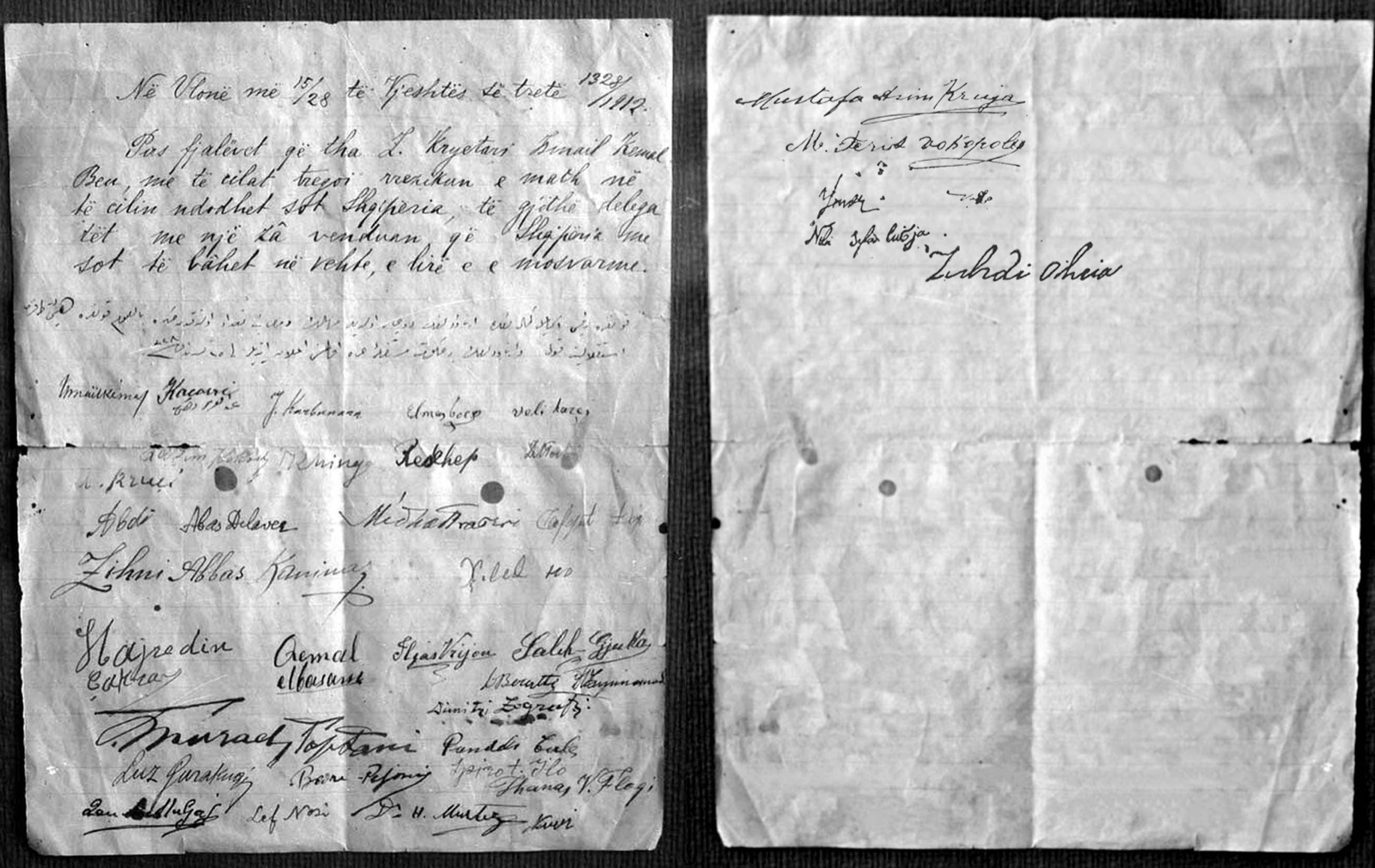 Original Albanian Declaration of Independence — signed by 40 delegates in Vlorë on November 28, 1912, with about 80 registered delegates attending the All-Albanian Congress.
Photo: Wikimedia Commons / public domain
Original Albanian Declaration of Independence — signed by 40 delegates in Vlorë on November 28, 1912, with about 80 registered delegates attending the All-Albanian Congress.
Photo: Wikimedia Commons / public domain
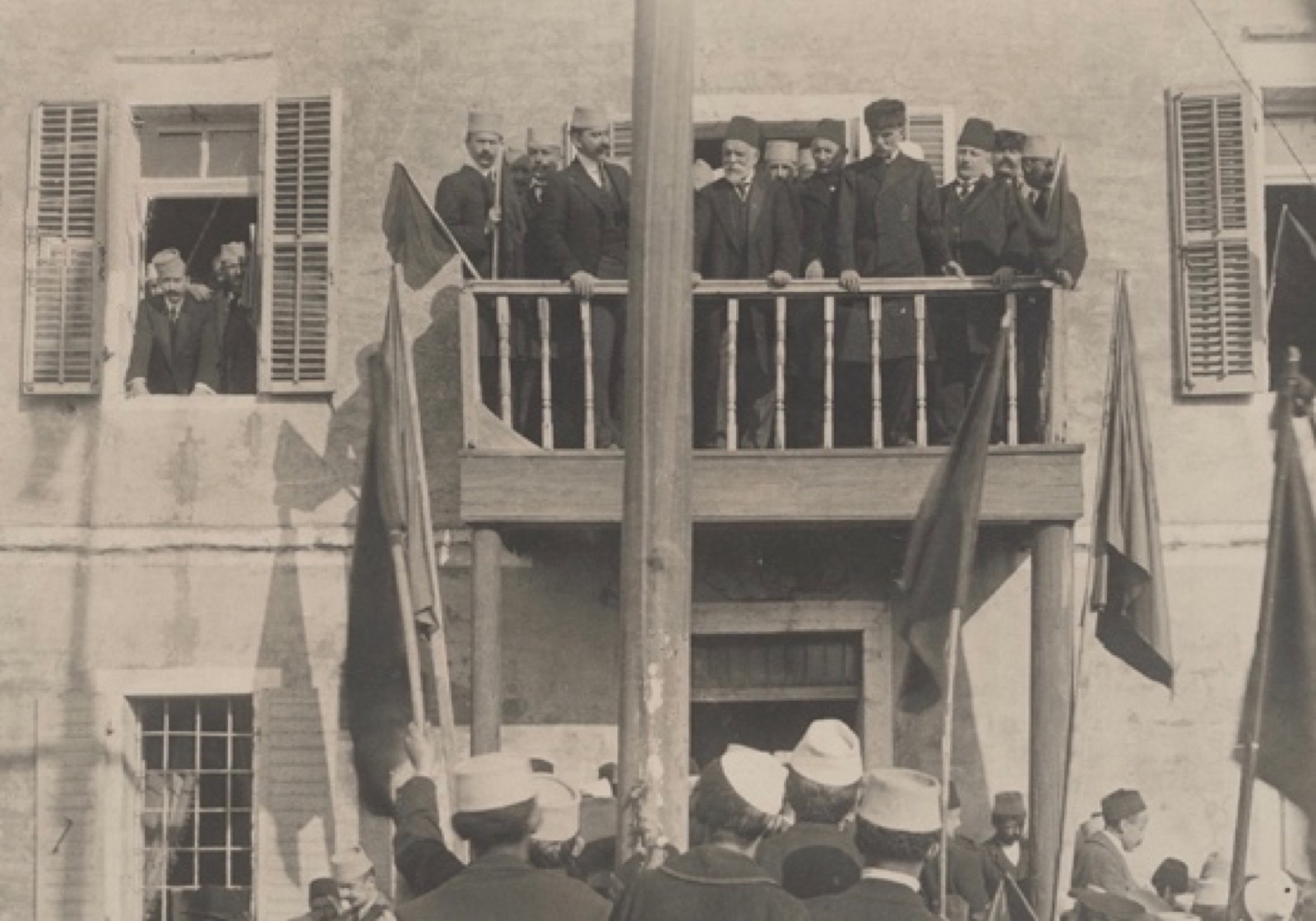 Ismail Qemali (seated center) and the provisional government cabinet, Vlorë, November 28, 1913 — first-anniversary commemoration of the declaration of Albanian independence.
Photo: Wikimedia Commons / public domain
Ismail Qemali (seated center) and the provisional government cabinet, Vlorë, November 28, 1913 — first-anniversary commemoration of the declaration of Albanian independence.
Photo: Wikimedia Commons / public domain
The international recognition followed quickly and the territorial settlement followed slowly. The Treaty of London (May 1913) recognized an independent Albania, and the Protocol of Florence (December 1913) fixed its borders — leaving roughly half of the Albanian-speaking population outside the new state. Kosovo was assigned to Serbia. Çamëria went to Greece. Significant Albanian populations remained in what is today North Macedonia and Montenegro. That uneven settlement is the reason the Albanian world has never been contained inside one country, and the reason the diaspora has stayed politically active through every generation since.
The flag itself
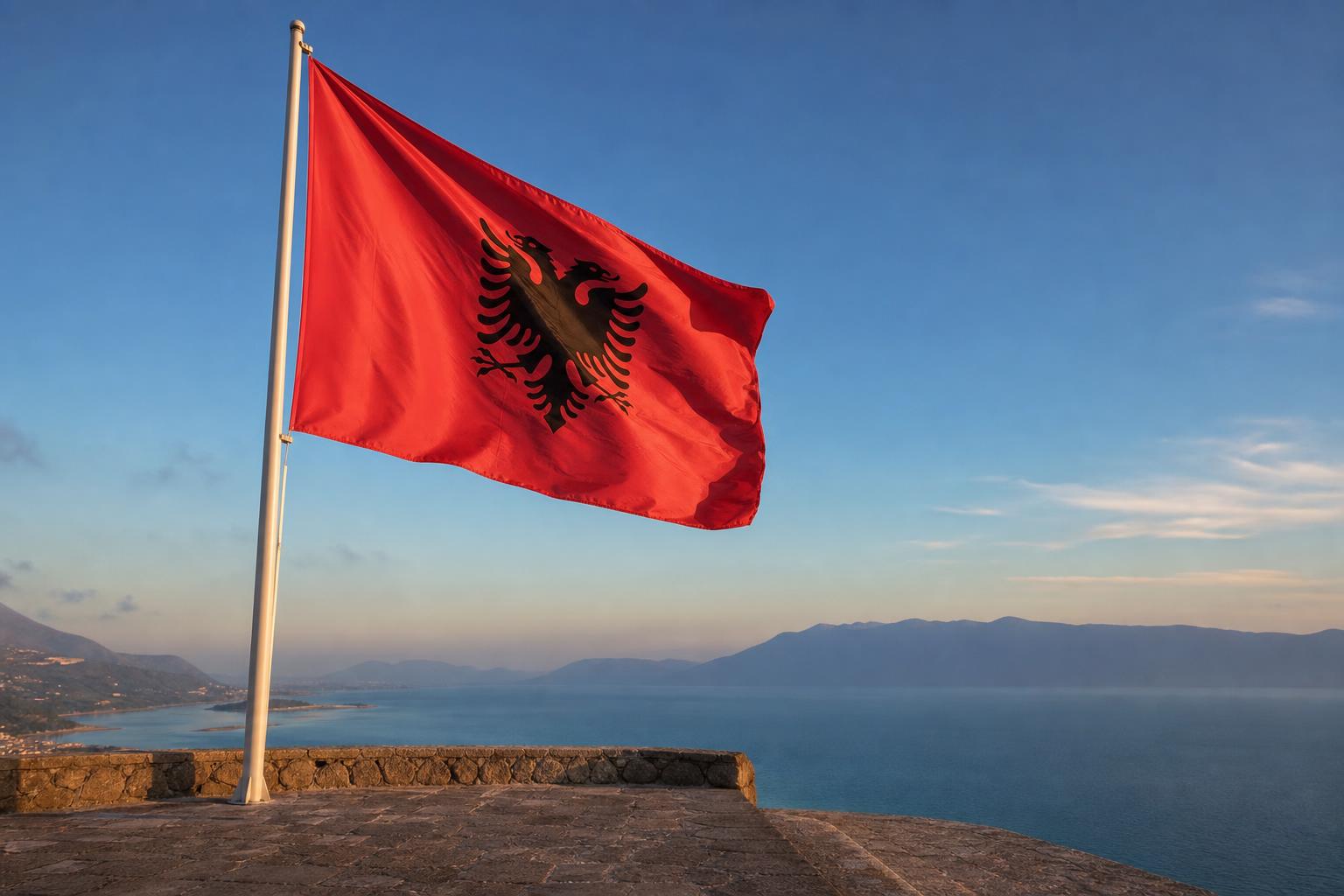
The flag is a single black double-headed eagle on a deep red field. No stripes, no stars, no inscriptions — just the bird and the color. It is one of the simplest national flags in Europe and one of the oldest in continuous symbolic use.
The double-headed eagle traces to the Eastern Roman (Byzantine) imperial tradition, where it represented dominion across two horizons — east and west. Medieval Albanian noble houses adopted the motif as their heraldry. The most famous of those houses was the Kastrioti family, whose son Gjergj Kastrioti — Skanderbeg — fought a 25-year campaign against Ottoman expansion in the 15th century under a black double-headed eagle on a red banner. Skanderbeg’s victories made the design legendary in Albanian memory. By the time 19th-century nationalists were looking for a symbol of resistance to Ottoman rule, the choice was already made for them.
Red carries the meaning it usually does on flags shaped by long resistance: bravery, valor, and bloodshed. The phrase “blood red” is not casual. It was chosen, and continues to be read, as the color of the cost paid for freedom.
The flag’s continuity through the 20th century is striking. King Zog’s 1928–1939 monarchy added a crown above the eagle. The 1939–1943 Italian occupation imposed fascist symbols and Italian colors. The 1946–1992 communist regime added a five-pointed gold star above the eagle and changed the red shade. The post-1991 republic stripped the additions and returned the flag to its 1912 form. Through every regime, the eagle and the red field stayed.
A note on Kosovo: Kosovo’s 2008 flag is a separate, deliberately different design — blue with a gold map of the country and six white stars — created under United Nations supervision to be neutral across Kosovo’s communities. Most Kosovar Albanians fly the Kosovo flag and the Albanian flag side by side, especially on November 28. The two flags are not in tension; they answer different questions.
How it’s celebrated in Albania
In Albania the day is a public holiday. Schools close. The official observance is anchored at Skanderbeg Square in Tirana, where the flag is raised, the president addresses the nation, and a wreath is laid at the National Historical Museum. A military parade marks the larger anniversaries. In Vlora — the city where it all happened — the Independence Monument is the focal point, and crowds gather at the harbor where Qemali came ashore.
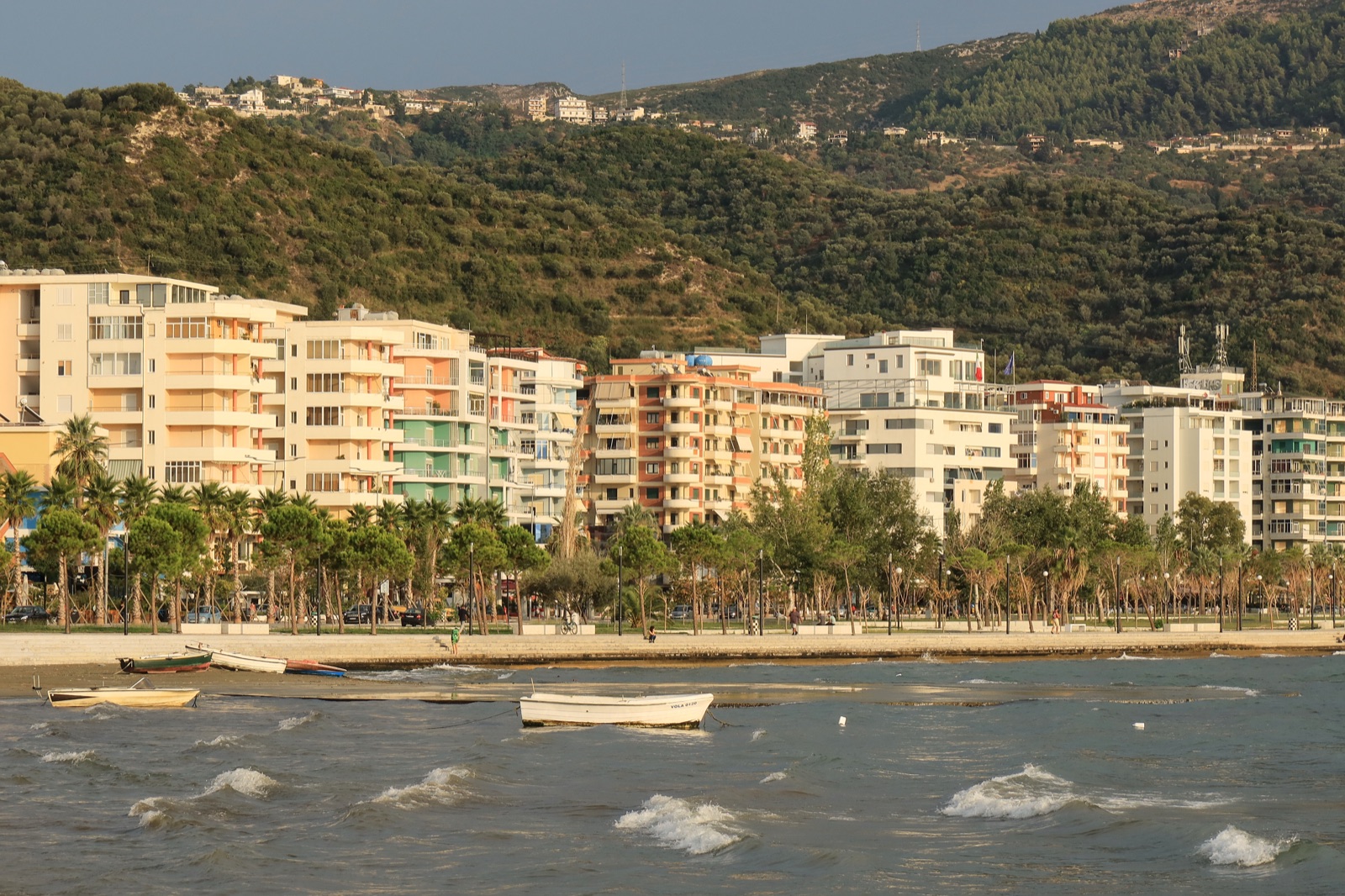 Vlorë promenade along the Adriatic — the harbor where Ismail Qemali landed on November 26, 1912, two days before the declaration.
Photo: Wikimedia Commons / CC BY-SA
Vlorë promenade along the Adriatic — the harbor where Ismail Qemali landed on November 26, 1912, two days before the declaration.
Photo: Wikimedia Commons / CC BY-SA
Outside the formal program, Flag Day is family. Three-generation dinners, the older relatives in red and black, the kids learning the words to Himni i Flamurit (the national anthem) for school recitations. The same scene plays out in Pristina, Skopje, Tetovo, Ulcinj, and every Albanian town and village in the Western Balkans.
How the US diaspora celebrates
This is where most of our readers live, so we’ll go city by city.
New York metro (Bronx, Yonkers, Westchester). The largest concentration in the country. Flag Day brings Albanian Catholic mass at the Church of Our Lady of Shkodra in Hartsdale (Westchester), the Vatra Federation gala, the Albanian American Civic League (AACL) annual program in Westchester, and a parade through Albanian commercial corridors of the Bronx. Illyria and Dielli, two of the oldest Albanian-American newspapers, run Flag Day editions. Expect crowds in the thousands across the metro on the weekend closest to November 28.
Detroit metro (Sterling Heights, Warren, Hamtramck, Southfield MI). The second-largest concentration. The Albanian American National Organization (AANO) has a Detroit chapter, and the local Independence Day dinner draws several hundred. Parish events anchor the local observance — St. Paul Albanian Catholic Church in Warren and Our Lady of Albanians in Southfield are among the largest Albanian parishes in the metro. Several Detroit-metro municipalities, including Sterling Heights and Hamtramck, have raised the Albanian flag at city hall on November 28 in recent years.
Boston and Worcester. Boston is the historical home of Vatra — the diaspora organization that helped midwife the 1912 declaration. The Boston-area gala is one of the oldest continuously running Flag Day events in the United States. Worcester’s Albanian community, anchored around the Albanian Saturday school, runs a student program every year where kids in fustanella (the traditional pleated skirt worn by men in folk dress) recite Skanderbeg poems and the national anthem.
Connecticut (Waterbury, Bridgeport). Waterbury hosts a long-running parish dinner. Bridgeport is home to a chapter of the Albanian American National Organization (AANO), and Connecticut’s Albanian community marks Flag Day with parish dinners and student scholarship awards in front of the community.
Chicago. The Albanian-American Community of Illinois (AACI), a Chicago nonprofit, runs a Chicago-area Flag Day program with live music, traditional performances, and a communal dinner.
Florida and Texas. Both newer for the diaspora and both growing fast. Flag Day programs in these states are smaller — dozens to low hundreds — but they are the seeds of what Detroit looked like 50 years ago.
Common elements across all of them. A flag-raising. The national anthem. Skanderbeg poem recitations, often by the youngest kids in the room. Folk dress: fustanella on boys and men, embroidered xhubleta dresses on girls and women. A live Albanian band — çifteli (the two-string lute), def (frame drum), clarinet, and accordion. Long looping rounds of valle (the Albanian folk dance, danced in a hand-linked circle). Dinner — tavë kosi (baked lamb and yogurt), byrek (filo pastry), grilled meats. Raki toasts. Speeches that run a little long. Children running between the tables.
What to bring and wear
Wear red, or wear black, or wear both. A small Albanian flag pin pinned to a lapel or scarf is the most common signal — most events have a table by the door selling them for a few dollars to fund the next year’s program. If you have a folk-dress accessory you’re comfortable in — a qeleshe (the white felt cap), a sash, an embroidered vest — wear it. If you don’t, dress like you would for a wedding.
Bring an appetite. Albanian hospitality at communal events is, structurally, more food than the room can finish. Bring cash for the door if it’s a benefit dinner, and bring a child if you have one — Flag Day is one of the few cultural events where kids are not just tolerated but central to the program.
Many events welcome non-Albanian guests. If you are dating, married into, working with, or simply curious about the community, this is the day of the year to show up.
The civic moment beyond the party
Flag Day is also when most Albanian-American organizations launch their annual fundraising, announce scholarship recipients, install new board members, and align on the year ahead. The atdhetare (patriotic, homeland-loving) tradition that the 1912 generation passed down is alive in the diaspora not as nostalgia but as ongoing civic work — schools, parishes, scholarships, regional chambers, advocacy in Washington, and infrastructure-building organizations like ours.
The day reminds us of two things at once. First, that an Albanian state exists at all because the diaspora helped will it into being in 1912 — the Boston Albanians who funded Vatra, the Bucharest Albanians who hosted Qemali, the New York and Worcester families who sent money home and pressure to Washington. Second, that the work didn’t end with the flag-raising. The 1913 border settlement left half of us outside the borders. Every generation since has had to keep finding ways to stay connected across those lines.
That’s what Flag Day is for. Not just the dinner. The reminder.
Get counted by the next Flag Day
If you’ve read this far and you haven’t yet been counted, that’s the action. The National Albanian Registry is a community-led count of Albanian Americans — free, private, three minutes, and run by the diaspora for the diaspora. Every name on the list makes the community more visible to the institutions that decide what gets funded, who gets recognized, and which categories show up on the next census.
Get counted at albanianregistry.org/register — and we’ll see you at Flag Day.