
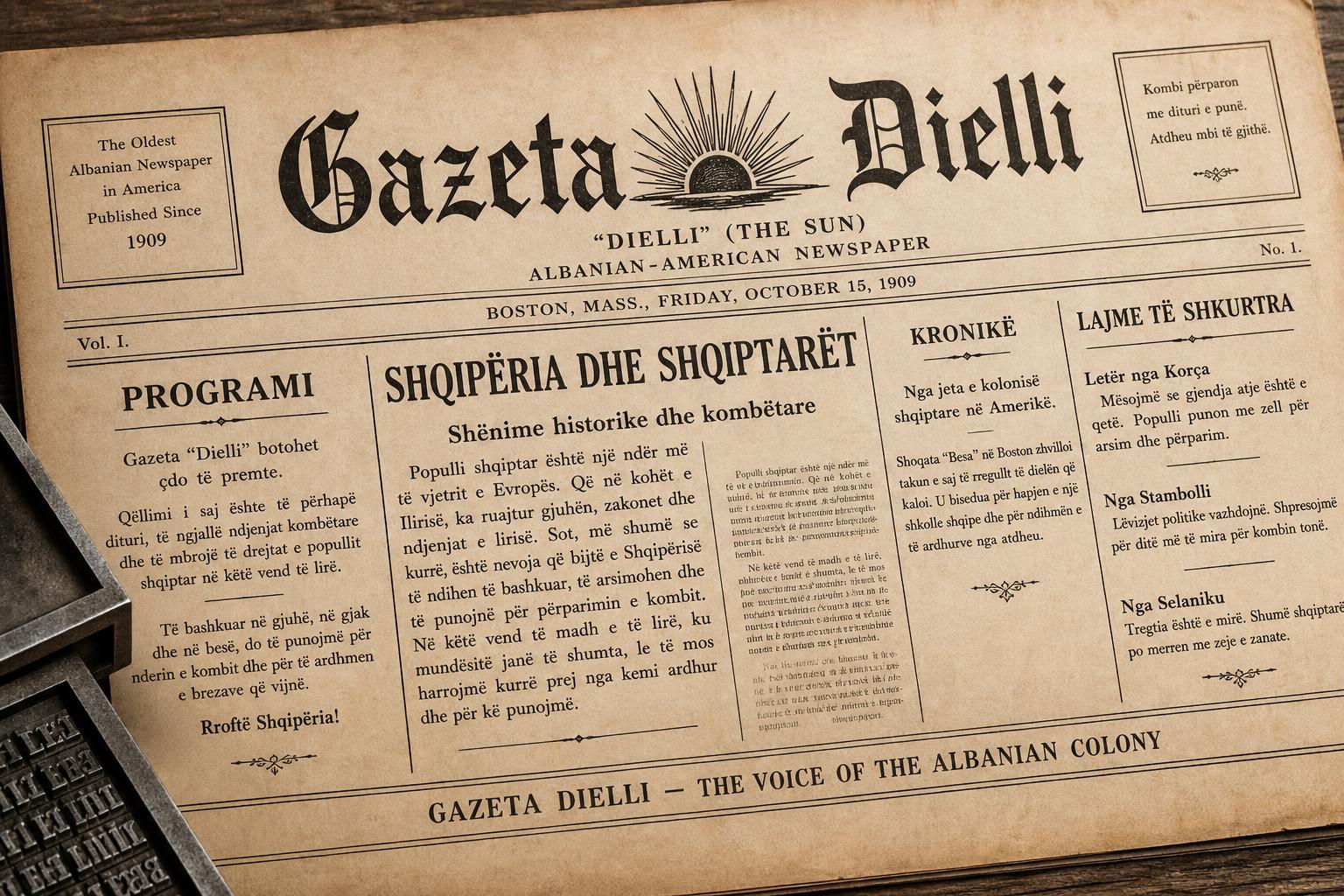
Long before there was a unified Albanian state, an Albanian Wikipedia, an Albanian-language Google search, or an Albanian-American TV channel, there was a four-page Albanian newspaper printed in Boston, Massachusetts. Its name was Dielli — Albanian for “the Sun” — and the first issue came off the press on February 15, 1909. The paper was founded by Fan Noli as the newspaper of the Besa-Besën society, a Boston Albanian-American political-cultural organization. Faik Konitza — the most consequential Albanian literary intellectual of his generation — arrived in Boston that autumn and took over as chief editor a few months after the founding.
One hundred and seventeen years later, the paper is still publishing.
That continuity is the headline. Gazeta Dielli — almost always referred to simply as Dielli — is the longest-running Albanian-language newspaper in the United States and one of the longest-running Albanian-language newspapers anywhere. Since 1912 it has been the official organ of the Pan-Albanian Federation Vatra — Vatra literally means “the hearth” in Albanian — the central civic body of the Albanian-American community. Today Dielli publishes online at gazetadielli.com, still tied to Vatra, still recognizable as the paper Noli launched in a Boston print shop in 1909.
This article is the institutional reference. What follows is what Dielli is, where it came from, the people who built it, and why a 117-year-old Boston newspaper still matters to today’s Albanian-American community.
What Gazeta Dielli is
Dielli is a community newspaper in the strict institutional sense of that phrase: a paper that exists primarily to inform, organize, and represent a specific community — in this case, the Albanian-American diaspora and its civic federation, Vatra.
It is not a commercial daily competing in a metropolitan market. It is not a state newspaper subsidized by a foreign government. It is not a recently-launched diaspora outlet. It is the institutional newspaper of organized Albanian-American life, published by a US-based 501(c)-style civic federation, written largely in Albanian with periodic English-language pieces, and circulated to a readership that is primarily second- and third-generation Albanian Americans, recent immigrants, and the small academic readership tracking Albanian-language press abroad.
The paper’s stated mission across its history has been threefold: report on the Albanian-American community, cover developments in Albania and Kosovo for diaspora readers, and serve as a documentary record of the federation’s activity. Across more than a century, that mission has been remarkably stable. The format has shifted — from weekly broadsheet to daily, back to weekly, and finally to digital — but the institutional posture has not.
For a community whose population in the United States is comparatively small (the U.S. Census estimates roughly 230,000 people of Albanian ancestry, with community estimates including ethnic Albanians from Kosovo, North Macedonia, and Montenegro running closer to a million), having a continuously-publishing paper of record is unusual. Most diaspora newspapers in the United States — Greek-American, Italian-American, Lithuanian-American, Polish-American — have peaked, contracted, merged, or folded. Dielli has not folded.
Boston, 1909: founding and the first decade
The founding date is February 15, 1909. The city is Boston. The founder of the paper as it has existed for the last 117 years is Fan Noli, the Ottoman-Thrace-born Albanian Orthodox priest, writer, and future prime minister of Albania, who published Dielli as the newspaper of the Besa-Besën society, a Boston-based Albanian-American political-cultural organization. Its first manager was George Konda.
Faik Konitza arrived in Boston in the autumn of 1909 — several months after the founding — and took over from Noli as Dielli’s chief editor. The historiography of late-Ottoman Albanian-language newspapers in the diaspora is tangled — papers folded, restarted under new names, merged, and changed cities — and the two men’s tenures at Dielli are sometimes conflated in popular accounts. What does not vary: by February 1909 there was a paper called Dielli publishing in Boston under the Besa-Besën banner, and that paper has been the spine of the Albanian-American press ever since.
The Boston of 1909 had a small but rapidly growing Albanian immigrant community, drawn primarily from the southern Albanian region of Korçë and the surrounding villages, and from Albanian-speaking Orthodox communities in Ottoman Thrace. Most early Albanian Americans worked in the textile mills of Worcester, Lowell, and the Massachusetts mill belt, with a smaller cohort in the iron and steel mills of the Great Lakes. Boston was the natural editorial capital because it was the educational, ecclesial, and civic center for this community — the same city in which Fan Noli had founded the Albanian Orthodox Church in America the year before, in March 1908.
The paper’s first decade ran in parallel with three institutional events that defined Albanian-American life: Noli’s church (1908), the founding of Vatra (1912), and the Albanian declaration of independence on November 28, 1912. Dielli covered all three from the inside.
Faik Konitza, Fan Noli, and the early editorial line
The two figures most associated with Dielli’s editorial identity in the 1910s and 1920s are Faik Konitza and Fan Noli — the same two men who would co-found Vatra in 1912 and would jointly anchor the early Albanian-American intellectual scene.
Konitza was the prose stylist and the polemicist. Born in Konitsa in 1875 (his pen name comes from the town), educated at Harvard and in Paris and Brussels, fluent in Albanian, French, English, German, Italian, Greek, Latin, and Turkish, he had already been editing Albanian-language periodicals in Brussels and London before he took over as Dielli’s chief editor in Boston in the autumn of 1909, several months after Fan Noli founded the paper. His prose set the register for modern literary Albanian: dry, exact, ironic, classical in its references, allergic to sentimentality. He is widely regarded as one of the founding voices of modern Albanian critical prose. Konitza later served as Albania’s first minister — later ambassador — to the United States, a post he took up in 1926; he held the post until 1939, when Fascist Italy invaded Albania, and died in Washington in 1942.
Noli was the orator and the institutional organizer. Born in Ottoman Thrace in 1882, ordained an Orthodox priest in 1908, founder of the Albanian Orthodox Church in America, briefly prime minister of Albania in 1924, and the canonical Albanian translator of Shakespeare and Cervantes — Noli’s range across religious, political, and literary work made him Dielli’s most consequential single editor. He edited the paper at multiple points across his long career, and his editorials shaped its political identity through the 1920s and 1930s.
The two men had different temperaments and would clash periodically — most sharply during and after Noli’s brief 1924 government, which Konitza criticized — but the editorial line they jointly forged for Dielli was consistent in its commitments: support for Albanian independence and territorial integrity, language standardization, ecclesial autonomy for Albanian Orthodox Christians, and a civic, inter-confessional Albanian nationalism that included Albanian Catholics, Sunni Muslims, Bektashi, Orthodox, and secular readers under one editorial roof.
That choice — to address the whole Albanian-American community across confessional lines rather than to identify with one religious bloc — was deliberate. It is the same choice Vatra made at its 1912 founding. It is part of the institutional inheritance the paper still carries.
Vatra and Dielli: an institutional partnership
In April 1912, Konitza, Noli, and a circle of Albanian-American leaders founded the Pan-Albanian Federation of America — Vatra — at a meeting in Boston. Within months, Dielli was established as the federation’s official organ, a status it has held continuously since.
The partnership has structural meaning. Vatra is the membership federation; Dielli is its newspaper of record. Federation announcements, chapter activity, fundraising drives, political resolutions, and obituaries of community elders all run in Dielli. The paper’s editorial voice has at various points been formally appointed by Vatra’s elected leadership and at other points operated with significant editorial independence inside the federation. The pattern across more than a century is that Vatra governs the institution and Dielli publishes it.
By 1919, Vatra had built a national network of local chapters across the United States, with concentrations in Massachusetts, New York, the Great Lakes industrial belt, and the Pennsylvania coal country. Dielli circulated through that chapter network. Mill workers in Worcester, restaurant owners in the Bronx, parish priests in Pontiac and Detroit, and small-business families in southwestern Pennsylvania all read the same Boston paper.
The federation-and-paper model is common in twentieth-century immigrant communities — Greek-American, Italian-American, Polish-American, Armenian-American, and Lithuanian-American communities all had something analogous. What is unusual about the Vatra-Dielli pair is the duration. The federation is the oldest continuously-operating Albanian-American organization. The paper is the longest-running Albanian-language newspaper in the country. Both have been at it since 1912.
Dielli during the Albanian National Awakening and WWI
The paper’s first decade overlapped with the closing chapter of the Albanian National Awakening (Rilindja Kombëtare) — the late-nineteenth and early-twentieth-century movement for Albanian language standardization, cultural recognition, and political independence from the Ottoman Empire. By the time Dielli launched in February 1909, the movement was at full pitch. The Congress of Manastir (Bitola) had standardized the Albanian alphabet in November 1908, three months earlier. Diaspora intellectuals in Bucharest, Cairo, Sofia, Istanbul, and Boston were arguing in print about language reform, ecclesial autonomy, and independence. Dielli arrived as one of the loudest American voices in that argument.
When Albania declared independence on November 28, 1912, Dielli and Vatra together became the diaspora’s primary instrument for arguing the new state’s case to American policymakers. The paper covered the First Balkan War (1912-13), the Treaty of London (1913) — which set Albania’s borders but excluded large Albanian-speaking populations in Kosovo and what is now North Macedonia — and the chaotic early years of the Albanian principality.
The paper’s most consequential period was the First World War and the immediate post-war settlement. With Albania occupied by Italian, Greek, French, Austro-Hungarian, and Serbian forces at various points and with partition proposals on the table at the 1919 Paris Peace Conference, Vatra and Dielli mobilized the Albanian-American community to lobby Washington and the Allied powers. Noli traveled to Paris as part of the Albanian delegation. The paper editorialized for territorial integrity. Vatra’s 1919-1920 lobbying — covered weekly in Dielli — is one of the under-told episodes of immigrant-diaspora foreign-policy influence in American history. When Albania was admitted to the League of Nations in December 1920, Dielli covered it as a diaspora victory.
The interwar and Cold War decades
The interwar period was the paper’s most ambitious phase in terms of frequency and reach. Dielli expanded to daily publication during the 1930s and 1940s, with a circulation that — according to the paper’s own institutional history and Vatra’s records — reached the low five figures at peak. For a community whose first-generation immigrant population was perhaps in the tens of thousands at the time, daily Albanian-language publication is a remarkable institutional achievement.
The paper covered the Italian invasion of Albania in April 1939, the Second World War under Italian and German occupation, the National Liberation War that ended in 1944, and the consolidation of communist power in Albania under Enver Hoxha by 1945. The post-war shift was sharp. With Albania closed off behind a particularly hard version of the Eastern Bloc — under Hoxha, Albania broke first with Yugoslavia, then with the Soviet Union, then with China — Dielli’s editorial line through the Cold War decades was firmly anti-communist and pro-democratic, in alignment with the broader Albanian-American diaspora.
Through the 1950s, 1960s, and 1970s, the paper served a community that had effectively no contact with the Albanian state. Letters home went unanswered or were censored. Travel was nearly impossible in either direction. Dielli’s role in those decades was preservation — keeping Albanian-language journalism alive in the United States while it was being forcibly homogenized inside Albania itself, where the regime imposed a single official literary standard, controlled all publishing, and persecuted writers and clergy.
The paper’s frequency contracted from daily back to weekly during the postwar decades, partly because the first-generation immigrant cohort was aging and partly because the institutional resources required to publish daily had thinned. But it kept publishing.
When Albania’s communist regime fell in 1991-92, Dielli covered the transition closely. The paper has since covered the 1997 pyramid-scheme collapse, the 1999 Kosovo war, NATO intervention, Kosovo’s 2008 declaration of independence, the 2020 Albanian citizenship-by-descent law (Law No. 113/2020), and the steady normalization of US-Albania and US-Kosovo relations. For diaspora readers who lived through the closed decades, the paper has been the through-line.
Dielli today: the move online and gazetadielli.com
Dielli’s current home is gazetadielli.com.
The shift to online-first publication tracks the broader trajectory of small-circulation diaspora newspapers in the United States. Print runs are expensive, postal distribution to a geographically scattered readership is even more expensive, and the audience for Albanian-language print journalism in North America is — like most diaspora print audiences — older and shrinking. The web is the natural home for a community newspaper of Dielli’s scale and mission.
The website carries news from Albania and Kosovo, coverage of Vatra chapter activity, obituaries and life-event notices, opinion essays, and historical reprints from the paper’s archive. The editorial structure remains tied to Vatra. The paper continues to publish primarily in Albanian, with periodic English-language pieces aimed at second- and third-generation Albanian Americans whose written Albanian may be limited.
The National Albanian Registry’s brand profile lists Dielli alongside Illyria (the New York-based Albanian-American newspaper) and ACTV Michigan as part of the contemporary Albanian-American media ecosystem. Each plays a different role: Illyria is a New York-headquartered weekly that has historically had a slightly different editorial profile and circulation footprint; ACTV Michigan is a Detroit-area television operation oriented toward the large Albanian-American community in Macomb and Oakland counties; Dielli is the Boston-Vatra paper of record with the longest institutional history. The three are complementary, not competitive in the commercial sense.
For Albanian-American readers in 2026, Dielli’s practical role is part news outlet, part community bulletin board, part historical archive. The paper has digitized substantial portions of its back catalog, and the archive itself is now one of the most important primary-source records of twentieth-century Albanian-American life in any single place.
Why Dielli matters to Albanian-American identity
The case for Dielli’s centrality is institutional, not sentimental.
The paper has counted Albanian-American voices for more than a century. Every immigrant generation since 1909 has read it. Every major event in Albanian-American civic life — Vatra’s founding, the 1919-1920 lobbying, the interwar daily edition, the Cold War preservation period, the post-1991 reconnection with Albania, the post-1999 settlement in Kosovo, the 2020 citizenship law — has been covered in its pages, often from the inside.
For a small, geographically scattered, multi-confessional community, that continuity is the thing that is hard to replicate. Churches, mosques, teqe (Bektashi lodges), social clubs, regional federations, sports leagues, and family networks all play their roles in Albanian-American life. But the institutional chain that runs from Fan Noli’s Boston print shop in February 1909 to gazetadielli.com in 2026 is unique. There is no other Albanian-American institution with that exact shape and that exact length of run.
The community that Dielli serves has changed almost beyond recognition since 1909. The first-generation mill workers from Korçë and Thrace are several generations gone. Today’s Albanian Americans include their descendants in Massachusetts, New York, Michigan, Illinois, and the South, plus large post-1990s immigrant cohorts from Albania proper, plus large Kosovar-Albanian and Macedonian-Albanian communities in New York, Detroit, Chicago, Boston, Worcester, Texas, and elsewhere. Across that expansion, the paper has continued to identify its readership as Albanian Americans, broadly defined — including ethnic Albanians from any of the Balkan homelands, of any faith or no faith, of any generation.
That definition matches the operating definition the National Albanian Registry uses for the Albanian-American community. It is the same inclusive definition that Vatra adopted in 1912 and that Dielli has carried in its pages since.
The National Albanian Registry exists to count Albanian Americans — across every state, every generation, every faith, every Balkan country of origin. Dielli has counted Albanian-American voices for 117 years. NAR is now counting Albanian-American faces. Add your name at /register — it’s free, takes about a minute, and is a community-led count of the US Albanian diaspora.