
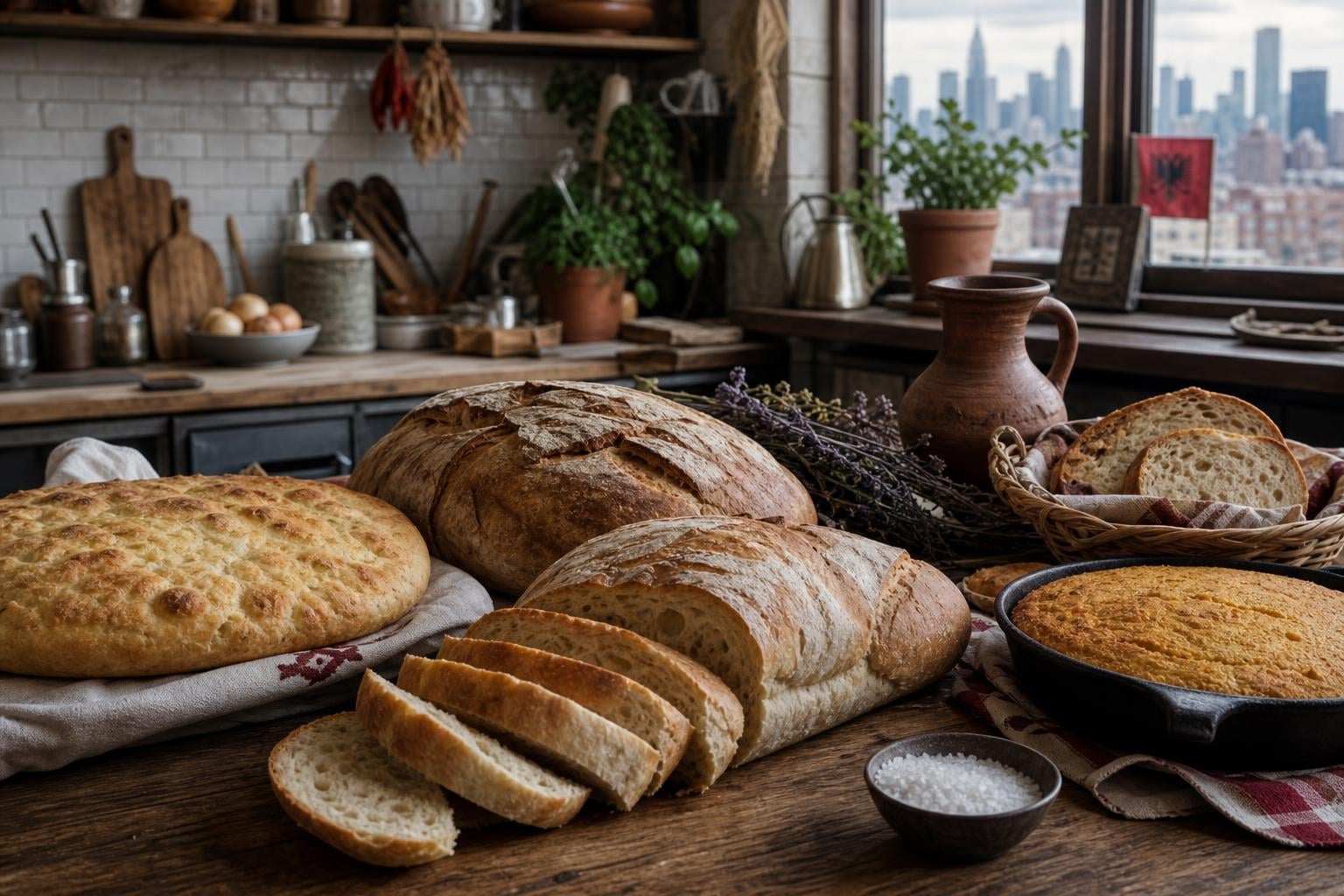
Bread is the quiet center of Albanian cooking. Before the byrek arrives, before the tave kosi comes out of the oven, before the raki is poured, there is buke on the table — a round loaf, a wedge of cornbread, a stack of fried petulla — and a small bowl of salt or cheese beside it. The dishes around it change with the region, the season, and the household. The bread is constant.
In the United States, that constancy travels. An Albanian American grandmother in a Bronx apartment shapes a round buke on a floured board the same way her mother did in a village outside Shkodër. A bakery on Central Avenue in Yonkers sells warm cornbread on Saturday mornings to a line of regulars. A family in Sterling Heights, Michigan, gathers for Sunday lunch and kulac me kos sits on the table next to the salad — the bread that means the meal has started.
This piece covers what Albanian bread is in the broad sense: the everyday loaves, the festive round breads, fried dough, cornbread, the filo pies that sit at the edge of the bread category, and the regional and ritual roles that buke plays in Albanian life. It also covers where to find Albanian bread in the US diaspora and what diaspora bakers actually make at home. The point is not a single recipe — those live in their own posts. The point is the shape of the category.
The Role of Buke in Albanian Culture
Bread carries weight in Albanian life that is hard to overstate. It is the staple food in the most literal sense — a calorie-dense, cheap, storable carbohydrate that fed families through long winters and uncertain harvests — but it is also a ceremonial object, a symbol of welcome, and a quiet ethical anchor.
A traditional Albanian table almost always starts with bread. When a guest arrives unannounced, the host puts out buke e krip — bread and salt — before anything else. The phrase ne kemi buke e krip (“we have bread and salt”) signals that the household is open and that the guest is owed the protection and care that come with that opening. It runs parallel in spirit to besa, the Albanian code of honor: a small set of words that names a much larger commitment.
Bread shows up in life-cycle rituals too. A round festive kulac is brought to weddings, christenings, and family blessings. At Easter, Albanian Orthodox and Catholic families bake bread for the table and sometimes for the cemetery, where loaves are left at family graves. At Bajram (Eid), Muslim Albanian families bake similar breads in a slightly different register. The religion of the household changes the calendar and the precise occasion; the bread on the table is recognizable across all of them.
The everyday register is the same idea in lower volume. Bread is on the table at every meal. It is rarely thrown away — stale loaves are toasted, soaked in milk or water for fërgesë-style dishes, or fed to chickens and dogs. Letting bread fall on the floor is treated as a small disrespect; many households still teach children to pick it up, kiss it, and place it back. The gesture is older than any single religion and survives the move to America largely intact.
Types of Albanian Bread
Albanian bread is not a single recipe. The category spans daily loaves, festive breads, fried doughs, flatbreads, and quick breads, and each one has its own pan, technique, and place on the table.
Buke (the daily loaf). The everyday Albanian bread is a round, slightly domed wheat loaf, leavened with yeast and baked in a hot oven until the crust is dark gold. Older village versions used a wood-fired stone oven or a furre (clay oven) shared between several households; modern home and bakery versions use a regular oven or a commercial deck. The crumb is open and chewy, the crust thick. The loaf is sliced rather than torn — Albanians cut bread at the table, often with the round held against the chest and the knife pulled toward the body, the same gesture seen in older Mediterranean kitchens.
Kulac. Kulac is the round festive loaf or bread-cake — baked in a single pan, cut into wedges, served at the center of the table. The word names a shape and an occasion more than a fixed recipe. Some kulac are leavened breads with eggs and oil; others are quick breads built on yogurt and chemical leavening, like kulac me kos (yogurt bread). The thread across all of them is the round pan, the wedge cut, and the ceremonial register.
Petulla. Petulla are fried dough rounds — leavened or yogurt-leavened dough torn into pieces, sometimes flattened, dropped into hot oil until they puff golden. They are eaten warm with white cheese, honey, fruit preserves, or yogurt. Petulla are weekend breakfast food and the dish a household cooks when guests arrive unexpectedly and there is no time to start a yeasted loaf.
Buke misri (cornbread). Yellow cornbread baked from cornmeal, water, and salt — sometimes with a small amount of wheat flour for structure. It is a northern and rural staple with a long history. For generations of mountain families it was the everyday bread, eaten with djathë i bardhë (white cheese), yogurt, fasule (white beans), or pickled vegetables. Buke misri still anchors hearty rural meals and shows up regularly in Gheg-tradition diaspora kitchens.
Pite-style flatbreads. Thin round flatbreads — sometimes leavened, sometimes not — cooked on a griddle, in a hot pan, or under a saç (a heavy iron lid heated by piled embers). These travel under different regional names and overlap with the pite-me-mish family on the savory side. The flatbread itself is a quick everyday product when there is no time to bake a full loaf.
Yogurt bread (kulac me kos and buke me kos). The leavening here is yogurt and baking soda or baking powder rather than commercial yeast. The result is between a quick bread, an Irish soda bread, and a savory cake — mixed in a single bowl, baked in under an hour, served warm. Bukë me kos sometimes names a yeasted loaf with yogurt in the dough as well, closer to a sandwich bread.
Buke Me Kos and Other Bread Pairings
Albanian bread rarely sits alone. It comes with something to dip, spread, or pair, and the pairing is half the dish.
The shortest pairing is buke me kos — bread with yogurt. A piece of warm loaf and a bowl of full-fat kos (Albanian yogurt), eaten with a spoon and a tear of bread. It is the breakfast a child gets when there is nothing else in the house and the snack an older relative offers when you sit down without warning. The yogurt does what butter and jam do on a Western breakfast table — but heavier, tangier, structural rather than ornamental.
Buke me djath — bread with white cheese — is the same logic with brined sheep- or cow-milk cheese instead of yogurt. Djathë i bardhë (Albanian white cheese, similar in style to feta) is the everyday cheese. Kaçkavall, the aged yellow cheese, shows up sliced for sandwiches and pressed for grilling. Buke e djath e ullinj — bread, cheese, olives — is the small meze plate that opens many Albanian meals.
Bread is also the structural partner to bean dishes and stews. A bowl of fasule (white beans) wants cornbread next to it. Tave dheu (clay-pot stew) wants a wedge of yeasted loaf. Tarator (cold cucumber-yogurt soup) wants a torn piece of bread to dunk. Albanian cooking is built around bread as the carrier carbohydrate — most dishes assume there is a basket of buke within arm’s reach.
In a hospitality context, bread and salt is the opener and stays on the table through the meal. Even when the meal moves on to byrek, meat, salad, and dessert, the bread does not get cleared until the table is fully reset. That presence — bread there all the way through — is part of how Albanian meals feel different from American ones.
Filo-Based Pies That Blur Into Bread
Albanian filo pies sit at the edge of the bread category. They are technically pastry, not bread, but they often play the role bread plays in other cuisines — the cut-and-share centerpiece, the carrier carbohydrate, the leftover that fills lunches for the next two days.
Byrek. The Albanian filo pastry: 5 to 12 paper-thin sheets of dough, a savory filling (spinach, cheese, lamb, leeks, pumpkin), baked in a round pan until the top is deep gold. Byrek is a fixture in the Albanian diaspora — the dish that anchors Sunday lunch, holiday tables, and darka meals. The name comes from the Turkish börek, but the Albanian version is its own dish — bigger pan, thinner layers, olive oil rather than butter, less binder in the filling.
Lakror. The Korçë layered pie — a southeastern Albanian cousin of byrek, often built with fewer thicker dough sheets rather than many thin ones, and traditionally baked under a saç. Lakror shows up in diaspora kitchens when the family is from the Korçë region; it is the regional pie that names where someone’s people are from.
Flija. The Albanian highland celebration dish — eight to fifteen paper-thin layers of plain batter brushed with butter and yogurt, traditionally cooked under a saç with glowing embers piled over the dome. Flija has no UNESCO Intangible Cultural Heritage listing — Albania’s actual 2022 inscription was xhubleta craftsmanship, not this dish — but it remains one of the most recognizable dishes tied to the Kosovo and northeastern Albanian highlands. Flija is bread-adjacent in a literal sense — flour-and-water layers built into a single round cake — but cultural register is firmly celebration food, not daily bread.
The difference between bread and these pies is real and worth keeping straight. Bread is leavened (or chemically leavened), baked in one piece, and serves as the carrier on the side of the meal. The filo pies are unleavened layered constructions, often filled, and they are themselves a course. Albanians do not usually call them bread. But the line between bread and pie blurs at the edges, and that blurring is part of why the bread category in Albanian cooking feels wider than it does in many other cuisines.
Regional Variations
Albania is small but culturally striped. The country splits between the southern Tosk tradition and the northern Gheg tradition, and that split shapes bread too.
Northern Albania (Gheg). Heavier bread tradition. Buke misri (cornbread) holds a central place — yellow, dense, slightly crumbly, the everyday loaf of the mountain villages around Shkodër, Tropojë, and Kukës. Yeasted wheat loaves are darker-crusted, often baked in wood-fired ovens, and pair with the meat-and-dairy heavy table the region is known for. Yogurt bread in the Gheg register tends to be savory — extra salt, sometimes herbs or grated cheese folded in.
Southern Albania (Tosk). Lighter, more Mediterranean in feel. Wheat bread dominates over corn. Olive oil shows up more often than butter. The southern table runs on bread, feta, olives, tomato salads, and grilled vegetables — a register that maps cleanly onto Greek and Italian-coast cooking. Southern kulac me kos sometimes carries a tablespoon of sugar and pairs with honey or reçel (fruit preserves) at breakfast.
Kosovo. Kosovo’s bread tradition leans on dairy and meat — heavier yeasted loaves, cheese-rich quick breads, and a strong byrek tradition that runs toward meat-and-onion fillings. Flija is at its strongest in the Kosovo highlands, and the saç is still a living piece of equipment in many rural households.
Arbëresh (Italian Albanian). The Arbëresh communities of southern Italy preserve a 15th-century Albanian foodway. Their breads carry Italian flour traditions on top of Albanian shapes — round festive loaves, fried doughs, and filo-adjacent pies that share the layering logic of byrek but use local Italian cheeses and herbs.
North Macedonian and Çam Albanians. Albanian communities in North Macedonia and Çam Albanians (originally from northwestern Greece) each have local variations — different cornmeal-to-wheat ratios in cornbread, different leavening preferences, different pairings on the table. The category is the same. The fingerprint is local.
In the diaspora, these regional lines blur quickly. A Kosovar grandmother in Yonkers and a Tosk grandmother in Worcester both end up shopping at the same Balkan grocer, using the same supermarket flour, and trading recipes at the same church bake sale. The first generation usually keeps the regional accent in their bread. By the third generation, the accent fades and the category survives.
Bread in Albanian-American Kitchens
Roughly 230,000 people reported Albanian ancestry in the 2024 American Community Survey, and the community estimate including Albanians who did not check the box plus second- and third-generation Albanian Americans runs closer to 1 million. New York holds about 56,000 of those, Michigan about 27,000, Massachusetts about 21,000. Bread follows the population.
In those four states and a handful of others, you can buy Albanian bread the way you would buy Italian or Polish bread in their own enclaves. The Bronx has several Albanian bakeries; Yonkers has more. Waterbury and Bridgeport in Connecticut have long-running byrektore (byrek shops) that also sell loaf bread and petulla. Sterling Heights and the Detroit suburbs have a dense Albanian commercial corridor with bakeries, butchers, and grocers. Worcester and the Boston suburbs hold their own concentration. Local Albanian Facebook groups are the fastest way to find a current shop near you — directories online are often out of date the moment a small bakery changes hands.
The home-baking side is alive too. First-generation Albanian American women in particular still bake regularly — yeasted loaves on Saturdays, petulla on weekend mornings, cornbread when there is a pot of fasule on the stove, and a kulac for Easter or a wedding. Second-generation Albanian Americans tend to bake less frequently but still call up their mothers for the kulac me kos recipe when a holiday approaches. Third generation Albanian Americans — children of Albanian Americans, often with one non-Albanian parent — are the generation where the recipes are most at risk of slipping. Writing them down matters.
The diaspora has also produced its own conventions. Frozen phyllo from the supermarket has replaced hand-rolled petë in most household byreks. Full-fat plain Greek yogurt (Fage 5%, Chobani Whole Milk Plain) stands in for kos. American all-purpose flour does the work that Albanian flour used to do. The substitutions are honest. The dishes still read as Albanian.
Making Albanian Bread at Home
This is not a recipe section — those live in their own posts. But a few staple notes hold across most Albanian breads.
Flour. All-purpose flour (around 10 to 12 percent protein) is the everyday choice. Bread flour works for yeasted loaves where a chewier crumb is wanted. Cornmeal for buke misri should be medium or fine grind — coarse polenta produces a gritty loaf. Whole-wheat flour was traditional in many village households; modern Albanian bakers in Albania and abroad mostly bake white now.
Leavening. Yeasted breads use commercial dry or fresh yeast. Quick breads like kulac me kos use baking soda activated by the yogurt’s acidity, sometimes with baking powder added for insurance. Wild-fermented sourdough (brumë) used to be common in village households and survives in pockets, but it is the exception in the diaspora.
Yogurt. Full-fat. Always. Low-fat or non-fat yogurt produces a dry, dense crumb in quick breads and there is no oven-stage fix. Greek-style strained yogurt or, where available, true Albanian kos gives the body the recipe expects.
Oven heat. Most Albanian breads bake at moderate-high to high heat — 375°F to 425°F is the working range. Yeasted loaves like a good initial blast of high heat to spring the dough, then settle to moderate. Quick breads and yogurt breads sit in the middle. Cornbread bakes a touch slower to dry the crumb without scorching the crust.
Pan. A heavy round pan is the most-used vessel — cast iron or a thick-walled aluminum tepsi. The round shape carries forward from the wood-oven and saç traditions where round was structural, not stylistic. A standard 9-inch cake pan or 10-inch cast-iron skillet covers most home recipes.
Resting. The same rule that applies to byrek and most pies applies to bread: pull the loaf, wait ten to fifteen minutes, and only then cut. The crumb finishes setting outside the oven. Cutting too early collapses the structure.
Beyond the technique, the larger point is that Albanian breads are forgiving. The category was built in village kitchens with no scales, inconsistent flour, and ovens that ran hotter on one side. The recipes that survived are the ones a tired person could cook in the dark. That forgiveness travels into the diaspora well.
Cultural Sayings and Rituals Around Bread
Albanian has a small vocabulary of bread-bound phrases that carry the weight of the dish. They are worth knowing — both because they recur in Albanian-American family speech and because they explain why bread occupies the cultural position it does.
Ne kemi buke e krip — “we have bread and salt.” A statement of hospitality and shared trust. The phrase is offered when a guest is welcomed into a home. Its register is closer to a vow than a menu line: bread and salt mean the household will protect and care for the guest under the rules of besa. Even families that have lived in the US for fifty years still use it, sometimes in English, sometimes in Albanian, almost always at a moment of welcome.
Buke e kripë e zemër — “bread, salt, and heart.” The longer version. It adds the heart to the formula and is heard at weddings, funerals, and major family gatherings. The phrase is a kind of motto: the household offers what it has — food, salt, and good will — and trusts the rest to follow.
Të hash bukë me dikë — literally “to eat bread with someone.” It means to share a meal but also to enter a relationship of mutual trust. To say you have eaten bread with someone is to say you know them and you stand with them.
Bread also has its small physical rituals. Letting a piece fall on the floor is treated as a minor disrespect; the standard response is to pick it up, sometimes kiss it lightly, and place it back. Cutting the loaf is often a household role — the head of the table cuts and distributes, or the youngest does, depending on the family and the region. Stale bread is repurposed before it is thrown away — into soups, soaked for fërgesë-style dishes, or toasted with oil and salt.
None of these rituals are unique to Albanians. Most Mediterranean and Balkan cultures share at least some of them. But they survive in Albanian-American kitchens with unusual vigor — partly because immigration tends to harden the rituals a family carries with it, and partly because bread is cheap and accessible enough that the rituals never had to fade.
Bread as Identity, Not Just Food
For Albanian Americans across generations, buke is one of the small things that signal Albanian-ness without explanation. A pot of fasule on the stove and a loaf of buke misri on the counter does what a flag on a wall does and what a song on a phone does. It identifies the household. It tells the children who walk in the door — even before words — what kind of family this is.
That identification work is one reason food posts on this site exist. Bread, byrek, kos, raki, flija, kulac — the recipes are the small parts of a community that show up in every kitchen, and writing them down is part of how the diaspora keeps itself recognizable to itself. The 1997 collapse of the Albanian pyramid schemes sent a new wave of Albanians to the US in the late 1990s; many of those families are now raising third-generation American kids in places like Worcester, Yonkers, and Sterling Heights. Whether those kids stay connected to Albanian-ness in adulthood has a lot to do with whether bread, and the rituals around it, stay on the table at home.
The National Albanian Registry exists to make that community visible — to count Albanian Americans accurately, to connect them to each other across state lines, and to keep the small things that make the community a community legible to its own next generation. If buke in your family kitchen is part of why you call yourself Albanian American, get counted at /register. It takes about a minute. It is free, and it is how the rest of the work — the count, the bakery map, the language programs — gets built.