
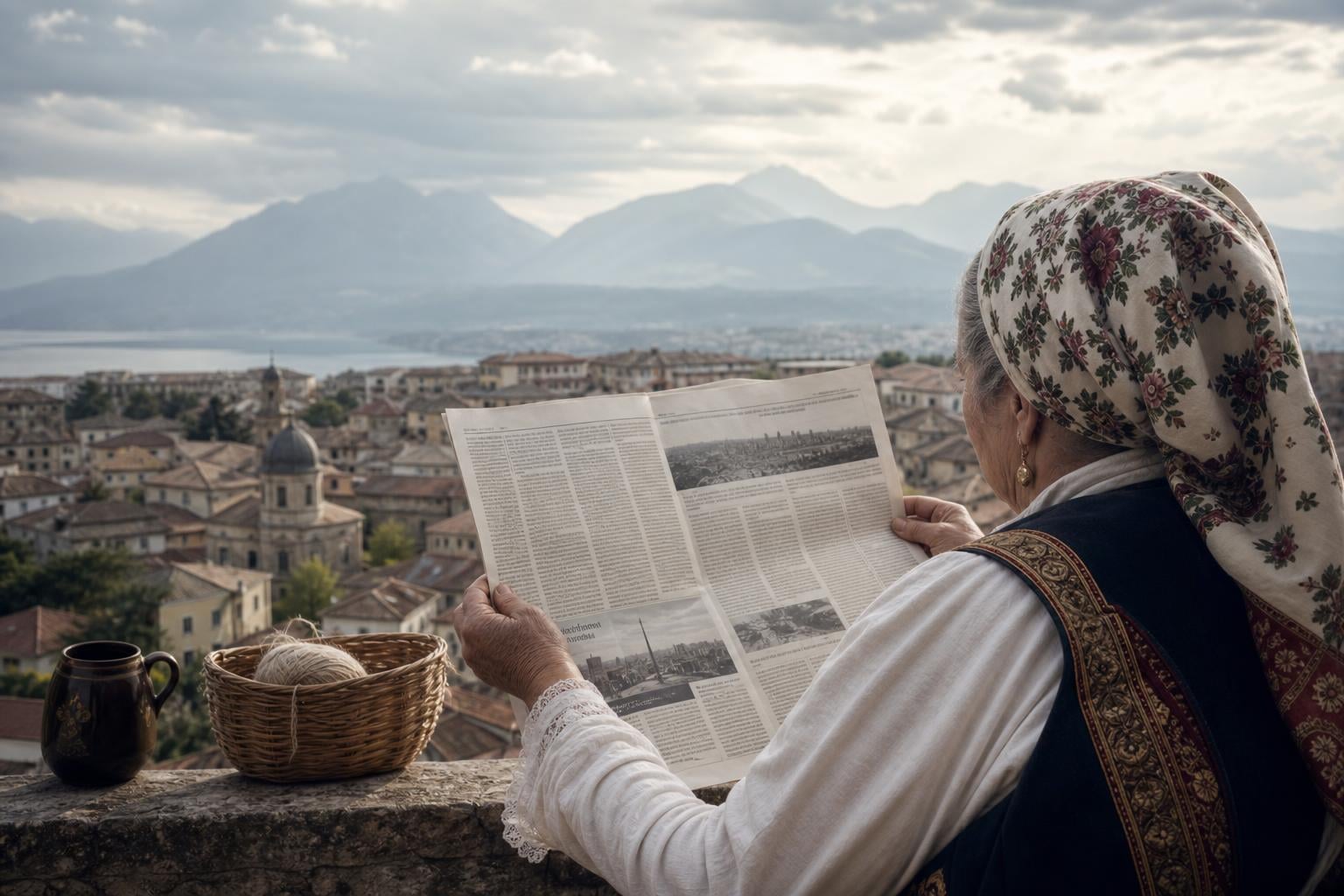
If you handed an Arbëresh-speaking grandmother in Piana degli Albanesi a copy of a modern Tirana newspaper, she could read most of it but not all of it. The vocabulary of politics, technology, and daily Albanian life would feel foreign. The grammar she would recognize. The sound of the sentences read aloud would feel familiar but slightly off — like hearing a song in your own language sung in an accent from another century.
That gap is the subject of this article. Arbërisht — the language Albanian Americans more often hear called Arbëresh or Italo-Albanian — is what 15th-century Albanian sounds like after 500 years of life in southern Italy. It is recognizably Albanian, descended from the same Tosk root as the modern standard, but it carries archaic features that the rest of the Albanian-speaking world has lost, and it absorbed a thick layer of Italian, Sicilian, and Greek that the Balkan Albanian language never did.
For the Arbëreshë community — the descendants of post-Skanderbeg refugees who settled across roughly 50 villages in seven Italian regions — Arbërisht is the most fragile piece of inheritance. UNESCO classifies it as definitely endangered. For the broader Albanian diaspora, including Albanian Americans whose family lines pass through Italy, the language is also a research-grade window into pre-Ottoman Albanian. This piece is about the language itself: where it sits, what it preserves, what it absorbed, and what is being done to keep it from quietly disappearing.
What Arbërisht actually is
The language has two names. Arbërisht is what speakers call the language; Arbëresh (plural Arbëreshë) is what speakers call themselves. Linguists writing in English use both, sometimes interchangeably. Italo-Albanian is the broader scholarly label and is also the standard term for the religious and ethnographic context — for example, the Italo-Albanian Catholic Church. In this article we use Arbërisht for the language and Arbëreshë for the community.
Arbërisht is a variety of Albanian, specifically a southern (Tosk) variety. The current consensus puts active speakers at roughly 80,000 to 100,000, with a wider heritage population of perhaps 250,000 who identify as Arbëreshë whether or not they use the language daily. Italian state estimates have at times reached as high as 260,000 for the cultural community, though those are not active-speaker counts. The Italian census does not collect data on minority languages, so every figure is an estimate stitched together from regional surveys, parish records, and field research.
The community is concentrated in southern Italy and Sicily, in approximately fifty communes across Calabria, Sicily, Basilicata, Molise, Apulia, Abruzzo, and Campania. Arbërisht is the language of those communes — bilingual road signs, parish liturgy in some villages, kitchen-table conversation among older speakers, and the older songs that families still sing at weddings and feasts. For the full community history and how the migration waves arrived in those regions, see our companion article on the Arbëreshë. This piece stays focused on the language.
A 15th-century snapshot, frozen and drifted
Most Arbëreshë trace their migration to the period between 1448 and roughly 1500. The first organized wave arrived in Calabria in 1448 with a force commanded by Demetrio Reres on contract from King Alfonso V of Aragon. A second wave came with Skanderbeg’s troops in Apulia in 1461. The largest movements followed Skanderbeg’s death in 1468 and the fall of Krujë in 1479, with later additions from the Peloponnese in the early 16th century, after Albanians serving as Venetian mercenaries between 1500 and 1534 evacuated Venice’s Peloponnese colonies as the Ottomans advanced, and were resettled in Italy along with the communities they helped evacuate.
Whatever Albanian those settlers spoke at the moment of departure is, in effect, the seed of Arbërisht. From that point forward, two languages were diverging. In the Balkans, Albanian continued to evolve under five centuries of Ottoman rule, picking up roughly 3,000 Turkish loanwords, undergoing further sound shifts, and eventually being standardized in 1972. In southern Italy, Albanian continued to evolve too — but in a different environment, surrounded by Italian and Sicilian, isolated from the rest of the Albanian-speaking world by the Adriatic and by the closed Ottoman frontier.
The result is not “frozen” in the strict sense. Arbërisht has changed. But it has changed differently, and many of the features it preserves — phonological, lexical, morphological — are the features modern standard Albanian eventually lost. Linguists describe it as an archaic Tosk variety: archaic relative to modern Tosk, not relative to Albanian’s deeper history.
Tosk roots with archaic features
Arbërisht is descended from Tosk, the southern dialect group of Albanian. (For the Tosk-Gheg split and how the modern standard relates to both, see our overview of the Albanian language.) That descent is visible in the standard markers of Tosk: rotacism (the older intervocalic n shifted to r, so older Arbën became Arbër), the loss of nasal vowels, and a shared core inflectional system with the southern Albanian-speaking world.
Within Tosk, several archaisms set Arbërisht apart from the modern standard.
Consonant clusters /kl/ and /gl/. Modern standard Albanian has palatalized these clusters to /q/ and /gj/ — a sound change dated to roughly the 16th–17th centuries, after the Arbëreshë had already left. Arbërisht keeps the older sounds. The standard Albanian word for language is gjuhë; the Arbërisht form is gluhë. The Albanian for person is njeri; older Arbërisht forms preserve kl- sequences in cognate vocabulary. Once you know the rule, you can hear the centuries.
Pre-Ottoman lexicon. The 3,000-word Turkish layer that runs through modern Albanian is largely absent in Arbërisht. The community left before sustained Ottoman contact, so daily-life words that the Balkan vocabulary expressed with Turkish loans (xhep “pocket,” çorape “socks,” dyqan “shop”) are expressed in Arbërisht with inherited Albanian terms or with Italian and Sicilian loans of later vintage. This absence is one reason Arbërisht sometimes sounds “more Albanian” to a Balkan ear — a loaded impression, but a real one.
Archaic morphology and syntax. Arbërisht preserves verb forms and constructions that modern standard Albanian has streamlined. Several Arbëresh dialects retain the older synthetic infinitive in contexts where standard Albanian uses the analytic për të + participle. Word order in subordinate clauses is also notably more flexible in some Arbëresh varieties — verb-final patterns survive in places where Tosk has shifted toward strict SVO. Verb morphology in everyday speech keeps simple-past and aorist distinctions that the standard has reduced.
Vocabulary the standard replaced. Many ordinary Arbëresh words exist as cognates of older Albanian forms that the modern standard supplanted. Katund — village — is the Arbëresh term, where standard Albanian uses fshat. Gluhë for language, where the standard has gjuhë. The settlements themselves are sometimes called katundi in older Arbëresh texts, with fshati a later, Balkan-influenced borrowing.
None of this makes Arbërisht “older” than standard Albanian — both are equally valid 21st-century languages — but it does make it a different snapshot of the same family.
Italian and Greek contact
Five hundred years of life inside the Italian Mezzogiorno left their mark. Arbërisht is, in practical terms, a language in deep contact with Italian and with the regional varieties around it: Calabrian, Sicilian, Apulian, and Molisan dialects of Italo-Romance, plus standard Italian as it spread through schooling and broadcasting in the 20th century.
The clearest layer is lexical. Arbërisht borrowed routine vocabulary from Italian and Sicilian for domains that the medieval settlers had no terms for: modern administration, urban infrastructure, recent technology, school subjects. Pincar (to think) comes from Sicilian pinzari. Qaca (town square) comes from Sicilian chiazza. Arbëresh place names are often layered — a Sicilian or Italian name on the map and an Arbërisht name in local speech, like Piana degli Albanesi (Hora e Arbëreshëvet) or Civita (Çifti).
The Greek layer is smaller but real. Some of it came through the Peloponnese-route migrations of the early 16th century, when communities that had spent generations in Greek-speaking southern Greece carried Greek vocabulary across to Sicily. More came through the Byzantine liturgical tradition of the Italo-Albanian Catholic Church, which celebrates the Divine Liturgy of St. John Chrysostom in Albanian and historically in Greek. Borrowings include parkalés (please) from Greek parakalō and hora (village, settlement) from Greek chōra.
What contact looks like in practice is code-switching. In a Calabrian Arbëresh village today, a single conversation can move between Arbërisht, regional Italian, and standard Italian within a few sentences, often within a single sentence. Modern domains pull Italian; family, food, religion, and the older agricultural world pull Arbërisht. This pattern is normal for stable bilingual minorities and is not, in itself, a sign of language loss — but it does change what a “monolingual Arbëresh speaker” means, since virtually no one under 70 in the community is monolingual in Arbërisht alone.
Syntactic influence from Italian is visible in word order in some varieties, in the spread of analytic constructions where archaic synthetic forms are receding, and in calques — phrases translated word-for-word from Italian into Arbërisht — that creep into casual speech.
Dialectal variation across the villages
Arbërisht is not one variety. Settlement happened in waves, from different Albanian-speaking regions, into different parts of Italy, and the Italian regional languages each community settled among were themselves distinct. The result is a cluster of related dialects with real differences, sometimes from one village to the next.
Calabrian Arbëresh is the largest cluster, spoken in the dozens of communes across Calabria — San Demetrio Corone, Lungro, Civita, Spezzano Albanese, Frascineto, San Cosmo Albanese, Vaccarizzo Albanese, and others. The Vaccarizzo Albanese variety has been studied as a particularly conservative form. Calabrian Arbëresh is the variety most often described in linguistic literature, partly because the University of Calabria sits in the middle of it.
Sicilian Arbëresh is centered on Piana degli Albanesi (Hora e Arbëreshëvet), with smaller communities in Contessa Entellina, Mezzojuso, Palazzo Adriano, and Santa Cristina Gela. The Sicilian variety reflects parts of its Peloponnese-route migration history — slightly more Greek vocabulary in some lexical fields, occasional ritual terms tied to the local church.
Apulian Arbëresh descends from the 1461 Skanderbeg-era settlement; surviving Apulian communes are fewer than they once were, and the dialect is among the more endangered subgroups.
Molisan Arbëresh survives in a small set of villages in Molise, including Portocannone, Ururi, and Montecilfone, with linguistic features that diverge from the Calabrian standard in vowels and lexicon.
Basilicatan, Abruzzese, and Campanian Arbëresh survive in smaller pockets, often a single village or a short chain. Some of these subgroups have only a few hundred active speakers each.
We do not rank these. There is no “purest” Arbëresh — the term is a folk concept, not a linguistic one. Each dialect represents a different migration cohort settling among a different host population, and each is a legitimate continuation of the same medieval Albanian root.
Writing Arbërisht
For most of its history, Arbërisht was a primarily spoken language. Routine writing in Arbërisht is a recent development. When the community did write — in poetry, religious texts, and 19th-century literature — the choice of orthography was its own debate.
The oldest substantial Arbëresh-language text is Lekë Matrënga’s 1592 catechism, E mbsuame e krështerë, printed in Rome and using a Latin-based orthography adapted for Albanian sounds. From there, a literary tradition built up slowly across the next three centuries, with major contributions from:
- Nicola Chetta (1741–1803), a Sicilian Arbëresh priest and poet who wrote one of the earliest Albanian-language sonnets and produced significant religious and lyrical works.
- Girolamo De Rada (1814–1903), born in Macchia Albanese in Calabria, the central figure of Arbëresh literature. His romantic epic Këngët e Milosaos (Songs of Milosao, 1836) is the best-known work in Arbëresh, and his journalism — including the multilingual review Fiamuri Arbërit — anchored Arbëresh communities to the Albanian National Renaissance unfolding back in the Balkans.
- Vincenzo Dorsa (1823–1885), a Calabrian Arbëresh philologist whose Su gli Albanesi introduced Arbëresh linguistic features to a wider European scholarly audience.
- Giuseppe Schirò (1865–1927), born in Piana degli Albanesi, who produced major Arbëresh-language poetry and scholarship and who taught Albanian language and literature at the University of Naples.
These writers used a range of orthographies. Some adapted Italian spelling conventions; some experimented with Greek-influenced systems; some used the various early Albanian-alphabet attempts that proliferated before the Balkans settled the question. Today, two main paths exist in Arbëresh publishing.
The first is the modern 36-letter Albanian alphabet standardized at the 1908 Congress of Manastir and tightened at the 1972 Orthographic Conference in Tirana. Many contemporary Arbëresh writers, scholars, and bilingual schools use the modern alphabet, which has the advantage of compatibility with publications from Tirana and Pristina.
The second path is historic Arbëresh orthographies — the spelling systems that De Rada, Schirò, and others developed locally — which preserve some letter conventions tied to Italian and Sicilian phonetic habits. Some communities and publishers prefer the historic orthography because it reflects the actual sound system of their own variety more faithfully than the Tirana standard does.
Italian Law 482/1999 (more on which below) recognizes Arbërisht for educational and signage purposes but does not prescribe a single orthography, leaving the choice to municipal and provincial authorities. The result is a working diversity rather than a uniform standard.
Endangerment status
UNESCO’s Atlas of the World’s Languages in Danger classifies Arbërisht as definitely endangered. The classification means children are no longer learning the language as their first language at home in many communities. UNESCO’s other categories — “vulnerable,” “severely endangered,” “critically endangered,” “extinct” — locate Arbërisht in the middle range: not yet limited to elderly speakers, but no longer being transmitted across generations at the rate needed for stability.
The structural pressures are familiar from minority-language situations across Europe. Schooling is conducted overwhelmingly in Italian, even where bilingual programs exist on paper. Mass media in Arbërisht is thin — some local radio, occasional regional television features, parish bulletins — against an ocean of Italian content. Intermarriage with non-Arbëreshë Italians has accelerated since the postwar period, and mixed-marriage households tend toward Italian as the home language. Migration out of the Arbëresh communes — to northern Italian cities, Switzerland, Germany, the United States — pulls speakers out of the dense daily contexts that sustain a minority language.
The result is generational shift: daily-use Arbërisht is strongest among speakers over 50, weaker among those between 25 and 50, and weakest among children and young adults. Several Arbëresh communes have active Arbërisht use in the home and the parish; others have effectively shifted to Italian, with Arbërisht surviving as a heritage marker rather than a daily language.
We do not romanticize this. Endangerment is a description, not a tragedy. Languages shift and sometimes disappear; the same has happened to most of the small languages of southern Europe and southern Italy. What is distinctive about Arbërisht is the combination of long historical depth (500 years of continuous community use), legal recognition (Italian Law 482/1999), institutional support (the church, the universities), and an active diaspora that increasingly identifies with the broader Albanian-speaking world. Whether those factors are enough to stabilize the language is an open question.
Revival efforts
Several institutions and policies are working against the structural pressure.
Italian Law 482/1999 — Norme in materia di tutela delle minoranze linguistiche storiche — formally recognizes Arbërisht as one of twelve historic linguistic minorities of Italy, alongside Catalan, German, Greek, Slovene, Croatian, French, Franco-Provençal, Friulian, Ladin, Occitan, and Sardinian. The law mandates support for minority languages in primary education, public broadcasting, and signage. Implementation is uneven across regions and municipalities, but bilingual road signs are now visible across the seven Arbëresh regions, and Arbërisht-language hours have entered some primary-school curricula.
The University of Calabria runs a Lingua e Letteratura Albanese (Albanian Language and Literature) program and is the institutional center of Arbëresh-language research in Italy. Its researchers have produced grammars, dictionaries, dialect studies, and corpus work that document Arbërisht varieties village by village. The university also trains teachers and translators who staff the bilingual programs in regional schools.
Formal exchanges with the University of Tirana have run since 1990, when Albania reopened to the outside world after the end of the communist period. The exchanges go in both directions: Tirana students study Arbëresh literature and dialectology in Calabria, while Arbëresh students complete coursework in standard Albanian in Tirana. The bilateral cultural agreements between Albania and Italy explicitly recognize the Arbëreshë heritage as a shared inheritance.
The Italo-Albanian Catholic Church is the other major institutional anchor. Its two eparchies — the Eparchy of Lungro (Calabria, erected 1919) and the Eparchy of Piana degli Albanesi (Sicily, erected 1937) — together with the Territorial Abbacy of Santa Maria di Grottaferrata, conduct liturgy in Albanian, train clergy in Arbërisht, and produce religious texts in the language. For many Arbëresh communities, the parish remains the most consistent context where Arbërisht is heard, sung, and read aloud every week.
Bilingual primary schools operate in several Arbëresh communes, with varying intensity. Some offer a few hours of Arbërisht instruction per week; a smaller number offer fuller bilingual immersion. The patchwork reflects local resources, political will, and parental demand.
Cultural institutions — the Arbëresh cultural centers in San Demetrio Corone and Piana degli Albanesi, regional Arbëresh festivals, the Arbëresh-language radio stations and online media, and a growing body of Arbërisht presence on social platforms — round out the ecosystem outside the school and the church.
None of this guarantees the language’s future. It does mean that Arbërisht in 2026 has more institutional support than it has had in any earlier period, and that the people working on it are doing so with full awareness of the demographic clock.
Why this matters to the US diaspora
Most Albanian Americans descend from late-19th and 20th-century migration to the United States, with roots in Albania, Kosovo, North Macedonia, and Montenegro. A smaller but real share has Arbëreshë roots, often via Italian American family lines that trace back to Calabrian or Sicilian villages whose Albanian identity faded in the second or third American generation.
Joseph J. DioGuardi, the former U.S. Representative from New York and longtime advocate for Albanian-American causes, is the most prominent example. His paternal family is Arbëresh from southern Italy. He is one of the cofounders of the Albanian American Civic League and has spoken publicly about the connection between his Arbëresh heritage and his political work on Albanian issues. There are many less visible cases — Italian-American families whose grandparents knew that the village language was “different,” who heard Arbëresh songs at weddings, who carried Arbëresh surnames without knowing the etymology.
For those families, Albania’s 2020 Citizenship Law (No. 113/2020) treats Arbëresh ancestry as a recognized path to Albanian citizenship by descent. Having an Albanian parent grants citizenship on request regardless of birthplace. Proving Albanian ancestry through a grandparent shortens the standard naturalization residency requirement from five years to three — it reduces the wait rather than removing it, and the law does not extend this specific path to the great-grandparent generation. Diaspora members with more distant Arbëresh lines should confirm current provisions with an Albanian consulate before applying.
For families curious about reconnecting, the language question is real. Learning standard Albanian opens the modern Albanian-speaking world: news from Tirana and Pristina, contemporary music and literature, conversation with Albanian Americans whose roots are in the Balkans. Learning Arbërisht specifically — through a Calabrian or Sicilian relative, a heritage program, or one of the dictionaries produced at the University of Calabria — is a narrower but deeper path into the family’s specific village and migration history. The two are not in conflict; many heritage learners eventually move between them.
The other reason the language matters to the US diaspora is structural. A language with 80,000 to 100,000 active speakers, no national state, and steady demographic pressure cannot survive on Italian institutions alone. The wider Albanian-speaking world — Albania, Kosovo, North Macedonia, the long-established Albanian American communities, and the smaller diasporas in Germany, Switzerland, and the UK — is increasingly part of the support system that keeps Arbërisht in print and in classrooms. Albanian Americans who count themselves part of that world are part of that support.
Get counted
Arbëresh heritage — by language, by ancestry, by parish — is recognized as Albanian heritage by the broader community and by the National Albanian Registry’s diaspora count. If your family carries an Arbëresh line, even at multiple generations’ remove, you belong in that count. You can add yourself at albanianregistry.org/register.