

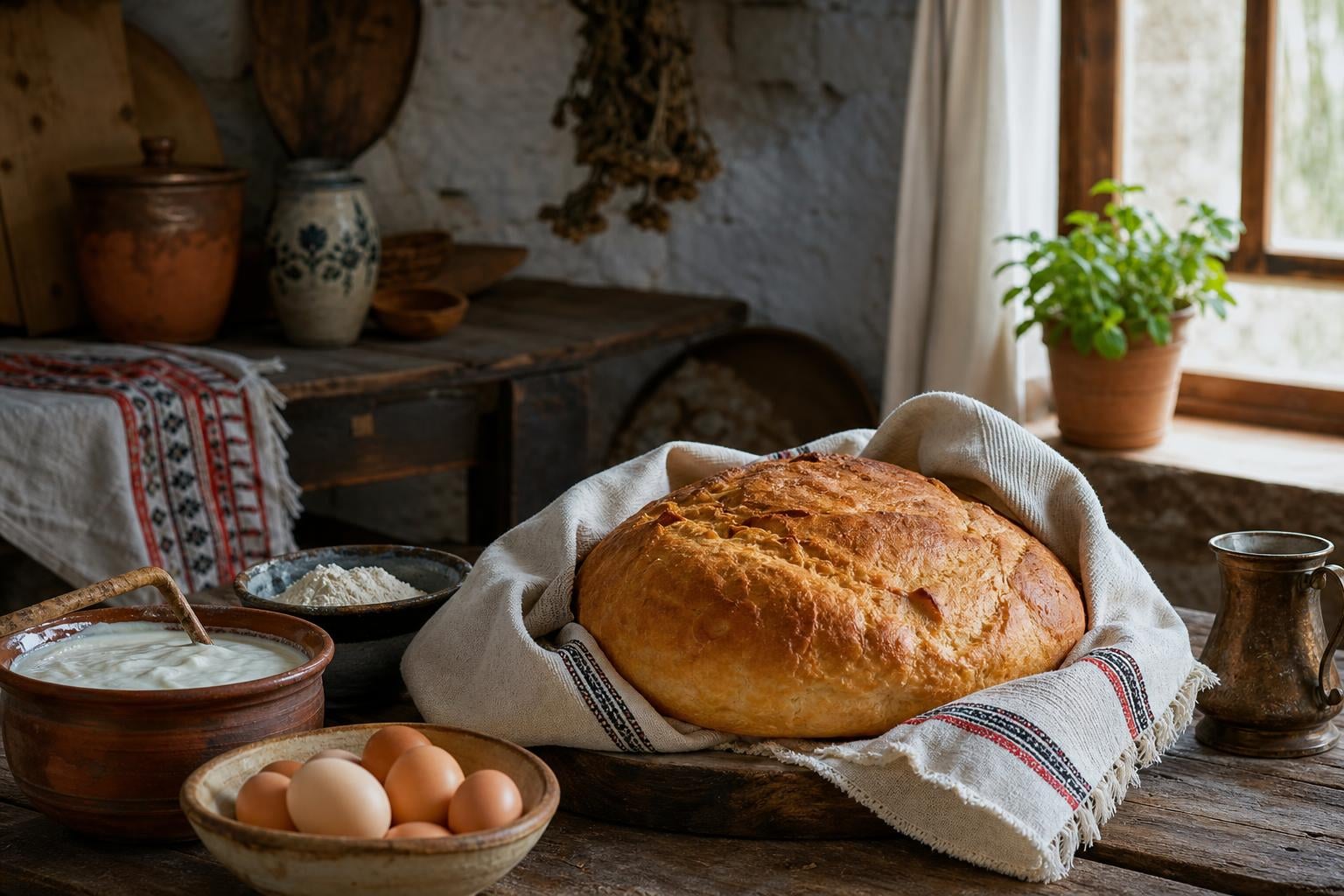
Kulaç me kos (Albanian yogurt bread) is the quietest dish on the Albanian table and one of the most reliable. It sits between a quick bread, an Irish soda bread, and a savory cake — leavened with yogurt and baking soda rather than commercial yeast, mixed in a single bowl, and baked in a round pan in under an hour. It is the bread that comes out for Sunday breakfast, for unannounced visitors, and for the moments when someone needs warm bread on the table and the dough hasn’t been started.
The dish is built on five ingredients that almost any kitchen has on hand: eggs, yogurt, butter, flour, and a chemical leavener. There is no proofing, no scale, no kneading. The technique forgives almost everything except low-fat yogurt and an underbaked center. This article covers what kulaç me kos is, the regional split between savory north and sweeter south, how it sits in the family of Albanian breads, the traditional recipe at home-kitchen scale, and where the dish lives in Albanian-American cooking today.
What Kulaç Me Kos Is
Kulaç is the Albanian word for a round bread or cake baked in a single pan and cut into wedges. The word names a shape and a context more than a single recipe — kulaç shows up across Albanian cooking in different forms, sometimes ceremonial, sometimes everyday. The unifying features are the round pan, the wedge cut, and the place at the center of the table.
Me kos means “with yogurt.” Albanian kos (Albanian yogurt) is full-fat, slightly tangier and thicker than American supermarket yogurt, traditionally made from cow’s or sheep’s milk and cultured at home. When kos is folded into a kulaç batter, it does three jobs at once: it carries the acid that activates the baking soda, it provides the dairy fat that gives the crumb its tender bite, and it adds the faint sour register that distinguishes the dish from a plain quick bread.
The structure is straightforward. Eggs are whisked, yogurt and melted butter folded in, the dry ingredients (flour, baking powder, baking soda, salt, and a small amount of sugar in some regions) stirred together separately, then the two are combined with as few strokes as possible and poured into a greased round pan. The pan goes into a 375°F oven for 35 to 40 minutes. The bread comes out the color of toasted hazelnut on top, fluffy in the middle, and slightly tangy throughout.
The dish sits inside the broad family of Mediterranean and Balkan quick breads — close cousins to Irish soda bread and to Greek yogurt cakes. Within Albanian cooking specifically, it belongs to the category of bukë (bread) rather than ëmbëlsirë (dessert), even when a small spoonful of sugar nudges it toward a tea-cake register. It is bread first.
The Yogurt Question — Kos
The yogurt is the load-bearing ingredient. Get it right and the rest of the recipe almost cooks itself; get it wrong and nothing else can rescue the loaf.
Albanian kos is traditionally cow’s-milk or sheep’s-milk yogurt, full-fat, cultured at home or bought from a local dairy. The texture is thicker than American supermarket yogurt — closer to Greek-style than the runny “stirred” yogurt that fills the dairy aisle in most US chains. The flavor is more sour than the average American plain yogurt because the home culture is allowed to develop longer, and because the milk is rarely diluted or stabilized. Many Albanian-American kitchens still strain a tub of supermarket yogurt overnight in cheesecloth to approximate the body of kos.
The closest US substitutes, in order:
- Full-fat plain Greek yogurt (5% or higher fat). The everyday diaspora swap. Fage Total 5% or Chobani Whole Milk Plain match the body well; the tang is slightly milder, but the bread comes out almost identical.
- Full-fat plain regular yogurt, strained. Line a fine-mesh strainer with cheesecloth, set over a bowl, and drain a tub in the fridge for 4 hours. Functionally Greek-style.
- Skyr. Icelandic skyr is technically a fresh cheese, but it works — same body, slightly less tang.
- Kefir. In a pinch only. Thinner than yogurt, so reduce by a quarter and accept a looser crumb.
What does not work: 0% Greek yogurt, low-fat plain yogurt, or any flavored, sweetened, or “light” version. The dairy fat is structural. A non-fat yogurt yields a dry, dense, rubbery loaf, and there is no fix at the oven stage.
The yogurt should be at room temperature when it goes into the batter. Cold yogurt seizes the melted butter into beads and slows the soda-acid reaction. Pull it out 30 minutes before mixing.
Regional Variants
Albania’s bread traditions divide along the same north-south line that shapes most of the country’s cooking. Kulaç me kos follows the split.
Northern Albania (Tropojë, Kukës, much of Kosovo). Savory. Extra salt is standard, sometimes a pinch of dried mint or oregano folded in, occasionally a handful of crumbled djathë i bardhë (Albanian brined white cheese) or grated kaçkavall (aged Albanian yellow cheese) stirred into the dry ingredients. Sugar is rarely added. The bread anchors a meat-and-dairy table — pulled apart alongside cured meats, cheese, and a small bowl of kos on the side.
Central Albania (Tirana and the surrounding plain). The most-cooked diaspora version. A tablespoon of sugar goes into the batter — enough to round the tang, not enough to make the bread sweet. The texture is slightly more cake-like than the northern version. This is what most adult diaspora cooks remember from childhood breakfasts.
Southern Albania (Korça, Berat, Gjirokastër). Thinner and broader — the batter spread into a 10- or 11-inch pan rather than a 9-inch one, baking faster, producing more golden crust per wedge. Sweetening creeps up slightly, and the bread sits closer to a tea-cake register. Often served warm with honey, butter, or reçel (fruit preserves).
Kosovar variants. Kosovo’s bread tradition leans more on cheese fillings. Some Kosovar kitchens fold crumbled feta into the batter, layer it through the middle, or melt grated cheese over the top toward the end of baking. The result is a saltier crust that pairs well with strong morning coffee.
The diaspora muddies these lines. A grandmother from Korça baking in a Bronx kitchen uses what is in the fridge, and the resulting bread is recognizable as kulaç me kos without sitting cleanly in any single regional tradition.
Kulaç vs. Other Albanian Breads
Kulaç me kos is one of several breads on the Albanian table, and the categories are easier to keep straight when the dishes are placed side by side.
Versus byrek (Albanian filo pastry). Different category entirely. Byrek is a layered filo pie — paper-thin sheets of dough, a savory filling between them, baked in a round pan. Kulaç me kos is a single pour of batter. Byrek takes 90 minutes and demands technique; kulaç me kos takes under an hour and forgives almost everything.
Versus flija (concentric Albanian crepe-cake). Flija is a northern dish built from alternating rings of flour-and-water batter, brushed with butter and cream between layers, baked slowly under a saç (covered iron baking pan). Hours of work and a special-occasion dish. Kulaç me kos is the opposite — quick, single-pour, weekday.
Versus bukë me kos. The closest cousin and the one most often confused. Bukë me kos is a yeasted bread with yogurt in the dough — proofed, kneaded, baked like a sandwich loaf. The leavening is yeast, not chemical. Kulaç me kos skips the yeast and lands at a tighter, cake-like crumb.
Versus everyday bukë. Albanian everyday bread is yeasted, kneaded, baked dark, served at every meal. Kulaç me kos does not replace it. The two take turns: weekday dinners with bukë, Sunday breakfasts with kulaç me kos.
When an English-language recipe titles a yeasted yogurt loaf “Albanian yogurt bread,” the dish is usually bukë me kos — not the quick bread covered here.
Ingredients
This is the central-Albanian (Tirana register) version, which sits in the middle of the regional spread and is the most-cooked diaspora variant. Yields one 9-inch round, serves 8.
- 3 large eggs, room temperature
- 1 cup (240 ml / 8 oz) full-fat plain yogurt — Albanian kos if available, otherwise full-fat plain Greek yogurt
- ½ cup (115 g / 4 oz) unsalted butter, melted and cooled slightly
- 1 ½ cups (180 g / 6.4 oz) all-purpose flour
- 1 tsp baking powder
- ½ tsp baking soda
- ¾ tsp kosher salt (or ½ tsp fine sea salt)
- 1 tbsp granulated sugar (optional — central and southern style; omit for northern savory)
- Optional savory addition: ¼ cup (30 g) grated kaçkavall or crumbled feta folded into the dry ingredients
- Optional sweet addition: ½ tsp vanilla extract or a pinch of ground cardamom
A note on the eggs and yogurt: room temperature is not negotiable. Cold eggs and cold yogurt seize the melted butter into beads, the batter looks broken, and the crumb comes out uneven. Pull both out 30 minutes before mixing.
A note on the butter: melt it gently — over low heat or in 20-second microwave bursts — and let it cool until it is liquid but no longer hot. Hot butter scrambles the eggs.
A note on the flour: measure by weight if at all possible, or use the spoon-and-level method (spoon flour into the cup, level off with the back of a knife). A scooped, packed cup of flour weighs 30 to 50 percent more than a properly leveled one and produces a dry, dense bread.
Step-by-Step Instructions
Step 1 — Heat the oven and prepare the pan (5 minutes)
Heat the oven to 375°F (190°C). Generously butter or oil a 9-inch round cake pan, including the sides. Skipping this step or greasing too lightly causes the bread to stick — the soda-yogurt reaction makes the surface slightly tacky in places. Don’t line the pan with parchment; the recipe is forgiving enough that a well-greased pan releases cleanly, and parchment ridges show up on the bottom crust.
Step 2 — Whisk the wet ingredients (3 minutes)
Crack the 3 room-temperature eggs into a large mixing bowl. Whisk for about 30 seconds until uniform and slightly foamy. Add the yogurt and whisk for another 20 seconds — the mixture should look smooth, with no visible streaks of yogurt. Pour in the melted, cooled butter in a slow stream while whisking. The wet base should be glossy and homogeneous, the color of a thin custard.
If the mixture looks broken or beaded, the butter was too hot or one of the dairy components was cold. Whisk vigorously for another 30 seconds; in most cases the emulsion comes back together.
Step 3 — Combine the dry ingredients (2 minutes)
In a separate bowl, whisk together the flour, baking powder, baking soda, salt, and sugar (if using). Whisk for 20 seconds — this is what distributes the leaveners evenly. A pocket of unmixed baking soda produces a metallic-tasting yellow streak in the finished bread, and there is no rescue. If using cheese (savory variant) or vanilla/cardamom (sweet variant), fold them into the dry mix now.
Step 4 — Combine wet and dry (1 minute)
Pour the dry ingredients into the wet. Fold gently with a rubber spatula or a wooden spoon, just until the flour disappears. The batter should be thick — somewhere between a brownie batter and a muffin batter — with a few small lumps still visible. Stop mixing the moment there are no dry flour streaks left.
This is the single most common failure point. Over-mixing develops the gluten in the flour and produces a tough, rubbery bread. Twelve to fifteen folds with a spatula is enough; if it takes more, the bowl was too small.
Step 5 — Pour and smooth (1 minute)
Scrape the batter into the prepared pan. Smooth the top with the back of the spatula or a spoon. Tap the pan gently against the counter twice to release any large air pockets.
Step 6 — Bake (35 to 40 minutes)
Slide the pan onto the middle rack of the 375°F (190°C) oven. Bake for 35 to 40 minutes, until the top is the color of toasted hazelnut, the edges have pulled slightly from the sides of the pan, and a toothpick or wooden skewer inserted into the center comes out clean.
For a more reliable doneness check, use an instant-read thermometer. The internal temperature at the center should read 200°F (93°C) or higher. Below 200°F, the center will still be wet when the bread cools — the most common reason a kulaç me kos fails on the second slice.
If the top is browning faster than the inside is setting (a sign of an oven that runs hot), tent the pan loosely with aluminum foil at the 25-minute mark and continue baking until the toothpick test passes.
Step 7 — Rest in the pan (10 minutes)
Pull the pan from the oven and let it rest on a wire rack for 10 minutes. Resting in the pan lets the structure firm up — the soda-yogurt crumb is delicate when hot, and turning out a still-warm loaf risks tearing. After 10 minutes, run a thin knife around the edge, invert the bread onto the rack, and flip it back so the golden top faces up.
Step 8 — Slice and serve (5 minutes)
Slice into 8 wedges with a serrated knife. Serve warm or at room temperature. The bread holds its texture for a full day at room temperature wrapped tightly in plastic, and 3 days refrigerated; reheat slices at 325°F (165°C) for 6 to 8 minutes to revive the crust.
Serving Kulaç Me Kos
The bread is built for breakfast, but it travels across the day. The diaspora pattern, in rough order of frequency:
Breakfast with honey and butter. A wedge split in half, a smear of soft butter on the warm cut side, a drizzle of honey on top. This is the most common diaspora breakfast use of the bread — Sunday mornings, holiday tables, hotel-style spreads at family gatherings. A glass of çaj mali (Albanian mountain tea) or strong coffee on the side.
Alongside djathë i bardhë (Albanian brined white cheese) and olives. The savory pairing. The bread’s faint tang plays against salty cheese the way a slice of country bread does in any Mediterranean meze (small-plate course) spread. Add tomato wedges, a drizzle of olive oil, and a couple of slices of cured meat for a small plate that holds an entire summer afternoon together.
With fresh tomato and cucumber salad in summer. A traditional Albanian chopped salad — cucumber, tomato, white onion, djathë i bardhë, olive oil, red wine vinegar, salt — sits next to a wedge of kulaç me kos. The salad’s acid cuts the bread’s richness; the bread’s body soaks the leftover dressing. A quiet, common weeknight dinner for a one-person household.
As the bread course at Sunday lunch. When the table is anchored by a stew like fasule or tavë kosi, kulaç me kos sometimes replaces the everyday loaf. The wedges go around the table along with the warm plates.
Reheated for school lunches. Cold kulaç me kos, wrapped in foil, holds a school lunch together. Spread with butter, jam, or a thin slice of cheese, the bread doesn’t go soggy the way a sandwich on commercial bread does.
The bread reheats well at 325°F for 6 to 8 minutes. The microwave is the wrong move — it steams the crumb, turns the edges rubbery, and erases the crust the oven worked to build.
Common Mistakes
A short list of what goes wrong, ranked by how often it actually happens.
Using low-fat or non-fat yogurt. The single most common reason a kulaç me kos fails. The dairy fat is structural — without it, the crumb is dry and dense, and no oven adjustment recovers it. Use full-fat yogurt every time. If only thin yogurt is available, strain it overnight before mixing.
Over-mixing the batter. The second most common failure. Folding the wet and dry together until smooth develops gluten in the flour and produces a tough, rubbery loaf. Stop mixing the moment the flour streaks disappear, even if a few lumps remain. Twelve to fifteen folds is enough.
Pulling the bread out too early. A toothpick test alone is unreliable for this recipe — the cheese and yogurt fat can wet a probe even when the structure is set. Use an instant-read thermometer and confirm the center is 200°F or higher. A bread pulled at 195°F looks done on the outside and reads wet on the second slice an hour later.
Greasing the pan too lightly. The soda-yogurt surface is slightly tacky in spots and grabs an under-greased pan. Brush butter or oil generously across the bottom and all the way up the sides; a thin film is not enough. A dusting of flour over the greased surface adds extra insurance for non-stick pans that have lost their coating.
Cold ingredients. Cold eggs and cold yogurt seize the melted butter, the batter looks broken before it goes in the oven, and the crumb comes out uneven. Pull both out of the fridge 30 minutes before mixing. If time is short, set the unopened yogurt tub in a bowl of warm tap water for 10 minutes.
Wrong pan size. A 9-inch round is the target. An 8-inch pan produces a too-thick batter that browns the top before the center sets; a 10-inch pan produces a too-thin batter that overbakes around the edges. If only a different size is available, adjust the bake: 8-inch pans need 5 extra minutes (and a foil tent on top); 10-inch pans need 5 fewer minutes and a closer eye.
Skipping the rest in the pan. The bread looks done at 35 minutes and most cooks want to flip it out immediately. The crumb is still setting for the next 10 minutes — a hot turn-out tears the bread along the edges. Wait the full 10 minutes.
Where Kulaç Me Kos Sits in Albanian Diaspora Cooking
The breads that survive immigration are the ones worth counting. Kulaç me kos is one of the few that traveled intact across the 20th-century Albanian-American migrations, and it survived for a structural reason: the recipe is forgiving and the ingredients are universal.
First-generation kitchens. For Albanian Americans who arrived in the post-1990 wave — Bronx, Yonkers, Waterbury, Sterling Heights, Worcester — kulaç me kos was often the only quick bread that survived the move. Yeasted breads required a starter and a sense of the local flour and water. Kulaç me kos required only a tub of yogurt, a stick of butter, and a 9-inch pan. New ovens, new flour brands, new water — none of it broke the bread.
Second-generation kitchens. Children raised in the US adapted the dish without losing it. The yogurt shifted to Greek-style — Fage, Chobani — and the texture stayed close enough that the older generation accepted it. The pan shifted from a heavy iron skillet to a standard cake pan. The oven became an exact 375°F instead of “hot enough.” The bread held.
Weddings, name days, Easter Sunday. Kulaç me kos appears at small ceremonies more often than at large ones — the breakfast the morning after a wedding, a child’s name day, Easter Sunday before church. The bread is too quiet for a wedding banquet (which calls for trilece and byrek) but right for the smaller moments around it.
The intergenerational hand-off. Because the recipe is short, kulaç me kos is one of the first dishes Albanian-American teenagers learn to bake on their own. Five ingredients, one bowl, one pan. A 14-year-old can produce a recognizable kulaç me kos without supervision, and the result tastes like the grandmother’s bread — not identical, but in the same family.
The dishes that fade are the dishes nobody bakes. The recipes that survive are the recipes worth counting — the ones the next generation can still pull off without asking. Kulaç me kos is a small bread, but it is on the short list of dishes that hold the Albanian-American diaspora together one Sunday morning at a time.