
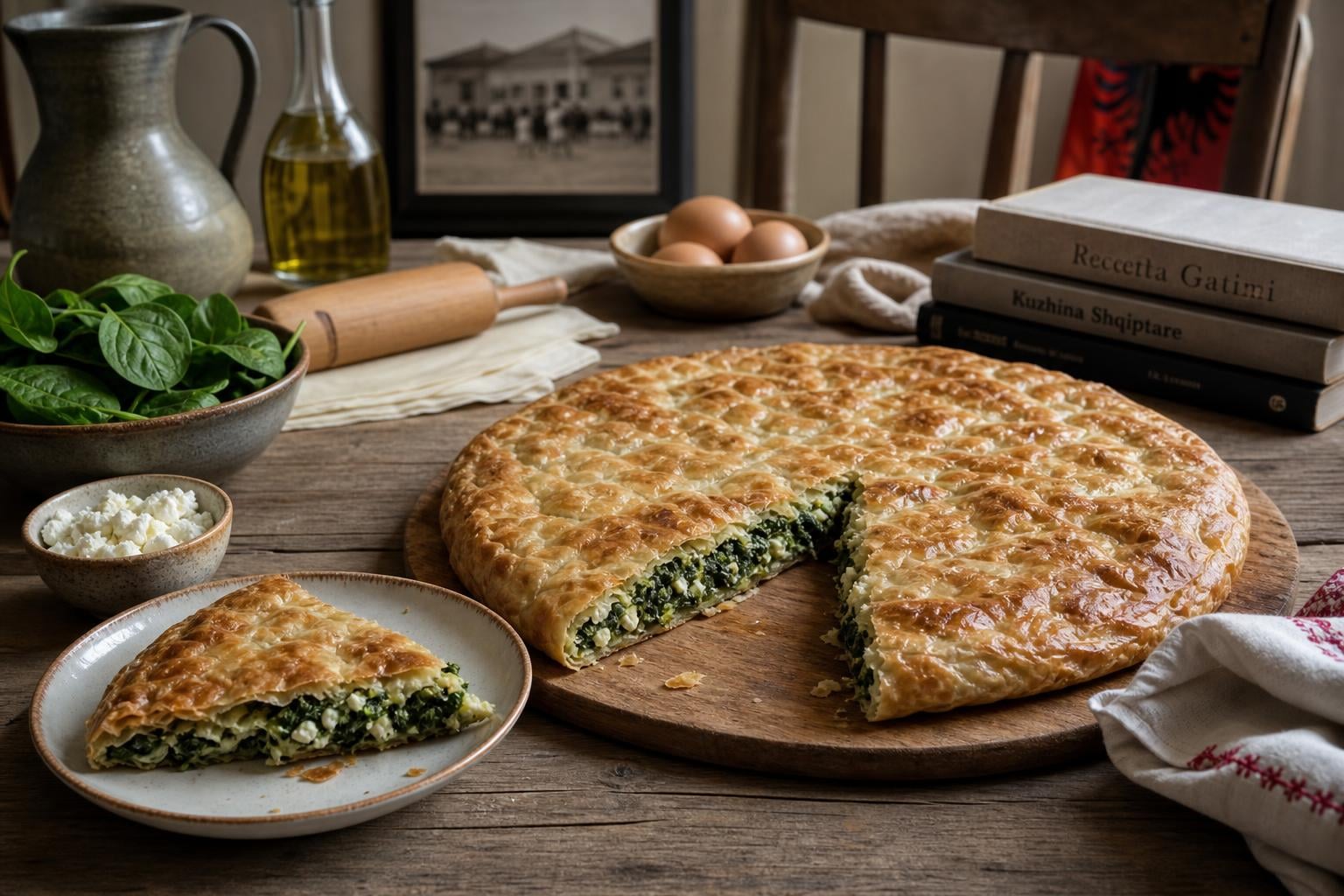
Spinach-and-cheese byrek is the dish most Albanian-American households actually cook. Other versions get more attention on the table — meat byrek at a Kosovar wedding, leek byrek at a Tosk holiday, pumpkin byrek in October — but the spinach-and-cheese version is what shows up on a Tuesday night in Worcester, in Sterling Heights, in the Bronx. The ingredients are in any US supermarket. The technique fits inside two hours. The pan feeds a family.
This piece is the long-form recipe with the cultural grounding around it. We cover what byrek me spinaq dhe djathë (spinach-and-cheese pie) is, why it is the diaspora default, how to source the ingredients in the US, and how to assemble and bake it without the usual mistakes — soggy bottom, dry top, collapsed layers when you cut in too soon.
NAR is the National Albanian Registry, a 501(c)(3) building a community-led count of Albanian Americans. The US Census counts roughly 230,000 of us as of the 2024 American Community Survey (B04006 ancestry table), with community estimates including ethnic Albanians and second- and third-generation households closer to a million. Documenting the recipes that traveled with those households is part of how the diaspora keeps its shape across generations.
History and Albanian Context
Byrek is the Albanian member of a Balkan-wide family of filo-pastry pies. The name traces back through Ottoman Turkish börek, most likely from a Turkic root meaning “kidney” (böğür/bögrek) — the derivation Turkish lexicographer Sevan Nişanyan documents. A rival theory ties the word to a root for a twisted or folded shape, but that account is weaker and disputed on sound-pattern grounds. The pastry itself — paper-thin sheets of dough stacked with a savory filling, baked in a round pan — moved across the Ottoman Empire and stayed behind in every kitchen the empire touched. Bosnian burek, Bulgarian banitsa, Greek spanakopita, Romanian plăcintă, and Albanian byrek are all cousins of one source, each with its own filling logic and dough handling.
The Albanian version is built around thin layers and a strong preference for olive oil over butter or yogurt-batter. Compared to Bulgarian banitsa, which uses a butter-and-yogurt mixture poured between sheets, Albanian byrek is lighter and crisper on top. Compared to Greek spanakopita, which typically binds the filling with egg and feta into a softer, more custardy interior, Albanian byrek leaves the filling drier and lets the layered filo carry the structure.
Spinach as a filling is documented across Albanian regions but particularly anchored in southern Albania (Tosk-speaking areas), where the broader cooking tradition leans Mediterranean — olive oil, greens, herbs, lighter dairy. Wild greens like nettle and dandelion (lakra) often substituted for cultivated spinach in village kitchens; the diaspora version standardized on frozen chopped spinach because it is consistent, cheap, and stocked everywhere.
In the US, the diaspora settled most densely in New York (~56,000 Albanian Americans per the 2024 ACS), Michigan (~27,000), Massachusetts (~21,000), New Jersey, Illinois, and Connecticut. Spinach-and-cheese byrek travels intact across all of those communities. A Worcester gjyshe (grandmother) and a Detroit one cook essentially the same dish, with small adjustments for what their corner store carries. That portability is part of why this version, more than meat or wild-greens variants, became the default.
Spanaqi dhe Djathë: The Filling Explained
The filling has four working parts: spinach, brined sharp cheese, soft fresh cheese, and binder.
Spinach carries volume, mild bitterness, and color. Frozen chopped spinach is the practical choice — already wilted, already chopped, only needs thawing and squeezing. Fresh spinach works but requires wilting down 2 pounds to yield the same useful weight after the water comes out, which is more work without a meaningful flavor difference for this application. Some households use a mix of spinach and chard or kale; the Tosk tradition allows it.
Brined sharp cheese is the salt, the tang, and most of the flavor. The reference cheese is djathë i bardhë — literally “white cheese,” the Albanian brined sheep- or sheep-and-goat-milk cheese in the broad feta family. It is harder to find outside Albanian and Greek specialty stores, but feta packed in brine — French, Greek, or Bulgarian — is the standard US substitute. Bulgarian sirene is sometimes closer in salt level. Avoid pre-crumbled supermarket feta in a tub: dry texture, unpredictable salt.
Soft fresh cheese is the body and the binder. Ricotta is the diaspora workhorse. Gjizë — the Albanian whey cheese pressed from the byproduct of feta-making — is the village reference, sold occasionally in Albanian and Balkan groceries. Cottage cheese works in a pinch if you drain it first; the texture is rougher than ricotta but the flavor reads correctly.
Binder is egg, sometimes with a small amount of yogurt. Two large eggs for a 12-inch pan is the standard ratio. The egg sets during baking and keeps the filling from spilling out when the pie is cut. Northern Albanian and Kosovar versions often add a few tablespoons of kos (plain yogurt) to enrich the filling; southern versions usually skip it.
The ratio that works is roughly equal weights of brined cheese and soft cheese, with spinach at about twice that combined weight after squeezing. Two eggs bind a 12-inch pan. Salt with a light hand — the feta has already done most of the work.
Choosing the Dough: Homemade vs Phyllo
Albanian filo is called petë. Traditionally, petë is rolled by hand on a wooden board with a long thin pin, the dough stretched and turned until a single sheet is large enough to cover a table and thin enough to read newsprint through. A skilled cook produces 10 to 14 sheets per byrek, each one paper-thin.
In a US kitchen, almost no one does this. Frozen phyllo from a supermarket freezer is what every Albanian-American household above a certain density uses on a regular basis. The major brands — Athens Foods (Apollo), Krinos, Fillo Factory — all produce 1-pound boxes of approximately 20 sheets, sized roughly 14 by 18 inches. Any of them works.
The case for hand-rolled petë is real but limited. Texture is slightly more variable in a good way: small thickness differences mean the layers shatter into uneven shards that hold crisp longer. Flavor is slightly toastier because hand-rolled dough often goes thinner and bakes drier. For a holiday meal where a grandmother is teaching a granddaughter, petë is the right call. For a Tuesday byrek with two pounds of spinach in the fridge, frozen phyllo is correct.
The technique gap between supermarket phyllo and a good outcome is smaller than people fear. Three rules close it: thaw the phyllo overnight in the refrigerator, never on the counter; keep the unused stack under a slightly damp kitchen towel while you work; brush each sheet with a thin coat of olive oil, not a flood. With those three habits, the difference between frozen and hand-rolled is mostly nostalgia.
Ingredients and Substitutions
For one 12-inch round pan, serving 6 to 8 as a main course or 8 to 10 as part of a meze spread:
Dough
- 1 lb (450 g) frozen filo dough (phyllo), thawed overnight in the refrigerator. About 20 sheets, depending on brand.
Filling
- 1 lb (450 g) frozen chopped spinach, fully thawed and squeezed dry
- 1 cup (220 g) feta cheese, crumbled — French, Greek, or Bulgarian, packed in brine
- 1 cup (240 g) ricotta cheese (whole milk), or gjizë if available
- 2 large eggs
- 1 teaspoon kosher salt (adjust down if your feta is very salty)
- ½ teaspoon freshly ground black pepper
- Optional: a pinch of grated nutmeg
- Optional: 2 tablespoons plain whole-milk yogurt (northern style)
For brushing
- ½ cup (120 ml) olive oil — a regular extra-virgin is fine; you do not need a high-end finishing oil
- Optional: 2 tablespoons unsalted butter, melted, mixed into the oil for richness (a northern Albanian touch)
Equipment
- A 12-inch round metal baking pan (a tepsi), or a 12-inch cake pan with at least 2-inch sides
- A pastry brush
- A clean kitchen towel, slightly damp
- A large bowl
- A sharp paring knife for scoring
US substitution notes
For the spinach: fresh in place of frozen requires about 2 pounds of fresh spinach, wilted in a dry pan in batches, then cooled and squeezed. The yield drops by roughly two-thirds.
For the feta: any feta in brine works. The cheaper the brine cheese, generally the saltier — taste a small piece first and back off the added salt if needed. Costco’s Apollo Greek feta is reliable. Trader Joe’s Greek feta in brine is acceptable. Whole Foods 365 Bulgarian-style sheep feta works.
For the ricotta: full-fat ricotta works best. Part-skim ricotta is more watery and the filling slumps; drain it in a strainer over a bowl for 30 minutes if that is all you can find. Farmer’s cheese is a passable substitute. Greek strained yogurt is not — the lactic acid is wrong.
For the filo: stay with Greek-style filo, not Turkish yufka. Yufka is thicker and built for a different layering style; it will not produce the shatter-crisp Albanian top.
Step-by-Step Preparation
Total time is about 90 minutes, with roughly 30 minutes of active work and an hour of baking plus rest. Read the whole method before starting — the filo is on a clock once it is unwrapped.
Step 1 — Thaw and set up
Move the filo from the freezer to the refrigerator the night before. On the day, pull it out 30 minutes before you start, but leave it in the plastic sleeve. Cold filo cracks; room-temperature filo unfolds.
Heat the oven to 375°F (190°C). Brush the round pan with a thin layer of olive oil, including the sides. Lay a clean kitchen towel on the counter, lightly damp.
Step 2 — Make the filling
Squeeze the thawed spinach hard. Put it in a clean kitchen towel, gather the corners, and wring over the sink until almost no water comes out — you should pull out a tight ball about the size of a softball. Frozen chopped spinach holds an astonishing amount of water; this single step prevents the most common byrek failure.
In a large bowl, combine the squeezed spinach, crumbled feta, ricotta (or gjizë), eggs, salt, pepper, optional nutmeg, and optional yogurt. Mix with a fork until uniform — the filling should be thick, tacky, and just barely able to hold a shape when scooped. If it looks wet or runny, the spinach was not squeezed enough; wring again.
Taste. The filling should taste slightly oversalted at this stage, because the filo will mute it. If it tastes flat, add ¼ teaspoon more salt and a few grinds of pepper.
Step 3 — Layer the bottom
Unroll the filo on the dry counter, not on the damp towel. Cover the stack with the damp towel. Work one sheet at a time.
Lay one sheet across the pan, letting the edges overhang. Brush lightly with olive oil — the brush should glide; do not flood. Lay a second sheet on top, rotated slightly so the overhangs point in a different direction. Brush. Repeat until 8 to 10 sheets are stacked in the pan, each lightly oiled.
If a sheet tears, lay it down anyway and patch with the next. Once the byrek is assembled, no one can see broken bottom sheets.
Step 4 — Spread the filling
Spoon the filling onto the layered filo and spread it in an even layer all the way to the edges. Even thickness is more important than perfect smoothness. A thick spot in the middle bakes into a wet pocket; a thin edge burns.
Step 5 — Layer the top
Lay one sheet of filo over the filling and brush with oil. Repeat for 8 to 10 more sheets, rotating each one slightly to vary the overhang.
Brush the very top sheet with a slightly heavier coat of oil — this is what produces the deep-gold finish. Some cooks scatter a few drops of water across the top before baking; the steam puffs the surface layers slightly. Optional.
Step 6 — Tuck and score
Tuck the overhanging filo down between the byrek and the pan wall. Some cooks crimp the edges into a rolled crust; others just tuck. Both work. The goal is no sharp edges sticking up to burn.
With the paring knife, score the top of the byrek into 8 wedges, cutting through only the upper filo layers — do not cut down into the filling. Scoring before baking lets you cut clean wedges after baking without shattering the surface.
Baking and Finishing
Bake at 375°F (190°C) on the middle rack for 35 to 40 minutes. The signs of doneness are visual and audible: the top should be deep gold and slightly puffed, the edges should pull a quarter-inch back from the pan wall, and the surface should sound crisp when you tap it with a fingernail.
If the top looks pale at the 35-minute mark, move the pan to the upper third of the oven for a final 5 minutes. If the top is browning fast at 20 minutes — a sign of an oven that runs hot — tent loosely with foil and continue baking.
Pull the pan from the oven and set it on a cooling rack. Rest the byrek for 10 minutes before cutting. This is non-negotiable. The cheese-and-egg filling is still loose when the pan comes out; cutting hot byrek collapses the wedges into a soft mess. Ten minutes of rest lets the egg set and the layers settle.
After the rest, cut along the scored lines all the way through the bottom. A pizza wheel works well; a sharp serrated knife with a sawing motion is the backup. Lift wedges out with a thin spatula and serve warm or at room temperature.
Common failure modes at the bake stage:
- Top is gold but bottom is pale and soft. The pan was on the wrong rack or the oven runs cool. Next time, use the lower-middle rack and add 5 minutes.
- Bottom is dark before top is done. Pan was too close to the heat source, or the oil layer on the bottom sheets was too thick. Less oil next time, middle rack.
- Top is gold but filling is wet. Spinach was not squeezed enough, or the rest was too short. Twelve minutes of rest fixes the second; only re-squeezing fixes the first.
- Layers stick together into one mat. Not enough oil between sheets, or the oil was unevenly applied. The sheets need a continuous thin film, not pools and dry spots.
Variations Across Regions
The spinach-and-cheese version is the diaspora default, but the same dish carries regional accents depending on where the family is from.
Southern Albania (Tosk). More olive oil between layers, thinner sheets, and often a mix of spinach with wild greens — lakra, nettle, dandelion, or chard — gathered in spring. The filling skews lighter, sometimes with no ricotta at all and just a higher proportion of feta loosened with egg. Lemon zest occasionally appears. The pie reads brighter and more vegetal.
Northern Albania (Gheg). Heavier on cheese, often with a few tablespoons of plain yogurt mixed into the filling for richness. Some northern cooks use a mix of butter and olive oil between layers instead of olive oil alone. The pie reads denser, with a more pronounced dairy backbone.
Kosovo. The Kosovar repertoire leans toward meat byrek, but spinach-and-cheese versions exist. Where they appear, the filling sometimes includes a small amount of finely grated kaçkavall — a yellow, firmer cheese in the kashkaval family — alongside the white cheese. Kosovar byrek also sometimes takes the spiral or coiled form (byrek i mbledhur) rather than the round-pan layered form, though the layered version is more common for the spinach filling.
Arbëresh (Italian Albanian). The Arbëresh communities of southern Italy, who preserve a 15th-century Albanian foodway, sometimes substitute Italian ricotta for gjizë (which is essentially the same cheese under a different name), and may add a small amount of Pecorino Romano. The dish carries Italian names in some Arbëresh villages but the structure is recognizably byrek.
Çam and North Macedonian. Çam Albanian families (originally from northwestern Greece) often add a touch more lemon and sometimes dill. Albanian families in North Macedonia (Tetovo, Skopje, Struga) make a version that is essentially identical to the southern Albanian one.
Across all of these, the working ratio holds: roughly equal feta and ricotta, twice that weight of squeezed spinach, two eggs as binder, 8-to-10 layers of filo on the bottom and the top.
Serving and Storing
Byrek is rarely served alone. The traditional accompaniments are simple:
- Kos (plain whole-milk yogurt) in a small bowl on the side, served cold. The acidity cuts the richness of the filling.
- A chopped salad of cucumber, tomato, white onion, feta, and olive oil with red wine vinegar. The fresh vegetables balance the starch.
- Bread is on the table because bread is always on the table in Albanian homes, even when there is already a starch in the meal.
Drinks: kos i rrahur (beaten yogurt thinned with cold water and salt — structurally identical to Turkish ayran) is the traditional non-alcoholic pairing. With wine, a light Mediterranean red works; an Albanian kallmet if you can find it at an Albanian or Balkan grocery. As a meze before a longer dinner, a small glass of raki — Albanian fruit brandy, usually grape — is the standard.
For storage, byrek holds at room temperature for the rest of the day. Wrapped in foil and refrigerated, three to four days. Reheat in a 350°F (175°C) oven for 8 to 10 minutes — the layers come back crisp. Do not microwave; the filo steams into a soft mat and the structure does not recover.
Byrek freezes well unbaked. Assemble in the pan as described, wrap tightly in two layers of plastic and one of foil, and freeze for up to two months. Bake from frozen — do not thaw first — at 375°F for approximately 55 minutes, with a foil tent for the first 30 minutes to prevent the top from browning before the center is hot. Frozen baked byrek loses some crispness; reheat at 350°F for 12 to 15 minutes.
For a meze platter, cut the cooled byrek into 1-inch squares and serve at room temperature alongside olives, white cheese cubes, sliced cured meats, and small bowls of dips. The byrek travels well to a potluck this way and stays acceptable on a buffet for several hours.
A Note on Documenting Recipes
Spinach-and-cheese byrek is one of the recipes most often lost between Albanian-American generations. The grandmothers cook it from memory; the daughters and sons watch from across the kitchen; the grandchildren grow up eating it without ever having held the rolling pin. When the generation that cooks without measuring is gone, what survives is a memory of a dish, not the dish itself.
Writing the numbers down is part of how the diaspora keeps its food alive across an ocean and three generations. So is teaching the technique — the squeeze of the spinach, the brush of the oil, the score of the top — to whoever is in the kitchen next time the family gathers.
If your family carries Albanian recipes forward — byrek, qifqi, tavë kosi, fasule, albanian dishes of any kind — we want to count you. NAR is building a community-led count of Albanian Americans, and preserving Albanian food traditions in the diaspora is part of the same effort. Get counted →