

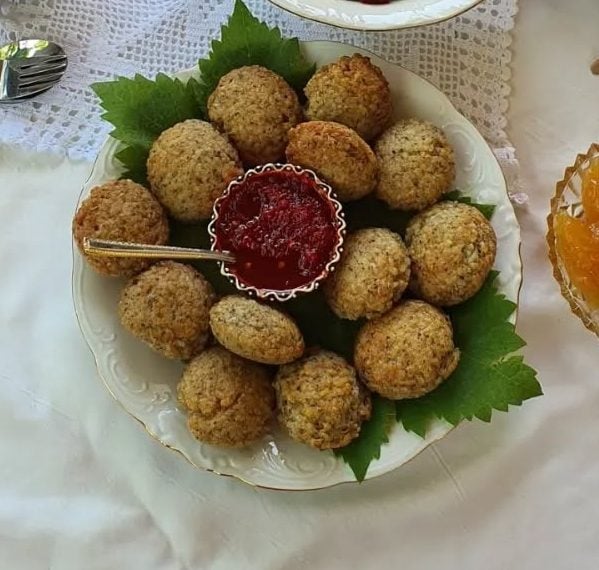
Qifqi is the rice fritter of Gjirokastër — small ovals of sticky short-grain rice bound with beaten eggs, white cheese, and a heavy hand of fresh mint, then fried until the outside is golden and the inside still soft. It is one of the most place-specific dishes in the Albanian kitchen. Mention qifqi to someone whose family is from southern Albania and you will get a knowing nod; mention it in northern Kosovo and you may get a polite blank stare. The dish is tied to the stone city in a way few Albanian dishes are tied to any single place.
This guide is for the Albanian-American cook who grew up eating qifqi at a grandmother’s table and wants the method written down before it slips away, and for the second- and third-generation cook who has only heard the word. The recipe is not complicated. The variables are — the rice you can find in a US supermarket, the cheese that substitutes for djathë i bardhë (Albanian white cheese), the oil temperature that decides whether the fritter holds together or falls apart in the pan. We will walk through each one.
A note on the count: NAR is the National Albanian Registry, a 501(c)(3) building a community-led count of Albanian Americans. Recipes like this one are part of the cultural record we are documenting. If your family carries a Gjirokastër dish forward, we want to know who you are and where you settled. More on that at the end.
What Qifqi Is
Qifqi is a fried rice fritter from the city of Gjirokastër in southern Albania. The shape is a small oval or short cylinder — about the size of a thumb, sometimes a little larger — and the color, when fried correctly, is the deep gold of a perfect omelet edge. Inside, the rice is soft but distinct grain by grain, bound by beaten egg that has set, flecked green with fresh mint, and salted by crumbled white cheese.
The word qifqi is Albanian. In the singular form a single fritter is qifqi; in the plural, you will sometimes see qifqe, though many cooks use qifqi for both. Pronunciation is roughly CHEEF-chee — the Albanian q is a palatal stop, a softer cousin to English ch. It is not pronounced kif-ki or kwif-kwee, and the first syllable is the stressed one.
There is no canonical Wikipedia-grade etymology, and the word does not have an obvious cognate in Turkish, Greek, or Italian. The most common explanation in Gjirokastër is that the name is onomatopoeic — the sound of the small ovals dropping into hot oil — though this is folk etymology and we will not press it as fact. What is fact is that qifqi shows up in Albanian cookbooks under its Gjirokastër origin, and that it is one of the dishes the city is known for.
Qifqi is rice-based, not meat-based. That distinguishes it from qofte (meatballs), which share no etymological root despite the similar opening syllable. It is also not stuffed, breaded, or layered — it is a single homogeneous mixture, shaped and fried, served plain.
Where Qifqi Comes From
Gjirokastër is in southern Albania, in the Drino valley, about an hour’s drive from the Greek border at Kakavija. The old town is a UNESCO World Heritage Site, recognized for its stone houses with slate roofs that climb the hillside in steps. The novelist Ismail Kadare grew up there; so did Enver Hoxha, the communist leader. The city has been continuously inhabited for a long time and the kitchens reflect that — Ottoman influence, Greek-border proximity, and a confident regional identity that did not blend into general Albanian cooking the way some other regional traditions did.
Rice cultivation has a long history in the lowlands of southern Albania and across the Greek-Albanian border. The combination of accessible short-grain rice, dairy traditions strong enough to produce sheep- and goat-milk cheeses, and herb gardens with mint as a staple gave the city the raw materials for a dish like qifqi. The mint, in particular, is load-bearing — Gjirokastër cooking leans on mint the way Tirana cooking leans on oregano or northern Albanian cooking leans on garlic.
The dish appears at Gjirokastër weddings, holidays, and Sunday tables. It is also a common item in the meze (small-plates) spread that opens a longer meal in Albanian and broader Balkan dining. It is not weekday food in the sense of being thrown together at the end of a workday — the rice has to be cooked and cooled, the mixture has to rest, and the frying is a stove-side operation that wants attention. But it is not occasion-food either. It sits in the middle: something you make when you have an hour and someone you want to feed.
What Makes Qifqi Different from Other Albanian Rice Dishes
Albania has more than one rice dish. Pilaf me pule is the standard rice-and-chicken plate. Japrak is the rice-and-herb-stuffed grape leaf. Tave kosi uses rice in some regional versions, baked under a yogurt-and-egg custard with lamb. Each of those is a different format — pilaf, stuffed vegetable, baked casserole.
Qifqi is none of those. It is a fritter, which puts it in the same structural category as Italian arancini or Lebanese kibbeh — a starch-and-bind mixture shaped by hand and fried in deep oil. Within Albanian cooking, the closest format-cousin is fergesë (the pepper-and-cheese skillet from Tirana), which shares the cheese and the southern-Albanian register but not the rice or the fritter shape.
The mint is the second distinguishing feature. Mint shows up in Albanian cooking — in qofte Tirona, in some yogurt sauces, in summer salads — but it is rarely the dominant note. In qifqi, the mint is loud. A working batch carries enough chopped mint that the fritters are visibly green-flecked. Cook the mint too long and it goes flat; underdo it and the rice tastes like nothing. The fryer’s job is to get the heat right so the mint blooms without burning.
The third is the cheese. Djathë i bardhë — literally “white cheese” — is the Albanian term for a brined sheep- or sheep-and-goat-milk cheese in the broad feta family. It is saltier than American supermarket feta and crumbles cleaner. In qifqi it does two jobs: salts the mixture and binds the rice with its melted protein. A bland fresh mozzarella will not substitute. A good Greek or Bulgarian feta will.
Ingredients
For roughly thirty fritters (serves four to six as part of a meal, or eight as meze):
- Short-grain rice — 1 cup (200 g) dry weight. Arborio is the easiest US substitute; sushi rice (Calrose, Nishiki) also works. Avoid long-grain.
- Water — 2 cups (475 ml) for cooking the rice
- Salt — 1 teaspoon for the rice water, plus more to taste at the end
- Eggs — 4 large, at room temperature
- Fresh mint — 1 cup (about 25 g) loosely packed leaves, chopped fine. Spearmint, not peppermint.
- Djathë i bardhë (Albanian white cheese) — 4 oz (115 g), crumbled. Substitute: French or Greek feta packed in brine. Bulgarian sirene also works.
- All-purpose flour — 2 to 3 tablespoons, depending on how wet the rice runs
- Black pepper — 1/2 teaspoon, freshly ground
- Neutral oil for frying — sunflower, canola, or peanut. Allow 3 to 4 cups; depth matters more than volume.
Optional, depending on the household:
- A small grated white onion (some Gjirokastër cooks add it; many do not)
- A pinch of dried oregano (rare; mint should carry the flavor)
- A second egg yolk if the mixture refuses to bind
The Traditional Method, Step by Step
Step 1 — Cook the rice dry
Rinse the rice under cool water until the water runs nearly clear. Combine with 2 cups water and 1 teaspoon salt in a heavy pot. Bring to a boil, reduce to the lowest simmer, cover, and cook 18 to 20 minutes. The rice should be fully tender and the water completely absorbed. If there is liquid left at the bottom, leave the lid off for two minutes over low heat to dry it out. Qifqi rice has to be drier than risotto rice — wet rice will not hold a shape.
Step 2 — Cool the rice
Spread the cooked rice onto a sheet pan in a thin layer. Let it cool for at least 30 minutes, or until barely warm to the touch. Hot rice will cook the eggs the moment you mix them in. This is the most-skipped step in diaspora kitchens and the most common reason a batch fails — a curdled, lumpy mixture that fries into something the texture of scrambled eggs rather than a fritter.
Step 3 — Mix the binder
In a large bowl, beat the eggs until uniformly yellow with no streaks of white. Add the crumbled cheese, the chopped mint, the black pepper, and 2 tablespoons of flour. Whisk to combine.
Step 4 — Combine and rest
Add the cooled rice to the egg-cheese-mint mixture and fold with a wooden spoon or spatula. Do not stir aggressively — you want the grains to stay intact. The mixture should hold its shape when you press it; if it slumps like wet porridge, add the third tablespoon of flour. If it crumbles dry, add a beaten egg yolk. Cover the bowl and let it rest for at least 20 minutes, or up to two hours in the refrigerator. The rest hydrates the flour and lets the rice fully absorb the egg.
Step 5 — Shape
Wet your hands lightly with cold water. Scoop about 1 tablespoon of the mixture and shape it into a small oval, roughly 1.5 inches (4 cm) long and 1 inch (2.5 cm) thick. Set the shaped ovals on a parchment-lined tray. The traditional Gjirokastër shape is closer to an elongated egg than a sphere — flatter on top and bottom than a meatball.
Step 6 — Fry
Heat 1.5 to 2 inches of neutral oil in a heavy-bottomed pot or deep skillet to 340 to 350°F (170 to 175°C). Test with a small piece of the mixture — it should sizzle immediately and bubble steadily without browning in under five seconds. Fry the ovals in batches of six to eight, turning once with a slotted spoon, for 3 to 4 minutes total until deep golden. Drain on paper towels.
Serve warm.
Critical-Path Notes (Where Batches Go Wrong)
The rice has to be dry. If there is any visible water at the bottom of the pot after cooking, the mixture will be too loose to hold. Cook the rice longer with the lid off, or spread it on a sheet pan and let it sit for an hour to dry before mixing.
The rice has to be cool. Hot rice cooks the eggs before you fry them. The result is a curdled, sticky mass that browns unevenly. Patience here is more important than every other step combined.
The mixture has to rest. Twenty minutes minimum. The flour hydrates, the rice firms up, and the shape becomes easy to maintain in the oil. Some Gjirokastër cooks make the mixture the night before and fry the next day — the flavor improves and the structure tightens.
Oil temperature matters. Too cool (below 320°F) and the fritters absorb oil and turn greasy. Too hot (above 365°F) and the outside browns before the inside is set. A clip-on candy thermometer is the cheap fix. Without one, the test-piece method works — drop in a small ball of the mixture, count to four; it should be deep gold by then.
Salt at the end if needed. The cheese is already salty. Taste a test-fry before salting the bulk of the mixture. A heavy hand on the salt is the most common over-correction.
How Qifqi Is Served in Gjirokastër Homes
The traditional service is plain and uncomplicated. A platter of qifqi, fried just before the meal, comes to the table warm. Alongside: a bowl of kos (plain whole-milk yogurt), sometimes plain, sometimes with a clove of garlic crushed and stirred through. A chopped salad — cucumber, tomato, white onion, a splash of olive oil and red wine vinegar, sometimes a sprinkle of crumbled cheese on top. Bread is on the table because bread is always on the table in Albanian homes; you may not eat it with the qifqi, but it is there.
Qifqi often appears as part of a meze spread that opens a longer meal. Other items on the spread: olives, white cheese cubes, sliced cured meats, speca të mbushur (stuffed peppers), maybe a small dish of fergesë. A glass of raki — Albanian fruit brandy, usually grape, sometimes mulberry — sits at each setting. The conversation runs longer than the food.
At weddings, qifqi is one of the dishes brought out in the first wave, before the heavier roasted meats. At Sunday lunch, it can be the main protein-and-starch on a table that already has soup and salad. It is rarely a solo meal — it pairs.
Gjirokastër’s own Wikipedia entry documents the city’s UNESCO-listed old town, its history, and its notable residents — but says nothing about food. Dishes like qifqi don’t show up in the official record; they live in cookbooks and in the kitchens of the families who make them, which is part of why a project like this one matters.
The Diaspora Version
In US kitchens, the recipe shifts in small ways. The rice is the biggest variable — most Albanian-American households cook with whatever short-grain rice the local supermarket carries. Arborio is the most common substitute and works well. Sushi rice (Calrose, Nishiki, Kokuho Rose) is the cheapest reliable option and arguably gives a better texture than arborio because the starch profile is closer to what was originally used in Gjirokastër.
Cheese is the second variable. Djathë i bardhë is hard to find outside of Albanian and Greek specialty stores. The closest US substitute is French or Greek feta — sold in brine, not the dry crumbled kind in a plastic tub. Bulgarian sirene, available at most Eastern European groceries, also works and is sometimes closer in saltiness than feta. Avoid anything labeled “feta-style” that is actually a soft fresh cheese; it will not hold up under the eggs.
Mint is usually no problem — most US grocery stores carry fresh spearmint year-round. The bunch should be fragrant when you crush a leaf between your fingers. Dried mint can substitute in a pinch (use one-third the quantity) but the flavor goes flat.
Equipment is rarely an issue. A heavy pot, a thermometer, a slotted spoon. The Gjirokastër original would have been fried in a wide-mouthed copper pan over wood; a Lodge cast-iron skillet on an electric range gives a result close enough that the difference is for sentimentalists, not cooks.
Where to Source Ingredients in the US
For the rice, almost any grocery store carries arborio or sushi rice. Trader Joe’s, Whole Foods, and most regional chains stock both. If you have an Asian supermarket nearby, look for Kokuho Rose or Nishiki — both are short-grain Japanese-style rice that cooks to exactly the right texture for qifqi.
For the cheese, Greek or Mediterranean groceries are the most reliable source. In New York, Astoria has half a dozen options within walking distance. In Boston, Stoughton and Watertown. In Michigan, the Albanian-owned groceries in Dearborn and Hamtramck stock djathë i bardhë under that name or as “Albanian white cheese.” Costco’s “Apollo Greek feta” is acceptable. Trader Joe’s “Greek feta in brine” also works. Avoid pre-crumbled grocery-store feta — the texture is wrong and the salt level is unpredictable.
For fresh mint, any supermarket produce section. If you grow it yourself, spearmint is the right variety — the broad-leafed garden mint, not peppermint and not chocolate mint.
If you are in an area with a large Albanian-American community — New York, Michigan, and Massachusetts are home to the three largest in the country — you will find dedicated Albanian groceries that carry not only the cheese but also Albanian-brand rice, raki, and kos. Outside those areas, the Greek and broader Balkan groceries fill the gap.
A Note on Variants
Some Gjirokastër families add a grated white onion to the mixture. Others insist this is wrong and that qifqi should taste only of rice, cheese, mint, and egg. Both versions are eaten in Gjirokastër; both are correct in the sense that they exist in the tradition.
A smaller number of households add a finely chopped scallion or a sprig of dill. This is uncommon. If you grew up with a version that included one of these, it is your version and you should keep cooking it that way.
The shape varies slightly between cooks. Some shape into shorter, plumper ovals; others into longer, slimmer cylinders. The rule of thumb is that a single fritter should cook through in three to four minutes in 340°F oil. If your shape is larger than that, lower the heat and extend the time; if smaller, raise the heat slightly so the crust forms before the inside dries.
Why Documenting Recipes Like This Matters
Albanian-American kitchens carry knowledge that is not written down anywhere. A grandmother in Worcester or the Bronx or Dearborn cooks qifqi from memory, having watched her mother in Gjirokastër do the same. When she stops cooking, that version of the recipe is often gone. The published Albanian cookbooks cover the broad strokes; they rarely capture the djathë i bardhë her family used, the mint variety from the garden, the way she shaped the ovals slightly flatter than her neighbor did.
NAR is building a community-led count of Albanian Americans — the registry side of the work. The recipe side is part of the same effort. Every dish that travels from a Gjirokastër kitchen to a US one is a thread in the diaspora’s cultural record. Documenting it — writing it down, photographing it, putting it where the next generation can find it — is how a tradition stays alive across an ocean and three generations.
If your family cooks qifqi — or any dish that travels through generations — we would like to count you. Adding your name to the registry helps us document who we are, where we come from, and what we carry forward. Get counted →