

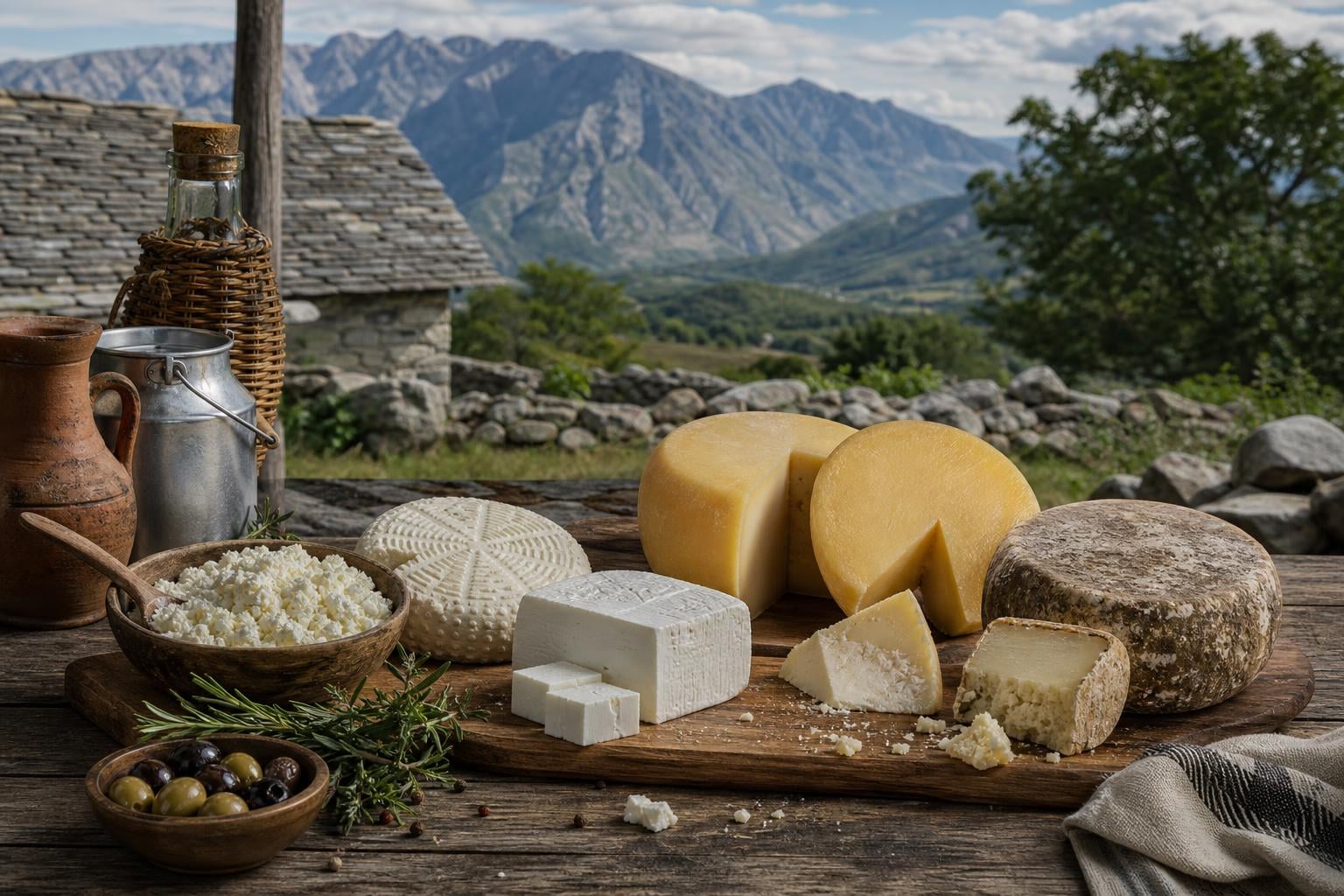
Albanian cuisine rests on dairy. Yogurt (kos) goes in the soup, on the meat, and beside the bread; butter and cream show up in the northern stews; and four cheeses anchor everything from the meze table to the holiday feast. The cheeses are simpler than the regional Italian repertoire and less internationally famous than the Greek ones, but they are the same Mediterranean dairy tradition working under a different name.
Each of the four does a specific job. Djathë i bardhë (Albanian brined white cheese) is the everyday salt-cured workhorse — the cheese that goes into byrek, on the chopped salad, and in the meze spread. Kaçkavall (aged Albanian semi-hard yellow cheese) is the sliceable, meltable, gratable one that lives in the toasted-bread breakfast and the baked casserole. Gjizë (Albanian fresh curd cheese) is the soft byproduct of cheesemaking that ends up sweetened with honey or stuffed into peppers. Sharri, also written djathë sharri, is the mountain cheese — sheep milk, long-aged, stronger flavored, the prestige cheese of the Sharr range.
This piece covers what each one is, how it’s made, how it’s used in Albanian cooking, and what to substitute when the original is out of reach in a US grocery store. The framing throughout is diaspora-practical: which version travels, which gets lost in translation, and what the US-Albanian kitchen actually puts in the byrek pan.
The Four Cheeses Every Albanian Kitchen Knows
Most Albanian cheese cooking comes down to four names. The categories sort by texture and age.
Djathë i bardhë — the brined white cheese. Sheep, cow, or a blend; salted curds aged in brine. Closest US equivalent: feta. Crumbly, salty, tangy. The cheese that goes into byrek, on chopped tomato-cucumber salads, and on the meze plate beside the olives.
Kaçkavall — the aged yellow cheese. Sheep or cow milk; pasta-filata family, related to Italian caciocavallo and the broader Balkan kashkaval tradition. Sliceable, mild-to-sharp depending on age, melts beautifully. The cheese for grilled bread, baked casseroles, and gratings over pasta-style dishes.
Gjizë — the fresh whey curd. Made by reheating the whey left from harder cheeses and skimming the curds that rise. Drier and tangier than US ricotta. Used in fërgesë (Albanian baked pepper-and-cheese casserole), eaten with honey for breakfast, and stuffed into peppers as speca me gjizë.
Sharri (or djathë sharri) — the mountain cheese. Sheep milk aged for several months in cool mountain conditions, sometimes wrapped in skin or set in brine. From the Sharr range on the Kosovo–North Macedonia–Albania border. Stronger, more complex flavor than everyday brined cheese. Closer in role to a Greek kasseri or a sharper aged feta.
These four account for the overwhelming majority of cheese on an Albanian table. Smaller-production cheeses exist — fresh string cheeses, smoked variants, alpine farm cheeses from Theth and Valbona — but for cooking purposes, knowing the four solves most recipe questions. The rest of the article looks at each in turn, then circles back to substitutes, sourcing, and the diaspora cheese question.
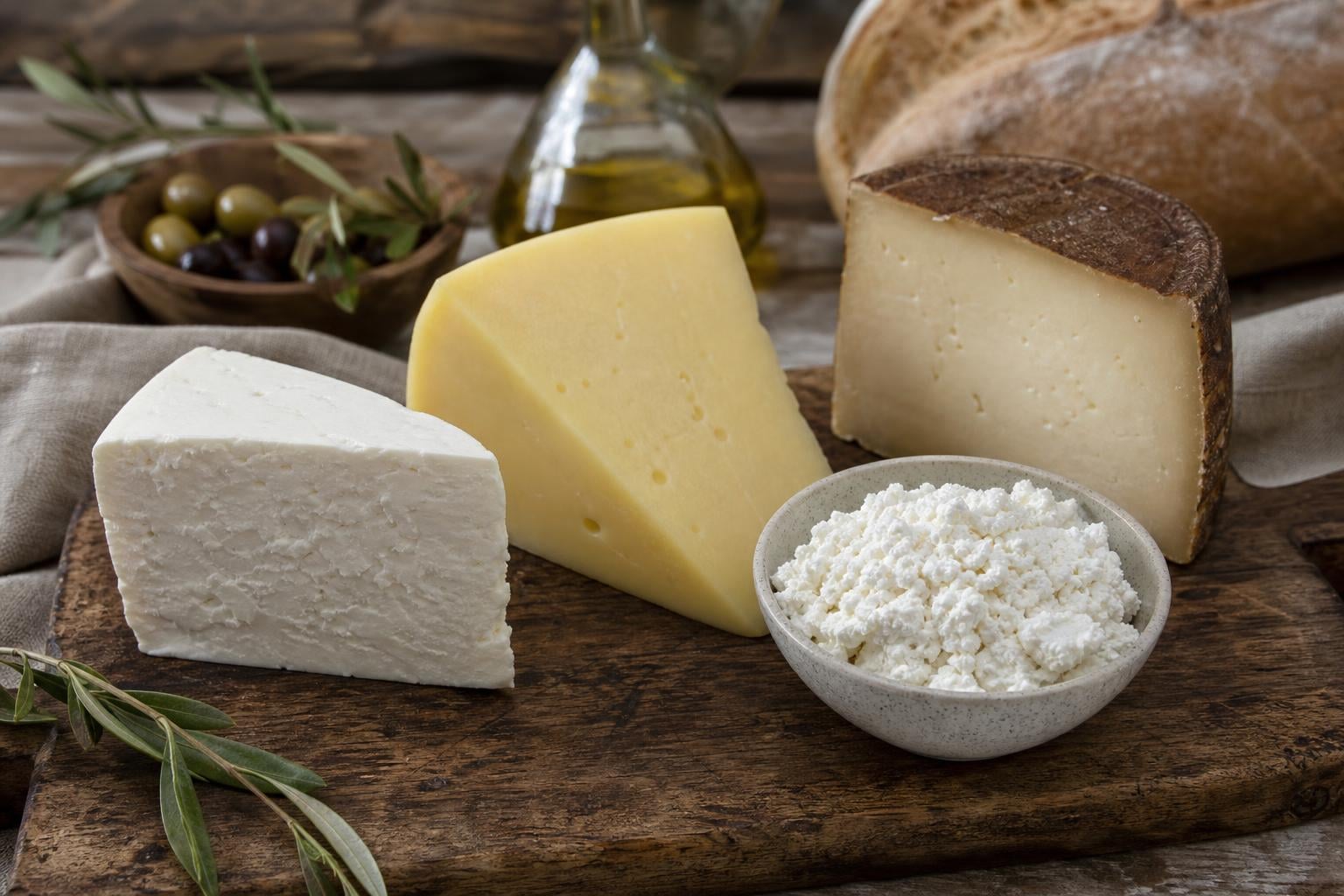 The four anchor cheeses of the Albanian table — djathë i bardhë, kaçkavall, gjizë, and sharri. — Graphic by NAR
Djathë i Bardhë — The Brined White Cheese
Djathë i bardhë literally translates as “white cheese.” It is the everyday cheese of Albania and Kosovo, the one that lives in the refrigerator door, gets cubed for the meze plate, and crumbles into nearly every savory pie. Functionally, it is feta’s first cousin.
The process is straightforward. Sheep milk, cow milk, or a blend is warmed and curdled with rennet. The curds are cut, drained, and pressed lightly into blocks. Those blocks are then salted heavily and aged in a brine bath for anywhere from a few weeks to several months. The salt does two jobs: it preserves the cheese, and it pulls moisture out, producing the characteristic firm-but-crumbly texture. Fat content typically runs in the 40–48% range on a dry-matter basis — similar to feta.
The flavor is what varies. Sheep-milk djathë i bardhë is richer, slightly sweeter, and tangier than the cow-milk version, which tends to be cleaner and milder. Mixed-milk versions split the difference and are common at smaller dairies. Younger cheese is softer and milkier; older cheese is firmer, sharper, and saltier. Diaspora cooks who grew up on a particular cheese can usually tell within a bite whether the dairy used sheep or cow.
The uses are everywhere. In byrek, it crumbles between filo layers, often mixed with gjizë or eggs. In a chopped salad, it sits on top of cucumbers, tomatoes, white onion, and a drizzle of olive oil — the everyday Albanian table salad, structurally similar to a Greek horiatiki. In fërgesë, it can stand in for gjizë or join it as a binder in the cheese-and-egg finish. On the meze plate, it appears in cubes alongside cured meats, olives, and pickled peppers.
The Greek-feta question matters here. Feta has been an EU Protected Designation of Origin since 2002, and the name is legally restricted to cheese made in specific regions of Greece following specific methods. Djathë i bardhë uses the same methods and very similar inputs, but it is made in Albania and Kosovo by Albanian dairies. They are siblings in a Mediterranean family of brined white cheeses, not duplicates. In US cooking, feta is the standard substitute when djathë i bardhë is unavailable, and the substitution works fine — the structure of the dish carries through.
Kaçkavall — The Aged Yellow Cheese
Kaçkavall is the aged Albanian cheese — semi-hard, deep yellow, sliceable, and the one most likely to show up melted on a piece of grilled bread. It is the most internationally recognized Albanian cheese and the one with the clearest connection to a broader Mediterranean family.
The cheese belongs to the pasta filata family — the “stretched-curd” tradition, in which curds are heated in hot whey or water until they become elastic, then stretched and shaped before aging. The Italian ancestor in this lineage is caciocavallo, a southern Italian pasta-filata cheese made from cow’s, sheep’s, or mixed milk — the best-known protected version, Caciocavallo Silano, uses cow’s milk — whose name and technique traveled across the Adriatic and through the Ottoman trade network. The Balkan descendants — Albanian kaçkavall, Bulgarian and Romanian kashkaval, North Macedonian kashkaval/качкавал, Serbian kačkavalj, Greek kasseri — all share that pasta-filata DNA. They are local variations on the same theme.
Production in Albania uses sheep milk, cow milk, or both. The curds are pressed, then heated in hot whey until they stretch, then molded into wheels or rectangular blocks. Aging runs from two months to a year or more. Younger kaçkavall is mild, springy, and excellent for melting; aged kaçkavall is firmer, sharper, and grates well over pasta-style dishes. Fat content typically sits between 25% and 30% by total weight — moderate by hard-cheese standards.
The uses are the most flexible of any Albanian cheese. Sliced cold, kaçkavall anchors the breakfast plate alongside olives, djathë i bardhë, and bread. Melted on toast or grilled bread, it becomes a quick weekday lunch. In a baked dish like tavë dheu or a stuffed pepper, it sits on top and forms a golden cap under the broiler. Grated, it tops baked pastas and gratins. In byrek me djath, the cheese-only byrek of northern Albania, kaçkavall sometimes joins djathë i bardhë in the filling for a richer, more melty result.
For US cooks, the closest substitute is the Bulgarian or Romanian kashkaval sold in Mediterranean and Greek markets — same cheese family, often the same dairies cross-importing. Greek kasseri is another close cousin. Provolone works in a pinch for melted applications. Sharp aged cheddar is a reasonable grating substitute, though the flavor sits in a different register.
Gjizë — The Fresh Curd
Gjizë is the cheese most US cooks have to work hardest to source — and the one Albanians miss most when they can’t. It is the fresh, soft, slightly tangy whey cheese that sits in a tub in the refrigerator and gets eaten by the spoonful with honey, stuffed into peppers, or folded into a byrek filling.
Production starts where the harder cheeses end. After sheep or cow milk has been turned into djathë i bardhë or kaçkavall, the leftover whey is reheated, sometimes with a little fresh milk added. As the temperature climbs, fine curds float to the surface. Those curds are skimmed off, drained briefly, lightly salted (or left unsalted), and packed for sale. The whole process takes a few hours, and the resulting cheese is fresh — meant to be eaten within a week or two.
The closest US analogs sit in three different rows of the dairy aisle. Italian ricotta is the standard substitute and the closest in production method, though supermarket ricotta is wetter and milder. German quark lives in the same fresh-soft-tangy family and is sometimes a better match for the texture. American farmer’s cheese (the dry, pressed kind, not the spreadable cream-cheese version) is a third option — drier, closer to gjizë’s firmer end. Greek anthotyro and manouri are the regional siblings most likely to be labeled accurately at a Mediterranean grocer.
Uses split into savory and sweet. Savory: gjizë is the canonical filler for fërgesë, where it gets folded into the pepper-tomato base with eggs and warmed until it sets into a soft custard. It also fills speca me gjizë — bell peppers stuffed with seasoned curd cheese and baked — and goes into byrek fillings, often combined with djathë i bardhë for body. Sweet: gjizë with honey and walnuts is a traditional Albanian breakfast or after-dinner plate, structurally similar to ricotta with honey in southern Italy.
The diaspora reality is that fresh gjizë is the cheese most often replaced. A US-Albanian kitchen running a half-and-half mix of ricotta and crumbled feta hits 80% of the original profile — ricotta for body, feta for tang. Whole-milk ricotta drained in a fine-mesh strainer for 30 minutes works in a pinch on its own. The substitution shows in the final dish only to a palate that grew up on the original.
Sharri (Djathë Sharri) — The Mountain Cheese
Sharri is the prestige cheese of the Albanian dairy tradition. It is named for the Sharr Mountains — Malet e Sharrit in Albanian, Шар Планина in Macedonian — the range that straddles Kosovo, North Macedonia, and a small piece of northeastern Albania. The cheese is made from the milk of sheep grazed in those high pastures, and the geography is part of the product.
Production is traditional and slow. Sheep milk is curdled with rennet, the curds are pressed and salted, and the wheels age for two to six months in cool mountain conditions. Some producers age in tin or wooden barrels filled with brine; older traditions wrapped wheels in animal-skin sacks (tulum-style aging, common across the Balkans) where the cheese matured under controlled humidity. The result is a firmer, drier, more flavor-concentrated cheese than everyday brined white — sharper, saltier, with the grassy notes of mountain pasture coming through.
No formal protected-origin status exists yet for Sharri-tradition cheese. North Macedonia is not an EU member, so EU PDO/PGI protection doesn’t apply there directly, and no registration has surfaced for a Sharr/Šar cheese under any spelling (including Шарски сир). Kosovo, Albania, and North Macedonia each produce their own Sharri-tradition cheeses from the same range under local, unregistered names. The point for a US cook is that any cheese sold as sharri or djathë sharri is operating in this tradition: sheep milk, mountain pasture, several months of aging, stronger flavor than the everyday brined white.
Uses are different from the other three. Sharri is rarely a cooking cheese; it is a tasting cheese, eaten in slices on bread with olives and cured meats, served as part of a substantial meze spread, or paired with a glass of raki or red wine after a meal. It can be grated for finishing, but the flavor is strong enough that a little goes a long way.
In the US, real sharri is hard to find. Specialty Balkan importers carry it intermittently, and some Albanian-American grocers in dense diaspora neighborhoods stock it around major holidays. The closest substitutes are aged Greek kasseri, a sharply aged feta, or a young Manchego — sheep-milk cheeses with similar age profiles. None is a true replacement, but each carries enough of the structural character to anchor a meze plate.
Albanian Cheese vs. Greek, Bulgarian, Italian
These cheeses do not exist in isolation. The Mediterranean and Balkan dairy tradition is one continuous network of related techniques, and the same recipes show up under different names across the region. Naming the family helps the diaspora cook source substitutes and helps non-Albanian readers understand what they are looking at.
Brined white cheeses. Albanian djathë i bardhë, Greek feta, Bulgarian sirene, Romanian brânză de burduf, Turkish beyaz peynir are all sheep, cow, or mixed-milk cheeses curdled with rennet, salted, and aged in brine. The PDO restriction on the name “feta” (EU 2002) means only the Greek version can legally use that label, but functionally these cheeses are very close. Recipes carry across them.
Pasta-filata yellow cheeses. Kaçkavall, kashkaval, kasseri, caciocavallo, kačkavalj — all stretched-curd cheeses descended from the same broader tradition. Italian caciocavallo is the historical anchor; the Balkan versions developed under shared Ottoman-era dairy networks. Within this family, kasseri is most commonly a sheep-milk cheese, caciocavallo often cow, kashkaval either or both. Substitution between them is straightforward in most cooked applications.
Fresh whey cheeses. Gjizë, Italian ricotta, Greek anthotyro and manouri, Romanian urdă, Spanish requesón, German quark (closer to a fresh curd than a whey cheese, but in the same soft-fresh family) are all the byproduct or fresh-curd category. Production is short, shelf life is short, and each tradition uses them in similar ways: sweet (with honey, in pastries) and savory (in fillings, stuffed vegetables).
Mountain aged sheep cheeses. Sharri, Greek graviera, Sardinian fiore sardo, Spanish Manchego, Bulgarian kashkaval Balkan, and various Caucasian and Anatolian sheep cheeses all share the long-aged sheep-milk profile. They are the prestige category — slower production, longer aging, deeper flavor.
The framing here is shared tradition, not competition. The same Mediterranean dairy logic produced these cheeses, and the borders between them shifted over the centuries. Albanian cooks in the US can move comfortably between Albanian, Greek, Bulgarian, and Italian cheese counters and find what they need; only the labels change.
Where to Find Albanian Cheese in the US
Sourcing breaks into three categories, in increasing order of authenticity.
Mainstream supermarkets. Most US grocery chains carry feta (a direct substitute for djathë i bardhë) and ricotta (a workable substitute for gjizë). Some carry Bulgarian or Romanian kashkaval in the international cheese case — that is the closest off-the-shelf match for kaçkavall. Trader Joe’s, Whole Foods, and Wegmans all stock at least two of the three categories.
Mediterranean, Greek, and Balkan grocers. This is the second tier and the right tier for most diaspora cooks. Greek delis carry feta, kasseri, and graviera. Bulgarian and Macedonian markets stock kashkaval, sirene, and sometimes Sharri-tradition mountain cheeses under various spellings. Turkish markets carry beyaz peynir (a feta-style cheese) and kaşar (a kashkaval-style cheese). The labels differ from the Albanian names, but the dairy is the same.
Albanian-American grocers. The most accurate sourcing comes from grocers in the dense Albanian-American diaspora neighborhoods. Belmont and Pelham Parkway in the Bronx, Yonkers and parts of Westchester County in New York; Sterling Heights, Warren, and Detroit in Michigan; Worcester and Boston in Massachusetts; Waterbury and Bridgeport in Connecticut; Paterson and Garfield in northern New Jersey. Stores in those areas stock cheeses labeled kaçkavall, gjizë shqiptare, and occasionally sharri, often imported from dairies in Albania, Kosovo, or North Macedonia. Search “Albanian grocery” or “dyqan ushqimor shqiptar” in the local zip code; community Facebook groups maintain current lists.
Online importers. A handful of Balkan-foods importers ship nationally. Balkan Foods USA is one example; there are others run by first-generation Albanian and Bulgarian families. Cold-shipping adds cost, and freshness varies by brand. For kaçkavall, online ordering is reliable. For gjizë, freshness is the constraint, and most diaspora cooks default to a local ricotta-and-feta substitute rather than ship a perishable curd cheese.
The article does not name specific stores, restaurants, or brands beyond category. The diaspora map shifts year to year as families open and close businesses; the neighborhoods are stable, but the storefronts are not.
How Albanian Cheese Is Made (Briefly)
The four cheeses share a common starting point and diverge from there.
The base. Raw or pasteurized milk — sheep, cow, or a blend — is warmed gently to 30–35°C. Rennet is added (animal rennet traditionally; vegetable or microbial rennet at modern dairies). Within 30 to 60 minutes, the milk sets into a soft curd.
Path 1: brined white cheese (djathë i bardhë). The curd is cut into small cubes, drained briefly to release whey, pressed lightly into blocks, and salted. The blocks then go into a brine bath — saturated salt water — for several weeks to several months of aging. The brine preserves the cheese and pulls moisture out, producing the firm-crumbly texture. The whey from this step becomes the raw material for gjizë.
Path 2: aged yellow cheese (kaçkavall). The curd is cut, drained, and then heated in hot whey or water until it becomes elastic — the pasta-filata stretch. The stretched curd is kneaded, shaped into wheels or blocks, and salted. Aging happens in cool, dry conditions for two months to over a year, with regular turning and brushing. The resulting cheese has a deeper yellow color, a firmer texture, and the characteristic mild-to-sharp flavor that develops with age.
Path 3: fresh whey cheese (gjizë). The leftover whey from steps 1 or 2 is reheated, sometimes with a small amount of fresh milk added to boost yield. As the temperature rises toward 85–90°C, fine curds rise to the surface. Those curds are skimmed, drained briefly, lightly salted (or left plain), and packed. The cheese is meant to be eaten fresh, within a week to ten days.
Path 4: mountain aged sheep cheese (sharri). A version of the brined white process with longer aging, smaller batches, and traditional storage — wooden barrels, brine, sometimes skin sacks. The longer aging concentrates flavor and dries out moisture, producing the firmer, sharper, more complex cheese.
These descriptions are simplified. Real production involves humidity control, milk-handling regulations, dairy-specific aging rooms, and details that vary from farm to farm. The point is the basic logic: rennet sets the curd, salt preserves the cheese, time develops the flavor, and what you do between those three steps determines which of the four cheeses you end up with.
The Diaspora Cheese Question
First-generation Albanian-American kitchens kept these cheeses alive through the simplest mechanism available: someone in the family knew where to buy them. A grandmother in the Bronx drove to Arthur Avenue. A grandfather in Sterling Heights had a friend at a Macedonian deli. A cousin in Waterbury smuggled a wheel of sharri in his suitcase after a visit home. The cheeses survived because the network did.
Second-generation kitchens lean on substitutes. Feta replaces djathë i bardhë on the salad. Ricotta replaces gjizë in the byrek. Mozzarella, provolone, or Bulgarian kashkaval stands in for kaçkavall on the toast. The dishes still come out recognizable, and the family still calls them by their Albanian names. What is lost is the texture and tang specific to the Albanian dairy tradition — the slightly different curd from a slightly different sheep eating slightly different grass. What is gained is that the dishes get cooked at all, in homes that might otherwise have skipped the recipe entirely.
Third-generation kitchens go further in both directions. Some grandchildren make a project of finding the originals — visiting Albania, ordering from Balkan importers, learning the names of the cheeses their grandparents used by default. Others substitute without knowing — making byrek with a generic Italian filo and supermarket feta because that’s what’s in the fridge, the family connection mediated entirely through the recipe rather than through the ingredient list.
Both versions are real Albanian-American cooking. The recipes carry the tradition; the cheeses carry the texture; the people doing the cooking carry the rest. Where the original cheese is available, use it. Where it isn’t, the substitute keeps the dish on the table, and that is most of what matters.
The four cheeses — gjizë, kaçkavall, djathë i bardhë, and sharri — are the kind of detail that gets lost between generations if no one writes it down. The dishes survive longer than the ingredient names. Knowing the names is part of how the cuisine stays whole.
If your family kitchen runs on these cheeses — or on the ricotta-and-feta substitutes that stand in for them — that is part of the Albanian-American food story we are tracking. NAR is building a community-led count of Albanian Americans, including the families teaching the next generation what to put in the byrek pan. The foods that survive immigration are worth counting. Get counted in two minutes. Free, neutral, and your data stays yours.