
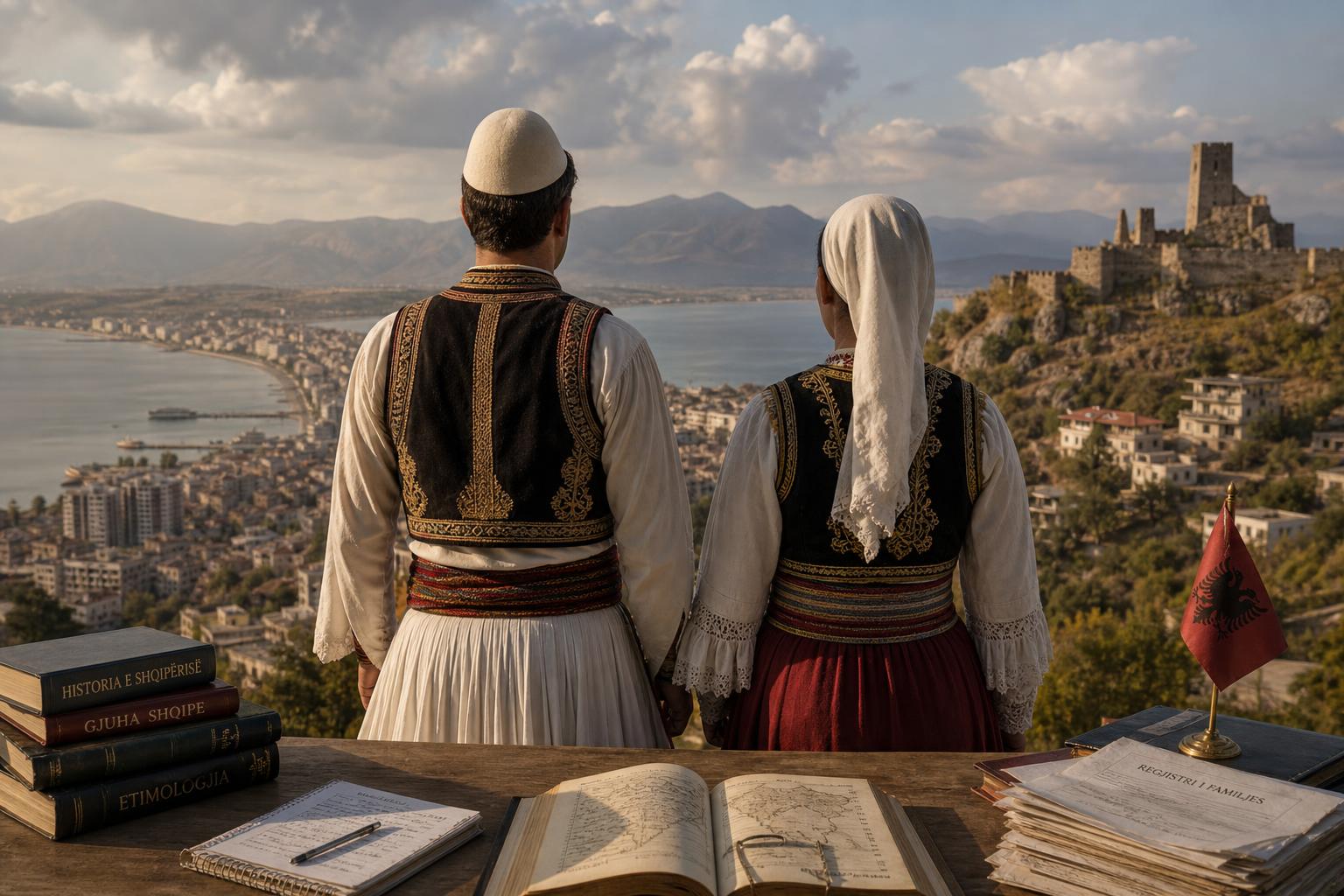
A name in your own language
Most words for a people are exonyms — names given by outsiders. “German” is what English speakers call the people who call themselves Deutsch. “Greek” is what English speakers call the people who call themselves Έλληνες (Hellenes). “Albanian” is the same kind of word.
In Albanian, the everyday term for an Albanian man is shqiptar. The word for an Albanian woman is shqiptare. The plural — the Albanians — is shqiptarët. The country is Shqipëria. None of these are translations of “Albanian.” They are the names the community has used for itself for the last three to four hundred years.
For Albanian Americans, this matters more than it sounds. The word you use to describe yourself shapes the room you walk into. Shqiptar in a kitchen in the Bronx, on a wedding video from Worcester, on a parade banner in Sterling Heights — it carries a different weight than “Albanian” on a tax form. Both are accurate. They are not the same word.
This explainer is for anyone who has heard shqiptar at home and wanted the longer story behind it: what it means, where it came from, why it replaced an older name, what the famous “land of eagles” line actually rests on, and how the word travels in a community that mostly lives outside Albania now.
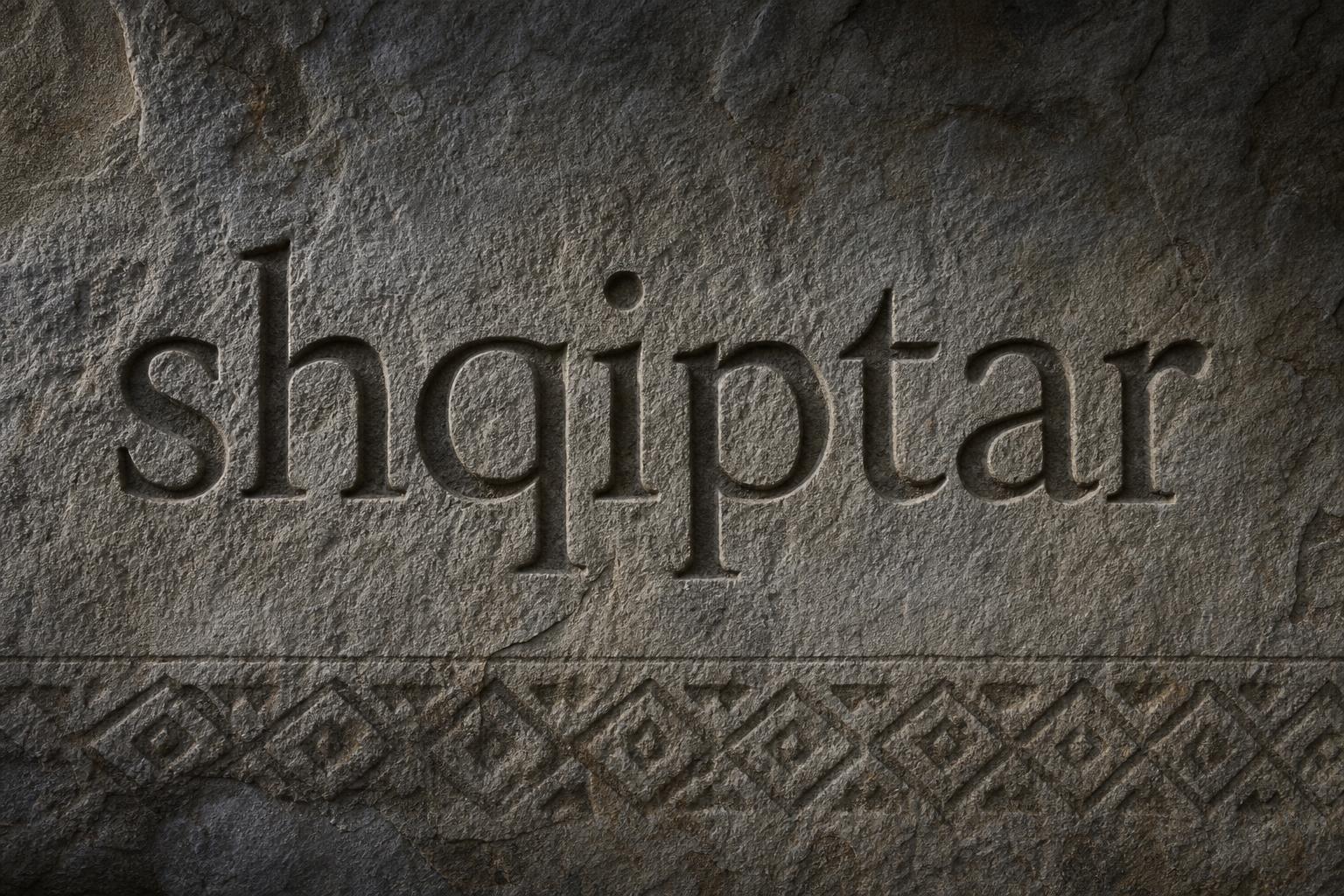 The everyday self-name of the Albanian people: shqiptar (m.), shqiptare (f.), and the country Shqipëria.
Image: NAR/gpt-image-2
The everyday self-name of the Albanian people: shqiptar (m.), shqiptare (f.), and the country Shqipëria.
Image: NAR/gpt-image-2
Shqiptar, shqiptare, Shqipëria: the basics
Albanian is a gendered language. Nearly every noun referring to a person comes in two forms, masculine and feminine, and the rule applies to ethnonyms as cleanly as to ordinary nouns.
- shqiptar — an Albanian man (also used generically when gender is not specified)
- shqiptare — an Albanian woman
- shqiptarët — the Albanians, plural, with the suffixed definite article
- Shqipëria — Albania, the country
- shqip — the Albanian language
In a sentence, the forms behave the way you would expect. Ai është shqiptar — “He is Albanian.” Ajo është shqiptare — “She is Albanian.” Ne jemi shqiptarë — “We are Albanians” (indefinite plural). Shqipëria është në Ballkan — “Albania is in the Balkans.” Flas shqip — “I speak Albanian.”
The pronunciation is roughly shchip-TAR for the masculine and shchip-TA-reh for the feminine. The opening cluster sh-q runs together as a single soft “shch” sound, closer to the English sh in push than to anything in English itself. The stress on shqiptar falls on the last syllable; on shqiptare, the second-to-last. Regional pronunciation varies — speakers from Kosovo and northern Albania tend to soften the q further than speakers from Tirana — but the spelling has been standard since the 1972 orthography conference.
A small but useful note for the diaspora: in casual Albanian-American speech, you will hear “shqipo” or “shqipja” and other shortened forms, and you will hear English plurals like “shqiptars.” Standard Albanian uses shqiptarë (indefinite plural) and shqiptarët (definite plural). The English-style “shqiptars” is colloquial; it is not wrong, but it is not what you will see in a book.
The older endonym: Arbër, Arbëresh, Arbëria
For most of recorded history, Albanians did not call themselves shqiptar. The older self-name was Arbër in the Tosk south and Arbën in the Gheg north, with the matching plural form Arbëresh for “an Albanian person” or “of the Arbër.” The land was Arbëria.
This is the name that travelled out into other languages in the medieval period. Byzantine Greek picked it up as Albanoi by the 11th century. Latin took it as Albanenses. Italian, French, English, German, and most other European languages built their words for the people from that root: albanese, albanais, Albanian, Albaner. Every modern European exonym for the Albanian people traces back to Arbër.
The older name itself goes back further still. The Greek geographer Ptolemy in the 2nd century AD recorded an Illyrian tribe called the Albanoi living near a town called Albanopolis in central Albania. Whether the medieval Albanians took their name directly from that ancient tribe, or whether the two names share a common older root, is debated by linguists. What is not debated is that Arbër was the standard self-name of the community for several hundred years before shqiptar replaced it.
Two diaspora communities still use the old name. The Arbëreshë of southern Italy — descendants of Albanians who fled the Balkans in waves between the 13th and 18th centuries, mostly after Skanderbeg’s death in 1468 — call themselves Arbëreshë and their language Arbërisht. The Arvanites of southern Greece, an older Albanian-speaking community in the Peloponnese and Attica, call themselves Arvanitë and their language Arvanitika. Both groups left the Balkans before shqiptar became the standard endonym, and they kept the older form. They are linguistic time capsules of medieval Albanian self-identification.
When and why the name changed
The shift from Arbër to shqiptar happened gradually, mostly in the 17th and 18th centuries, with the new word fully dominant by the time of the 19th-century Albanian National Renaissance (Rilindja Kombëtare). The earliest recorded uses of shqiptar and Shqipëria in written Albanian come from the late 17th and 18th-century writings of Catholic clerics in the north — figures like Pjetër Bogdani, whose 1685 Cuneus Prophetarum is one of the earliest substantial Albanian-language books — though even there the older terminology is mixed in.
By the time of the Rilindja writers — Naim Frasheri, Sami Frasheri, Pashko Vasa — shqiptar and Shqipëria are the default. Vasa’s famous 1880 nationalist poem O moj Shqypni uses the new form in its title. By the time of the 1912 declaration of independence, the older Arbëria survives only in poetry and in the diaspora communities that left before the change.
Why the shift happened is less clear than when. Several factors are usually proposed: the rise of the new word as a marker of in-group cohesion under Ottoman rule; a deliberate distancing from the religious and political baggage attached to the older Latinate name; the preference of Albanian-language writers for a term grounded in their own language rather than in Greek or Latin. None of these is the whole answer. What is clear is that the change was completed from the inside, by Albanian speakers, and the older form survived only where the speech community had physically left the Balkans before the change took hold.
”Land of the eagles” — the folk etymology
Ask any Albanian American what Shqipëria means and most will tell you, with some pride, that it means “land of the eagles.” The two-headed black eagle on the Albanian flag, the eagle on Skanderbeg’s banner, the eagle on the Kastrioti family crest — the symbol is genuinely old, going back at least to the 15th century, and the connection between Shqipëria and shqiponjë (Albanian for “eagle”) is phonetically obvious.
This is the popular etymology. It is the version you hear at weddings, on flag day, in soccer chants, and in tourist brochures. And it is not entirely wrong — there is a real morphological relationship between shqip and shqipe (one regional word for the bird) and shqiponjë (the standard word). The two roots ride alongside each other in the modern language.
But most professional linguists treat the eagle reading as secondary, a folk etymology that crystallized after the fact. The bird and the people share a sound, the symbol fit the story, and the explanation is satisfying. That does not make it the correct historical derivation.
What linguists actually argue: the verb shqiptoj
The mainstream scholarly position, associated most closely with the Albanian linguist Eqrem Çabej and the British Albanologist Robert Elsie, traces shqiptar to the Albanian verb shqiptoj — “to pronounce, to articulate, to speak clearly.” Under this reading, a shqiptar is, etymologically, “one who speaks clearly” or “one who speaks our language” — that is, an Albanian-speaker, recognizable by his ability to pronounce the Albanian language correctly.
This is the same self-identifying logic at work in the names of many ethnic groups. The Slavs called themselves Slověne — speakers of the word — and called outsiders Němci, mutes. The ancient Greeks called outsiders bárbaroi, people whose speech sounded like bar-bar. Naming yourselves after your ability to use your own language, in contrast to outsiders who cannot, is one of the oldest naming patterns in Indo-European.
Under the shqiptoj reading, Shqipëria would mean something like “the land of those who speak Albanian” — a linguistic-community boundary rather than a heraldic one. Shqip, the language itself, would be the deeper root: the same word as the verbal shqiptoj, contracted and used as a name. The eagle resemblance becomes a happy coincidence reinforced by national symbolism, rather than the source of the name.
Neither theory has fully won the academic argument, and both are still taught. The honest summary is that the eagle is the better story and the speech-verb is the better linguistics.
”Albanian” as the exonym: from Albanoi to Albania
The English word Albanian — and the country name Albania — are exonyms, names given by outsiders. The chain is straightforward.
Greek geographers from the 2nd century AD record an Illyrian tribe in the central Balkans called the Albanoi, with a town called Albanopolis. By the 11th century, Byzantine sources are using the same name for the medieval Albanian community. The word travels into medieval Latin as Albanenses, into Italian as albanese, into French as albanais, and into English by way of all of those. By the time of the early modern European maps, Albania is the standard Latin and English name for the country.
The exonym, in other words, captures a genuinely old version of the Albanian self-name — the Arbër root — and freezes it. While Albanians in the Balkans were shifting their own self-name to shqiptar in the 17th and 18th centuries, the rest of Europe kept the older form. Today, English speakers use a name based on a 2nd-century Illyrian tribe, while Albanian speakers use a name based on a 17th-century Albanian verb. Both are correct. They sit on different sides of a sound change that happened in the middle.
For diaspora practical purposes, this is why the US Census records “Albanian ancestry” rather than “shqiptar ancestry.” The American Community Survey reported about 224,000 Albanian Americans on the most recent ancestry tables. Community estimates put the real figure closer to a million. The word on the form is “Albanian”; the word in the kitchen is shqiptar.
How shqiptar travels in the diaspora
In the United States, shqiptar and shqiptare are everyday code-switching words. A second-generation kid in Worcester or the Bronx does not learn the word in a textbook. They hear it from a grandmother (gjyshe) at a family dinner, from a cousin at a wedding, in a phone call from an uncle in Tirana, in the Albanian-language Mass at an Orthodox parish, in the Friday sermon at an Albanian American Islamic center.
The word does specific work that “Albanian” cannot do in English. It carries warmth. It marks an in-group. It signals to another speaker, we are the same kind of people, in a way that the English exonym, accurate as it is, does not. When two Albanian Americans meet at a conference and one says, “je shqiptar?” — “are you Albanian?” — the question is doing more than gathering demographic information.
For first-generation immigrants, shqiptar is usually the default. English came later; the self-name in the home language is the one that came first. For the second generation, the picture is more mixed. Many use shqiptar with family and “Albanian” at school, work, and on official forms. By the third generation, the home-language word often survives at weddings, funerals, and flag-day events but recedes in everyday speech. None of this is unique to Albanians; it is the standard arc of an immigrant ethnonym in the United States.
What is distinctive is the geography of the community. The largest US Albanian populations are in New York (~56K), Michigan (~27K), and Massachusetts (~21K), with substantial communities in Connecticut, Illinois, and Texas. Within those clusters — in Little Albania in the Bronx, in Sterling Heights and Warren outside Detroit, in Worcester — shqiptar is the working word. Step a block outside, it becomes “Albanian.” Step into a registry form, it becomes a checkbox. The word has versions of itself for every register.
Variants across the Albanian-speaking world
Shqiptar is the standard form across the Albanian-speaking world, but the word lives a slightly different life in different places.
In the Republic of Albania itself (~2.18 million ethnic Albanians), the word is the unmarked default — the everyday term, with no special weight beyond ordinary self-reference. In Kosovo (~1.45 million ethnic Albanians, roughly 93% of the population), shqiptar is also standard, though Kosovo Albanians sometimes use kosovar as a parallel civic identity referring specifically to citizenship of Kosovo. The two terms are not in conflict; many people are both.
In North Macedonia and Montenegro, where ethnic Albanians are sizable minorities, shqiptar is the in-community word and the local Slavic-language exonyms (Albanci, Albanac) are used in cross-community contexts. In the Preševo Valley of southern Serbia, where there is also a long-established Albanian-speaking population, the same pattern holds.
The two old-diaspora communities are the interesting case. The Arbëreshë of southern Italy — about 100,000 active speakers across some 50 villages — call themselves Arbëreshë, not shqiptar, because their ancestors left the Balkans in the 14th-16th centuries, before the new self-name became standard. Their language, Arbërisht, is a medieval form of Tosk Albanian preserved in southern Italy. The Arvanites of southern Greece use a similar older terminology. Both communities are recognized by the modern Republic of Albania as part of the broader Albanian community, and the 2020 Albanian Citizenship Law explicitly extends citizenship-by-descent eligibility to their lines.
The National Albanian Registry treats all of these — shqiptar, kosovar with Albanian ethnicity, Arbëreshë, Arvanite — as one community for counting purposes. The naming differences reflect different paths through the same diaspora history, not different peoples.
A note on misuse abroad
Like almost every ethnonym in Europe, shqiptar has occasionally been weaponized as a slur in the languages of neighboring peoples. In some Slavic-language contexts in the former Yugoslavia, the cognate forms Šiptar (Serbian) or šiptar (with the lowercase form often the offensive one) have been used pejoratively rather than neutrally; the standard Slavic exonyms Albanci/Albanac are the neutral terms. Albanian speakers in those regions are generally well aware of which usage is which.
This is a fact about the host languages, not about the word shqiptar itself. In Albanian, the word is and has always been the neutral, in-community self-name. In English, “Albanian” carries no slur load. The handful of cases where the word has been turned into something hostile are a feature of cross-community politics in specific places, not of the word as Albanians use it.
The community has not changed its self-name in response. Shqiptar remains the standard word in Albanian, and any push to retire it because of how outsiders have abused the cognate would be an over-reaction to a problem that lives in someone else’s language.
Why the word still matters
For an Albanian American in 2026, shqiptar and shqiptare still earn their keep in three ordinary places.
At the kitchen table. It is the word a grandmother uses, the word a parent calling from Tirana uses, the word that travels with the language. Letting it fade in the second generation is one of the small ways a diaspora language thins out. Keeping it — even alongside English — keeps a thread of continuity that does not have an English substitute.
On a community form. When a Saturday school (shkolla shqipe), a parish, a mosque, a community organization, or the National Albanian Registry asks a member to identify themselves, the choice between “Albanian,” “shqiptar,” “Kosovar Albanian,” “Arbëresh,” or all of the above is not a trivia question. It is a low-stakes way of telling the institution what the person actually is.
On the official US Census. The American Community Survey records “Albanian ancestry” — about 224,000 reported on the most recent tables. NAR’s count, including ethnic Albanians who do not show up in the ACS undercount, is structured around the broader category that shqiptar covers in the home language. Both numbers matter. They measure related but different things.
The word does not need to be foregrounded all the time. It does not need to replace “Albanian” in English-language contexts where “Albanian” works. But it is the one Albanians chose for themselves, somewhere between the 17th and 18th centuries, after a few centuries of using Arbër, and it has held up for three hundred years in spite of Ottoman rule, Communist rule, mass migration, and the ordinary erosion of diaspora languages. That is worth knowing about, and worth keeping.
Get counted
Whether you call yourself shqiptar, shqiptare, Albanian American, Kosovar, Arbëresh, or all of the above depending on the room — the National Albanian Registry counts you. The form takes a couple of minutes; the count is community-led, free, and never partisan.
You can add yourself at albanianregistry.org/register.