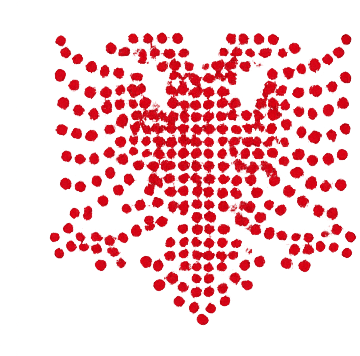

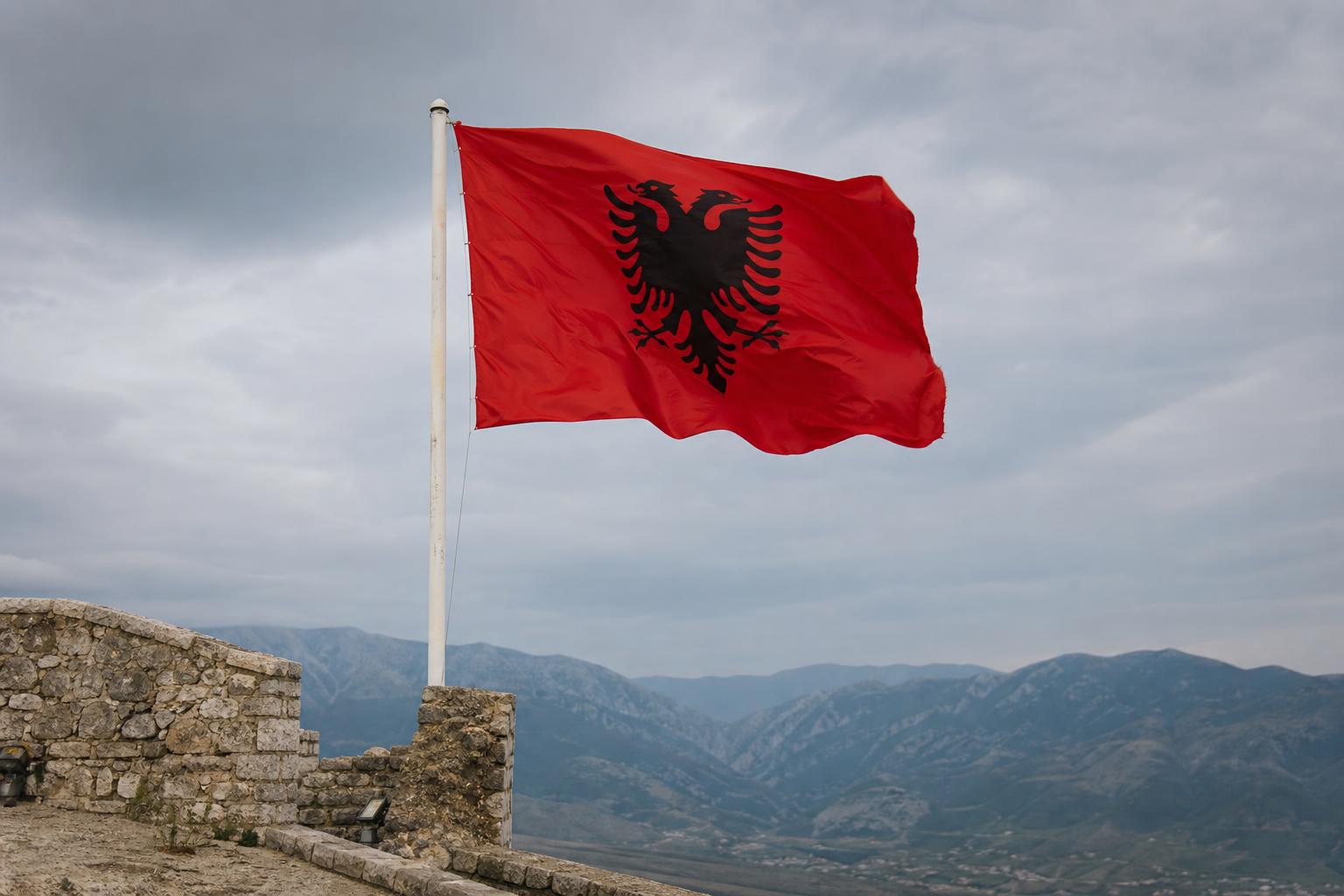
Its origins predate Albania itself. The eagle motif descends from Byzantine imperial heraldry, and the version Albanians carry today is the direct descendant of Skanderbeg’s 15th-century war banner, raised over Krujë in November 1443 and over the declaration of independence at Vlorë in November 1912.
Through five centuries of Ottoman rule, monarchy, foreign occupation, and one of the harshest communist dictatorships in Europe, the basic image survived almost unchanged: black eagle, two heads, red field. Other regimes added stars, crowns, fasces, helmets — and one by one those additions were stripped back off. The eagle and the red stayed.
This piece covers where the flag comes from, what its elements mean, how it changed across the 20th century, and why it shows up in every Albanian-American home — over the doorway, in the parish hall, on the wall behind the cash register, on the lapel pin, on the soccer jersey, on the tattoo. For the diaspora, the flag is not decoration. It is the most compact possible statement of the inheritance.
The double-headed eagle in history
The double-headed eagle is older than Christianity, older than Rome, older than any state still flying it.
The earliest examples are Bronze Age, from the Hittite Empire of central Anatolia in the second millennium BC. The most famous surviving image is carved into the Sphinx Gate at Alaca Höyük, in modern-day Turkey — a stone relief depicting two-headed birds clutching hares in their talons. Hittite scholars read the motif as royal insignia: a sign of unified rule over a wide territory (Wikipedia: Double-headed eagle). Variants of the same design appear elsewhere in ancient Anatolia and the wider Near East, in Mesopotamian, Sumerian, and later Persian iconography.
After the Bronze Age collapse the symbol effectively disappears for two thousand years. It re-emerges in the Eastern Roman Empire — Byzantium — by about the 10th century, first in court art and decorative work, then as official imperial heraldry under the Palaiologos dynasty in the 13th-15th centuries (Wikipedia: Double-headed eagle). Under the Palaiologoi the double-headed eagle became the emblem of Byzantine imperial sovereignty itself. The two heads symbolized the dual authority of the emperor: spiritual and temporal, or — read geographically — east and west, the two halves of the old Roman world that Byzantium still claimed in theory.
From Byzantium the motif spread along every line of political and dynastic contact.
Russia adopted it in 1472 when Ivan III married Sophia Palaiologina, niece of the last Byzantine emperor. The double-headed eagle became central to Russian imperial heraldry under the Rurikids, the Romanovs, and — after a Soviet interruption — the modern Russian Federation, which restored it in 1993.
Serbia used variants of the double-headed eagle from the 12th century onward under the Nemanjić dynasty, drawing directly on Byzantine models.
The Holy Roman Empire used the Reichsadler, a double-headed eagle, as its imperial sign from the 15th century until the empire’s dissolution in 1806. Through Habsburg dynastic continuity, the symbol survived in the Austrian and Austro-Hungarian Empires until 1918.
Albania received the motif through the Kastrioti family — through Skanderbeg.
The shared inheritance is why the double-headed eagle still appears today on the flags or coats of arms of Albania, Russia, Serbia, Montenegro, North Macedonia (in some variants), and the modern Greek Orthodox Church, and in the heraldry of the Holy See and several modern Habsburg-descendant houses. Across cultures the variations are real but minor: the eagle is sometimes crowned, sometimes orbed, sometimes hatched in different colors. The basic two-headed bird is the same.
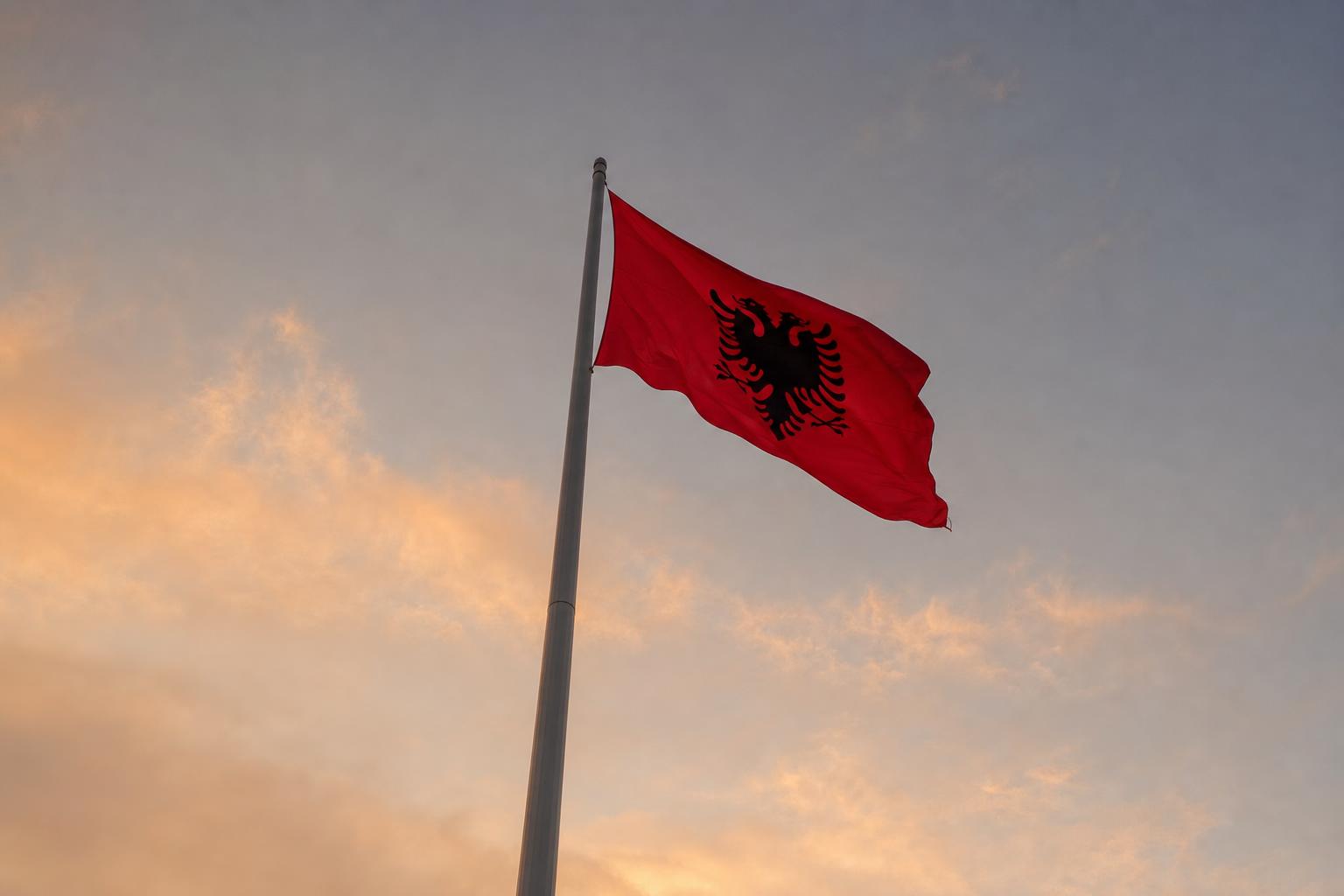 The modern Albanian flag — black double-headed eagle on red, 5:7 aspect ratio per Law Nr. 8926 of 22 July 2002.
Graphic by NAR
The modern Albanian flag — black double-headed eagle on red, 5:7 aspect ratio per Law Nr. 8926 of 22 July 2002.
Graphic by NAR
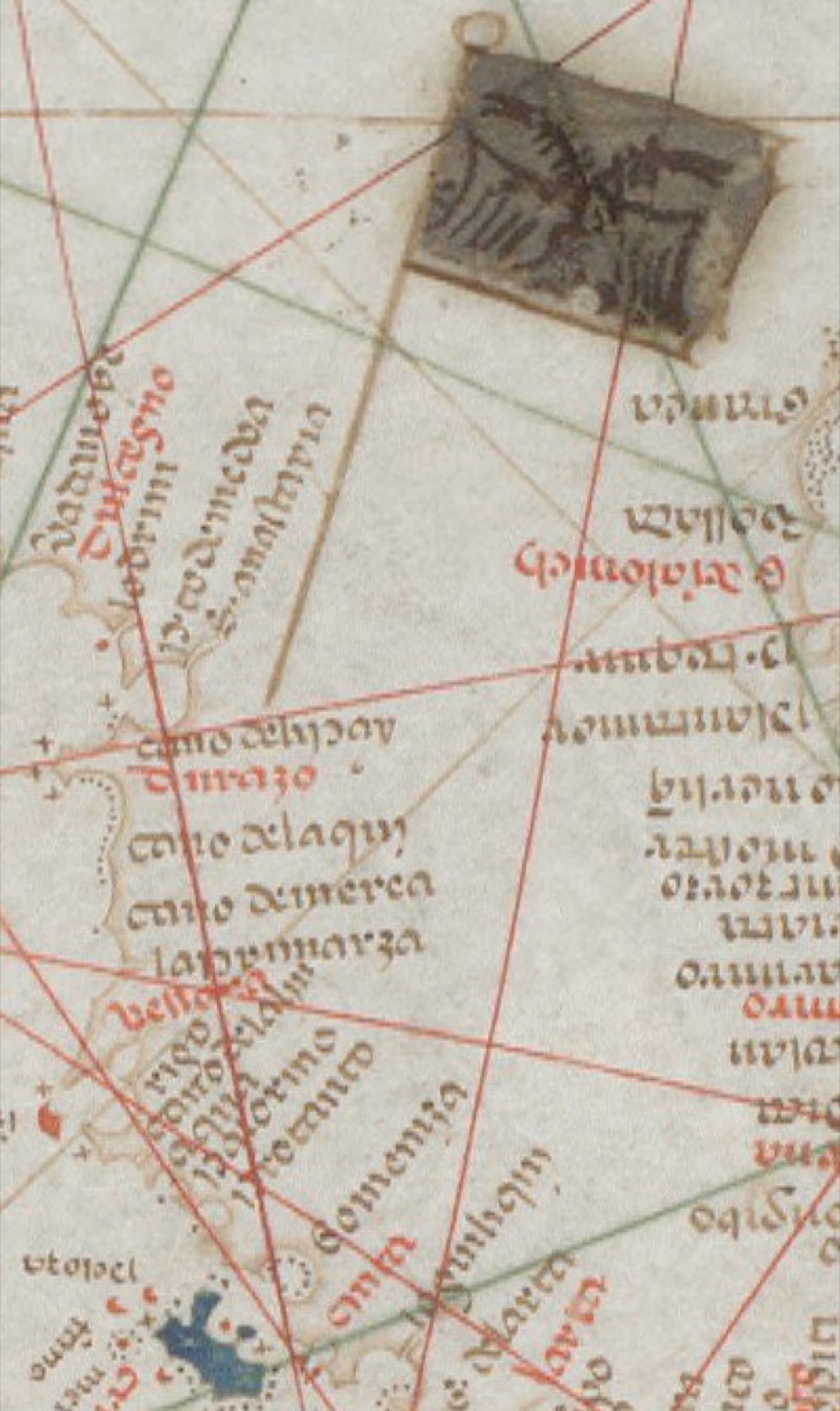 Reconstructed 15th-century Skanderbeg banner — the Kastrioti family standard raised over Krujë on 28 November 1443 and the direct ancestor of every Albanian flag flown since.
Image: Wikimedia Commons / public domain
Reconstructed 15th-century Skanderbeg banner — the Kastrioti family standard raised over Krujë on 28 November 1443 and the direct ancestor of every Albanian flag flown since.
Image: Wikimedia Commons / public domain
Skanderbeg’s banner
Gjergj Kastrioti — Skanderbeg — adopted the double-headed black eagle on red as his family’s heraldic banner. The Kastrioti clan claimed descent, debated by modern scholars, from a branch of the Byzantine imperial nobility, which is the cleanest explanation for why a small Albanian princely house was using a Byzantine-style imperial eagle as its personal device in the early 15th century.
The story of how it became the Albanian national flag is, in effect, the story of Skanderbeg’s defection.
In November 1443, after roughly two decades as an Ottoman officer, Skanderbeg left the Ottoman lines during the Battle of Niš, rode south to his ancestral fortress of Krujë with about 300 Albanian compatriots, and took control of the city on 28 November 1443. He raised over the fortress walls the red banner with the black double-headed eagle — the Kastrioti family standard. He renounced Islam, returned to Catholic Christianity, and declared the principality of Kastrioti restored (Wikipedia: Flag of Albania).
For the next 25 years, until his death from malaria at Lezhë on 17 January 1468, Skanderbeg fought the Ottoman Empire from under that banner. The League of Lezhë in 1444, the relief of Krujë against Murad II in 1450, the Battle of Albulena in 1457, the second siege of Krujë against Mehmed II in 1466-67 — all were fought under the same red flag with the same double-headed black eagle. By the time of his death the banner was no longer just a Kastrioti family standard. It was the visible sign of organized Albanian resistance.
After Skanderbeg, the banner survived in three ways.
Among Albanian noble families, who carried the heraldry forward in exile and in the Italian Renaissance courts where many ended up. Skanderbeg’s son Gjon Kastrioti II emigrated to the Kingdom of Naples and was granted the Duchy of San Pietro in Galatina. The Castriota line continued in Italian nobility for centuries.
Among the Italian Arbëreshë communities — the descendants of roughly a quarter of the Albanian population who fled to southern Italy after the fall of Krujë in 1478 and the fall of Shkodër in 1479. The Arbëreshë preserved 15th-century Albanian language, Byzantine-rite Catholicism, and the Skanderbeg banner across more than 500 years and 50-some villages in Calabria, Sicily, Apulia, Basilicata, and Molise. Their parishes and civic associations still display Skanderbeg’s eagle today.
In folk memory through the Ottoman period, when most of the Albanian-speaking territory lived under direct Ottoman rule. The banner did not fly officially anywhere. But the kuq e zi — the red-and-black — survived in songs, embroidery, oral history, and the iconography of the Catholic and Orthodox parishes that retained some autonomy under the Ottoman millet system. When the Albanian national movement formed in the late 19th century, the banner was waiting.
The 1912 declaration
When Ismail Qemali declared Albanian independence at Vlorë on 28 November 1912 — five centuries to the month after Skanderbeg raised the same banner over Krujë — he raised the Skanderbeg flag.
This was a deliberate choice. The Albanian national movement had spent the second half of the 19th century building an explicit historical line from Skanderbeg to itself. Intellectuals in Italy, Egypt, Romania, and the Ottoman cities of Istanbul and Bucharest had published Skanderbeg histories, Skanderbeg poetry, and Skanderbeg iconography in Albanian-language journals across the diaspora. By 1912 the connection was canonical: the new Albanian state would not design a new symbol. It would re-raise the medieval one.
According to Eqrem Vlora’s memoirs, the flag raised at Vlorë on 28 November 1912 was a black double-headed eagle on red field given to him in Paris around 1909 by Don Aladro Kastriota, a Spanish-Basque diplomat who claimed — unverified — descent from the Kastrioti house through his paternal grandmother (Wikipedia: Flag of Albania). It is the best-known version of the story, but no physical trace of the actual flag raised that day survives. A competing account, recorded by Kristo Floqi, holds that the flag was sewn locally in Vlorë by Marigo Posio from purchased cloth, to a design by Dom Mark Vasa and Petro Fotografi — historians treat the flag’s exact origin as unresolved. Whichever account is accurate, both serve the same symbolic claim: the new Albania was declared as the continuation of Skanderbeg’s Albania.
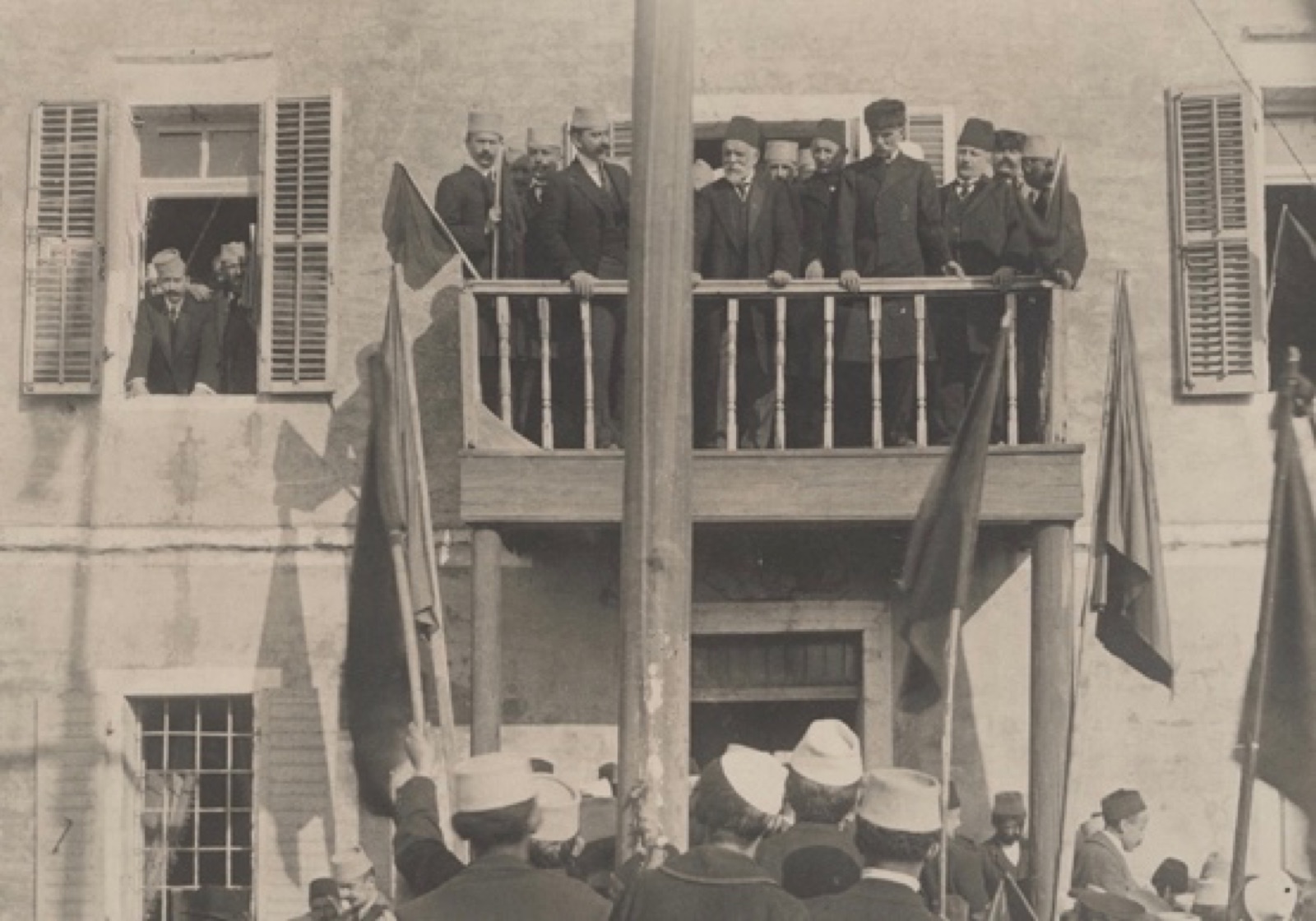 Ismail Qemali (seated center) with the provisional government cabinet at Vlorë, 28 November 1913 — first anniversary of the independence declaration, the Skanderbeg banner visible behind them.
Photo: Wikimedia Commons / public domain
Ismail Qemali (seated center) with the provisional government cabinet at Vlorë, 28 November 1913 — first anniversary of the independence declaration, the Skanderbeg banner visible behind them.
Photo: Wikimedia Commons / public domain
Every Albanian state since 1912 has flown a variation of the same flag. The visual continuity, through everything that followed, is rare in European national heraldry.
The flag through the 20th century
The 20th century put the Albanian flag through more political transformations than most flags survive. Each regime modified it. None of them could replace it.
1912-1925: The Skanderbeg eagle. The basic form. Black double-headed eagle on red field, no additions. Used by the provisional government, by the short-lived Principality of Albania under Wied (1914), and by the early republican governments of the 1920s.
1925-1928: The Republic. Albania became a republic under Ahmet Zogu in 1925. A small star was added above the eagle to mark the republican character of the state.
1928-1939: The Kingdom under Zog. Zogu was crowned King Zog I of the Albanians on 1 September 1928. The republican star was replaced with a royal crown above the eagle.
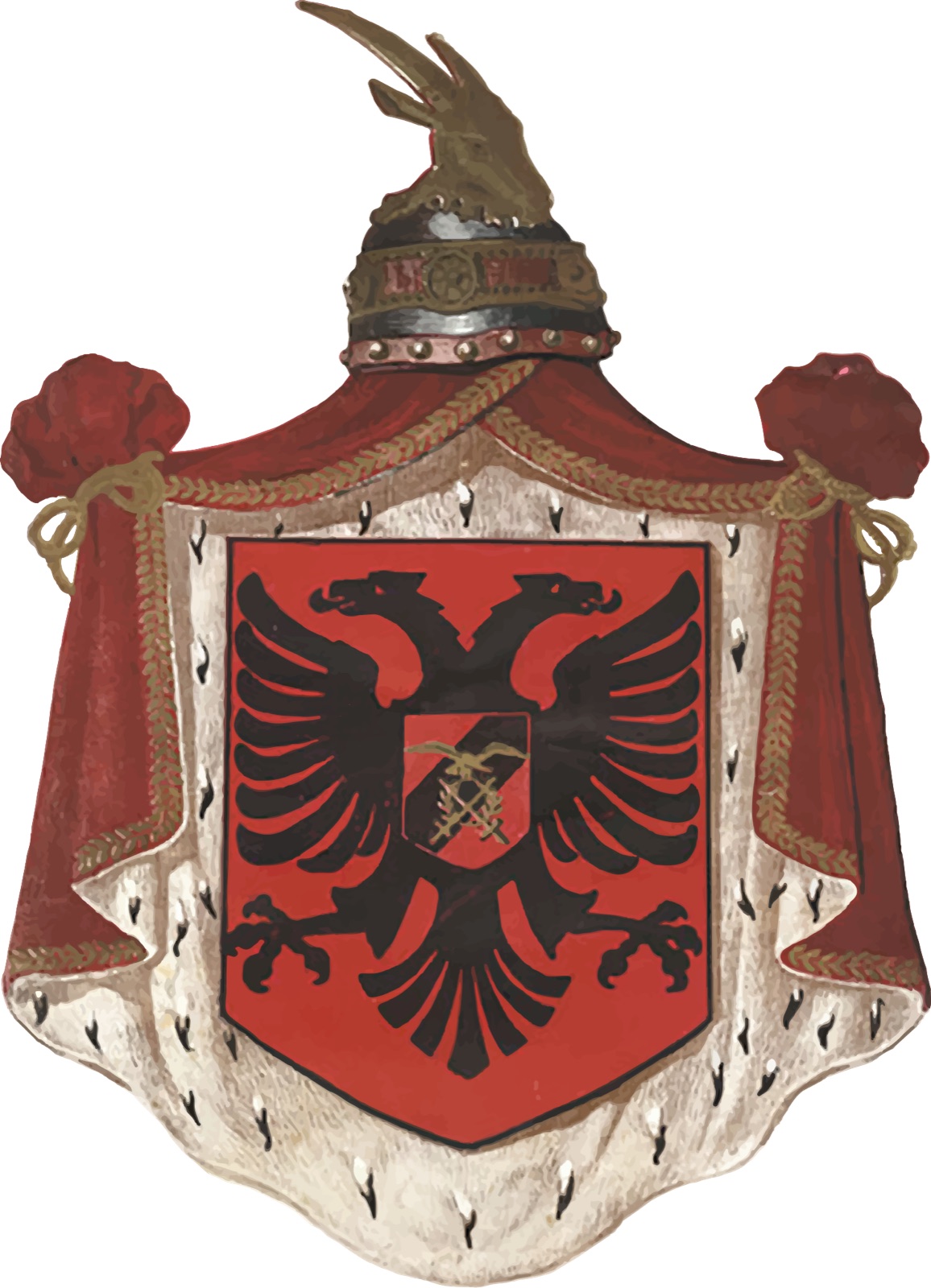 Royal coat of arms of the Kingdom of Albania (1928-1939) — the Skanderbeg eagle topped with the royal crown of King Zog I, in use until Mussolini’s Italian invasion on 7 April 1939.
Image: Wikimedia Commons / public domain
Royal coat of arms of the Kingdom of Albania (1928-1939) — the Skanderbeg eagle topped with the royal crown of King Zog I, in use until Mussolini’s Italian invasion on 7 April 1939.
Image: Wikimedia Commons / public domain
1939-1943: Italian occupation. Italy invaded on 7 April 1939. Zog fled. The new Italian-controlled “Albanian Kingdom” (in personal union with the Italian crown) modified the flag to add the lictor fasces — the bundled-rod symbol of Italian Fascism — flanking the eagle (Wikipedia: Flag of Albania). It was the most aggressive single intrusion on the flag in its modern history. It lasted four years.
1943-1944: German occupation. After the Italian armistice in September 1943, German forces occupied Albania. The collaborationist regime restored the flag to its pre-Italian September-1928 form, sometimes adding the Skanderbeg helmet above the eagle as a nationalist signal. The German period was short — barely a year — and the helmet variant did not outlast it.
1944-1992: Communist Albania. The People’s Republic of Albania was proclaimed in 1946 under Enver Hoxha. A gold-bordered red star was placed above the eagle, formalized on 10 January 1946. The star remained for 46 years through one of the most isolated and ideologically rigid communist regimes in Europe.
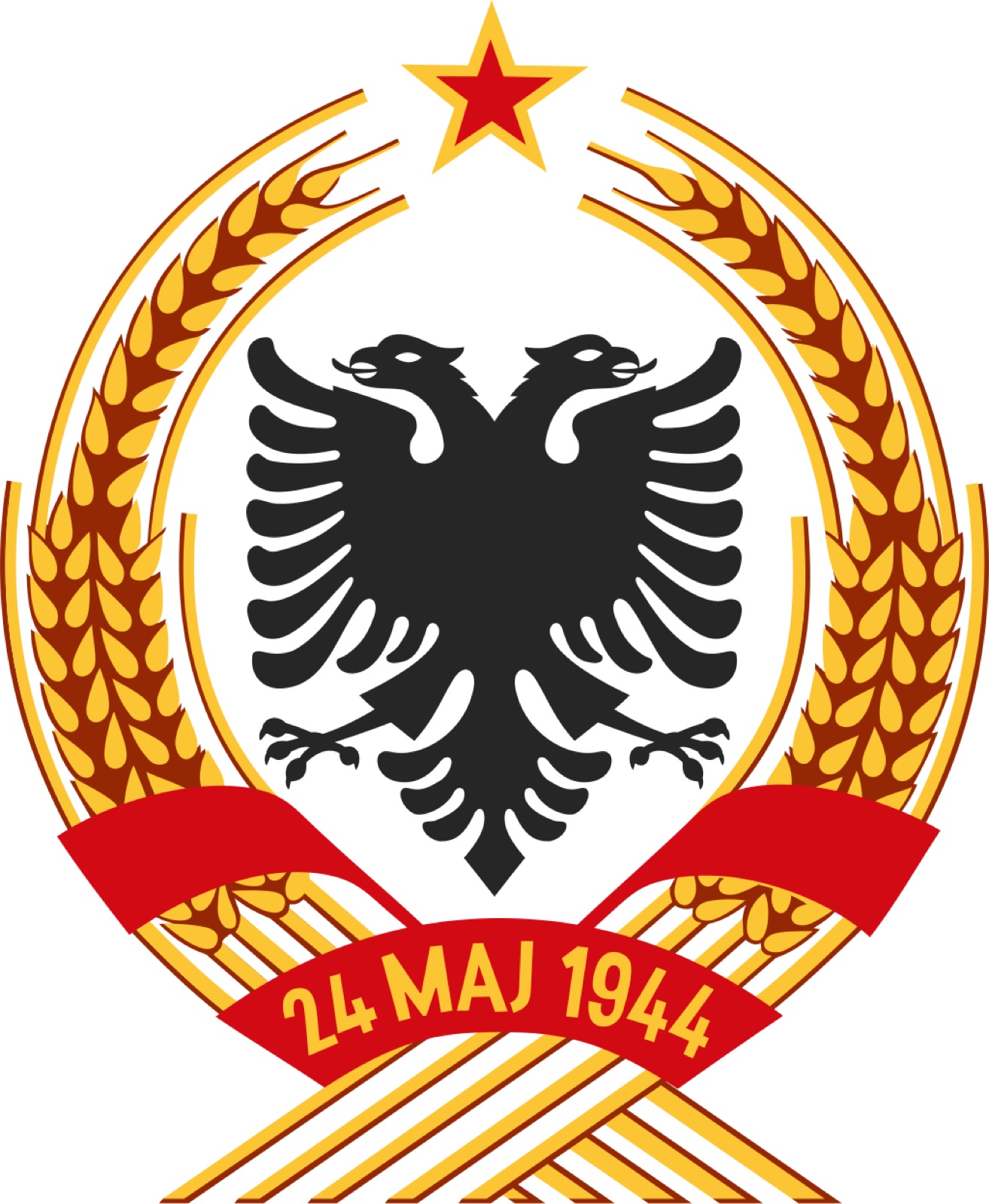 State emblem of the People’s Republic of Albania (1946-1992) — the gold-bordered red star was added in 1946, two years into Enver Hoxha’s 1944-1985 rule, and remained for 46 years — through the rest of his rule and seven more years under his successor. Estimates of the regime’s death toll range from 5,000 to 25,000 Albanians killed, with tens of thousands more sent to forced-labor camps. Removed 7 April 1992.
Image: Wikimedia Commons / public domain
State emblem of the People’s Republic of Albania (1946-1992) — the gold-bordered red star was added in 1946, two years into Enver Hoxha’s 1944-1985 rule, and remained for 46 years — through the rest of his rule and seven more years under his successor. Estimates of the regime’s death toll range from 5,000 to 25,000 Albanians killed, with tens of thousands more sent to forced-labor camps. Removed 7 April 1992.
Image: Wikimedia Commons / public domain
1992-present: Restoration. The communist star was removed on 7 April 1992 following the collapse of the regime. The flag returned to its 1912 form: black double-headed eagle, red field, no additions. The current specifications were standardized by Law Nr. 8926 on 22 July 2002 (Wikipedia: Flag of Albania).
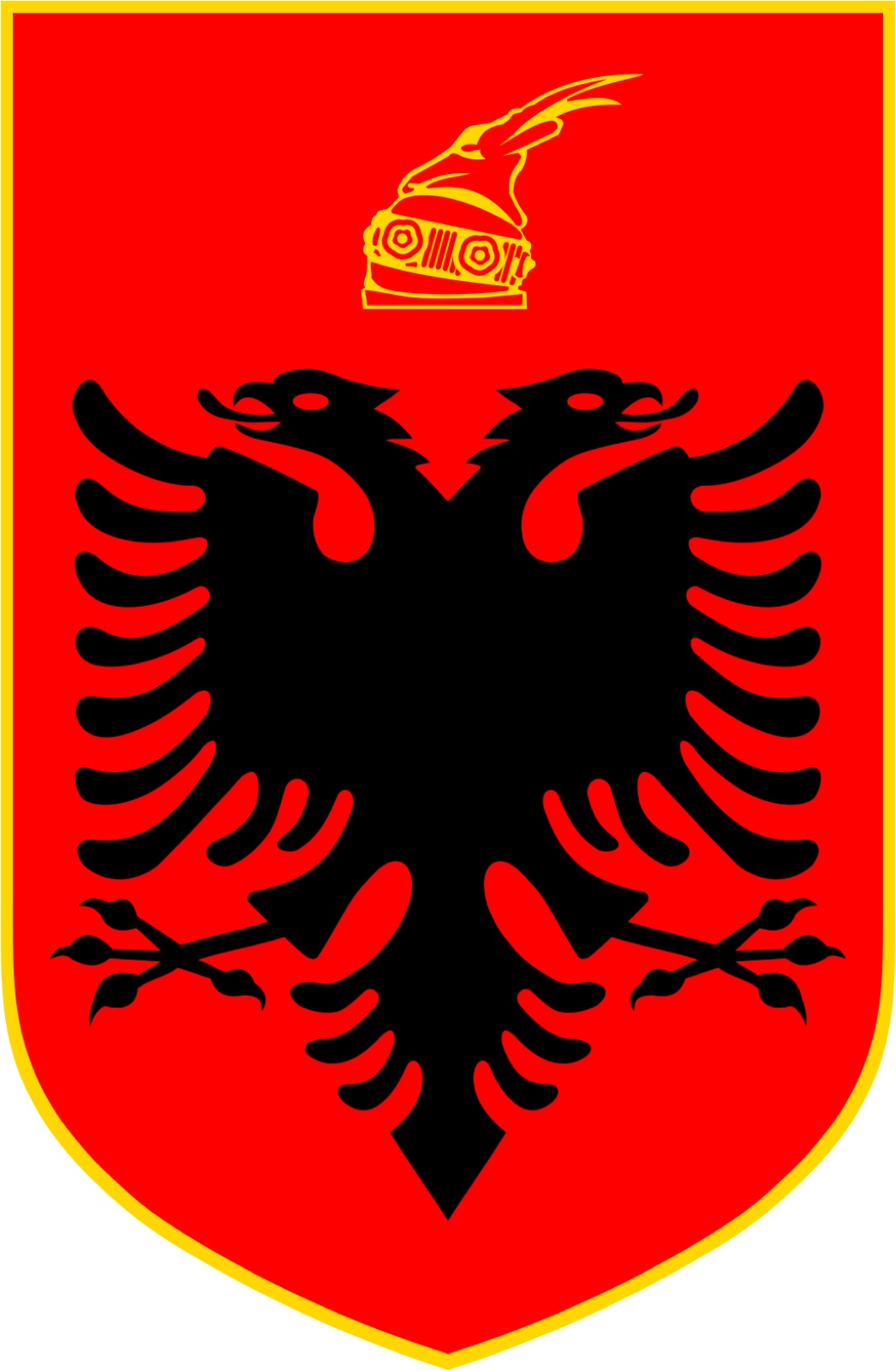 Coat of arms of the Republic of Albania, adopted 1998 — the goat-horned Skanderbeg helmet (the original sits in Vienna’s Kunsthistorisches Museum) above the double-headed eagle on the red shield.
Image: Wikimedia Commons / public domain
Coat of arms of the Republic of Albania, adopted 1998 — the goat-horned Skanderbeg helmet (the original sits in Vienna’s Kunsthistorisches Museum) above the double-headed eagle on the red shield.
Image: Wikimedia Commons / public domain
The visual continuity through that sequence is the part worth holding onto. Compared to the flags of Germany, Italy, Russia, China, or most successor states of the former Yugoslavia, the Albanian flag is unusual in how little it changed during the 20th century. The eagle survived the kingdom, the Italian fasces, the German occupation, and the Hoxha star. Each addition was added on top of the eagle, never in place of it. And each addition, in turn, came back off.
The flag’s design specifications
The flag’s exact specifications are fixed by Law Nr. 8926, adopted 22 July 2002:
- Aspect ratio: 5:7 — slightly wider than tall (Wikipedia: Flag of Albania).
- Colors: pure red (#FF0000) and black (#000000) per the law. In practice, ceremonial flags and embroidered pieces are often rendered in a deeper crimson closer to Pantone 186, which most Albanian-American flag manufacturers use as a default.
- Eagle silhouette: a single black double-headed eagle, centered on the red field, in profile. Both heads face outward (the left head looks left, the right head looks right). The wings are spread, the talons forward, the tail short and pointed downward.
- Feather count: each wing has nine feathers; the tail has seven feathers (Wikipedia: Flag of Albania).
- Symmetry: the eagle is bilaterally symmetric across a vertical axis through the body. The flag reads identically when reversed.
The specification is tight enough that most Albanian state flags, military flags, and consular flags look identical. Civilian and diaspora flags vary more — the eagle silhouette in particular has half a dozen common variants in circulation, with slightly different feather treatments, beak angles, and talon positions. None of them are wrong; they are different traditions of the same image.
The Kosovo flag and other Albanian regional flags
Kosovo declared independence on 17 February 2008 and adopted a deliberately different flag from Albania’s. The Kosovo flag is blue with a gold map of Kosovo and six white stars above it, representing the country’s six main ethnic groups (Albanians, Serbs, Turks, Goranis, Roma, and Bosniaks). The choice was a political signal, made under heavy international supervision, that Kosovo would present itself as a multi-ethnic state rather than an Albanian-majority one with a Skanderbeg banner.
In civic and government use the Kosovo state flag is the official emblem. In private and family use, Albanian Kosovars overwhelmingly still display the red-and-eagle Albanian flag — at weddings, at independence-day gatherings, on national-team match days, on lapel pins, and in the home. The two flags are often flown together. They are not, in the diaspora’s reading, in competition.
A few related flags share the family resemblance:
- The Arbëresh flag — the Skanderbeg banner, sometimes with the Kastrioti family arms added — is used by the Italian-Albanian Arbëreshë communities of southern Italy, by their Byzantine-rite eparchies, and by their cultural associations.
- The Albanian Bektashi flag is similar in field and eagle, with religious iconography (often the green flag of the order, or a teqe-style emblem) added.
- Albanian organizations in North Macedonia, Montenegro, and the Preshevo Valley of southern Serbia use the basic Albanian flag for ethnic and cultural purposes, and the relevant state flags for civic ones. The Albanian flag at a North Macedonian Albanian wedding is not a political claim. It is a cultural one.
The pattern is consistent across the Albanian world: the state flag of wherever you live, plus the red-and-eagle for everything ethnic, cultural, religious, and familial. In the diaspora, the same logic applies — American flag in front of the house, Albanian flag inside the door.
The flag in Albanian-American life
The flag appears at every major moment in Albanian-American civic life.
When it appears. Flag Day (28 November), Albanian Independence Day (the same day, treated separately as a parade and banquet event in larger communities), Skanderbeg Day, Easter, Bajram (Eid), Catholic and Orthodox feast days, weddings, baptisms, soccer matches (especially when the Albanian or Kosovo national team plays), civic dedications, parade days in Detroit, Worcester, the Bronx, Staten Island, Boston, and Chicago, and the funerals of community elders.
Where it is displayed. In nearly every Albanian-American home — over a doorway, framed in the living room, draped on a wall, or kept folded for outdoor occasions. In every Albanian Catholic, Orthodox, Sunni, and Bektashi parish or xhami in the United States. In Albanian-owned restaurants, bakeries, coffee shops, contracting offices, real estate offices, dental practices, and law firms — sometimes as the full flag, sometimes as a lapel pin, sometimes as an eagle silhouette painted on a window. In nearly every Albanian-American civic organization’s hall: Vatra in Boston, the Albanian American National Organization in New York, the Albanian American Civic League, the GKS Fund in Michigan.
The etiquette. The same conventions that apply to most national flags: never let it touch the floor, never use it as a tablecloth or as fabric for clothing, never fly it torn or faded. A worn flag is retired by burning it respectfully, often at the end of an Independence Day gathering, and the ashes are sometimes buried.
The emotional weight. For first-generation Albanian Americans the flag is a direct line to a country some of them left under coercion, with little prospect of return for decades, and to which they are still tied by family, language, and memory. For second- and third-generation Albanian Americans the flag is more often a sign of inheritance — the visible mark of a family that came from somewhere specific, kept its name, and did not assimilate quietly. In both cases the flag carries weight that decoration cannot. It is one of the few things in an Albanian-American household that does not get questioned.
Related symbols
A handful of related images and gestures travel with the flag.
- The phrase kuq e zi — “red and black” — is the everyday shorthand for the flag and, by extension, for Albanian identity itself. A kuq e zi shirt, a kuq e zi scarf, a kuq e zi tie at a wedding all carry the same meaning without needing the eagle drawn out.
- Skanderbeg’s helmet — the goat-horned helmet from the 15th-century original held in Vienna’s Kunsthistorisches Museum — is the second-most-common Albanian national motif. It appears on coins, statues, the Order of Skanderbeg, and beside the eagle in informal heraldry.
- Mother Teresa with the flag. The most iconic 20th-century photograph of an Albanian holding the flag is Mother Teresa — born Anjezë Gonxhe Bojaxhiu in Skopje to an Albanian family — draped in the kuq e zi on visits to Albania in the early 1990s, after the fall of communism. The image is everywhere in the diaspora.
- The eagle salute — hands crossed at the wrists, fingers spread, thumbs locked, forming the silhouette of a double-headed eagle — is a gesture used most visibly by Albanian and Kosovar soccer players after goals, but is also common at weddings, parades, and family photos. It is the flag rendered as a hand sign.
Why this matters for the diaspora
For Albanian Americans, the flag is the most compact possible statement of an inheritance that took five centuries of work to keep intact. Skanderbeg raised it. The Arbëreshë preserved it. Vlora re-raised it. Every regime of the 20th century tried to add to it, and each addition came off again. The eagle is still there.
That continuity is the reason the flag carries the weight it does in Albanian-American homes. It is not a decoration. It is a record.
If you are Albanian American — from Albania, from Kosovo, from North Macedonia, from Montenegro, from the Italian Arbëreshë villages, from anywhere in the diaspora — the National Albanian Registry exists to count you. The community-led count of Albanian Americans starts with the people who claim the inheritance the flag stands for.
Add your name at /register — free, encrypted, community-led.