
A community larger than its country
More Albanians live outside the Republic of Albania than inside it. That sentence sounds like rhetoric, but it is arithmetic. Albania’s resident population is about 2.4 million. Kosovo holds another 1.45 million or so. Add the ethnic Albanians of North Macedonia, Montenegro, and southern Serbia and the Balkan total comes to roughly 4.5 million. The worldwide ethnic Albanian population, depending on how the historic communities are counted, lands somewhere between 9 and 12 million.
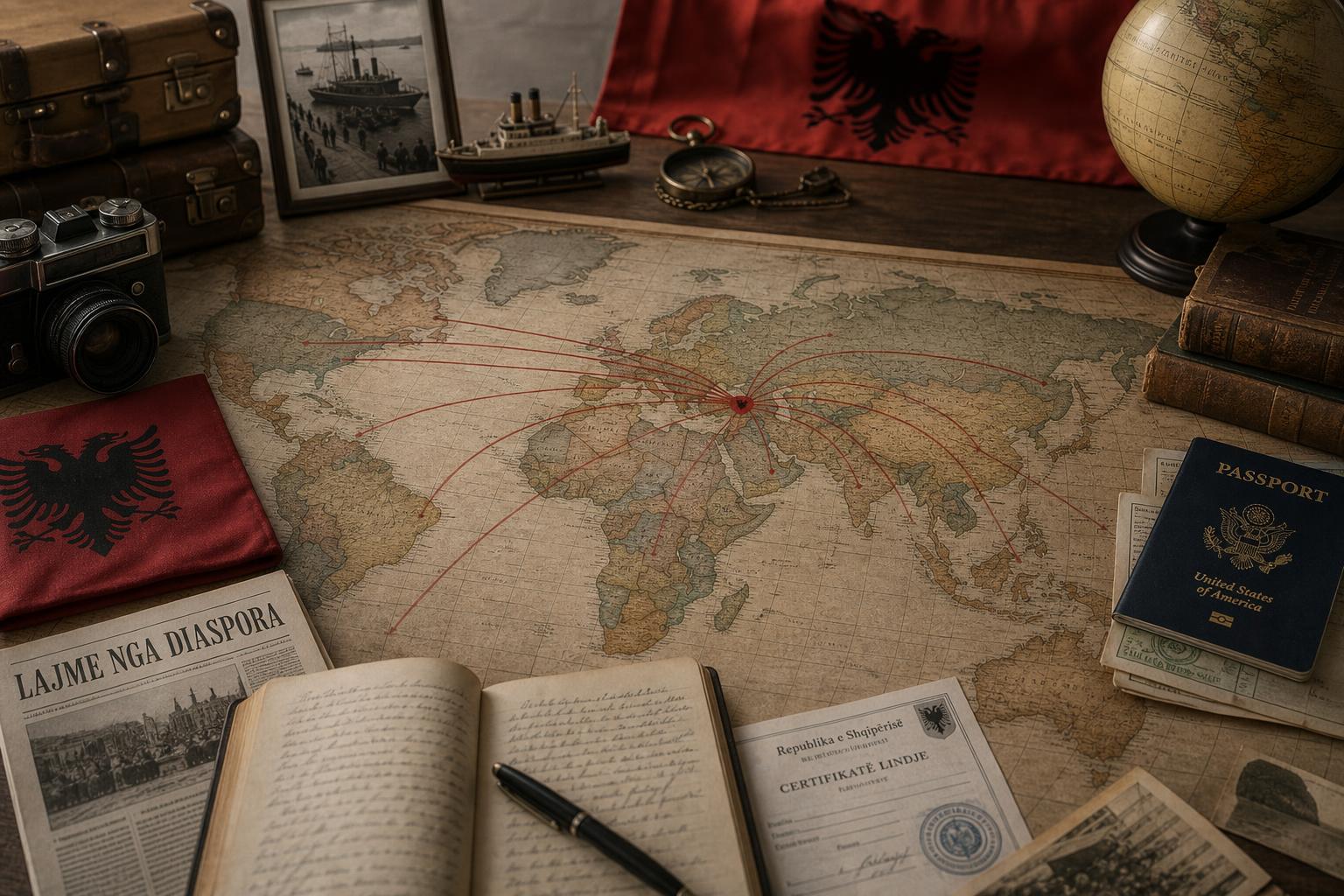
That math has consequences. The Albanian story is not contained by Albania’s borders. It runs through Italian mountain villages that have spoken Albanian since the 1400s, through Greek towns whose grandmothers prayed in a tongue called Arvanitika, through Turkish neighborhoods built by Ottoman-era Albanians, through Bronx parishes and Detroit pastry shops, through Swiss valleys and German factory floors. The diaspora is not an extension of Albania. In many places, it predates the modern Albanian state by half a millennium.
For an Albanian American reader, the practical question is: where do I fit? The 230,000 Albanian Americans the US Census records (and the roughly one million the community counts) are a real but small slice of a much bigger picture. This explainer walks through that bigger picture country by country, names the major migration waves with dates and numbers, and frames where the United States sits in the global community.
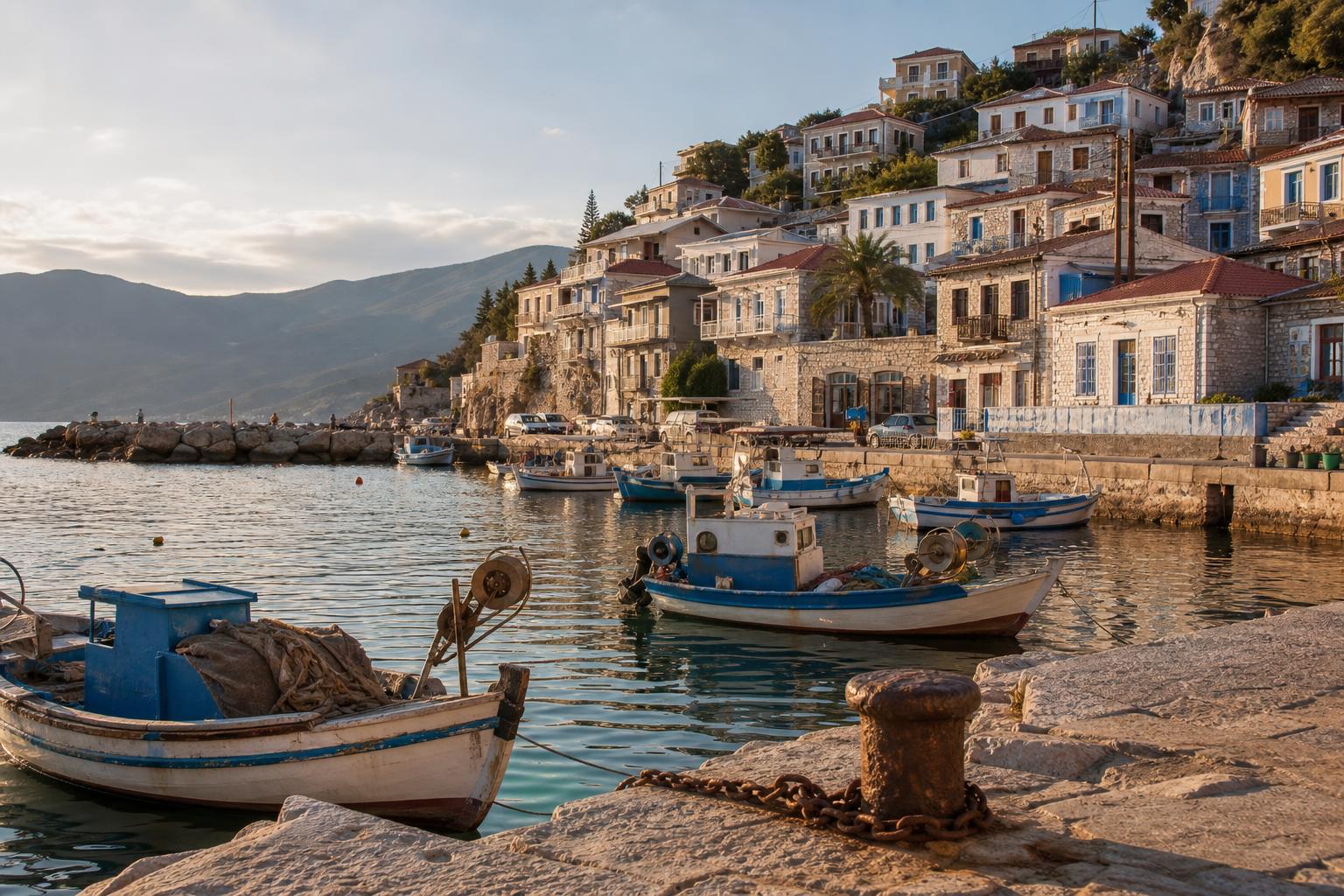 A southern Italian coastal village in the Calabrian Arbëreshë belt — one of the oldest continuously Albanian-speaking regions outside the Balkans.
Graphic by NAR
A southern Italian coastal village in the Calabrian Arbëreshë belt — one of the oldest continuously Albanian-speaking regions outside the Balkans.
Graphic by NAR
Diaspora shqiptare: what the word actually covers
The Albanian word for diaspora is diaspora shqiptare (literally “the Albanian diaspora”). The slug of this article — diasporate — is a community spelling variant you see in family WhatsApp groups, Facebook pages, and Albanian-language press in the United States. Both forms point to the same thing.
The word covers four kinds of people who often get lumped together but who arrived in their host countries for very different reasons across very different centuries:
- Recent labor migrants. Albanians and Kosovars who left after 1990 for Italy, Greece, Germany, Switzerland, the UK, and the US. Most of the conventional “diaspora” lives here.
- Cold War exiles. Albanians who escaped the communist regime (1944-1991) by sea, by mountain, or by defection. The community in the US dating to the 1950s-1980s sits in this group, layered on top of an earlier industrial-labor wave from the early 1900s.
- Historic Albanian populations. Communities established centuries ago in what is now Italy (Arbëreshë), Greece (Arvanites), Turkey, Romania, Bulgaria, Egypt, and Ukraine — Albanian by descent and often by language, but not migrants in any modern sense.
- Balkan-adjacent ethnic Albanians. Albanians of North Macedonia, Montenegro, the Preševo Valley in southern Serbia, and Çamëria in northwestern Greece. They live in their ancestral territory, separated from the Republic of Albania only by 20th-century border drawing.
Definitions matter because the headline numbers depend on which group you include. The strict-diaspora number (recent migrants only) is around 3 to 4 million. The broad-community number (everyone of Albanian descent, anywhere) climbs to 9 to 12 million. We use the broad number because it reflects how the community sees itself — and because the cultural and political ties between the historic and recent communities are real, not theoretical.
The math: stayers versus diaspora
The cleanest way to grasp the scale is a side-by-side count. The figures below are mid-range estimates that vary year to year and source to source.
The Balkan core (the “stayers”):
- Albania (resident population): ~2.4 million
- Kosovo (ethnic Albanians, ~92% of pop.): ~1.45 million
- North Macedonia (ethnic Albanians, ~25% of pop.): ~500,000-700,000
- Montenegro (ethnic Albanians): ~30,000
- Southern Serbia (Preševo Valley): ~50,000-70,000
That gives a Balkan core of roughly 4.4 to 4.7 million ethnic Albanians living in their ancestral region.
The global diaspora (recent + historic):
- Italy: ~440,000 recent + ~100,000 historic Arbëreshë
- Greece: ~500,000-700,000 recent + historic Arvanites (count disputed)
- Germany: ~250,000-300,000
- Switzerland: ~200,000-300,000
- Turkey: ~500,000 to 5,000,000 of Albanian descent (count strongly disputed)
- United Kingdom: ~70,000-140,000
- United States: ~230,000 (ACS) to ~1,000,000 (community estimate)
- Canada: ~36,000
- Australia: ~25,000-40,000
- Sweden, Belgium, Austria, the Netherlands, France: ~30,000-60,000 each
- Argentina: ~40,000 (community claim, mainly Arbëreshë descent)
- Romania, Bulgaria, Ukraine, Egypt: small historic communities, each in the low thousands
The diaspora total, depending on which Turkish figure you accept, lands between 3 and 6 million. Sum the two columns and the global ethnic Albanian population sits at 8.5 to 11 million, with most credible academic estimates clustering near 10 million.
This is why the diaspora is not a footnote to the Albanian story. It is roughly half of it.
Italy: the closest neighbor with the oldest community
Italy’s relationship with Albania has two layers. The older layer is the Arbëreshë, descendants of Albanians who fled the Balkans between the 13th and 18th centuries — mainly after the death of the national hero Skanderbeg in 1468 and the fall of Krujë in 1478. They settled in roughly 50 villages across seven southern Italian regions (Calabria, Sicily, Basilicata, Apulia, Molise, Abruzzo, Campania) and still speak a 15th-century form of Albanian called Arbëresh. About 100,000 active speakers remain; the broader heritage population is several times that.
The newer layer is the post-1991 migration. When Albania’s communist regime collapsed, the first place tens of thousands of Albanians went was across the Adriatic. The August 1991 Vlora ship exodus — when an estimated 10,000 to 20,000 Albanians boarded the ship and crossed to the Italian port of Bari — was the iconic image of that wave. A second surge followed the 1997 pyramid scheme collapse, when over 16,000 Albanians arrived by sea in a single year (see our explainer at /blog/1997-pyramid-scheme-collapse).
Today around 440,000 Albanian citizens hold legal residence in Italy, making them one of the country’s largest non-EU immigrant groups. Counted alongside Italians of Albanian descent (including naturalized citizens and the Arbëreshë), the total reaches roughly 700,000 to 900,000 — Italy’s largest single ethnic-minority community of foreign origin. The integration is uneven but real: Albanian is the second-most-spoken foreign language in Italian schools, and Italian-Albanian intermarriage rates are among the highest of any immigrant group.
Greece: layers of an old neighbor
Greece presents a more complicated picture, because the question of “who is Albanian” overlaps with sensitive questions about Greek national identity. Three groups live there:
- Recent Albanian migrants (post-1991): roughly 500,000 to 700,000 at peak, though the number has dropped since the 2010 Greek financial crisis as many returned to Albania or moved on to Germany.
- Arvanites: descendants of Albanians who settled in southern Greece (Attica, Boeotia, the Peloponnese, Euboea) between the 13th and 18th centuries. They speak (or once spoke) Arvanitika, a southern Albanian dialect now severely endangered. Most Arvanites today self-identify as Greek; estimates of those with Arvanite ancestry range from 200,000 to perhaps a million.
- Çams (Çamët): Muslim Albanians native to the Çamëria region in northwestern Greece (Epirus) who were expelled in 1944-1945. Most Çams live today in Albania; a smaller community remains in Turkey. The Greek state’s recognition of the expulsions remains contested. We take no position on the political question and refer readers to /blog/chameria for context.
The interaction between these layers is one reason Greek-Albanian numbers are hard to fix. Many recent migrants have naturalized as Greek citizens. Many Arvanites do not identify as Albanian at all. The headline “500,000-1,000,000 Albanians in Greece” is the best the data supports, with the wide range reflecting which groups you include.
Germany and Switzerland: the German-speaking Balkans
Germany and Switzerland together host roughly half a million ethnic Albanians, the great majority of them from Kosovo and North Macedonia rather than from the Republic of Albania.
Switzerland’s Albanian community took shape through the Yugoslav-era guest-worker program of the 1960s-1980s, which brought Kosovo Albanian men to work in construction, hospitality, and industry. The 1990s civil unrest in Yugoslavia, and the 1999 Kosovo war specifically, brought their families and tens of thousands of refugees. Around 200,000 to 300,000 Albanians live in Switzerland today, with heavy concentrations in the cantons of Zürich, Bern, Basel, Lucerne, and St. Gallen. The community is large enough that Swiss politics now reckons with it routinely; the Swiss-Kosovar footballer Granit Xhaka is the most visible cultural ambassador.
Germany’s Albanian population grew more recently, with the main wave following the 1999 Kosovo war and a second surge in the mid-2010s as Albanian and Kosovar nationals took advantage of EU labor mobility (Kosovo) and visa-free Schengen access (Albania, since 2010). Estimates range from 250,000 to 400,000. The community is younger, less concentrated geographically, and weighted toward Berlin, North Rhine-Westphalia, and Bavaria.
Add Austria (~40,000), Belgium (~30,000), the Netherlands (~20,000), and Scandinavia (Sweden ~60,000, Denmark ~15,000, Norway ~15,000), and the German-speaking and northern European corridor accounts for nearly a third of all diaspora Albanians.
The United States: where the community count gap is widest
The American picture is the one most readers of this site already know, but the numbers bear repeating because the gap they reveal is the entire reason NAR exists.
The American Community Survey (ACS) — the Census Bureau’s annual survey, which is the source for federal Albanian ancestry figures — records about 230,000 Albanian Americans. Community-led estimates put the real figure at roughly 1 million. The gap has several drivers:
- Second- and third-generation Albanian Americans who select “American,” “European,” or no ancestry on the form.
- Kosovo Albanians and Macedonian Albanians who often report birth country (Kosovo, Yugoslavia, Macedonia) rather than ethnic ancestry.
- Households in which one census respondent answers for everyone and reports only the dominant household identity.
- Albanian Americans who are reluctant to answer ancestry questions because of memories of state surveillance in the home country (a real, documented driver in immigrant communities from former authoritarian regimes).
The largest US Albanian populations sit in New York (~56,000 ACS / over 200,000 community), Michigan (~27,000 / over 100,000), Massachusetts (~21,000), Connecticut, New Jersey, Illinois, Pennsylvania, Florida, and Texas. Detroit-area suburbs (Sterling Heights, Warren, Macomb County) and the Bronx-Westchester-Yonkers corridor in New York are the two densest metropolitan clusters. The full state-by-state picture lives at /blog/albania-in-america and /blog/albanian-americans; the Kosovar-American sub-community is profiled at /blog/kosovo-america.
The first major US-bound wave was 1900-1920 industrial-labor migration to mill towns and meatpacking centers in Massachusetts, Michigan, and Illinois. The second was the post-1991 economic migration, layered with 1999-2000 Kosovo war refugees admitted through the US refugee program. Today the community is roughly third-generation in some places and first-generation in others — which is why a single headline number does not capture it.
Historic populations: the diaspora before the diaspora
Three communities deserve specific mention because they predate every other entry on this list by centuries.
Arbëreshë (Italy, since the 1400s): Profiled in full at /blog/arbereshe. About 100,000 active speakers across 50 villages in southern Italy. The Italo-Albanian Catholic Church, an Eastern-rite Catholic body in communion with Rome, is centered in this community. Famous descendants include 19th-century Italian Prime Minister Francesco Crispi and constitutional scholar Costantino Mortati.
Arvanites (Greece, since the 1200s-1700s): Speakers of Arvanitika, the southern Albanian variant. Were the dominant population in parts of Attica, Boeotia, and the Peloponnese into the 19th century. Most now self-identify as Greek; the language is severely endangered, with mostly elderly speakers. Many heroes of the Greek War of Independence (1821-1829) were Arvanites, most famously the naval commander Andreas Miaoulis.
Albanians of Turkey (since the 1500s): A community formed across four centuries of Ottoman administration and shaped by the Balkan Wars (1912-1913) and the population exchanges that followed. Estimates of Turkish citizens with Albanian ancestry range from a conservative 500,000 to a maximal 5 to 6 million; the Turkish state does not record ethnicity in its census, and assimilation is far advanced. The Albanian community of Turkey is concentrated in İzmir, Bursa, Istanbul, and parts of eastern Anatolia, with smaller historic settlements scattered as far east as Hakkari.
Smaller historic communities exist in Romania (around Bucharest and the Black Sea coast), Bulgaria, Ukraine (the village of Karakurt and others in Bessarabia), and Egypt (a once-significant community founded by Albanians in Muhammad Ali’s military and administrative apparatus; most have since emigrated or assimilated).
Migration waves: the timeline that produced today’s map
Five waves shaped the modern diaspora. Naming them with dates makes the rest of the article easier to read.
1900-1924 industrial labor. Albanians from the southern Tosk region (Korçë, Përmet, Gjirokastër) joined the broader European labor migration to the United States, settling in mill towns and meatpacking centers. The community founded the first Albanian Orthodox parishes in America (Boston, 1908) and was politically active in the Albanian independence movement.
1944-1991 communist period. Albania’s borders were sealed under Enver Hoxha’s regime. The diaspora in this period grew mainly through Kosovo and North Macedonia, where Yugoslav-era guest-worker programs brought Albanians to Germany, Switzerland, Austria, and Sweden, and through small numbers of political defectors and refugees from Albania itself.
1991 collapse of communism. Mass emigration began as soon as the regime fell; the Vlora ship’s August 1991 crossing to Bari became its iconic image. Tens of thousands crossed to Italy; tens of thousands more walked through the mountains to Greece. The first half of the 1990s saw an estimated 600,000 Albanians leave the country — about 18% of the population in five years.
1997 unrest. The collapse of the pyramid schemes (see /blog/1997-pyramid-scheme-collapse) triggered a second mass departure, mainly to Italy and Greece, plus the first significant US-bound flow since the Cold War.
1999 Kosovo war. Roughly 850,000 Kosovo Albanians were displaced during the conflict, most into neighboring Albania and North Macedonia and tens of thousands abroad. The majority returned after the war, but the resettlement abroad of a significant minority — particularly in Germany, Switzerland, and the United States — durably enlarged the Western diaspora. See /blog/kosovo-us-relations for the US side of that story.
2000s-2020s EU labor migration. A slower, more economic wave. Visa-free Schengen access for Albanians (2010) and Kosovo’s gradual movement toward visa liberalization (granted 2024) opened legal migration channels that earlier waves had to go around. The destination split shifted from “anywhere we can get to” toward “specifically Germany, the UK, and the US.”
Identity in the second and third generation
The diaspora question that matters most to Albanian American readers is rarely about numbers. It is about whether and how the next generation will hold on to the identity. NAR’s experience suggests the honest answer is mixed.
The first generation almost always retains the language, the cuisine, the family ties, and the besa — the code of honor profiled at /blog/albanian-besa. The second generation usually retains the cuisine, the major holidays, and a strong cultural pride; the language often slips. The third generation, by demographic precedent across every diaspora ever studied, retains the surname and a sense of where the family came from — and often not much more, unless the family makes a deliberate effort.
The deliberate effort is what keeps a diaspora alive across centuries. The Arbëreshë are the proof case: a community that has held its language and Eastern-rite Catholic identity for 500 years not by accident but by stubborn intergenerational work. The Albanian American community is younger and less geographically concentrated than the Arbëreshë were, which is both a disadvantage (no village to anchor in) and an advantage (mobility, intermarriage, professional integration without losing identity).
For Albanian American families thinking about the next generation specifically: the things that consistently work, across diaspora communities, are language at home (even broken or imperfect), regular contact with family in the homeland, food traditions that the kids cook themselves, and recognition by an institution that the identity exists and counts.
That last point — institutional recognition — is the gap NAR was built to close. The American Community Survey says there are 230,000 Albanian Americans. The community knows there are roughly a million. Closing that gap is not an abstract exercise. It is what makes the second-, third-, and fourth-generation kids visible in the systems that allocate civic resources, language access under the Voting Rights Act and Title VI of the Civil Rights Act (see /blog/voting-rights-act-203-albanian-americans and /blog/civil-rights-act-title-vi-albanian-americans-language-access), and political representation. The diaspora’s future is partly a function of whether the diaspora gets counted.