

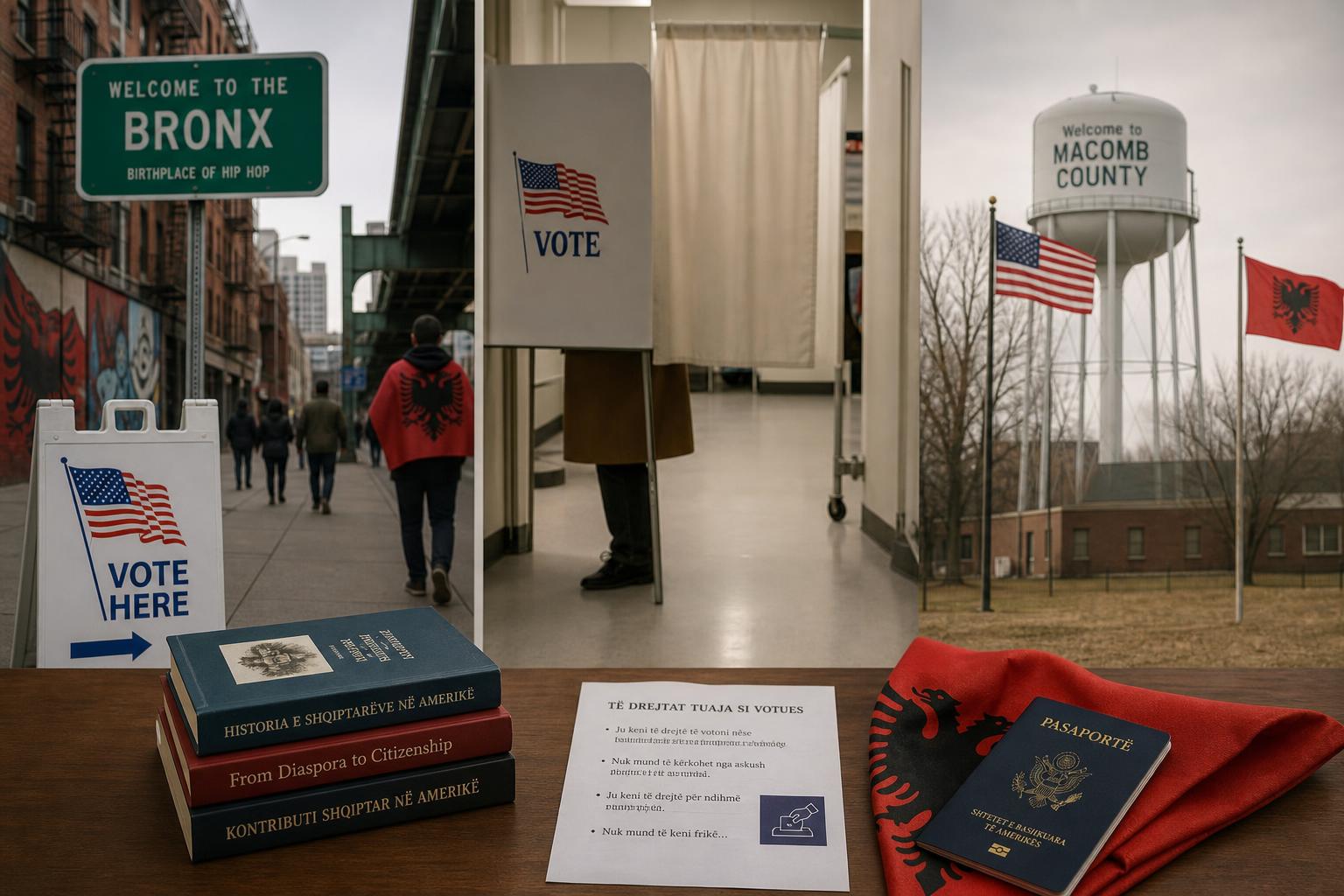
The plain answer is no. Section 203 of the Voting Rights Act, the federal language-access provision, covers four named groups, and Albanian is not one of them. The list has been closed since the provision was added in 1975. Reauthorizations in 1982, 1992, and 2006 left it untouched.
This piece walks through what the statute says, what its 10,000-voter threshold looks like applied to the counties with the largest Albanian-American populations, the state and local mechanisms that bridge the gap today, and what it would take to change the federal answer.
What Section 203 says
The federal statute, codified at 52 U.S.C. §10503, defines “language minorities” in subsection (e) as:
“persons who are American Indian, Asian American, Alaskan Natives, or of Spanish heritage.”
That is the entire list. It is closed by enumeration. A jurisdiction is required to provide bilingual election materials when more than 5% of voting-age citizens, or more than 10,000 voting-age citizens of a single political subdivision, are members of one of those four groups, are limited-English proficient, and the group’s illiteracy rate exceeds the national average. Statewide coverage triggers only on the 5% test. Illiteracy is defined in §10503(b)(3)(E) as “failure to complete the 5th primary grade.”
Congress reauthorized §203 in 2006 for 25 years. The current authorization runs through 2032. The 2006 reauthorization also moved the data source from the decennial census to the American Community Survey and put determinations on a five-year cycle. The most recent determinations were issued by the Census Bureau on December 8, 2021, based on 2015–2019 ACS five-year data. The next determinations are due in 2026.
The point of stating the list cleanly is to remove a common misreading: §203 is not a sliding scale that adds languages as a community grows. Even at 100 million Albanian-American voters, §203 as written would not apply. The barrier is the closed list, not the count.
Why Albanian isn’t on the list
When Congress added the language-minority provisions in the 1975 amendments, it identified four groups with documented voting discrimination tied to language: American Indians, Asian Americans, Alaska Natives, and persons of Spanish heritage. The factual record on those four groups was specific — Spanish-language ballots had been refused, Asian-language voters had faced literacy tests, tribal communities had been denied registration. The closed list reflects that 1975 record.
The list has not expanded in any of the four reauthorizations. The named omitted examples in mainstream coverage are Arabic and Haitian Creole, but Albanian is in the same structural position. Bills in the 118th Congress (2023–2024) tried to push the door open: H.R. 5295, the Expanding the VOTE Act, directed the Department of Justice to issue notices on §203 coverage and ordered the Government Accountability Office to study reducing the threshold and expanding the covered-language definition. It did not amend the list directly, and it did not become law. S. 4, the John R. Lewis Voting Rights Advancement Act of 2024, would have restored other VRA provisions but did not expand §203’s covered languages either.
For an Albanian-American household, the practical takeaway is that amending §203 is a federal lift Congress has not taken in 50 years. There is no near-term version of this where the closed list opens for Albanian.
What the threshold looks like applied to Albanian counties
Even if Albanian were on the list, the 10,000-voter threshold would only fire in a small handful of places. The math is worth seeing in numbers, county by county.
The largest Albanian-American county in New York State is Bronx County, New York, with 9,546 residents reporting Albanian ancestry on the 2019–2023 ACS five-year estimate. That total is below the 10,000 voting-age citizen threshold before any further filter is applied. The §203 trigger is not total ancestry — it is voting-age citizens of the language minority who are limited-English proficient and whose group illiteracy rate exceeds the national average. The eligible subset is materially smaller than the ancestry total.
Other New York counties with substantial Albanian-American populations:
- Queens County: 9,356
- Staten Island (Richmond): 8,282
- Westchester County: 7,917
- Kings County (Brooklyn): 7,519
- Manhattan (New York County): 2,823
Statewide, New York reports 56,226 Albanian-ancestry residents — 25.2% of the U.S. total of roughly 230,000. In metropolitan Detroit, Macomb County, Michigan holds one of the largest Albanian-American concentrations outside the New York region: 10,779 residents reporting Albanian ancestry on a 2013–2018 ACS five-year estimate — an older data vintage than the 2019–2023 figures above, but one on which Macomb outranks every county listed.
ACS ancestry estimates undercount smaller European-heritage groups. The survey asks for a write-in, accepts up to two responses, and is sample-based, which understates communities that vary by surname pattern and intra-family identification. The Census Bureau itself disclosed a modeling error in the 2021 determinations affecting Houma and unspecified Alaska Native tribes — not a fatal error, but a public reminder that the methodology is not infallible for smaller groups.
The policy gap is also a counting gap. A more accurate community-led count is one of the inputs the federal trigger reads when the next determinations are issued.
Where state and local law fills the gap
If §203 does not deliver Albanian-language voting material, what does? Three categories of state and local mechanism, in roughly descending reach.
New York City voter-registration forms. The NYC Campaign Finance Board, in partnership with the Mayor’s Office of Immigrant Affairs, makes voter-registration forms available in 11 languages beyond the five established languages of English, Bengali, Chinese, Korean, and Spanish. Albanian is on that 11-language list — added in September 2016 as part of a six-language expansion that also added Greek, Italian, Polish, Tagalog, and Yiddish. The earlier July 2016 expansion added Arabic, French, Haitian Creole, Russian, and Urdu. Order forms via the CFB site.
NYC Civic Engagement Commission Poll Site Language Assistance. A separate program, this one provides in-person interpretation at select polling places. It currently covers Arabic, Bengali, Chinese (Cantonese, Mandarin), French, Haitian Creole, Italian, Korean, Polish, Russian, Urdu, and Yiddish — the full current list at the NYC CEC’s program page. Albanian is not on that list as of 2026.
The John R. Lewis Voting Rights Act of New York. Signed by Governor Hochul in June 2022, the NYVRA added a state-level language-assistance trigger of 2% of voting-age citizens, or no fewer than 300 such citizens — a much lower bar than §203’s 10,000. Critically, the NYVRA’s definition of “language minority” copies §203’s closed list verbatim: “American Indian, Asian American, Alaskan Natives, or of Spanish heritage.” Albanian voters are not covered by NYVRA’s language-assistance section either. Other NYVRA provisions on vote dilution are open-group and reach Albanian voters; the language section does not.
NY Election Law §3-506. A single-language statute requiring NYC’s board of elections to provide Russian-language voter-registration information. It does not cover Albanian. Source text at FindLaw.
Hamtramck, Michigan. Hamtramck became §203-covered in October 2011 for Bengali — the trigger was the Bangladeshi community, which is now about 21% of the city’s 28,433 residents. After the city failed to deliver, AALDEF sued in 2021 on behalf of a Bangladeshi voter who was denied a Bengali ballot in 2020. The resulting federal consent decree requires Hamtramck to operate a Bengali-language election program through July 2025. In July 2022, Hamtramck and Dearborn each passed local resolutions making Arabic-language ballots available, with implementation supported by the Michigan Secretary of State. Albanian Hamtramck residents — 3.1% of the city in the 2000 census, since largely migrated to Macomb and Oakland counties — do not have a separate Albanian-language program at the local or county level.
The pattern is consistent: where federal law shuts the door, state law sometimes opens a smaller one, and local resolutions can open a smaller one still. None of them is automatic. Each required organizing.
What Title VI does that Section 203 doesn’t
There is a separate federal track that does not depend on §203’s closed list.
Title VI of the Civil Rights Act of 1964 prohibits national-origin discrimination by recipients of federal funding. The Supreme Court in Lau v. Nichols (1974) held that discrimination on the basis of limited English proficiency is a form of national-origin discrimination under Title VI. Executive Order 13166, signed August 11, 2000, requires every federal agency and every recipient of federal funding — which includes most polling places — to take reasonable steps to provide meaningful access to LEP individuals. The four-factor test is the number or proportion of LEP persons in the eligible service population, the frequency of contact, the importance of the service, and the resources available.
Title VI’s LEP framework is open-group. It is not limited to §203’s four categories. An Albanian-American voter denied meaningful access to a federally-funded polling place can press a Title VI claim — a path §203 does not give.
The trade-off is structural. §203 is automatic where it applies. Title VI is complaint-driven and resource-dependent. The federal door under Title VI exists but does not open by itself.
What it would take to change
There are three levers, on three different timelines.
Federal. An amendment to 52 U.S.C. §10503(e) adding Albanian (and likely Arabic, Haitian Creole, and others). Indirectly attempted in H.R. 5295. Never passed. The closed list has not moved in 50 years. This is the longest path.
State. A state Voting Rights Act with an open-group definition, lower thresholds, and Albanian explicitly named. The NYVRA’s 2%-or-300 trigger is the right threshold model — it is just paired with the wrong covered-group definition. Closing that drafting gap is a state-legislative effort, not a federal one.
Local. City-council resolutions like the 2022 Hamtramck and Dearborn Arabic-ballot resolutions. Faster, cheaper, narrower in reach, and immediate inside the city that passes them. The Albanian-American community has the civic infrastructure to do this in Yonkers, in the Bronx, in Macomb County, in Worcester. It is a city-council case, not a federal one.
Counting. Across all three levers, the input that the policy reads is the count. ACS undercounts smaller European-heritage groups. A community-led count strengthens the numerical case the next time §203 determinations or NYVRA threshold tests are run. It does not rewrite the closed list, and on its own it does not change federal law — but it is one of the inputs that decides which threshold tests fire and which do not.
What this means for you
The federal answer is no. No jurisdiction in the United States is currently required to provide Albanian-language ballots, polling-place interpretation, or registration material under federal law. That is the statute as written.
If you live in New York City, Albanian voter-registration forms have been available through the Campaign Finance Board since 2016. Order one for yourself or a relative. In-person Albanian interpreters at polling places are not currently part of the city’s program — not yet.
If you live in metropolitan Detroit, no separate Albanian-language election material is currently provided. Macomb and Oakland counties are not §203-covered for any non-Spanish language.
What changes the answer is unglamorous: county-level counts that fire the §203 threshold, state laws written with open-group language, local resolutions, and an honest community count. NAR’s role in that is the count itself — that is the input. Be counted. The count alone does not amend §203; it makes the population case the next time the federal threshold reads the data, and the next time a state legislator or city council asks how many Albanian-American voters live in their district.
For the broader civic context, see the Albanian American population overview and the Albania–U.S. relations explainer. For a working example of how a small Albanian-American community moved federal foreign policy through ordinary constituent civic engagement, see the Texas case study. The mechanics that work for foreign-policy attention work for language access too — they are the same mechanics, applied to different doors.