

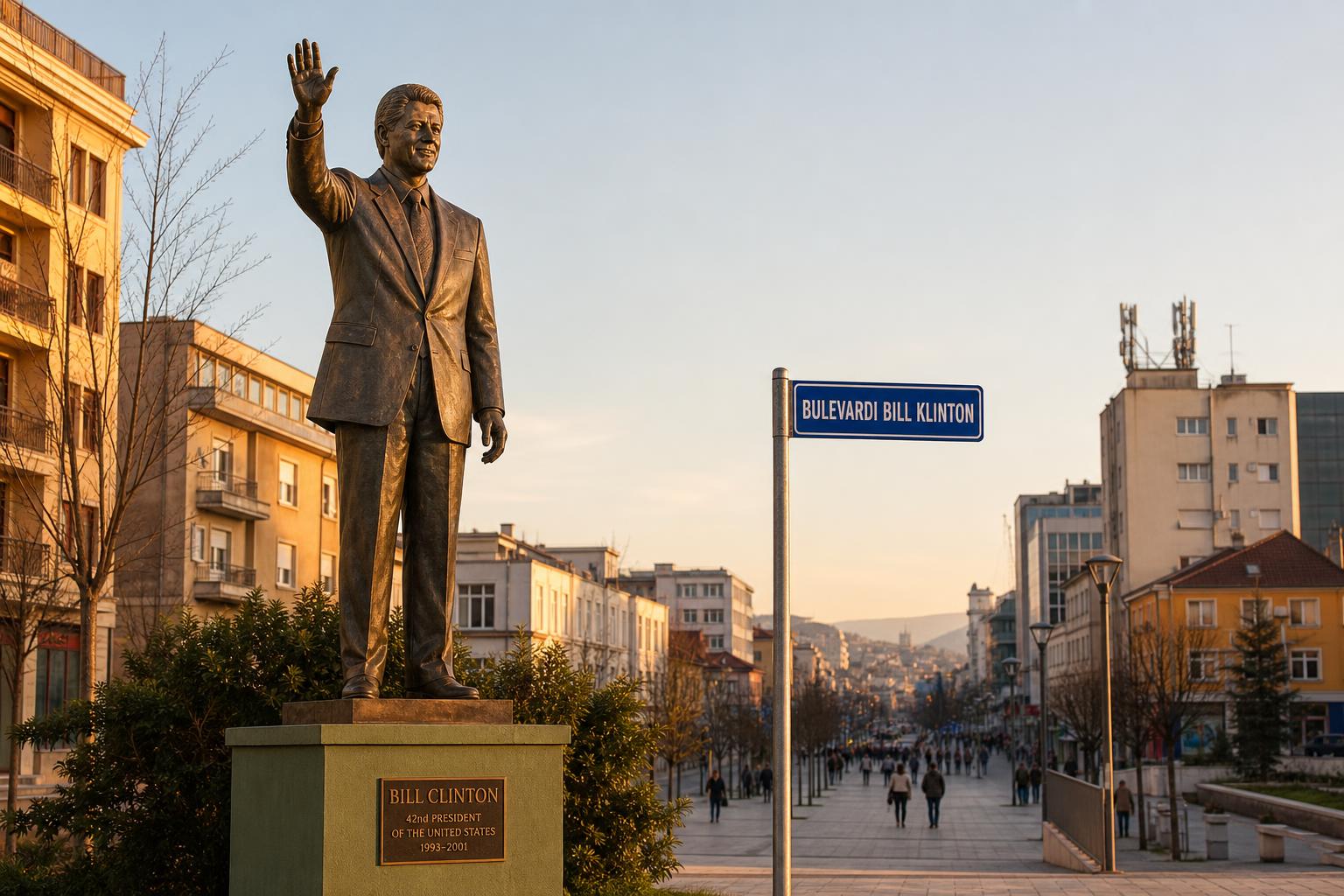
The United States is not Kosovo’s largest trading partner or its closest neighbor. It is the outside power that has done the most to shape Kosovo’s existence as a state. The 78-day NATO air campaign of 1999 was a US-led operation. The recognition that turned the 17 February 2008 declaration of independence into international fact came from Washington the next morning. The largest US military base built in Europe since Vietnam sits on a hilltop in southeast Kosovo. A boulevard in central Pristina is named for an American president, and a bronze statue of him stands on it.
For Albanian Americans — particularly the roughly 4,000 Kosovar Albanians who arrived through Fort Dix in 1999 — none of this is abstract. The bilateral relationship is why their families’ passports work and why the towns they came from have functioning state institutions.
This article walks through the relationship: why it matters, how it was forged in 1999, what Camp Bondsteel and the Clinton statue are, where the dialogue sits today, and what the diaspora bridge looks like.
Why the US matters disproportionately to Kosovo
Most countries with US security ties are members of formal alliances. Kosova (Albanian for Kosovo) is not. It is not a NATO member, not an EU member, and not a UN member — and yet its bilateral relationship with Washington is one of the closest any small European state holds. The asymmetry has a specific origin: the US is the reason Kosovo exists as a state in its current form.
Kosovo’s territorial sovereignty rests on the NATO air campaign of March-June 1999 and the security architecture that followed. Its 2008 declaration of independence was preceded by years of US-led negotiations and followed within hours by US recognition. Its constitutional order was built under a UN administration the US largely shaped. Its membership in international financial institutions and the survival of its arrangements with Serbia have depended on US diplomatic cover when European partners were divided.
That dependence runs in both directions in public memory. Polling across the 2010s consistently showed the United States as the most-favored foreign country in Kosovo, often by margins above 80% — figures unmatched anywhere else in Europe. The names Bill, Hillary, Madeleine (after Madeleine Albright), and Tony (after Tony Blair) became unusually common Kosovar Albanian first names for children born around 1999.
The relationship is not a NATO treaty under Article 5, the way Albania’s has been since 2009. It is a state that owes its existence in part to American intervention, sustained by a framework Washington continues to underwrite.
1998-1999: the NATO intervention and its US lead
The Kosovo question moved from a regional dispute to an international crisis across 1998. After Slobodan Milošević revoked Kosovo’s autonomy in 1989, Serbian authorities had run parallel systems excluding Kosovo’s roughly 90% Albanian population for nearly a decade. The Kosovo Liberation Army (KLA) emerged in the mid-1990s and was in open conflict with Serbian security forces by 1998. Forced displacement of Kosovar Albanian civilians scaled rapidly through that autumn and the winter of 1999.
The Rambouillet talks of February-March 1999, hosted in France with US lead negotiator Christopher Hill and Secretary of State Madeleine Albright as the political driver, sought a negotiated settlement. The Kosovar Albanian delegation signed; the Yugoslav delegation refused. NATO then began an air campaign on 24 March 1999 that ran 78 days, ending with Yugoslav withdrawal under the Kumanovo Agreement of 9 June 1999 and UN Security Council Resolution 1244 establishing UN administration over Kosovo.
The campaign was a NATO operation in form and a US operation in substance. The United States contributed the majority of aircraft sorties, the bulk of the precision-guided munitions, and the political weight that held the 19-member alliance together through 78 days of contested operations.
The intervention was contested then and remains so. Russia and China opposed the campaign at the UN Security Council, where it was conducted without explicit Council authorization. Belgrade then and Belgrade now characterize it as an unlawful aggression. The United States and most NATO members characterize it as a humanitarian intervention undertaken to halt mass forced displacement. The disagreement is unresolved; we present both positions because both are still held by the parties involved.
In practical effect, the campaign ended Serbian governance of Kosovo. The roughly 800,000 Kosovar Albanian refugees displaced into Albania, North Macedonia, and Montenegro at the height of the crisis returned across the summer of 1999. UN administration began in June, with the US in a senior position throughout.
Camp Bondsteel and the post-war footprint
The most visible US presence in Kosovo is Camp Bondsteel, on a hilltop near Ferizaj (Uroševac), roughly 35 kilometers southeast of Pristina. Construction began in June 1999, immediately after the Kumanovo Agreement, on land leased from local Kosovar landowners. The base became the headquarters of the US contingent of the NATO Kosovo Force (KFOR) and remains so.
Bondsteel is named for Staff Sergeant James L. Bondsteel, a US Army soldier awarded the Medal of Honor for actions in Vietnam in 1969 — US Army naming convention, not a Balkan reference. The base covers approximately 955 acres and was for years described as the largest US military installation built in Europe since the Vietnam era.
KFOR is the NATO-led peacekeeping force authorized by UN Security Council Resolution 1244 (10 June 1999). It has operated continuously since with rotating contingents from NATO members and partner states. Force size has fluctuated — from roughly 50,000 personnel at its 1999 peak to a sustained level of several thousand in recent years — but the force has never stood down, and its legal authority under UNSCR 1244 has not been withdrawn.
The base is the most concrete expression of the US security commitment to Kosovo. When tensions rise between Pristina and Belgrade, KFOR — with Bondsteel as its US-anchored backbone — is the security guarantor none of the parties wants to test directly. The base is in Kosovo because Kosovo’s leadership, across two decades of changing governments, has wanted it there.
February 17-18, 2008: the declaration and same-day US recognition
After nearly nine years of UN administration, a negotiation process led by former Finnish President Martti Ahtisaari did not produce an agreed settlement with Serbia. The Ahtisaari Plan of 2007 proposed supervised independence with extensive minority protections; Serbia rejected it, and Russia signaled it would veto any Security Council resolution endorsing it. The Kosovar leadership, in coordination with the United States and major EU members, moved to a unilateral declaration.
On 17 February 2008, the Assembly of Kosovo in Pristina adopted the declaration of independence. Prime Minister Hashim Thaçi read it; President Fatmir Sejdiu co-signed. The new constitution and state symbols — including the deliberately civic blue-and-yellow flag with six stars for Kosovo’s six recognized communities — were adopted with the declaration.
US recognition came the following morning. President George W. Bush issued the formal recognition statement on 18 February 2008, and Secretary of State Condoleezza Rice delivered the diplomatic note establishing US-Kosovo bilateral relations. The United States was among the first to recognize, alongside Albania (which recognized on the day of the declaration), the United Kingdom, France, and Germany. The US Embassy in Pristina opened later in 2008 with Tina Kaidanow as the first US Ambassador.
The recognition was contested. Serbia, Russia, China, Spain, Greece, Cyprus, Romania, and Slovakia declined to recognize, and most have maintained that position. Reasons differ — concerns about secessionist precedents at home (Spain, Romania, Slovakia), historical alignment with Serbia (Russia, Greece, Cyprus). The International Court of Justice advisory opinion of 22 July 2010 held that Kosovo’s declaration did not violate international law, but did not adjudicate the deeper question of statehood.
By 2026, Kosovo is recognized by roughly 110 of the 193 UN member states. UN membership remains procedurally blocked by Russian and Chinese veto positions. Kosovo is, however, a member of the IMF, the World Bank, FIFA, UEFA, and the International Olympic Committee — and applied for EU candidate status in December 2022.
The ongoing Belgrade-Pristina dialogue
The largest unfinished piece of post-2008 Kosovo policy is the relationship with Serbia. The EU-mediated Belgrade-Pristina dialogue, launched in March 2011 under EU High Representative Catherine Ashton, has produced agreements covering license plates, customs, telecommunications, and the legal status of Kosovo’s Serb-majority municipalities. Its highest-profile product was the Brussels Agreement of 19 April 2013, committing Pristina to an Association of Serb-Majority Municipalities and Belgrade to dissolving the parallel security and judicial structures it maintained in northern Kosovo.
Implementation has been slow and incomplete on both sides. The Association has not been operationalized in the form Belgrade wants. The parallel structures have not been fully dissolved. Periodic crises — over license plates, a north Kosovo mayoral election in April 2023, the Banjska attack of 24 September 2023 in which a Kosovo police officer was killed — have stalled progress repeatedly.
The United States is not the formal mediator; the EU holds that role. But Washington has been a continuous shaping presence. Special Presidential Envoys for the dialogue have included Richard Grenell (2019-2020) and, in subsequent administrations, Gabriel Escobar and Derek Chollet. The Washington Agreement of 4 September 2020, signed in the Oval Office between PM Avdullah Hoti and President Aleksandar Vučić, focused on economic normalization.
The phrase “Ohio meetings” sometimes appears in coverage of the dialogue. Camp Bondsteel sits in Kosovo, not Ohio; the Ohio reference is to Wright-Patterson Air Force Base, the facility where the 1995 Dayton Agreement ended the Bosnian War. Suggestions that a Kosovo-Serbia comprehensive settlement might be negotiated at a Dayton-style retreat have surfaced repeatedly; no such summit has produced a final agreement.
US policy on the dialogue has been continuous across administrations: mutual recognition between Kosovo and Serbia as a condition for full normalization, paired with EU integration as the destination for both. Russia’s December 2023 veto of routine Security Council statements on Kosovo signaled that the geopolitical context has hardened since 2022.
US sanctions tools applied to parallel structures
The United States has used targeted financial sanctions to shape behavior in the dispute, with measures running in both directions over the years.
Against parallel structures and obstructionist actors. The United States imposed Treasury OFAC sanctions on Milan Radoičić under the Global Magnitsky sanctions program, as part of a broader Global Magnitsky designation round — citing corruption tied to transnational organized crime, specifically bribery of Kosovo and Serbian security officials to enable the smuggling of goods, drug money, and weapons — well before Pristina identified him as a leader of the armed group involved in the Banjska attack of September 2023. After Banjska, the State Department publicly called him a criminal who must be held accountable, rather than issuing a new Treasury designation.
Toward Pristina. When the Kosovar government has taken steps Washington views as escalatory, the United States has used reduced engagement and conditional pauses rather than formal sanctions. After Pristina’s spring 2023 imposition of Albanian-mayor administrations on northern municipalities following an election the local Serb population boycotted, the US publicly suspended Kosovo from the Defender Europe 2023 exercise series. The pause was lifted as conditions changed, but the precedent is on the record.
The asymmetry — full OFAC designations on individual obstructionists, calibrated diplomatic pressure on Pristina — reflects two very different relationships. Serbia is treated as a state Washington seeks to draw westward; Kosovo is treated as a partner expected to operate within US-shaped frameworks. Designated individuals lose US-dollar banking access and US travel — material consequences in a small economy where most banking touches the dollar.
The Albanian-American diaspora as bilateral connective tissue
The state-to-state relationship is reinforced by one of the most concentrated diaspora populations in the United States. Roughly 230,000 Americans report Albanian ancestry on the 2024 American Community Survey, with community estimates including ethnic Albanians from Kosovo, North Macedonia, and Montenegro running closer to one million. The top states are New York (~56,000), Michigan (~27,000), and Massachusetts (~21,000), with secondary concentrations in New Jersey, Connecticut, Illinois, and Texas.
The Kosovar-American component is more recent than the historic Tosk-Albanian community built between 1900 and 1940. The largest single arrival was Operation Provide Refuge in 1999, which admitted close to 14,000 Kosovar Albanian refugees from Macedonian camps to the United States — roughly 4,000 processed through Fort Dix, New Jersey, in May and June 1999. Many returned after the war; many stayed. The community today is concentrated in the New York metro area — the Bronx, Yonkers, Westchester, and Staten Island — with additional density in northern New Jersey and in the Detroit metropolitan area.
The diaspora has been a recognized policy interlocutor in Washington since the 1990s. The Albanian American Civic League (AACL), founded in 1989 by former US Congressman Joe DioGuardi, ran sustained advocacy on Kosovo. The National Albanian American Council (NAAC), founded in Washington, DC, in 1996, added a complementary track. The bipartisan Congressional Albanian Issues Caucus is the institutional home of that engagement on Capitol Hill.
Cultural memory: the Clinton statue, Newborn, and the boulevards
Public memory in Kosovo is unusually explicit about American involvement, and the built environment shows it.
Bill Clinton Boulevard (Bulevardi Bill Klinton) is a major thoroughfare in central Pristina, renamed for Clinton in the early 2000s in recognition of his role as US president during the 1999 NATO campaign. On 1 November 2009, during a Clinton visit to Kosovo, a 3.5-meter bronze statue of Clinton was unveiled on the boulevard. The sculpture, by Kosovar artist Izeir Mustafa, shows Clinton waving with documents in his other hand. It is a routine stop on diplomatic visits and a gathering point on US national holidays. A boutique called Hillary, named for Hillary Clinton, opened on the same boulevard as a women’s clothing store; the owner’s own choice, not an official action.
Other US figures are similarly honored. A statue of Madeleine Albright stands in Pristina. George W. Bush has streets and squares named for him in several Kosovar towns.
The Newborn monument in central Pristina is the most-photographed public sculpture in Kosovo. The seven-letter typographic structure was unveiled on 17 February 2008, the day of the declaration. Each anniversary the sculpture is repainted in a new theme — flags of recognizing countries one year, civic-protest motifs another, anti-corruption messaging another. The monument is both a statement of statehood and a running editorial on the state of the project.
For Kosovar Albanians, naming streets and erecting statues is not unusual public-diplomacy gratitude — it is a sustained civic commitment that has held across changing governments and changing US administrations.
Where the relationship is going
Two questions shape the next decade: NATO membership and EU integration.
NATO accession. Kosovo has declared NATO membership a strategic goal. The procedural barrier is that four NATO members do not recognize Kosovo (Spain, Greece, Romania, Slovakia), and accession requires unanimous consent. Until at least one position changes, formal MAP candidacy is unavailable. Interim work — Kosovo Security Force capacity-building, joint exercises with US forces, defense institution reform — proceeds bilaterally.
EU integration. Kosovo applied for EU candidate status in December 2022. The same five EU non-recognizers — Spain, Greece, Cyprus, Romania, Slovakia — slow the path. Visa liberalization for Kosovar passport holders entering the Schengen Area entered into force on 1 January 2024 after years of delay; Kosovo was the last Western Balkans state to receive that status. The US position is consistently that Kosovo’s path runs through Brussels, with Washington as a reinforcing partner.
Belgrade-Pristina dialogue. The 2023 Ohrid framework — never formally signed but treated by the EU as a working document — covers mutual recognition of state symbols, missing-persons resolution, and the Association. US policy remains anchored on mutual recognition as the destination, paired with continuous KFOR security cover until reached.
Security cooperation. Beyond Bondsteel and KFOR, Foreign Military Financing and IMET programs support Kosovo Security Force interoperability, and joint exercises with the US Iowa National Guard under the State Partnership Program have run since 2011.
Diaspora politics. As more Kosovar-American children born in the US after 1999 reach voting age, the political profile of the Kosovo issue in US elections is becoming more durable, not less.
If you’re an Albanian American — from Kosovo, Albania, or anywhere else in the diaspora — you can add yourself to the count. NAR is a 501(c)(3) community-led count, and the certificate is a recognition document, not a government ID.
Sources
- Wikipedia — Kosovo–United States relations
- Wikipedia — Foreign relations of Kosovo
- Wikipedia — Camp Bondsteel
- Wikipedia — Bill Clinton Boulevard, Pristina
- Wikipedia — Kosovo Force (KFOR)
- US Department of State — U.S. Relations With Kosovo
- UN Security Council Resolution 1244 (10 June 1999)
- International Court of Justice — Advisory Opinion on Kosovo’s declaration of independence (22 July 2010)