
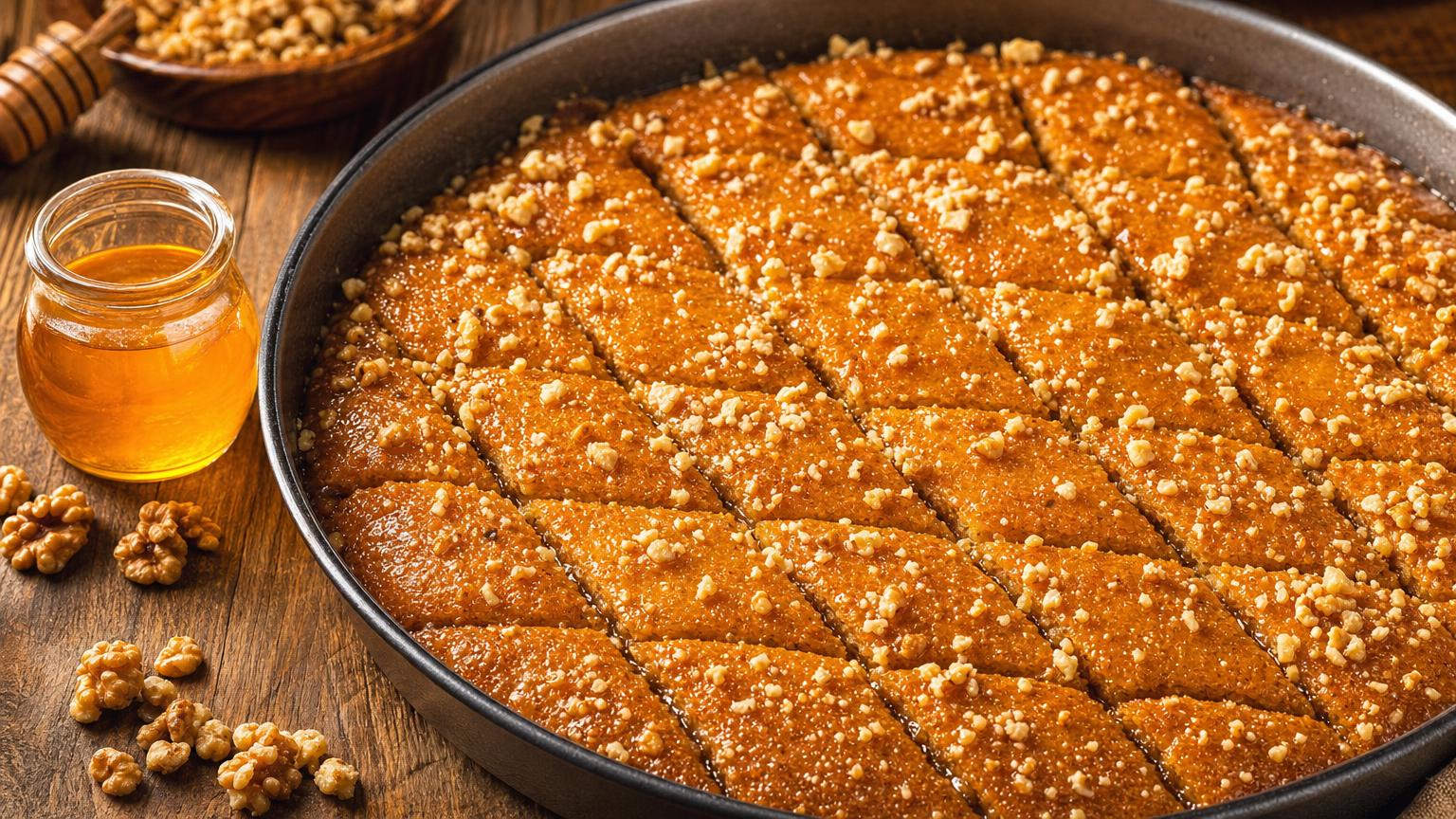
Shendetlie is the Albanian honey-and-walnut cake — a sponge built around ground walnuts, sweetened with honey, baked in a square or rectangular pan, then soaked while still warm with a cool honey-lemon syrup. The name carries a wish. Shëndet (pronounced shen-DET) is the Albanian word for health; shëndetlie (sometimes spelled shendetli) literally means “for health” or “of health.” When a family bakes shendetlie, the cake itself is well-wishing in edible form.
The dish belongs to the same Ottoman-Balkan family as baklava, revani, and the syrup-soaked cakes that run from Greece through Turkey to the Levant. Within that family, shendetlie has its own logic. No filo. No semolina. The walnut is load-bearing — body, flavor, and oil come from it — and the honey appears twice, once in the batter and once in the syrup. The result is dense, fragrant, and built to keep for a week.
This piece covers what shendetlie is, where it sits in the Albanian dessert tradition, when it gets served, the regional variations, the traditional recipe at home-kitchen scale, and the critical-path notes that decide whether a shendetlie comes out right.
What Shendetlie Is
Shendetlie is a single-layer honey-and-walnut sponge cake, baked in a square or rectangular pan, scored before baking into 12 to 16 square pieces, and soaked with syrup after it comes out of the oven. The structure is simple. Eggs beaten with sugar and honey, butter folded in, ground walnuts and flour added together, the batter spread in a buttered pan and baked until the top is deep gold. While it cools, a syrup of water, sugar, honey, and lemon juice cooks down on the stove. The cake is soaked warm with the cool syrup and rests at least an hour and a half before serving.
The texture is closer to a moist tea cake than a layered pastry. The walnuts give a slightly oily, dense crumb. The syrup soaks the top half through and the bottom half partway, leaving a faint dry edge against the pan. Cut into squares and stacked, the pieces hold their shape; the syrup tacks the surface but does not pool.
The flavor runs in three registers at once. From the walnuts, an earthy, slightly bitter base. From the honey — present in both batter and syrup — a long floral sweetness that lingers after the bite. From the lemon zest in the batter and the lemon juice in the syrup, a thread of brightness that keeps the dessert from going cloying. Some regional versions add cinnamon, clove, or nutmeg; the spice is a supporting note, never the lead.
What shendetlie is not: a quick cake. The bake itself is short — 35 to 40 minutes — but the soak needs at least an hour and a half in the fridge before serving, and the cake improves overnight. Most Albanian grandmothers bake shendetlie the day before they plan to serve it.
The Name and Its Meaning
The name is the cake’s most distinctive feature, and the reason it occupies a different cultural slot than other Albanian sweets.
Shëndet is the Albanian word for health. It runs through everyday Albanian speech the way “salud” or “à votre santé” run through Spanish and French. Shëndet i mirë — “good health” — is the standard toast before raki. Për shëndetin tënd — “for your health” — is what one says when handing over a glass. Shëndet is what one wishes for newborns, for couples getting married, for the recently bereaved, for friends recovering from illness, for everyone at a family table.
Shendetlie carries that word into the cake itself. The -lie suffix is an Albanianized form (likely via Ottoman Turkish -li, which forms adjectives) producing a word that translates roughly as “of health” or “for health.” A cake whose name is a wish.
The naming connects to an older folk-medicine logic. Honey was a household remedy across the Mediterranean and the Balkans for sore throats, coughs, low energy, and convalescence. Walnuts, with their oil content and their visual resemblance to a brain, carried a separate set of folk associations with strength and clarity. A cake combining both, served warm with tea on a cold winter evening, was the kind of dessert a grandmother would make when somebody in the household needed looking after. The name codified that role.
The cake is not legally or medically health food, of course. It is a dessert, sweetened heavily with honey and sugar, dense with walnut oil. The “for health” framing is cultural, not nutritional. But the framing matters because it shapes when the cake gets served. A cake whose name means health goes naturally on the table at moments when health is what one wishes for.
Where Shendetlie Sits in Albanian Culinary Tradition
Albanian dessert is a small, deep tradition — fewer dishes than the savory canon, heavily concentrated in the syrup-and-nut category that came in through the Ottoman period. The major slots:
Baklava (bakllava). Filo, chopped walnuts or almonds, syrup. The wedding cake, the Bajram cake, the centerpiece of the holiday tray.
Trilece. Sponge cake soaked in three milks. A relatively recent arrival via Latin-American tres leches, now firmly Albanian. The diaspora wedding standard.
Revani. Semolina sponge soaked in syrup. Plain, light, slightly grainy. The everyday cousin of baklava.
Kabuni. Lamb-and-rice with raisins, sugar, and cinnamon — a sweet-savory dish associated with Krujë in central Albania.
Sheqerpare. Buttery cookies soaked in syrup. Smaller than shendetlie, no walnuts.
Shendetlie. The honey-walnut cake. The cold-weather, family-table, well-wishing slot.
Halva (hallvë). Semolina cooked with butter, sugar, and pine nuts. Served at memorial meals across the Albanian-speaking world.
Within that map, shendetlie occupies a specific place. Heavier and more rustic than trilece, less work than baklava, more present than revani in cold months, and distinct from halva in that it does not carry the same memorial association. It is the dessert a grandmother bakes when family is coming, when somebody is recovering from a flu, when Christmas is two weeks out and the kitchen smells of honey and walnut for an afternoon.
Both shendetlie and baklava are Ottoman-era syrup-and-nut cakes that share the honey-walnut-lemon backbone. Shendetlie is sometimes described as baklava without the filo work, but the texture is genuinely different. Baklava layers crackle; shendetlie sponges. Baklava is engineered for a wedding tray; shendetlie is engineered for a family afternoon.
Regional Variations
Shendetlie is more uniform across regions than byrek or qofte, partly because the recipe has fewer moving parts. The variations that survive concentrate in spice profile, syrup ratio, and walnut grind.
Southern Albania (Tosk). Most associated with Korçë, Berat, Gjirokastër, and the southern coast. Heavy on honey, lemon zest and juice as the brightening agent. Some southern families add a little olive oil alongside the butter for a more open crumb. Spice is restrained: cinnamon yes, clove sometimes, nutmeg rarely.
Northern Albania (Gheg). Shkodër, Lezhë, and the northeast highlands run denser — more butter, heavier hand on the cinnamon-clove-nutmeg trio. Walnuts are sometimes ground finer for a tighter crumb. Some northern households use honey blended with pekmez (grape molasses) in the syrup for a darker, less-sweet result.
Kosovar. Kosovo’s tradition tracks closely with the northern Albanian version — denser, more spiced, slightly more syrup-saturated. Kosovar families often serve shendetlie at religious holidays alongside baklava.
Çam and southern coastal. Çam Albanians (from northwestern Greece) preserve a version that overlaps significantly with the Greek karydopita (walnut cake). Some food historians treat them as regional siblings rather than separate dishes. The Çam version often adds brandy or raki to the batter.
Diaspora. In Albanian-American kitchens, the regional fingerprints fade. Most diaspora cooks bake from a single grandmother’s recipe. Supermarket honey is more uniform than village honey; the kitchen processor replaces the hand-cranked grinder. A Tosk grandmother in Worcester and a Gheg grandmother in Sterling Heights end up baking shendetlies that taste more similar to each other than either does to its village original.
When It’s Served
Shendetlie’s “for health” name shapes its cultural slot. The cake is served at moments when shëndet is what the household wants to wish for.
Christmas (Krishtlindjet). The strongest association in many Albanian households. Shendetlie is a winter cake, and it appears on Christmas tables across both Catholic and Orthodox Albanian traditions. Often baked the day before Christmas Eve and held in the fridge through the holiday meal.
Family gatherings. Sunday dinner, name-day celebrations, the dinner the night before a big event. The everyday-celebration cake — familiar enough to be ordinary, special enough to mark the occasion.
Convalescence and well-wishing. When somebody is recovering from illness, expecting a child, starting a new job, or returning from a long trip, shendetlie is one of the cakes a grandmother might make. The “for health” framing makes it the dessert form of a wish.
Memorial meals (për shpirt). Some families serve shendetlie at the meal that follows a funeral or at the 40-day memorial gathering. Halva is the more traditional memorial sweet, but where halva carries too direct an association, shendetlie can take its place.
Religious holidays. Less central than baklava on Bajram or Easter, but present. Some Muslim Albanian families bake shendetlie alongside baklava for the Eid table; some Orthodox families bake it for Easter; the Catholic Albanian tradition tilts more strongly toward Christmas.
Weddings. Less common in the diaspora than trilece or baklava. Shendetlie shows up at the darka e nuses — the bride’s family dinner the night before the wedding — more often than at the wedding itself.
Shendetlie is a household cake more than a public-occasion cake. It gets baked at home for people the cook knows and wants to wish well.
The Traditional Recipe
This is the standard southern-Albanian version, scaled to a 9×13 pan and 12 to 16 squares. It uses ingredients available in any US supermarket. Active work runs about 25 minutes; the bake is 35 to 40 minutes; the soak and rest add at least 90 minutes before serving (overnight is better).
Ingredients
For the cake:
- 6 large eggs, room temperature
- 1 cup (200 g) granulated sugar
- 1 cup (340 g) honey, mild and floral (clover, orange-blossom, wildflower)
- ½ cup (115 g) unsalted butter, melted and slightly cooled
- 2 cups (200 g) walnuts, coarsely chopped or pulsed in a food processor (medium grind — not flour, not chunks)
- 2 cups (250 g) all-purpose flour
- 2 tsp baking powder
- ½ tsp baking soda
- 1 tsp ground cinnamon
- ¼ tsp ground cloves (optional, traditional in northern versions)
- ¼ tsp salt
- Zest of 1 lemon
For the syrup:
- 1 cup (240 ml) water
- 1 cup (200 g) granulated sugar
- ½ cup (170 g) honey
- 2 tablespoons fresh lemon juice
- 1 strip lemon peel (optional)
A note on the honey: a mild floral honey carries the cake. Strong dark honeys (buckwheat, chestnut) can overwhelm the walnut. Clover, orange-blossom, wildflower, or acacia all work. Albanian mjaltë mali (mountain honey) is the village standard if a Balkan grocery is nearby.
A note on the walnuts: freshness matters. Walnuts go rancid faster than most nuts, and a stale walnut tastes bitter rather than earthy. Toast lightly (5 minutes at 350°F) before chopping if there is any doubt.
Equipment
- A 9×13 inch baking pan, at least 2 inches deep
- A stand mixer or hand mixer with a whisk attachment
- A medium saucepan for the syrup
- A heatproof spatula
- A sharp knife for scoring before baking
- A ladle or measuring cup for pouring the syrup
How to Make Shendetlie
Step 1 — Prep the pan and oven (5 minutes)
Heat the oven to 350°F (175°C). Butter the 9×13 pan generously, including the sides. Line the bottom with parchment if the pan is older or the corners are not perfectly square; otherwise straight butter is fine.
Step 2 — Beat the eggs and sugar (5 minutes)
Crack the 6 room-temperature eggs into the mixer bowl. Beat on high for 4 to 5 minutes until pale yellow and roughly tripled in volume. Add the sugar in a slow stream and beat 2 more minutes until glossy and falling from the whisk in thick ribbons.
The cake’s lift comes from the air whipped into the eggs. Under-beat by 90 seconds and the crumb closes up, the syrup struggles to penetrate, and the texture turns gummy.
Step 3 — Add honey, butter, lemon zest (2 minutes)
Reduce to medium. Pour in the honey in a slow stream; the foam should hold. Add the melted butter (cooled but still liquid) the same way. Add the lemon zest. Beat just until uniform — 30 to 45 seconds.
Step 4 — Fold in dry ingredients and walnuts (3 minutes)
In a separate bowl, whisk together the flour, baking powder, baking soda, cinnamon, cloves if using, and salt. Add the chopped walnuts and toss to coat — the flour keeps the walnuts from sinking to the bottom during the bake.
Fold the dry-and-walnut mixture into the egg-honey base in three additions with a rubber spatula. Do not stir or beat. The batter should look thick, walnut-flecked, and slightly bubbly.
Step 5 — Pour, score, and bake (40 minutes)
Pour the batter into the prepared pan and smooth the top. With a sharp knife, score the top into 12 to 16 squares — through the surface only, not down to the pan. Scoring before baking is what lets the syrup penetrate evenly and gives clean cuts on serving.
Bake at 350°F (175°C) for 35 to 40 minutes. Done when the top is deep gold to mahogany, the edges pull slightly from the pan, and a toothpick comes out clean. Honey caramelizes faster than refined sugar, so the cake will look darker than a plain sponge — trust the toothpick.
Step 6 — Make the syrup while the cake bakes (12 minutes)
About 15 minutes into the bake, start the syrup. Combine water, sugar, honey, lemon juice, and lemon peel in a medium saucepan over medium heat. Stir until the sugar dissolves, then simmer gently 5 to 7 minutes until it thickens slightly and coats the back of a spoon. Pull from the heat and cool to room temperature.
The syrup must cool. Hot syrup on a hot cake seals the surface and leaves the middle dry; cool syrup on a warm cake draws in evenly. This is the most-missed step in home shendetlie.
Step 7 — Soak (5 minutes active, 90+ minutes resting)
Pull the cake from the oven. Rest 5 minutes in the pan — surface stopped steaming but still warm. Pour the cool syrup over the warm cake in a steady spiral, pausing every few ounces to let it absorb. Use all of it.
Cover and rest at least 90 minutes at room temperature, then refrigerate. Overnight is better.
Step 8 — Cut and serve
Cut along the scored lines all the way through. Lift squares out with a small offset spatula. Serve at room temperature; pull from the fridge 30 minutes before eating to let the honey loosen. Some households dust the top with chopped walnuts or press a single walnut half into each square during the soak.
Common Mistakes and Critical-Path Notes
Three steps decide whether shendetlie comes out right.
Beat the eggs to ribbon stage. The cake is mostly egg-foam structure. Under-beaten eggs produce a tight crumb that does not soak. The full 4-to-5-minute whip is the load-bearing move.
Cool the syrup, soak the warm cake. Hot-on-hot seals the surface. Cool-on-warm penetrates evenly. This is the most common failure mode in home shendetlie. Start the syrup partway through the bake so it has time to come to room temperature before the cake comes out.
Coat the walnuts in flour before folding. Walnut oil makes the nuts slippery, and they sink to the bottom of an egg-foam batter if not prepped. Tossing the chopped walnuts with the dry ingredients suspends them through the bake.
A few more notes:
- Stale walnuts are a death sentence. Rancid walnut oil tastes bitter and metallic. If a walnut tastes bitter raw, do not use it.
- The bake will look dark. Honey caramelizes faster than refined sugar. A copper-penny color is correct; pulling early gives a gummy middle.
- Do not skip the rest. A shendetlie cut immediately after the soak is wet and structureless. The 90-minute minimum is what lets the cake re-set around the syrup.
- No microwave. If a refrigerated square needs warming, 30 seconds at 50% power is the limit. Better to serve at room temperature.
Serving and Pairing
Shendetlie is served cold or at room temperature, never hot. The traditional pairings are simple and lean Mediterranean.
Tea. Strong black tea — Albanian çaj mali (mountain tea, made from sideritis, a herbal tisane) or a strong English-breakfast — is the classic pairing. The bitter tannins cut the honey-and-walnut sweetness; the heat loosens the syrup in the mouth. This is the cold-evening, kitchen-table version of how shendetlie gets eaten in most Albanian households.
Albanian coffee or Turkish-style coffee. A small cup of strong, unsweetened Albanian coffee works the same way — bitter against sweet, hot against cold. Shendetlie does not need accompaniment, but a small coffee is the most-served pairing in a diaspora household serving the cake to guests.
Walnut topping. Chopped walnuts dusted on top just before serving, or a single walnut half pressed into each square. The texture contrast helps. The flavor doubles down on the walnut already in the cake.
Whipped cream — sparingly. A small dollop of unsweetened whipped cream is a modern addition, more common in Tirana bakeries than in home kitchens. Traditionalists skip it; the cake is meant to stand alone with its syrup.
Raki. A small glass of raki (Albanian fruit brandy) after the cake — particularly walnut or grape raki — is the older Albanian dessert habit. Sweet cake, dry brandy, the bitter on the palate cleared by the alcohol. Less common with shendetlie specifically than with baklava, but appropriate.
What does not pair: oaky red wine, anything carbonated, milk-based desserts. Shendetlie is a dry-pair cake. The syrup carries the moisture; a wet pairing fights it.
Shendetlie in the Diaspora
Among Albanian-Americans, shendetlie occupies a quieter place than byrek, trilece, or baklava. Less photographed, less ordered at restaurants, less likely to show up at a wedding. Shendetlie is a home cake — it does not travel well to a venue or portion neatly onto a wedding plate.
But it survives in households. The cake is part of the cold-month repertoire in many Albanian-American kitchens: the Sunday afternoon bake, the night-before-Christmas bake, the dessert a grandmother makes when grandchildren are visiting and there is time to do it slowly.
The diaspora neighborhoods where it shows up most reliably: the Bronx and Yonkers in New York; Sterling Heights and Warren in metro Detroit, home to a sizable Catholic Albanian community that keeps the Christmas tradition strong; Worcester and Boston in Massachusetts; Waterbury and Bridgeport in Connecticut. Most Albanian-owned bakeries in those neighborhoods keep shendetlie on the seasonal menu rather than year-round.
Where it disappears: households where the grandmother generation has passed without writing the recipe down. The cake survives if somebody in the next generation learns to make it.
A Note on Survival
Recipes survive when communities count themselves. Languages survive when communities pass them down. Names survive when grandparents write them out. Albanian Americans are roughly 230,000 by the 2024 American Community Survey count, and somewhere between three and five times that by community estimates that include ethnic Albanians the Census misses. The cake whose name means health is part of what travels with that population — not a museum piece, but a living thing that gets baked or does not get baked, in households that show up or do not show up.
Recipes survive when communities count themselves. Register with NAR — free, neutral, your data stays yours. The community-led count of Albanian Americans only works if every household shows up.