
Three words, used the same way an English speaker might say “Happy Easter” or “Merry Christmas” — a warm exchange between family, neighbors, the cashier at the Albanian grocery, the cousin you only call twice a year. In Albanian-American homes from the Bronx to Sterling Heights, the phrase travels in person, by text, by voice memo, by Facebook post, by every channel a multi-generational family runs.
This piece is for several readers at once. Albanian Muslims who want a clean explainer to send a non-Albanian friend or partner. Albanian Catholics, Orthodox, Bektashi, and secular relatives who want to send the greeting to Muslim cousins without getting it slightly wrong. Non-Albanians married into, working with, or curious about the community who want to understand what is being said and why.
What follows: the phrase itself, the response, what Eid al-Fitr is in Albanian Muslim tradition, the difference between the two Bajrams, the foods that anchor the day, how the US diaspora observes it, and where Bajram sits inside the broader picture of Albanian religious life. Nothing here is religious instruction — it is community context, the kind of thing a relative might explain over coffee.
The phrase, translated
Gëzuar Fitër Bajramin is built from three words.
Gëzuar — pronounced roughly guh-ZOO-ar — is the Albanian word for “happy” or “joyful,” used as a holiday wish across the calendar. It is the same word that opens Gëzuar Vitin e Ri (“Happy New Year”) and the same word raised over a glass of raki in a gëzuar toast at a wedding. The grammar is participial — literally something like “[may you be] gladdened” — but the function is identical to English “happy” in a holiday greeting.
Fitër comes through Albanian from the Arabic fiṭr, meaning “breaking [the fast].” The same root produces iftar — the daily meal that breaks the Ramadan fast at sunset — and fitra or zakat al-fitr, the obligatory charity given before the Eid prayer so that the poorest households can also celebrate. Albanian inherited fitër the way it inherited many Islamic terms: through Ottoman Turkish, between roughly the 15th and 19th centuries, with the spelling and ending bent to fit Albanian phonology.
Bajram is the Albanian word for a religious feast day. It comes from the Turkish bayram (“festival”), itself ultimately from a Persian root, and was adopted across the Balkans during the Ottoman period. In Albanian, Bajram names the holiday; bajrami with the definite article -i names “the Bajram.” Pluralized, bajramet are “the Bajrams” — the two holidays together.
Put together: Gëzuar Fitër Bajramin is “[Have a] joyful Festival of Breaking-the-Fast.” The accusative ending -in on Bajramin signals that the holiday is the object of the wish — what the speaker is wishing the listener. In casual speech the phrase is often shortened to Gëzuar Bajramin or just Gëzuar Fitrin; the long form is the most formal.
A note on spelling. Some older or hand-written greetings drop the diacritical ë and write Fitr or Fiter. The official spelling is Fitër. Both are read the same.
How to say it and what to say back
The exchange usually goes one of two ways.
In person — at the mosque after the morning prayer, at the door of a relative’s house, at a community center — the speaker says Gëzuar Bajramin or Gëzuar Fitër Bajramin, often with a hug, a cheek kiss, or a hand placed on the heart. The person greeted answers with one of:
- Faleminderit, gëzuar edhe ty. — “Thank you, happy [Bajram] to you too.” The most common response between peers.
- Edhe ty gëzuar. — “To you as well, joyful.” Shorter, used among close family or friends.
- Bajrami i mbarë. — “[A] blessed Bajram.” A more elevated reply; i mbarë carries the sense of fortunate, prosperous, going well.
- Faleminderit, shëndet dhe paqe. — “Thank you — health and peace.” Often added by older relatives.
- T’u pranoftë. — “May it be accepted [by God].” Used in more religious households; closer to the Arabic taqabbal Allah minna wa minkum that Muslims worldwide exchange on Eid.
By text the same phrases work. Gëzuar Bajramin familjes — “Happy Bajram to the family” — is a common WhatsApp opener for group chats.
To older relatives, the formal “you” Ju matters. Gëzuar Bajramin Ju uroj familjes suaj — “I wish you and your family a happy Bajram” — is on the formal end. To peers and younger people, ti and the short forms are normal.
A small etiquette note: any version above is fine, including the simple Gëzuar Bajramin with a name. The gesture lands.
Eid al-Fitr in Albanian Muslim tradition
Eid al-Fitr is the festival that ends Ramadan, the Islamic month of dawn-to-sunset fasting. It falls on the first day of Shawwal, the tenth month of the Islamic lunar calendar. Globally Muslims greet each other with Eid Mubarak (“Blessed Eid”); in Albanian, the same wish travels under the name Bajram.
The day starts early. Across Albania, Kosovo, North Macedonia, and the diaspora, families wake before sunrise, wash, and put on something new or freshly pressed — a suit for men, a dress for women, an embroidered cap (qylah or plis, depending on region) for some elders. The first stop is the Salat al-Eid, the morning Bajram prayer, held at the mosque or — when the crowd outgrows the building — outdoors in a school yard, parking lot, or park.
Before the prayer, observant Muslims pay zakat al-fitr — known in Albanian as zekati i fitrit or simply fitri — a small obligatory charity (a measure of staple food, or its cash equivalent) so that poorer households can also celebrate. In the diaspora the amount is typically a per-person fixed dollar figure announced by the local mosque the week before; the funds flow to community welfare projects, food banks, or relatives in the homeland.
After the prayer, the day breaks into visits. The first visit is usually to the eldest in the family — a grandparent, a great-aunt, the relative who hosted the family iftar dinners during Ramadan. Younger members kiss the elder’s hand and often touch their forehead to it; the elder offers sweets and a small cash gift to the children (the bahshish, in some households). The pattern repeats outward: parents, then siblings, then cousins, then neighbors and coworkers.
The second day is for friends and the wider circle. The third day winds down. Bajram in Albanian usage is a three-day stretch, though only the first day is the formal religious observance.
A note on the relationship to fasting. Practice in Albanian Muslim families varies widely. Some fast the full month every year. Some fast partially. Some — particularly second- and third-generation diaspora — observe Ramadan culturally without fasting and still gather for Bajram. The 1967 ban on religion under the Enver Hoxha regime, which closed every mosque, church, and teqe (Bektashi lodge) in Albania for more than two decades, is part of why practice today is uneven. The post-1991 revival rebuilt institutions; the practice that survived is private, varied, and rarely policed within families.
Fitër vs. Kurban: the two Bajrams
Albanian has names for both Eid holidays, and the names map differently than the Arabic ones do.
Fitër Bajrami / Bajrami i Madh — Eid al-Fitr, “the Big Bajram.” The three-day feast at the end of Ramadan. In 2026 it falls on or about March 20, depending on local moon sighting; mosques in the US typically confirm the exact date the night before, and you may see a one-day split between communities that follow Saudi Arabia’s announcement and those that wait for the local sighting.
Kurban Bajrami / Bajrami i Vogël — Eid al-Adha, “the Little Bajram.” The Feast of Sacrifice, falling on the tenth day of Dhu al-Hijjah, roughly 70 days after Fitër Bajrami. Globally it commemorates the prophet Ibrahim’s (Abraham’s) willingness to sacrifice his son. The Albanian name, Kurban, comes through Ottoman Turkish from a Semitic root meaning “sacrifice” or “offering.” Families who can afford it sacrifice a sheep or lamb (in the diaspora, almost always through a halal butcher) and divide the meat into thirds: one for the family, one for relatives and neighbors, one for the poor.
The naming convention is the part that catches outsiders off guard. The “Big” Bajram (i Madh) is Eid al-Fitr, even though in classical Islamic theology Eid al-Adha is sometimes considered the more significant of the two. The Albanian name reflects social weight, not theological ranking: Fitër Bajrami is the bigger family event because it ends a full month of communal fasting and pulls everyone home. Kurban Bajrami is shorter, quieter, and more centered on the sacrifice itself.
Both holidays are observed by Sunni and Bektashi Albanians. The greeting Gëzuar Bajramin works for either; if specificity is needed, Gëzuar Fitër Bajramin and Gëzuar Kurban Bajramin are the precise forms. Generic Gëzuar Bajramin in late spring almost always means Fitër; in late summer or early fall, almost always Kurban.
The foods that anchor the day
Bajram is a holiday of sweets first.
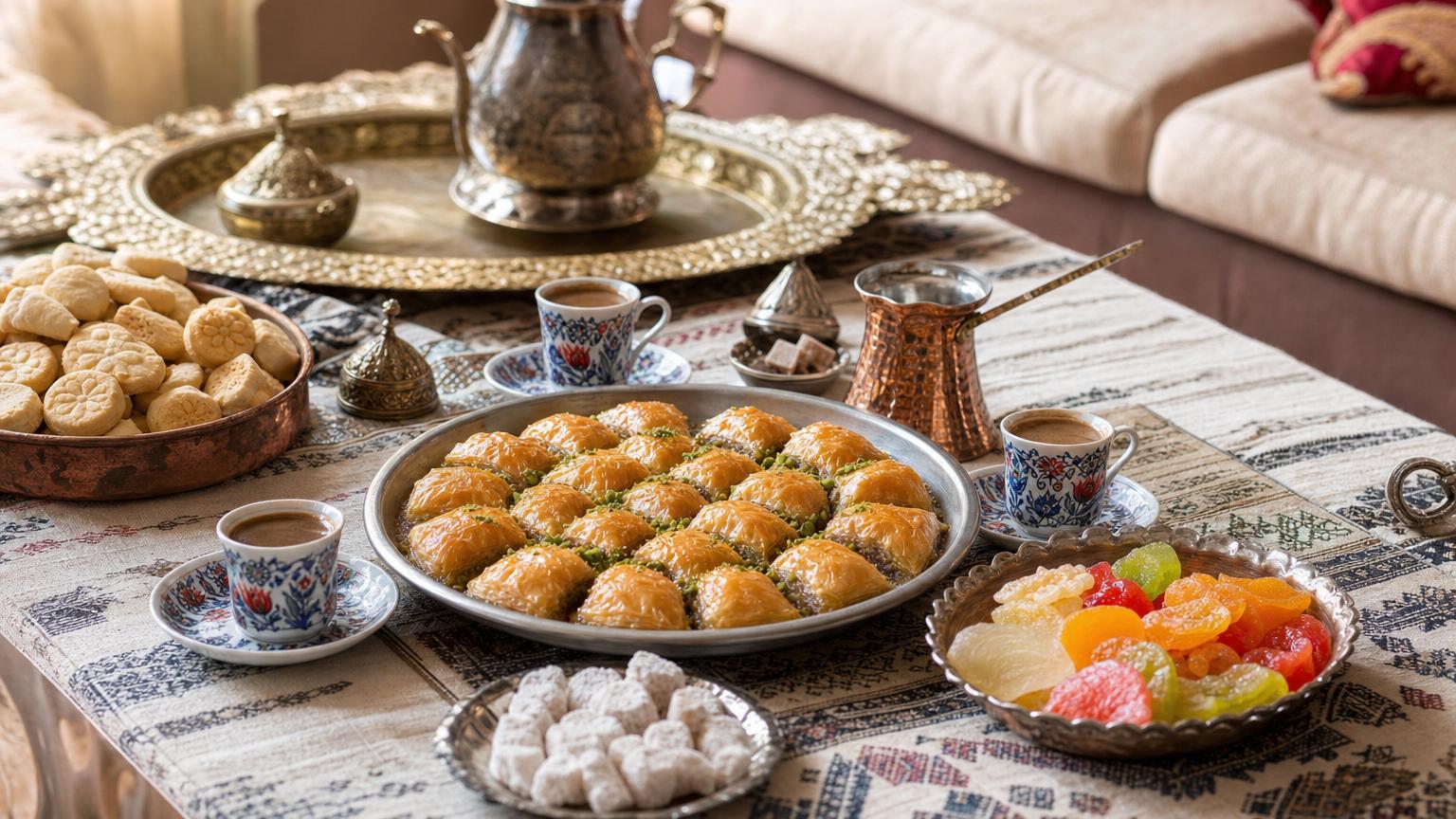
The morning starts with coffee — Albanian kafe brewed in a long-handled xhezve, served in small cups — and a tray of pastries set out at the entrance of the home for any visitor. The classic spread:
- Bakllava — Albanian baklava, layers of paper-thin filo brushed with butter, filled with walnuts (the Albanian version leans walnut-only, where Levantine versions often use pistachio), baked, and soaked in cold lemon-scented sugar syrup. The Bajram bakllava is usually cut into diamonds or small squares.
- Sheqerpare — literally “piece of sugar.” Soft butter cookies with an almond pressed into the center, baked golden, then poured over with warm syrup until each cookie absorbs and softens. Sheqerpare keeps for days; many households make a tray on the eve of Bajram for the visits to come.
- Kadaif — also spelled kataif — a dessert built from shredded vermicelli-like pastry, layered with walnuts, baked, and finished with syrup. Common at religious holidays and weddings.
- Llokum — the Albanian rendering of lokum, the soft confection often translated as Turkish delight. Cubes dusted in powdered sugar, sometimes flavored with rose or mastic, served with the coffee.
- Trilece, revani, and a rotating cast of regional sweets fill in the rest of the tray, depending on what the family makes well.
The savory side comes later in the day, when family meals begin. Byrek — the Albanian filo pie, with spinach, cheese, leeks, or meat, covered in a full explainer at /blog/byrek — is on most Bajram tables. So is grilled lamb (qengj), pilaf (pilaf), and a chopped salad with feta. Tavë kosi (lamb baked under yogurt and egg) appears at the larger gatherings.
A small drink note. Raki, the Albanian fruit brandy that anchors most secular celebrations, is less prominent on Bajram than at a wedding or Flag Day. Many observant Muslim households skip alcohol entirely; others — particularly Bektashi and more secular families — pour a small toast. The custom varies house by house and is not contested. In any case, the holiday is sweet first; raki, if it appears, comes later.
A note on portions: Albanian hospitality at communal events is structurally more food than the room can finish, and Bajram is no exception.
Bajram in the diaspora
Most US Albanian Muslims live in a handful of metro areas, and the local mosque usually anchors the Bajram observance.
New York metro. The largest Albanian Muslim community in the country. The Albanian American Islamic Center of Queens (Glendale) and the Albanian Islamic Cultural Center (Staten Island — its building started in 1973 as a general Islamic center and was relocated and renamed under the Albanian name in 1990) anchor the morning prayer. Bajram prayers in Queens regularly outgrow the building and spill into adjacent streets and lots. Multiple smaller community mosques across the Bronx, Yonkers, and Westchester host their own observances. After prayer, the day flows into family — and into the Albanian commercial corridors of the Bronx, where bakeries pre-sell trays of bakllava and sheqerpare in the days before.
Detroit metro. The Albanian Islamic Center on Harper Avenue, built in Harper Woods in 1963 and visible by its Balkan-style dome and minaret, is one of the oldest Albanian-American mosques in the country. It serves both the older Albanian-American community established mid-century and newer arrivals from Albania, Kosovo, and North Macedonia. Sterling Heights, Warren, and the rest of the Detroit metro Albanian belt fill out the picture. Local imams typically deliver the Bajram khutbah (sermon) in Albanian, English, or both.
Massachusetts and Connecticut. Boston-area and Worcester families gather at smaller mosques and community spaces; the Boston-area Albanian Sunni and Bektashi communities are well established but more dispersed than in New York or Detroit. In Connecticut, Waterbury and Bridgeport host smaller Albanian Muslim populations whose Bajram observance often happens at non-Albanian-specific mosques, with family meals afterward.
Other regions. Chicago, the Texas metros, and South Florida have growing Albanian Muslim communities — small enough that the morning prayer is usually at a non-Albanian mosque, and the family gathering carries the Albanian shape of the day on its own.
The intergenerational adaptation is its own story. First-generation immigrants often replicate the homeland calendar exactly — full fast, dawn prayer, three days of visits. Second-generation children grew up with school the day after Bajram and learned to compress: prayer in the morning, family lunch, normal life resumed by Tuesday. Third-generation kids may not fast at all and still know that Bajram means going to gjyshja (grandma) for sweets. The compression is not loss; it is how a holiday survives a US calendar that doesn’t pause for it.
A practical note: most US employers do not list Bajram as a holiday. Albanian-American workers who want the day off typically take it as a personal or floating day. Some heavily Muslim school districts — including parts of Hamtramck (MI) and Paterson (NJ) — have begun closing for Eid; outside those districts, families plan around the school day.
Albanian religious diversity and the besa
Bajram is a Muslim holiday. It is also, in Albanian-American life, a holiday that crosses confessional lines in everyday practice.
Albania is the most religiously plural country in the Balkans. The 2023 Albanian census recorded 45.86% of the population as Muslim (primarily Sunni), 4.81% as Bektashi (the Sufi order with its world headquarters in Tirana), 8.38% as Roman Catholic, and 7.22% as Albanian Orthodox, with a substantial share declaring no religion or declining to answer. (For most of the previous two centuries the Muslim share was higher; the 2011 census recorded 56.7% Sunni and 2.09% Bektashi, and the 2023 numbers reflect both demographic change and a shift in how respondents self-identify.) Kosovo is more uniformly Muslim — roughly 95% — with smaller Catholic and Orthodox minorities. North Macedonia’s Albanian community is majority Muslim with smaller Catholic enclaves. The diaspora carries that whole mix.
What that produces, on the ground, is families that look like this: a Catholic mother from Shkodër, a Sunni father from Tirana, an Orthodox grandmother from Korçë, and a Bektashi great-uncle from the south. Holidays alternate. Easter (Pashkë) is observed on one calendar; Bajram on another; the family shows up to all of them.
The mechanism that makes this normal — at the level of daily Albanian-American life — is besa, the Albanian code of honor that obligates protection and respect between people regardless of which side of any line they sit on. The most-cited modern application of besa is the WWII rescue of roughly 2,000 Jews sheltered in Albanian homes — Muslim, Catholic, and Orthodox families together — under the explicit logic that there is no Christian or Muslim or Jewish honor; there is only Albanian honor. The same logic, in a smaller register, is what makes a Catholic Albanian sending Gëzuar Bajramin to a Sunni cousin completely ordinary, and what makes a Sunni Albanian showing up to an Orthodox cousin’s vezët e kuqe (red-egg) Easter table the same.
The Bektashi tradition deserves its own note here. Bektashism is a Sufi order that originated in 13th-century Anatolia, became widespread under the Ottomans, and — after Atatürk closed the lodges in Turkey in 1925 — relocated its world headquarters to Tirana in 1930. Bektashi practice integrates Sufi devotional forms with reverence for Imam Ali and a more relaxed posture toward some external rules of orthodox Islam (alcohol, gender mixing, ritual prayer frequency); a Bektashi teqe feels different from a Sunni mosque. The Bektashi celebrate Bajram, mark the spring equinox as Sultan Nevruz (the Bektashi New Year), and hold their holiest gatherings at Mount Tomorr in southern Albania each August. A 2024 Albanian government proposal to designate the Bektashi World Headquarters as a sovereign micro-state — smaller than Vatican City — drew international attention; whether that proposal becomes a formal entity remains to be seen.
The point, for a piece on the Bajram greeting: religion in Albanian life is not a primary identity marker the way it is in some neighboring countries. The 19th-century Albanian-nationalist line Feja e shqiptarit është shqiptaria — “the religion of the Albanian is Albanian-ness” — overstates the case (religion clearly matters in many households), but it captures something real about how identity sits. Sending Bajram greetings across confessional lines is not a political gesture; it is the family default.
When Bajram falls
The Islamic calendar is lunar. Twelve months of 29 or 30 days, totaling roughly 354 — about 11 days shorter than the Gregorian solar year. Bajram therefore moves backward through the seasons by about 11 days each year.
A rough recent and upcoming sequence for Eid al-Fitr (Fitër Bajrami) in the United States:
- 2024: April 10
- 2025: March 30 (in most US communities)
- 2026: approximately March 20
- 2027: approximately March 9
These are the most-likely dates; local mosques confirm based on moon sighting and may differ by a day from the date observed in Saudi Arabia or in another diaspora community. A two-day split — some families celebrating on day one, others on day two — happens periodically and is not unusual. Most US Albanian mosques announce the confirmed start of Bajram on the night the Shawwal moon is sighted, which is typically the night before the day itself.
In the Albanian language, the start of Ramadan is fillimi i Ramazanit, the first day of fasting is agjërimi, and the breaking of fast each evening is iftar, often spelled iftar or iftari in Albanian. The 27th night of Ramadan — Nata e Kadrit, Laylat al-Qadr, “the Night of Decree” — is the most spiritually significant night of the month and draws large crowds to the mosques the night before Bajram morning.
The other Albanian Muslim holiday on the calendar is Kurban Bajram (Eid al-Adha), about 70 days after Fitër — in 2026, on or about May 27. The Bektashi mark Sultan Nevruz on March 22 as the spring equinox / New Year holiday and the birthday of Imam Ali. None of these are public holidays in the US; most are observed at home and at the mosque.
A small note on language
The Albanian Muslim vocabulary is overwhelmingly inherited from Ottoman Turkish, which inherited much of it from Arabic and Persian. Xhamia (the mosque, from Arabic jāmiʿ), namaz (prayer, from Persian), iftari, sadaka (alms-giving), and teqe (the Bektashi lodge, from Turkish tekke) all entered Albanian during the Ottoman period and stayed.
What makes the Albanian Muslim register feel distinct is how comfortably it sits next to the Catholic and Orthodox registers in the same language. Krishtlindje (Christmas) and Pashkë (Easter) are Albanian-formed words from the Christian traditions; Bajram and Ramazan are Albanian-formed words from the Islamic tradition; all four live in the same dictionary, used by the same speakers, often inside the same family. A full overview of the language sits at /blog/albanian-language.
What this has to do with the registry
The National Albanian Registry counts Albanian Americans across every line — Sunni, Bektashi, Catholic, Orthodox, secular. The count is not a religious survey; it does not ask faith. The point of recording the diaspora’s full shape is that the diaspora has a full shape: about 230,000 Albanian Americans in the latest American Community Survey, with a community estimate closer to a million when second- and third-generation households are included. Inside that number is the Sunni family in Glendale that hosts forty cousins for Bajram and the Orthodox family in Boston that hosts thirty for Easter and the Catholic family in Detroit that does both because the marriages are mixed.
Counting all of us — Muslim, Catholic, Orthodox, Bektashi, secular — is how the diaspora keeps its shape on a US census form that has rarely had a category for us. Register with NAR — free, three minutes, your data stays yours. Gëzuar Bajramin if you’re observing this week, and welcome to the count whenever you’re ready.